Food Industry Robots: Only 1 in 4 Is Washdown-Ready
IFR: US food robot orders jumped 30% in 2025 while automotive stalled. In our 355-robot database, only 23 of 90 food-tagged robots are washdown-rated.
US automotive robot orders sat flat in 2025, down just 1% to 13,500 units. Food industry orders surged 30% in the same year, the fastest-growing segment the IFR named in its latest US market report. That is the demand signal. Here is the supply problem it runs into: of the 90 robots in our own 355-robot database tagged for food-and-beverage work, only 23 (25.6%, roughly 1 in 4) actually carry a washdown-rated arm. An “industries: food-bev” tag on a spec page tells you a robot is marketed at that sector. It does not tell you the robot survives the hose.
How fast is the US food-industry robot market growing?
The IFR’s 2025 US market report put total US industrial robot installations at 38,000 units, up 11% year-on-year, the first double-digit growth in several years. Automotive, historically the market’s anchor, installed 13,500 units, “just 1% below last year’s result,” essentially flat and near what looks like a mature ceiling. Food came in as the standout: a 30% year-on-year jump, the largest gain of any named segment in the release. Metal and machinery and electrical-electronics each landed around 3,000 installations, filling out the middle of the market. Engineering.com’s coverage of the same IFR data highlighted the same shift: food and beverage is where the growth is now, not the traditional automotive base. The US also climbed two spots in global robot density rankings, to 8th, at 307 robots per 10,000 manufacturing employees, evidence this isn’t a one-sector blip but a broader reinvestment cycle with food leading it.
For buyers this is a straightforward read: if you’re specifying a robot for a food or beverage line in 2026, you’re one of the fastest-growing buyer segments in the country, and vendors know it. That makes the next number more important, not less.
How many robots in our database are actually built for food and beverage work?
Of 355 robots in the Industrial Robotics Hub database, 90 (25.4%) carry an industries tag identifying them for food-and-beverage applications. One honest caveat before the headline finding: that 90 is a merge of three inconsistent tag spellings in our own data, food-bev (73), food-and-beverage (7), and food-beverage (10). It’s a minor data-hygiene gap, not a database-integrity problem, but it means a naive single-string filter on this field would undercount by nearly a fifth. We merged all three before running any analysis below.
Does a “food-and-beverage” tag mean the robot can survive a washdown?
No, and this is the central finding. Of the 90 food-tagged robots, only 23 (25.6%) carry a washdown-rated arm, meaning environment.ipRatingArm of IP67, IP68, or IP69K, the tiers that mean sealed against jets, temporary immersion, or high-pressure/high-temperature washdown respectively. The other 74.4% are tagged for a sector that runs caustic wash cycles daily and don’t publish an arm sealed for it.
That gap matters because “food-and-beverage” as an application tag covers a lot of ground, from dry secondary packaging that never sees a hose to wet primary processing lines that get sanitized multiple times per shift. A tag alone doesn’t tell you which side of that line a given robot sits on. The IP rating on the arm does. Buyers who spec off the industries filter and skip the environment spec are the ones who find out the hard way, usually after the first caustic-wash cycle finds a seam the datasheet didn’t mention.
Which robot types close the washdown gap, and which don’t?
environment.ipRatingArm (IP67, IP68, or IP69K counted as washdown-rated).Delta robots lead at 42.9%, and cobots follow close behind at 31.3%. Both classes tend to run compact, sealed housings by design, common on packaging and pick-and-place lines that sit right at the wash zone, so a washdown-rated variant is a natural catalog extension rather than a special-order part. Palletizers land at 27.3%, plausible since palletizing cells often sit at the end of a line, past the wettest processing stages, but still handle sealed cases that came out of a washdown area.
Articulated arms drop to 11.1%, and SCARA robots hit zero. Both classes historically carry larger motor housings and cabling runs at the base and forearm, hardware that’s expensive to seal to IP67+ and was, for years, positioned outside the direct wash zone on the assumption that upstream or downstream stations handled the wet work. That assumption is exactly what a buyer needs to check before ordering, not read off the industries tag as if it were resolved.
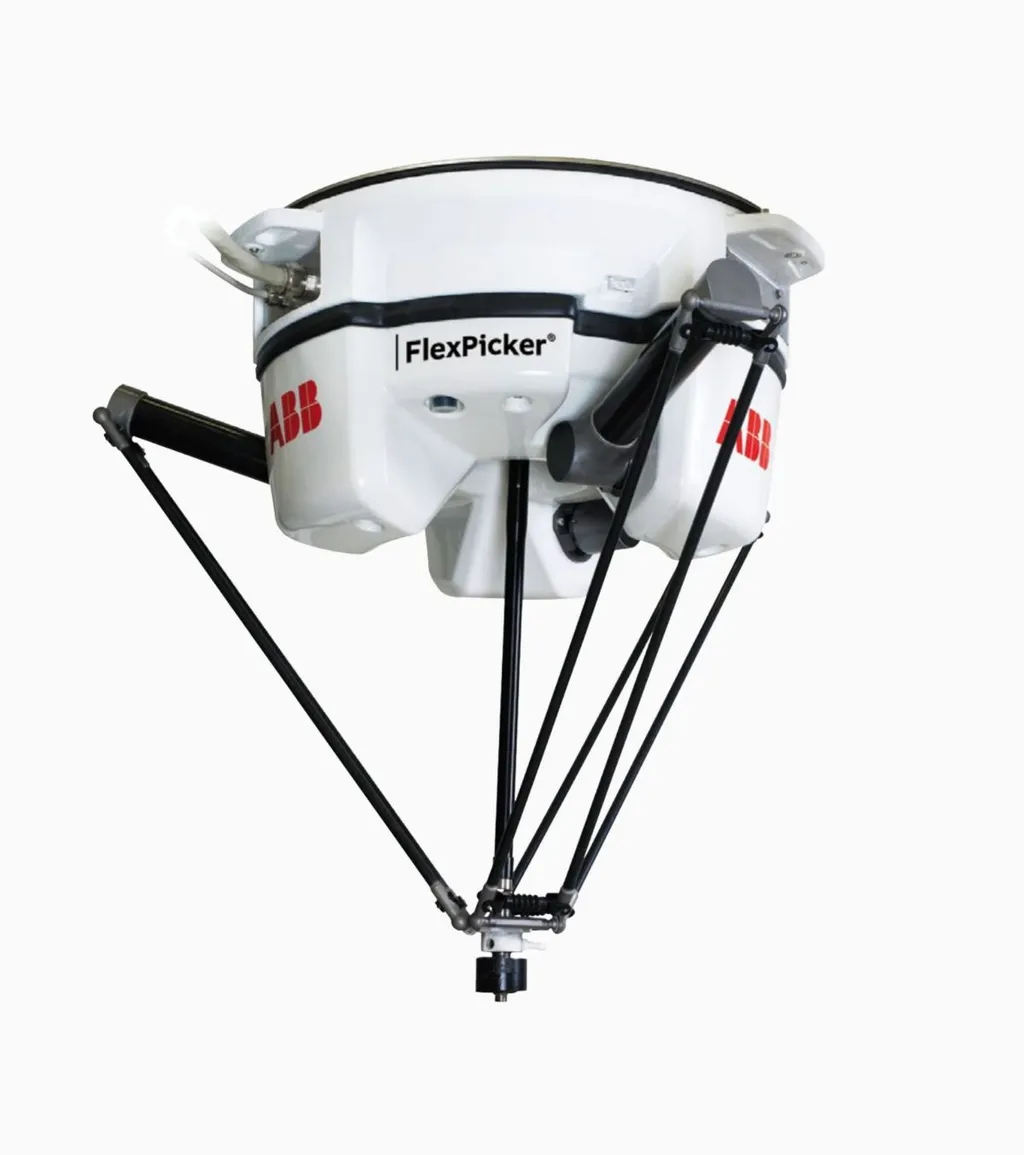
Our hero robot for this piece, the ABB IRB 360 FlexPicker, carries the database’s highest washdown tier, IP69K, the rating built for high-pressure, high-temperature spray-downs, and is one of the most recognizable delta robots on packaging lines specifically because that rating comes standard. The FANUC M-3iA, another delta, matches it.
Which brands actually deliver a washdown-ready food robot, and which don’t?
The brand breakdown is sharper than the by-type numbers. 10 of the 16 brands (62.5%) that tag at least one robot for food-and-beverage work have zero washdown-rated model in that set. A buyer filtering by industries tag alone, without checking ipRatingArm, has better than 3-in-5 odds of landing on a brand whose entire food-tagged lineup is unsealed for a wash cycle.
| Brand | Food-Tagged Robots | Washdown-Rated (IP67+) | % |
|---|---|---|---|
| AUBO | 5 | 5 | 100.0% |
| JAKA | 3 | 3 | 100.0% |
| FANUC | 6 | 5 | 83.3% |
| Yaskawa | 10 | 6 | 60.0% |
| ABB | 6 | 3 | 50.0% |
| Dobot | 3 | 1 | 33.3% |
| Doosan | 10 | 0 | 0.0% |
| Techman | 10 | 0 | 0.0% |
| Kawasaki | 6 | 0 | 0.0% |
| Mitsubishi | 6 | 0 | 0.0% |
| Universal Robots | 6 | 0 | 0.0% |
| Estun | 5 | 0 | 0.0% |
| Staubli | 5 | 0 | 0.0% |
| KUKA | 4 | 0 | 0.0% |
| Epson | 3 | 0 | 0.0% |
| Han’s Robot | 2 | 0 | 0.0% |
Only two brands clear every food-tagged model they sell: AUBO (5 of 5, including the AUBO i5/iS7 line at IP67) and JAKA (3 of 3, its Pro5/Pro12/Pro16 cobots all at IP68). FANUC is close behind at 83.3% (5 of 6), and Yaskawa clears 60% across its largest food-tagged lineup of the group (10 robots). Everyone below that is a coin flip or worse, and 10 brands, including household names like Universal Robots, KUKA, and Staubli, publish zero washdown-rated model among their own food-tagged robots. That doesn’t mean those brands make bad robots. It means their food-and-beverage tag, on its own, isn’t telling a buyer anything about wash survivability, and treating it as if it does is the trap.
What should a food-plant buyer check before ordering?
Don’t stop at the industries filter. Open the individual spec sheet and check environment.ipRatingArm directly: IP67 or better for anything near a wash-down zone, IP69K if the line runs high-pressure, high-temperature cleaning cycles, which is standard in raw-protein and dairy processing. If a vendor’s food-tagged catalog shows zero IP67+ models, as ten brands in our own database do, that’s not necessarily disqualifying, some of those robots may genuinely sit in dry zones, but it’s a question to ask before signing, not a surprise to discover after the first shift.
This finding is a narrower, application-specific cut of the same underlying spec gap covered in our broader washdown-rating prevalence piece, which looks at IP67+ coverage across the whole catalog by robot type without cross-referencing application tags. That post answers “how common is washdown-rating overall.” This one answers “does the food tag mean anything,” and the answer is: not on its own. For the market-side view of why this matters now, our cobot order-share analysis covers how non-automotive industries, cobots included, have been taking share of total orders; this piece is the sector-specific food data behind that same shift, not a restatement of it.
The rated payload on the box tells you what the robot can lift. The IP rating on the arm tells you what the robot can survive. For a food-industry buyer riding the fastest-growing segment in the US market right now, only the second number should decide the order.
Compare these robots