Exotec, GXO Deploy 127-Robot Skypod System for Guess in Venlo
GXO and Exotec's 127-robot Skypod AS/RS now runs Guess's EMEA/Asia fashion fulfillment in Venlo, Netherlands, handling up to 70,000 pieces a day.
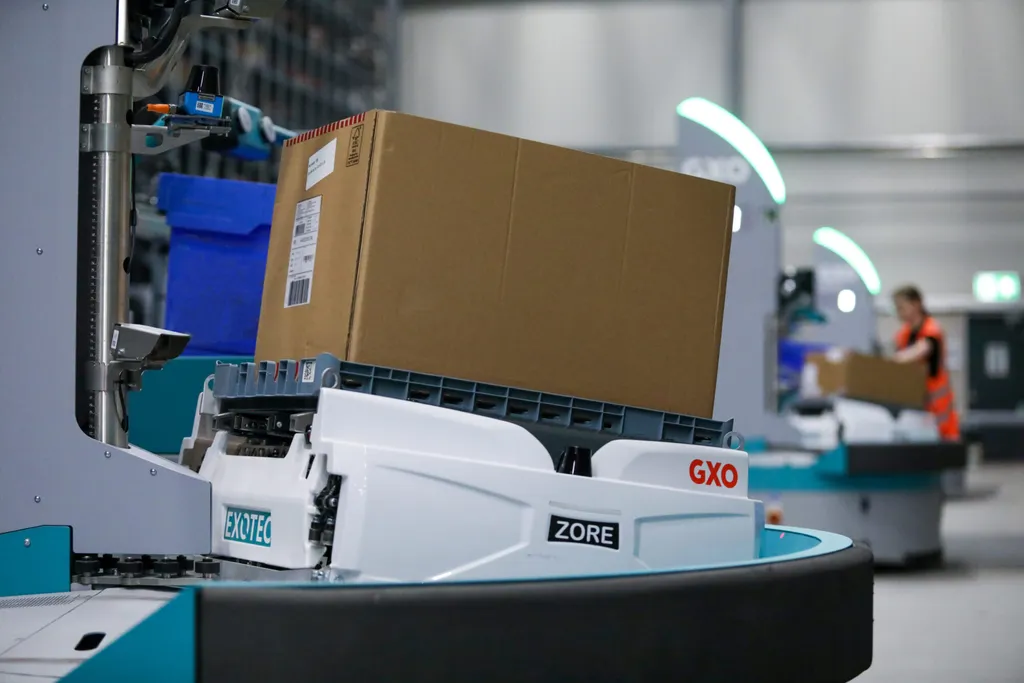
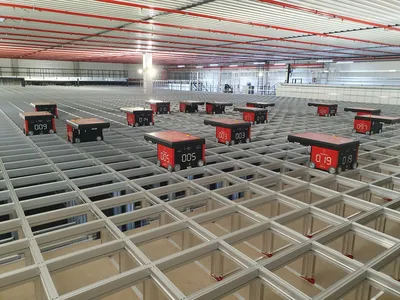
GXO Logistics and French warehouse-robotics maker Exotec announced September 15 that a 127-robot Exotec Skypod automated storage-and-retrieval system (AS/RS) is now running at GXO’s Venlo, Netherlands facility, handling fashion brand Guess’s fulfillment across EMEA and Asia. The system spans 60,000 rack locations feeding 8 goods-to-person picking stations over roughly 200 meters of conveyor, and GXO and Exotec say it processes 40,000 to 70,000 pieces a day, with peak throughput of up to 2,200 order lines per hour.
The deal is notable less for its scale — mid-sized by AS/RS standards — than for who built it: Exotec says it acted as the full system integrator, designing and implementing the Venlo automation directly with GXO rather than GXO sourcing robots, conveyor, software, and workstations separately and stitching them together itself. That single-point-of-responsibility model has become one of Exotec’s main sales pitches against warehouse operators who traditionally assemble automation from several vendors.
What a Skypod-style goods-to-person system actually does
Skypod belongs to a category of warehouse automation called goods-to-person (GTP) AS/RS — a sharp break from how most warehouses have picked orders for decades. In traditional pick-to-cart or pick-to-light warehousing, a human picker walks the aisles pushing a cart, pulling items off shelves by hand; a large fraction of a picker’s shift is spent walking, not picking. A GTP system flips that: small autonomous robots climb a three-dimensional rack grid, retrieve a tote or case containing the ordered item, and deliver it to a stationary picker standing at an ergonomic workstation. The picker never leaves the station — the inventory comes to them, one tote after another, and a well-tuned system can queue up enough totes that the picker is rarely waiting.
Exotec’s robots — small, teal-and-white units the company calls “Skypod robots” — climb vertically on rails built into the rack structure itself, rather than running only along the floor like a typical AS/RS shuttle, which is what lets a Skypod installation pack far more storage density into a given warehouse footprint. On Exotec’s own current product page, the company states its Skypod robots carry payloads of up to 30 kg (66 lbs), travel at speeds of up to 4 m/s, and operate on racks up to 14 meters tall, retrieving any given order “in under 2 minutes,” with each workstation able to cycle up to 600 bins per hour. Those are general Skypod-platform specifications published by Exotec for the system as a category, not figures specific to the Venlo installation — Exotec and GXO have not disclosed the exact robot count’s individual travel speed or rack height actually built at Venlo, only the site-level totals (127 robots, 60,000 locations, 8 stations) in the September 15 announcement.
Why fashion fulfillment is a demanding fit for GTP
Fashion retail is a stress test for warehouse automation in a way that, say, industrial-parts distribution usually isn’t: a single garment style can exist as dozens of separate SKUs once size and color are factored in, order volumes swing hard with seasonal collections and sale periods, and Guess ships across both EMEA and Asia out of the same Venlo site, multiplying the destination and packaging variability GXO’s operation has to absorb. Wim Vermeir, Exotec’s Senior Sales Executive for Benelux, put it directly in the companies’ joint announcement: “Fashion logistics doesn’t tolerate approximation — high SKU counts, seasonal spikes, and EMEA-wide distribution require precision engineering, not off-the-shelf automation. With GXO, we designed a system built specifically for those demands, and the throughput numbers speak for themselves.”
Mark Donné, GXO’s Operations Manager at the Venlo site, described the effect on daily operations: “The impact has been evident from day one. Our automated solution with Exotec, tailored specifically for Guess, has helped take our operation to the next level, enabling faster processing, greater predictability and a smoother workflow across the site. As our business with Guess continues to grow, we have the scalability and flexibility needed to support future demand.” GXO — the world’s largest pure-play contract logistics provider — continues to run the parts of the operation the robots don’t touch: inbound receiving, quality control, garment conditioning, and outbound distribution for Guess across the site.
For material-handling and pick-and-place applications broadly, GTP AS/RS systems like Skypod compete against simpler autonomous mobile robot fleets that shuttle whole shelving units to pickers rather than climbing a fixed grid — a design tradeoff between Skypod’s higher storage density and an AMR fleet’s lower upfront rack investment, and one warehouse operators weigh differently depending on site footprint and SKU count.
Sources
- Exotec, GXO Automate Guess Fashion Fulfillment — Exotec, Sep 15, 2026
- GXO and Exotec Partner to Advance Fashion Fulfillment for Guess in the Netherlands — RoboticsTomorrow, Sep 15, 2026
- GXO automates fashion fulfilment operation in the Netherlands — Logistics Manager, Sep 16, 2026
- GXO and Exotec announce automation partnership to boost fashion fulfilment for Guess in the Netherlands — Retail Technology Innovation Hub, Sep 16, 2026
- Automated Warehouse Robots (Skypod system specifications) — Exotec
Frequently asked questions
How many robots and rack locations are in the Venlo system? +
127 Exotec Skypod robots working across 60,000 rack locations, feeding 8 goods-to-person picking stations over roughly 200 meters of conveyor, according to Exotec and GXO's joint September 15, 2026 announcement.
How much can the system process in a day? +
GXO and Exotec state the system handles 40,000 to 70,000 pieces per day, with peak throughput of up to 2,200 order lines per hour. These are the companies' own operational figures, not numbers independently audited by a third party.
What does 'goods-to-person' mean, and how is it different from how warehouses usually pick orders? +
In a goods-to-person (GTP) system, mobile robots retrieve totes or cases from a storage grid and bring them to a stationary human picker at an ergonomic workstation. That's the reverse of traditional pick-to-cart or pick-to-light warehousing, where a person walks the aisles pulling items themselves — GTP is built to cut picker walking time and let one person handle far more order lines per hour.
Who is responsible for the Venlo system — GXO or Exotec? +
Exotec acted as the system integrator for the deployment, designing and implementing the automation jointly with GXO rather than GXO assembling components from multiple vendors. GXO, the facility operator, continues to manage inbound logistics, quality control, garment conditioning, and outbound distribution for Guess across the site.
More news