Cobot Payload vs Weight: A 50 kg Cobot That Weighs 990 kg
We checked payload-to-weight across all 18 collaborative robots in our database. The 50 kg FANUC CR-35iB weighs 990 kg; the UR10e hits a 7x better ratio.
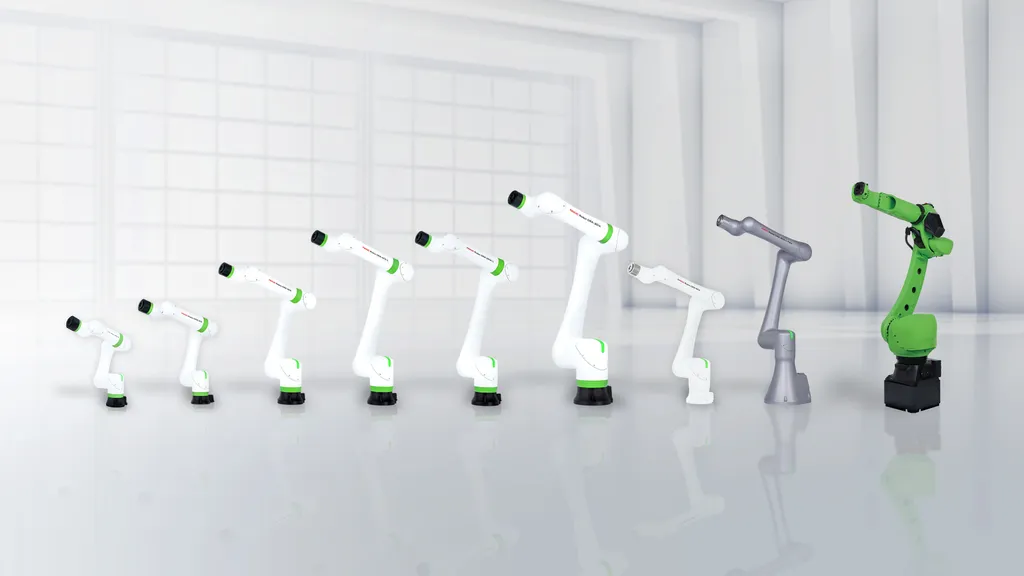
The strongest cobot in our database lifts 50 kg. It weighs 990 kg. That is 19.8 kg of robot per kilogram of payload - roughly 20 to 1. The Universal Robots UR10e lifts 12.5 kg and weighs 33.5 kg, which works out to 2.7 kg of robot per kilogram of payload. Both are listed as collaborative robots. One of them you can bolt to a light frame on a mobile base; the other needs an industrial footer and a forklift to move.
This post runs the payload-to-weight ratio across all 18 collaborative robots in our analysis of 56 robots in the Industrial Robotics Hub database. The headline number from the FANUC CR-35iB is not a flaw - it reflects a genuine engineering constraint. But it matters when you are speccing the installation, not after you have already bought it.
Which collaborative robot has the highest payload?
The top eight cobots by rated payload, from our database:
| Payload | Robot | Reach | Robot Weight |
|---|---|---|---|
| 50 kg | FANUC CR-35iB | 1,813 mm | 990 kg |
| 30 kg | FANUC CRX-25iA | 1,889 mm | 105 kg |
| 25 kg | Doosan H2515 | 1,500 mm | 74.5 kg |
| 20 kg | FANUC CRX-20iA/L | 1,418 mm | 64 kg |
| 20 kg | Universal Robots UR20 | 1,750 mm | 64 kg |
| 12.5 kg | Universal Robots UR10e | 1,300 mm | 33.5 kg |
| 12 kg | ABB GoFa CRB 15000-12 | 1,270 mm | 53 kg |
| 12 kg | Techman TM12 | 1,300 mm | 33.3 kg |
All specs from the Industrial Robotics Hub database, June 2026.
The CR-35iB stands alone at 50 kg. The next tier - CRX-25iA, H2515, the 20 kg pair - clusters between 64 kg and 105 kg of arm weight. Then there is a gap, and the CR-35iB sits at nearly 10x the weight of an arm that carries half as much.
What is payload-to-weight ratio and why does it matter?
Payload-to-weight ratio is rated payload divided by arm weight - how many kilograms the arm can lift per kilogram of its own mass. Higher is better, and the gap between cobots is wider than most buyers realize.
The number matters because the arm weight is real weight you are installing. On a static fixed mount in a welded cell it is mostly a foundation question. On a light gantry, a repurposable frame, or an autonomous mobile robot (AMR), it determines whether the platform can carry the arm at all. A 990 kg arm does not go on an AMR. A 33.5 kg arm sometimes does.
For cobots specifically, there is also a secondary issue: the “collaborative” rating at high payload often means slow speed limits and large safety zones, which cuts the throughput argument for going collaborative in the first place.
Which cobot has the best payload-to-weight ratio?
The UR10e leads our database at 0.37 - meaning it lifts 37 cents of payload per dollar of arm mass. The CR-35iB hits 0.05.
The spread is 7x from top to bottom. The TM12 sits within rounding error of the UR10e and costs notably less in most markets - useful data if you are looking at 12 kg payloads. The Doosan H2515 at 0.34 is the best ratio in the 25 kg class, and the only arm above 20 kg that keeps a ratio above 0.30. See the Doosan H2515 vs UR20 comparison for how those two split on reach and cycle time.
Why does a 50 kg cobot weigh 990 kg?
The short answer: power-and-force-limited (PFL) collaborative safety at high payloads requires heavy structure and high joint torque sensing, and the physics of torque scale badly with payload.
ISO/TS 15066 sets contact force limits for collaborative operation - typically 150 N for sensitive body regions, lower for the head and neck. At 12 kg payloads you can meet those limits with lightweight arms moving at reduced speeds. At 50 kg, the kinetic energy in a moving load is large enough that achieving safe contact forces requires either very slow motion (which kills throughput) or mechanically heavy joints with the mass needed to damp and absorb impact without exceeding the limits.
The CR-35iB uses a heavy-duty articulated arm base - essentially an industrial-class arm with a compliant skin layer and force-limiting software overlaid on top. The green soft casing is real, but the structure underneath is the same mass that an industrial arm of that payload class would carry. You are not buying a purpose-built lightweight collaborative design; you are buying an industrial arm with a safety wrapper.
That wrapper gives you cage-free operation at payloads that would otherwise require a fenced cell. But the 990 kg arm weight means the installation cost, the floor loading, and the logistics of repositioning are closer to a traditional industrial arm than to anything else in the cobot category.
What this means when you spec a cobot
Rated payload is the number on the box. Payload-to-weight ratio is the number that determines what you are actually installing.
For a fixed cell on a reinforced concrete floor, arm weight is mostly irrelevant - you pour the footer and move on. For anything mobile, ceiling-mounted, or on a light frame, it becomes the binding constraint. A 990 kg arm is not a mobile cobot. The 33.5 kg UR10e is a candidate for a cart-mounted flexible cell; the CR-35iB is not.
Two other things worth noting from our database scan. First, zero of 56 robots publish a real list price - every single one is price on application. If you are comparing cobots on total installed cost, you are doing it on spec sheets and integrator quotes, not on any manufacturer’s published number. Second, the 18 cobots in the database span a 66 kg to 990 kg weight range at very different payload ratings. The range within the “collaborative” label is wide enough that it barely functions as a single category.
If you are sizing a cobot installation, start with the payload you need, then check the arm weight against your mounting structure before you check anything else. The ratio column in the table above is faster to read than the spec sheet footnotes.
Data from our analysis of 56 robots (18 cobots) in the Industrial Robotics Hub database. All specs from manufacturer datasheets as of June 2026.