Cobot Speed Reality Check: What ISO/TS 15066 Does to Throughput
In power-and-force-limited mode a cobot can lose 40-60 percent of its throughput, worst case far more. Here is what the safety standard actually costs you.
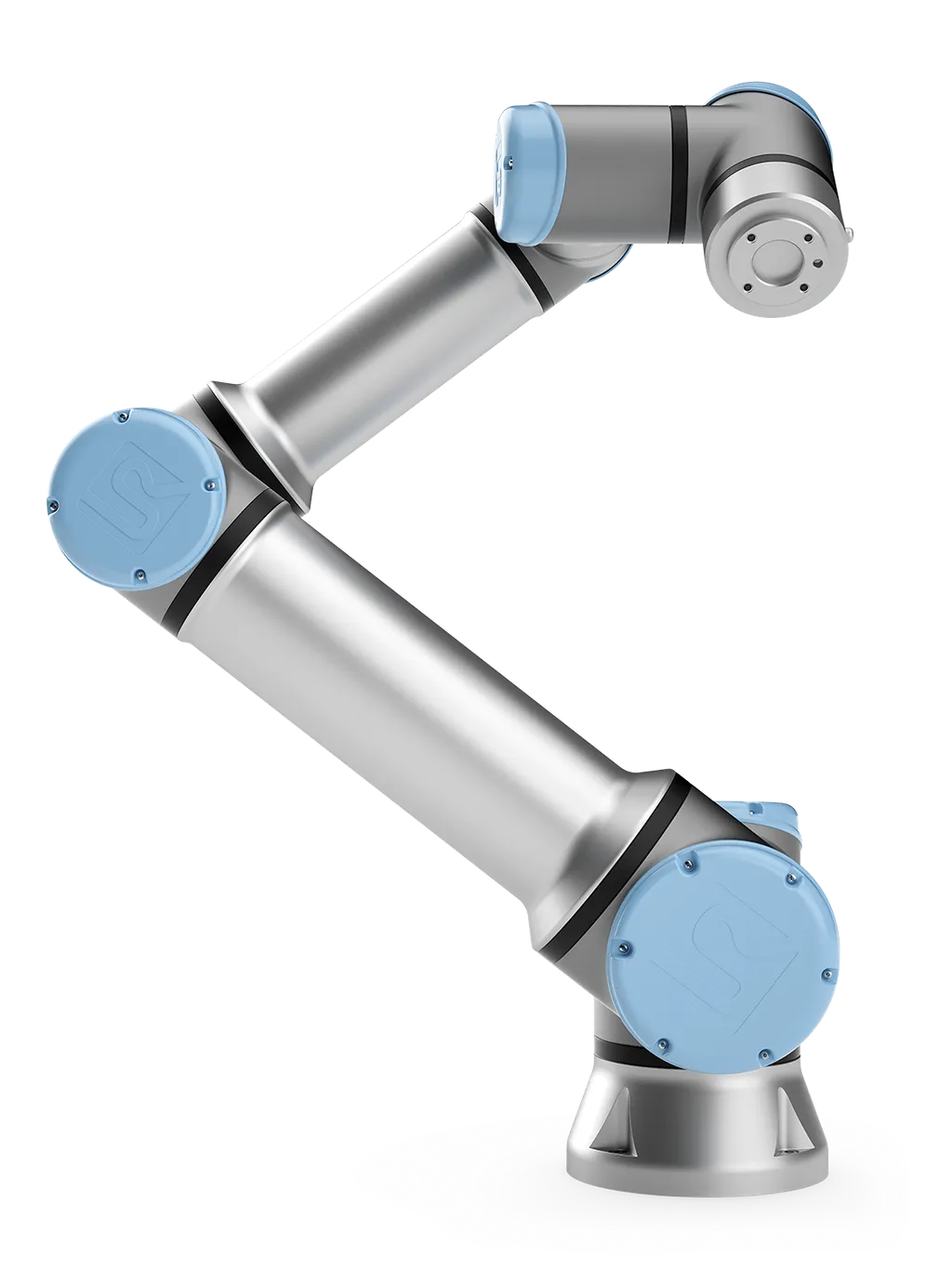
In power-and-force-limited collaborative mode, a cobot operating at ~250 mm/s instead of 1,500 mm/s loses roughly 40-60% of throughput in a typical cycle. In the worst-case Granta Automation example - 10 boxes/min fenced down to 1-1.5 boxes/min under full PFL - that is an 85-90% drop. “No fence needed” is not a product feature. It is a conditional outcome of a site-specific risk assessment, and the price you pay in speed is real.
What does ISO/TS 15066 actually limit?
ISO/TS 15066 is the technical specification that gives collaborative robot operation its legal footing. It defines four collaboration modes: safety-rated monitored stop (SRMS), hand guiding (HG), speed and separation monitoring (SSM), and power and force limiting (PFL). The throughput hit is mode-specific. Most buyers hear “cobot” and assume PFL, because that is the mode that allows continuous operation with a human in the cell. It is also the most restrictive.
PFL sets biomechanical limits on the energy a robot can transfer to a human body on contact. The standard publishes tables of maximum allowable contact force and pressure per body region - the chest, for instance, has a transient contact limit of 140 N and a quasi-static limit of 35 N. Working backward from those limits through the robot’s mass and stiffness gives you a clamping speed. For most commercially available cobots, that ceiling lands somewhere between 150 and 250 mm/s under full PFL. Compare that to the TCP speeds on a fenced articulated arm - typically 1,000-2,000 mm/s in production - and you see immediately where the throughput goes.
How bad is the throughput hit in practice?
The Granta Automation worked example is the most cited concrete illustration, and it is worth reading carefully. A fenced cell running at 10 boxes per minute - a real packaging scenario - drops to approximately 1 to 1.5 boxes per minute under worst-case PFL operation. That is an 85-90% reduction, and Granta labels it clearly as a worst-case scenario. The worst case applies when the human is assumed to be present continuously, at close range, with no zone-based speed scaling.
The more typical real-world range, where humans share the cell but are not constantly within arm’s reach, is 40-60% throughput loss versus fenced operation. That is still significant. On a line running 16 hours a day, a 50% throughput drop either doubles headcount requirements or halves output. Neither outcome pencils out at the price points most cobot vendors advertise.
The numbers are not a criticism of cobots. They are the engineering reality of the safety physics. A robot that can injure you will be constrained from injuring you, and that constraint has a speed cost.
What is the difference between PFL, SSM, and SLS?
The three modes most relevant to throughput planning are PFL, SSM, and SLS (safely limited speed). They sit at different points on the speed-versus-access trade-off.
| Mode | Typical TCP Speed | Throughput Impact vs Fenced | When to Use |
|---|---|---|---|
| Power and Force Limiting (PFL) | 150-250 mm/s | -40% to -90% depending on presence model | Human continuously present, contact is possible |
| Speed and Separation Monitoring (SSM) | 250-800 mm/s (zone-dependent) | -20% to -50% | Human present intermittently; laser scanner defines zones |
| Safely Limited Speed (SLS) | Up to rated speed when zone clear | -5% to -20% at system level | Human present only during setup/maintenance, not continuous |
| Fenced Industrial Robot | 1,000-2,000+ mm/s | Baseline (0% loss) | No human access during operation |
SSM is the mode that makes “collaborative” actually viable for throughput-sensitive applications. Under SSM, the robot runs at full speed when no human is detected in its monitored zones and slows progressively as a human enters successive safety zones (typically defined at 3m, 2m, 1m from the robot envelope). A laser area scanner feeds those zone signals to the safety PLC. The practical result is that you get most of your speed back when the human is elsewhere in the cell - which, in most real workflows, is most of the time.
SLS is simpler: a hard speed cap that applies whenever the cell is in a defined state (maintenance mode, tool change, operator access). It does not use real-time zone monitoring. It is appropriate when humans are in the cell only occasionally and briefly, not during normal production cycles.
The choice between these modes is not made by the robot vendor. It is the output of a risk assessment per ISO 10218-2 and ISO/TS 15066, conducted for the specific application, payload, end effector, and facility layout. A cobot vendor selling you on “no fence needed” without a completed risk assessment is selling you a marketing claim, not a safety determination.
Is “no fence needed” actually real?
Conditional on the application, yes. For tasks that are inherently slow, light-payload, and low-repetition - small-component assembly, quality inspection, light material handling - PFL operation at 200 mm/s may be fast enough. Some applications have natural dead time (fixture loading, part settle time, adhesive cure) where the cobot sits idle anyway, making the speed cap irrelevant to cycle time.
The applications where “no fence” typically fails economically are anything with a tight takt time, heavy payload (>10 kg at reach), or long TCP path lengths. A cobot versus industrial robot decision matrix has to include throughput at the rated safety speed, not throughput at the robot’s unrestricted maximum.
The Automation World analysis frames this correctly: the decision is not “cobot or fenced robot” on principle, it is a question of whether the application’s throughput requirement can be met within the collaborative speed envelope. Many cannot.
What does throughput look like across modes?
Throughput Relative to Fenced Operation (Illustrative)
Ranges are illustrative; actual values depend on cycle geometry, payload, and risk assessment outcomes. Worst-case PFL based on Granta Automation packaging example.
If I need throughput and humans in the cell, what are my realistic options?
The engineering answer depends on whether “humans present” means continuously present or periodically present.
If humans are in the cell continuously (mixed assembly, operator assist, kitting), the realistic choices are PFL at reduced throughput or a hybrid SSM cell. A hybrid SSM cell uses a laser area scanner to define dynamic speed zones. The robot runs fast when the human is in the outer zone or out of the cell entirely, slows when they enter the intermediate zone, and stops when they reach the exclusion boundary. This is more expensive than a basic cobot installation - the safety scanner, safety PLC, and integration labor add $15,000-$30,000 to the project cost depending on cell complexity - but it recovers most of the throughput that pure PFL loses.
If humans enter only for loading, unloading, or maintenance (classic machine tending), an SLS-configured cell with interlocked access points often meets the throughput target without the scanner overhead. The robot runs at full speed during the autonomous cycle and drops to safely limited speed only during the access window.
If you genuinely need full throughput with short takt times and cannot give up access, the right answer is a fenced industrial robot, full stop. Browse the robots database with a payload and reach filter and you will find purpose-built cells that are cheaper per unit output than a cobot running at 200 mm/s. The EVS International 2026 comparison makes this point clearly: cobots cost more per unit installed but less per unit when human redeployment is the primary goal. If throughput is the primary goal, the calculus is different.
The decision framework in three questions
Before specifying a cobot for a throughput-sensitive task, answer these three questions in order:
-
What is the minimum acceptable throughput? Calculate the cycle time your takt demands, add the TCP path length, and check whether the result is achievable at 250 mm/s or below. If not, pure PFL will not work.
-
How often are humans actually in the robot’s envelope? If the answer is “most of the cycle,” SSM will recover some throughput but not all. If the answer is “only during changeover,” SLS is cheaper and simpler. Run a time-motion study, not an assumption.
-
What is the cost of the alternative? A fenced articulated robot with light-curtain access costs roughly the same as a mid-range cobot plus SSM infrastructure. Over a 5-year horizon, the throughput difference may dwarf the installation cost difference. Model it at your actual production volume before committing.
The standard does not care what the vendor’s marketing says about collaborative operation. It cares about the energy transferred on contact and the body region receiving it. Design to the physics, not the brochure.
Marcus Renner spent ten years integrating robots into automotive and packaging lines before writing about them. He runs the spec analysis at Industrial Robotics Hub.