Robot Speed by Type: SCARA Runs 3x Faster Than Cobots
We checked max tool speed on 105 robots in our database: SCARA arms median 5,000 mm/s, 3x the cobot median of 1,500 mm/s. Only 40% publish a speed.
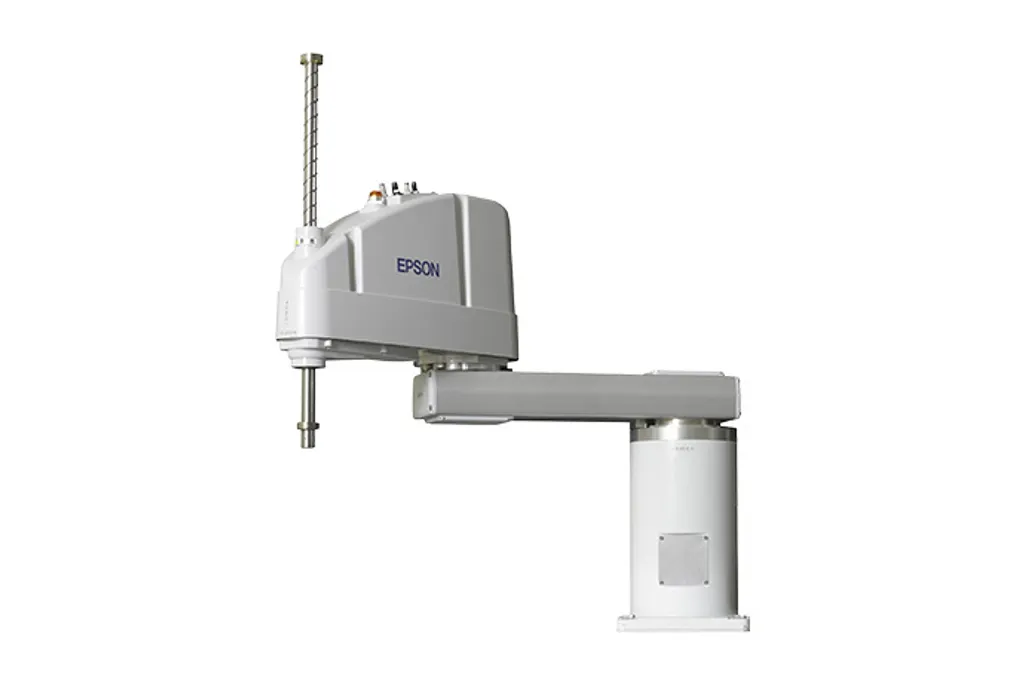
SCARA arms in our database median 5,000 mm/s at the tool tip - 3.3x the cobot median of 1,500 mm/s - and the fastest single robot we track, the Epson G20, hits 11,000 mm/s while carrying 20 kg. Those numbers come from our analysis of 105 robots in the Industrial Robotics Hub database that publish a max TCP speed. The other 158 do not publish one at all. Speed opacity is worse than price opacity: at least a few manufacturers list prices. On speed, 60% of the industry says nothing.
Which robot type is the fastest?
SCARA, with a median of 5,000 mm/s. Delta robots post a higher median at 10,000 mm/s, but that figure rests on two robots in our database - a small sample that aligns with the delta class’s well-documented high-speed-pick reputation but should not be taken as a clean statistical median. SCARA at n=10 is the most defensible “fastest practical class” claim we can make from our own data.
The by-type breakdown:
Palletizers at 3,000 mm/s sit above articulated arms despite being single-purpose machines. That makes sense physically: palletizer geometry is optimized for a single repeating arc between pick and place positions, which allows faster joint velocities without the multi-axis coordination overhead of a six-axis arm. Articulated arms median 2,000 mm/s because their six joints are sharing the speed budget across complex paths. Cobots and AMRs both sit at 1,500 mm/s, but for entirely different reasons - cobots are fenced in by safety law, AMRs are fenced in by the warehouse floor.
Why are cobots the slowest class?
By design, not by weakness. ISO/TS 15066 governs power-and-force-limiting (PFL) collaborative robot operation. The standard sets contact-force and pressure limits for human-robot shared workspaces: to stay within those limits, a robot must reduce speed whenever a person is in the cell. Cap the contact force and you cap the speed. Cobots were built for PFL compliance first; the speed ceiling is a consequence of that compliance.
The tradeoff is explicit in the ISO/TS 15066 framework. A collaborative robot rated for 1,500 mm/s in free-run drops further inside a shared workspace because the safety controller is actively monitoring human proximity and reducing speed before contact can occur. The 1,500 mm/s figure in our data is the published max - what a cobot actually achieves on a cycle with a person nearby is lower.
The 2026 trade press is loud about cobots getting faster cycle times. The safety physics sets the ceiling. Power-and-force limiting is not a firmware setting that gets optimized away in a future release. It is the physical mechanism that makes the arm safe to touch. A cobot that runs at full industrial speed next to a person has crossed from collaborative to fenced - whether the integrator acknowledges that or not.
Speed and collaboration are physically opposed in ways that marketing language softens. That is not a criticism of cobots. It is the reason cobots exist: the constraint buys you something - a shared workspace, no fence, flexible deployment. If you do not need that tradeoff, the constraint is just a cost.
Which robots are the fastest in our database?
The top five, by published max TCP speed:
| Robot | Type | Max TCP speed | Payload |
|---|---|---|---|
| Epson G20 | SCARA | 11,000 mm/s | 20 kg |
| Staubli TX2-90 | Articulated | 10,900 mm/s | 14 kg |
| FANUC M-3iA/6S | Delta | 10,000 mm/s | 6 kg |
| Mitsubishi MELFA RV-20FR | Articulated | 10,000 mm/s | 20 kg |
| KUKA KR DELTA | Delta | 10,000 mm/s | 3 kg |
Source: our analysis of the Industrial Robotics Hub database. All speeds are published max TCP (tool-center-point) speed figures.
The Epson G20 is the standout in that table. 11,000 mm/s is the fastest published speed in our database, and it carries 20 kg - a rare combination. Most robots at 11,000 mm/s are lightweight pick-and-place machines optimized for small parts; a 20 kg SCARA running that fast is unusual and is what the Epson G20’s design is built around. The Staubli TX2-90 at 10,900 mm/s is the fastest articulated arm on the list, which is notable: articulated arms at this speed are uncommon, and 14 kg payload at 10,900 mm/s is not a spec many integrators expect from a six-axis arm.
The FANUC M-3iA/6S and KUKA KR DELTA entries confirm the delta class’s speed credentials. Delta robots are purpose-built for high-cycle picking - the parallel-arm geometry keeps the moving mass low and the path distances short, which is why deltas dominate food sorting and pharmaceutical blister-pack lines. The 10,000 mm/s figures match what the wider market reports for the class, even if our two-robot sample is too small to anchor a median.
At the slow end, the slowest published figures in our database belong to Doosan cobots - the A0509, M0609, M1013, H2017, and related models - all at 1,000 mm/s. That is the floor of the published-speed distribution. Fastest to slowest across the database: 11,000 mm/s vs. 1,000 mm/s, an 11x spread.
How many robots even publish a speed?
105 of 263 (40%). The other 158 publish nothing - no max TCP speed, no peak joint velocity, nothing that lets a buyer compute a cycle time estimate before the RFQ.
That is worse than price opacity, which we covered in an earlier post. On pricing, 98.3% of robots publish no number. On speed, “only” 60% are silent - but speed is a spec buyers can reasonably expect to find in a public datasheet. A cobot’s rated payload shows up on the product page. Its maximum speed frequently does not, even though speed is one of the two variables (along with distance) that drive cycle time, which drives throughput, which drives ROI.
The 40% coverage is also uneven across types. SCARA coverage is reasonable (10 of 31 in the database), and articulated coverage is the best in absolute terms (28 of 86). Cobot coverage looks decent in count (55 robots publish a speed), but 55 out of 103 cobots is only 53% - and those are the robots where the published speed is the ceiling, not the operating speed inside a shared workspace.
SCARA arms publish more often partly because their main competition is dedicated motion systems (linear slides, belt conveyors) that always publish speed. If a SCARA vendor does not publish cycle time data, the comparison against a linear conveyor is impossible, and the SCARA loses on paper. Market pressure produces disclosure.
Cobots have less pressure because buyers evaluate them on deployment flexibility and safety certification, not speed. The commercial conversation starts with “can I put this next to a person” before “how fast does it go.” That sequencing explains why cobot speed specs are scattered while cobot payload specs are almost universally published.
What this means for your cycle-time budget
If throughput is your binding constraint, a fenced SCARA or delta will out-cycle a cobot by 3x to 7x on the same path. That gap does not narrow with software tuning or firmware updates. The cobot’s value is in the shared-space flexibility - fenceless deployment, rapid repositioning, safety certification that survives an audit. If your cell does not need any of those things, you are paying for a safety architecture you will never use and running at one-third the speed of an alternative.
The practical split: pick operations on small parts at high rates belong behind a fence with a SCARA or delta. Assembly, machine tending, and palletizing where human access matters belong to the cobot or fenced-arm calculation depending on how often the cell needs to be interrupted.
The number to put in your RFQ is max TCP speed at payload, in mm/s, on your specific path distance. Most datasheets do not print it for cobots, and 60% of the industry does not print it at all. Ask for it in writing before you commit to a vendor. A robot that cannot tell you its cycle time at your payload is a robot whose integrator will discover the answer after the cell is built.
The 11x spread from 1,000 mm/s to 11,000 mm/s in our database is not noise - it is the full range of what the market offers. Buying in the wrong band costs you either throughput or a fence you did not budget for.
Compare these robots