AUBO Robots Buyer Guide: IP67 Cobots Up to 35 kg
AUBO's iS series is the only Chinese cobot line with full IP67 washdown rating across multiple models. That single spec opens food and pharma applications most Chinese arms cannot touch.
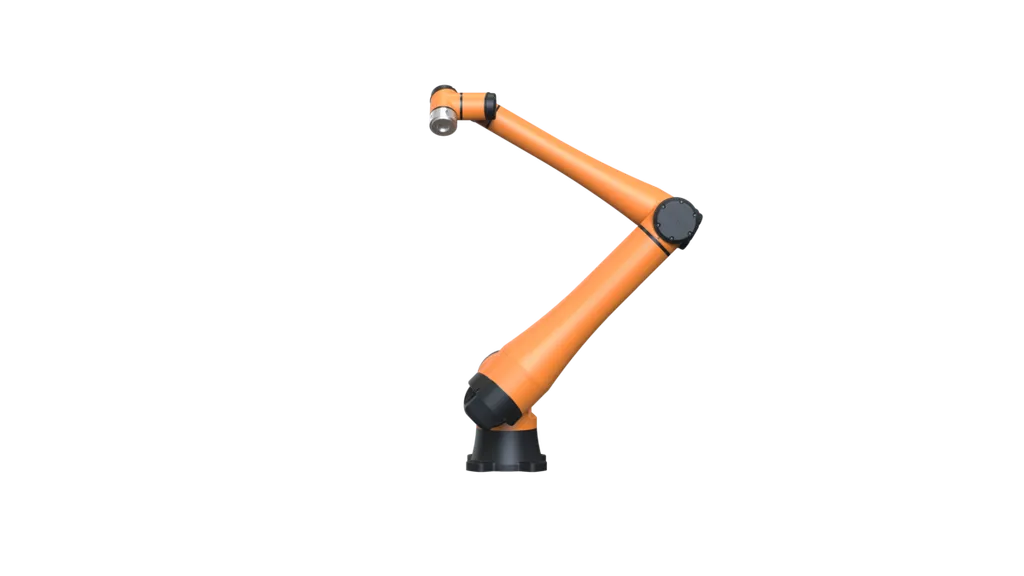
One spec separates AUBO from most of its Chinese cobot competitors: the iS series is IP67 rated across the whole line. Full immersion protection at up to 35 kg payload. In our analysis of 67 Chinese-brand robots in the IRH database, only AUBO’s iS series consistently hits IP67. That single fact opens the food processing, pharmaceutical, and chemical sectors that IP54-rated arms cannot touch without an enclosure workaround.
AUBO Robotics was founded in 2015 in Beijing. The company focuses entirely on collaborative arms; no industrial-arm product line. Eleven robots in the Industrial Robotics Hub database, organized into two families: the i series (standard, IP54) and the iS series (washdown, IP67).
What does AUBO actually make?
| Model | Payload (kg) | Reach (mm) | Repeatability (mm) | IP rating |
|---|---|---|---|---|
| i3 | 3 | 625 | ±0.02 | IP54 |
| i5 | 5 | 886 | ±0.02 | IP54 |
| i10 | 10 | 1,300 | ±0.03 | IP54 |
| i16 | 16 | 1,350 | ±0.03 | IP54 |
| i20 | 20 | 1,650 | ±0.05 | IP54 |
| iS3 | 3 | 625 | ±0.02 | IP67 |
| iS7 | 7 | 886 | ±0.02 | IP67 |
| iS10 | 10 | 968 | ±0.03 | IP67 |
| iS20 | 20 | 1,647 | ±0.05 | IP67 |
| iS20L | 20 | 2,000 | ±0.05 | IP67 |
| iS35 | 35 | 2,100 | ±0.10 | IP67 |
Source: IRH database, AUBO product pages.
The iS series mirrors the i series at payload parity but adds full IP67 sealing. The iS35 at 35 kg / 2,100 mm reach is the heaviest cobot in the AUBO catalog and one of the heaviest IP67 cobots on the market from any manufacturer.
Browse the full AUBO lineup at /brands/aubo/.
What are AUBO’s hardware strengths?
IP67 is the lead story. Dust-tight and immersion-rated to 1 m depth for 30 minutes. In a properly configured washdown cell, the iS series does not need IP-rated enclosures around the arm. For food manufacturers who run hot water and detergent washdowns between shifts, that reduces cell complexity and cleaning time. In our IRH washdown analysis, fewer than 21% of all robots in the database hit IP67 — AUBO’s iS series is among the most capable Chinese entries in that category.
35 kg ceiling. The iS35 at 35 kg is heavier than Universal Robots’ heaviest cobot (UR20 at 20 kg). For heavy-part machine tending, pallet pick-and-place, and large-part assembly, 35 kg IP67 is a meaningful specification.
Safety certifications. The AUBO i and iS series carry ISO 10218-1, ISO/TS 15066, and PLd Cat.3 certification — the full set that Western safety authorities require for collaborative deployment without a fixed guard. CE marking is documented.
PROFINET and Modbus. The i series fieldbus documentation shows PROFINET and Modbus TCP/RTU support. AUBO also provides an open SDK and Python/C++ API access, which supports custom integration beyond what the teach pendant provides.
Long-reach variants. The iS20L at 2,000 mm reach and iS35 at 2,100 mm cover large work envelopes typical of automotive body panel handling and aerospace assembly.
What are the honest gaps?
Service network. AUBO’s Western presence runs through regional distributors, not owned service centers. In-country engineering support depends on distributor capability, which varies. For a high-uptime food manufacturing line, the question to ask before signing is: where is the nearest distributor with certified AUBO service engineers, and what is their documented response time? The answer varies by country.
Ecosystem depth vs UR+. AUBO’s developer community and third-party integration library are growing but trail Universal Robots’ UR+ ecosystem (1,000+ certified integrations). Gripper, vision, and safety-scanner integrations require integrator-side driver work more often than with UR. Budget accordingly.
US Section 301 tariff (25%). The same tariff math that applies to all Chinese-origin robots applies here. EU buyers have no equivalent tariff disadvantage.
iS series premium. The IP67 iS models carry a price premium over the standard i series. The total washdown-ready cell cost still needs to be modelled against a non-IP67 arm plus an IP67 enclosure — sometimes the enclosure approach is cheaper, sometimes the sealed arm wins. Run the numbers for your specific layout.
Repeatability at heavy end. The iS35 at ±0.10 mm is reasonable for palletizing but not appropriate for precision assembly applications that need ±0.03 mm or better. Verify the repeatability spec against your process tolerance before specifying.
Who should buy AUBO?
Good fit: Food, pharmaceutical, or chemical manufacturers in the EU who need IP67 cobots at 3-35 kg payload and have in-house integration capability or a distributor with AUBO experience. Applications where the iS series’ IP67 rating eliminates the need for an enclosure and the cost saving offsets the longer parts-logistics tail vs UR.
Poor fit: US buyers who have not modelled the 25% tariff impact. Applications needing UR+-style ecosystem breadth for fast peripheral integration. Precision assembly requiring better than ±0.05 mm (use the lighter i series models). High-uptime lines where parts response time is critical and the nearest distributor has limited spare-parts inventory.
How does AUBO compare to the alternatives for washdown applications?
In the IP67 cobot space, the realistic comparison list is short. Universal Robots’ UR series reaches IP54 in standard configuration and IP67 only with the UR+ IP67 gripper kit — the arm itself is rated IP54. Techman’s TM series is IP54. FANUC’s CR-7iA/L hits IP67 on specific variants. ROKAE’s xMate CR series is IP67 across the line and goes heavier (45 kg). AUBO’s iS series sits between ROKAE (higher payload ceiling) and UR (larger ecosystem, lower maximum payload).
For the 3-20 kg range in washdown environments, the iS10 and iS20 are the most direct European-market options before you accept either a smaller ecosystem (ROKAE) or a non-IP67 arm that needs an enclosure (UR, JAKA, Dobot). The iS20L’s 2,000 mm reach is particularly useful for applications where the robot needs to reach into a wash tank or across a wide processing line.
What does AUBO’s open SDK enable?
AUBO provides C++ and Python APIs alongside the standard graphical pendant interface. For applications that require real-time force control, computer vision integration at the controller level, or custom motion planning (pharmaceutical liquid handling, for instance), the open API allows more sophisticated programming than a purely graphical teach-in workflow. This is a meaningful capability for small-batch, high-mix operations where programs change frequently and engineers need programmatic control over motion sequences.
The SDK is not as deeply documented in English as UR’s SDK, but it is functional and AUBO’s technical documentation has improved substantially since 2024. European integrators with Python experience report successful deployments using the API for custom washdown cell control logic.
The iS series is the most defensible technical argument for a Chinese cobot in food and pharma applications in the European market. The IP67 rating is real, the payload range is competitive, and the PLd Cat.3 certification is in order. The service infrastructure is the variable that requires due diligence before commitment.
Back to the hub: Chinese Industrial Robots in 2026 — A Western Buyer’s Reality Check. Full AUBO lineup: /brands/aubo/.