Estun Robots Buyer Guide: 700 kg Payload, Full Industrial Range
Estun is the only Chinese robot brand in our database with a 700 kg industrial arm. Listed on the Shanghai Stock Exchange, it competes directly with FANUC and KUKA on heavy payload, not on cobot simplicity.
A 700 kg industrial robot from a publicly listed Chinese company with EtherCAT, PROFINET, EtherNet/IP, and Modbus-TCP all on the same controller. That is the Estun ER700-2800 — and Estun is the only brand among the six covered in this guide that is not pitching cobots as its primary product. Thirteen robots in the IRH database, zero of them collaborative. This is an industrial-arm and SCARA builder competing in FANUC and KUKA territory.
Estun Automation was founded in 1993 in Nanjing. It is publicly listed on the Shenzhen Stock Exchange (002747), which means audited financials and a corporate governance structure that differs materially from privately held cobot startups. Estun also owns a majority stake in German machine tool specialist CLOOS Welding Technology, acquired in 2018 — a strategic move that gave it European welding-robot market access and German engineering integration experience.
What does Estun actually make?
The ER product line covers five robot categories: compact articulated arms (MI series), mid-range articulated arms (B series), SCARA robots (SR series), palletizers (PL series), and a heavy arm that sits in its own class.
| Model | Type | Payload (kg) | Reach (mm) | Repeatability (mm) | IP rating |
|---|---|---|---|---|---|
| ER4-550-MI | Articulated | 4 | 550 | - | IP65 |
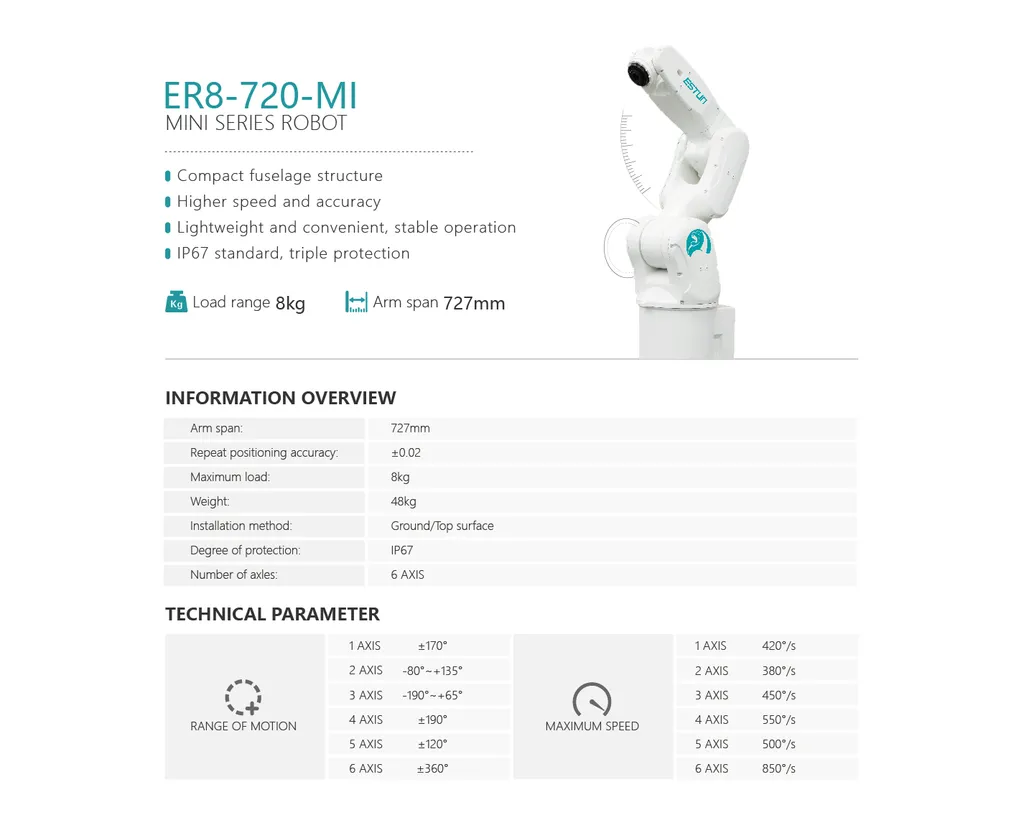
| ER8-720-MI | Articulated | 8 | 727 | ±0.02 | IP67 |
| ER20-1200-MI | Articulated | 20 | 1,200 | ±0.03 | IP67 |
| ER12B-1510 | Articulated | 12 | 1,510 | ±0.03 | IP54 |
| ER20B-1760 | Articulated | 20 | 1,756 | ±0.03 | IP54 |
| ER30B-2700-LI | Articulated | 30 | 2,700 | ±0.05 | IP54 |
| ER50B-2100 | Articulated | 50 | 2,100 | ±0.05 | IP54 |
| ER100B-3000 | Articulated | 100 | 3,000 | ±0.06 | IP54 |
| ER220B-2650 | Articulated | 220 | 2,650 | ±0.06 | IP54 |
| ER700-2800 | Articulated | 700 | 2,800 | ±0.10 | IP54 |
| ER10-600-SR | SCARA | 10 | 600 | ±0.025 | IP20 |
| ER50-1200-SR | SCARA | 50 | 1,200 | ±0.025 | IP54 |
| ER120-2400-PL | Palletizer | 120 | 2,400 | ±0.04 | IP54 |
Source: IRH database, Estun product pages.
Browse the full Estun lineup at /brands/estun/.
What are Estun’s hardware strengths?
700 kg payload — the heaviest Chinese industrial arm in our database. The ER700-2800 at 700 kg / 2,800 mm reach / ±0.10 mm competes with FANUC M-2000iA, KUKA QUANTEC, and ABB IRB 8700 in heavy stamping, die casting, and large-part handling. This is not a cobot. It is a full-size heavy industrial arm in the same category as the arms that transfer engine blocks and press automotive body panels. No other Chinese brand in our six-brand analysis touches this payload range.
Comprehensive fieldbus on the heavy arm. The ER220B-2650 documents EtherCAT, Modbus-TCP, PROFINET, and EtherNet/IP support — the four fieldbuses that cover essentially every PLC on the market. Estun’s heavy arm controller is not the limited fieldbus of a cobot startup; it is a PLC-grade motion controller.
IP67 on compact MI models. The ER8-720-MI and ER20-1200-MI carry IP67, which is unusual for compact industrial arms in the 8-20 kg range. That makes them viable for wet or high-contamination compact machining cells without enclosure modifications.
SCARA presence. The ER50-1200-SR is a 50 kg SCARA at ±0.025 mm repeatability — heavy-payload SCARA for assembly and pressing applications. Most robot vendors’ SCARA catalogs cap at 20 kg; Estun’s 50 kg SCARA occupies a specific niche in heavy precision assembly.
CLOOS ownership gives European welding-robot credibility. The 2018 acquisition of CLOOS (a respected German welding robot integrator) means Estun has boots on the ground in Germany and European market experience in a demanding application segment. For European welding cell buyers, that heritage is relevant.
Public company stability. Audited accounts, stock exchange reporting, and the governance requirements of a listed Chinese manufacturer reduce the business-risk profile compared to venture-backed startups. Estun’s financial statements are public.
What are the honest gaps?
No collaborative product. Estun does not build cobots. Every arm in the catalog is a traditional industrial robot that requires a risk assessment, guarding, and an operator-safety solution. If your application needs collaborative operation (people sharing the work envelope without a fixed guard), Estun is not the right vendor.
Service network is EU-weighted, thin in North America. CLOOS’s European presence gives Estun better EU service infrastructure than most Chinese brands. North American service for Estun arms is limited; parts logistics from Nanjing for a large arm running in a North American automotive plant carry real downtime risk.
US Section 301 tariff (25%). The tariff applies to Estun arms entering the US. A 220 kg heavy arm at a notional $180,000 list price lands at approximately $225,000 before integration. That narrows the price gap with FANUC and KUKA at the heavy-payload tier, where Western brands’ mature North American service networks are a compelling competing argument.
Software ecosystem. Estun’s controller software and offline programming environment are less documented in English than FANUC Roboguide or ABB RobotStudio. Western integrators familiar with the major brands typically need additional onboarding time with Estun’s platform.
IP20 SCARA. The ER10-600-SR is IP20 only — suitable for a clean, dry environment but not for any factory area with coolant splash, dust, or humidity. The ER50-1200-SR at IP54 is better protected but still not washdown-rated.
Who should buy Estun?
Good fit: European heavy-industry buyers (automotive, metalworking, casting) who are evaluating 100-700 kg industrial arms and are open to a Chinese brand with CLOOS’s EU market presence. SCARA buyers who need 50 kg capacity at ±0.025 mm and cannot find that specification from Western brands at a competitive price. Companies that have done the tariff math in the EU (no equivalent tariff) and find the landed cost competitive with FANUC and KUKA.
Poor fit: Any application that requires collaborative operation. North American buyers who have not carefully modelled the 25% tariff on heavy-arm prices and who cannot verify North American service response capability before committing. Deployments that depend on a deep English-language software ecosystem and mature third-party post-processor libraries.
Estun is not a cobot brand trying to compete with Universal Robots. It is an industrial robot builder trying to compete with FANUC and KUKA, and its 700 kg arm is a direct shot across that bow. The question for Western buyers is whether the price advantage after tariffs, and the service infrastructure at their location, justify the brand switch.
Back to the hub: Chinese Industrial Robots in 2026 — A Western Buyer’s Reality Check. Full Estun lineup: /brands/estun/.