Han's Robot Buyer Guide: Elfin Series, EtherCAT Lead, Cleanroom Focus
Han's Robot Elfin series runs EtherCAT natively -- a rare fieldbus choice among Chinese cobots that gives it an edge in high-speed motion control and cleanroom automation.
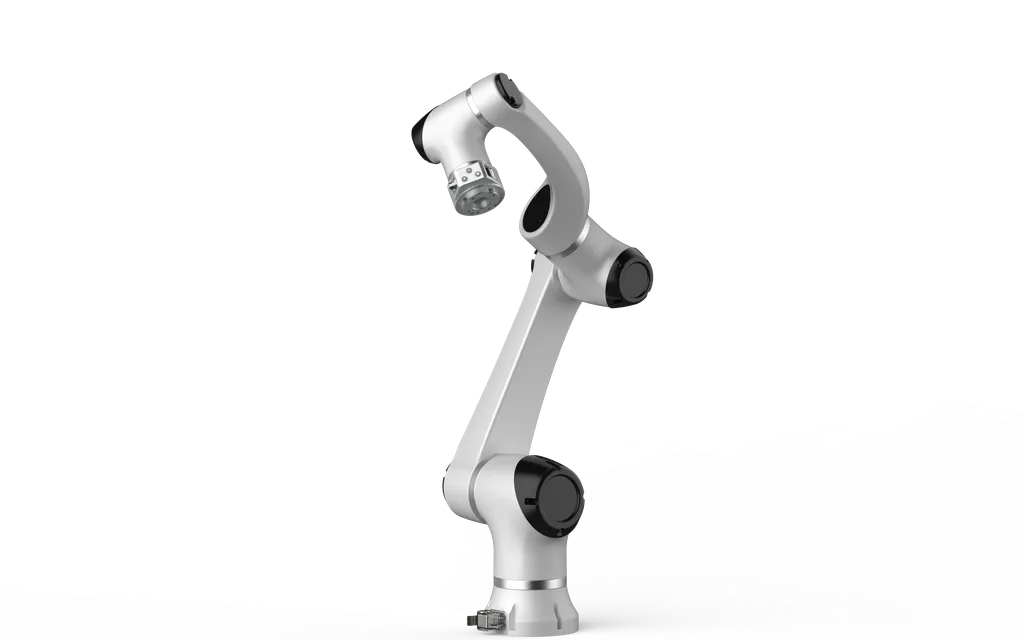
Eight cobots. Fifteen kilograms maximum payload. And native EtherCAT — the fieldbus that industrial motion controllers actually prefer when cycle time matters. That is Han’s Robot’s differentiated position in the Chinese cobot market, and it is more meaningful than it sounds.
Han’s Robot Co. Ltd. is a subsidiary of Han’s Laser Technology Industry Group, one of China’s largest laser equipment manufacturers. Founded in Shenzhen, Han’s Robot focuses entirely on the Elfin cobot series. Eight models in the Industrial Robotics Hub database, all collaborative, covering 3-15 kg payload.
What does Han’s Robot actually make?
The product line is the Elfin series, named by payload and reach variant:
| Model | Payload (kg) | Reach (mm) | Repeatability (mm) | IP rating |
|---|---|---|---|---|
| Elfin E03 | 3 | 590 | ±0.02 | IP54 |
| Elfin E05 | 5 | 800 | ±0.03 | IP54 |
| Elfin E05-L | 5 | 950 | ±0.03 | IP54 |
| Elfin E05-Pro | 3.5 | 800 | ±0.02 | IP54 |
| Elfin E10 | 8 | 1,000 | ±0.03 | IP54 |
| Elfin E10-L | 10 | 1,300 | ±0.05 | IP54 |
| Elfin E10L-Pro | 8 | 1,300 | ±0.10 | IP54 |
| Elfin E15 | 15 | 1,300 | ±0.10 | IP54 |
Source: IRH database, Han’s Robot product pages.
The naming convention is payload-class (E03 = 3 kg class, E05 = 5 kg class, E10 = 8-10 kg class) with L for long-reach and Pro for enhanced performance variants. The Pro models trade slightly different payload/reach combinations for improved repeatability.
Browse the full Han’s Robot lineup at /brands/hans-robot/.
What are Han’s Robot’s hardware strengths?
Native EtherCAT. This is the headline spec. EtherCAT is the fieldbus of choice for high-speed, time-synchronized motion control — it is what servo drives, linear motors, and precision motion stages run natively. Among Chinese cobots, most implementations center on Modbus TCP and PROFINET. Han’s Robot offering EtherCAT alongside PROFINET and Modbus gives it a material advantage in applications where the cobot is one axis in a larger multi-axis motion system: CNC machine tending on EtherCAT-based machine tools, semiconductor handling, PCB assembly, or precision dispensing.
Repeatability at the light end. The E03 and E05-Pro hit ±0.02 mm. That is at the tight end of what cobots publish — matching UR5e and JAKA’s light Zu models. For small-component assembly and precision pick-and-place, ±0.02 mm is a meaningful spec advantage over competitors posting ±0.05 mm in the same payload class.
Parent company resources. Han’s Laser is a large, publicly listed industrial company. Han’s Robot benefits from an industrial-grade manufacturing supply chain and R&D infrastructure that smaller pure-cobot startups do not have. This is not a guarantee of quality, but it is a different risk profile than a 10-year-old venture-backed startup.
Portfolio coherence. The Elfin line is narrow and well-defined. Eight models, one architecture, one controller philosophy. For integrators who learn the platform once and deploy repeatedly, that consistency reduces per-project engineering overhead.
What are the honest gaps?
15 kg ceiling. Han’s Robot does not make anything above 15 kg. Applications needing 20 kg, 30 kg, or 35 kg payload require a different brand. This is a hard catalog constraint, not a configuration issue.
Service network. Han’s Laser’s Western presence is primarily in laser processing equipment. The Han’s Robot distribution network for cobots in the US and EU is thinner than JAKA’s or AUBO’s at the time of writing. Western deployments typically go through a small number of system integrator partners, and service response depends heavily on those partners’ inventory and expertise.
IP54 only across the full line. No IP67 washdown-rated model exists in the Elfin series. For food and pharma washdown applications, Han’s Robot is not the right choice without a custom enclosure solution.
US Section 301 tariff (25%). Chinese-origin industrial goods entering the US carry the same 25% tariff as all other brands in this guide. The tariff does not apply in the EU.
Limited ecosystem documentation in English. Han’s Robot has improved its English-language technical documentation, but integrators outside China report that support forums, function block libraries, and third-party driver documentation are primarily in Chinese. For a Western integrator working alone, budget extra time for the first platform integration.
Who should buy Han’s Robot?
Good fit: European automation integrators with EtherCAT-based multi-axis machine control who need a cobot arm that talks natively to the same network without a gateway. Precision assembly and dispensing applications in the 3-10 kg range where ±0.02 mm repeatability matters. Shops integrating into Han’s Laser equipment lines, where a shared ecosystem gives natural support advantages.
Poor fit: Applications above 15 kg — full stop, there is no Elfin model for it. Washdown environments. US deployments where the tariff and thinner distribution network both work against the value case. Projects where English-language support documentation and a broad third-party ecosystem are requirements.
How does the Elfin compare to other 3-15 kg cobots?
The closest direct comparison is between the Han’s Robot E05-Pro (3.5 kg / 800 mm / ±0.02 mm, EtherCAT) and the Universal Robots UR3e (3 kg / 500 mm / ±0.03 mm, Modbus/PROFINET). The UR3e wins on reach-to-payload ratio and has the full UR+ ecosystem; the Elfin E05-Pro wins on fieldbus architecture and repeatability spec. For an integrator building a machine-tending cell on an EtherCAT-native CNC, the fieldbus choice alone can eliminate a gateway device and a day of commissioning.
JAKA’s Zu 3 (3 kg / 626 mm / ±0.02 mm, PROFINET/EtherNet/IP) competes directly on repeatability and is more affordable in most Western markets, but does not have EtherCAT. AUBO’s i3 (3 kg / 625 mm / ±0.02 mm) is similar, with PROFINET support.
The Han’s Robot differentiation is narrow but real: EtherCAT and the lightest-arm repeatability spec in the Chinese cobot lineup. If neither of those matters for your application, JAKA, AUBO, and Dobot offer more developed Western ecosystems at similar prices.
What is the integration profile like?
Integrators who have deployed Elfin arms in Europe report that the physical installation and teach-in are straightforward — standard 6-axis kinematics, hand-guided motion teaching, and a graphical pendant. The friction appears at the PLC driver layer: for Western EtherCAT masters (Beckhoff TwinCAT, for example), the Elfin ESI (EtherCAT Slave Information) file integration requires a setup step that is documented but not always pre-packaged in integrator toolchains outside China.
For PROFINET deployments, function blocks and GSDML files are available from Han’s Robot. That is the path of least resistance for integrators running Siemens or Rockwell PLCs who do not specifically need EtherCAT.
Han’s Robot is a specialist product, not a general-purpose cobot platform. In its lane — light, precise, EtherCAT-native — it is a strong choice. Outside that lane, the catalog ends fast.
Back to the hub: Chinese Industrial Robots in 2026 — A Western Buyer’s Reality Check. Full Han’s Robot lineup: /brands/hans-robot/.