JAKA Robots Buyer Guide: 12 Cobots, No Teach Pendant Required
JAKA's Zu and Pro series span 1-30 kg with phone-based programming and PROFINET support. Here is what Western buyers need to know before signing a PO.
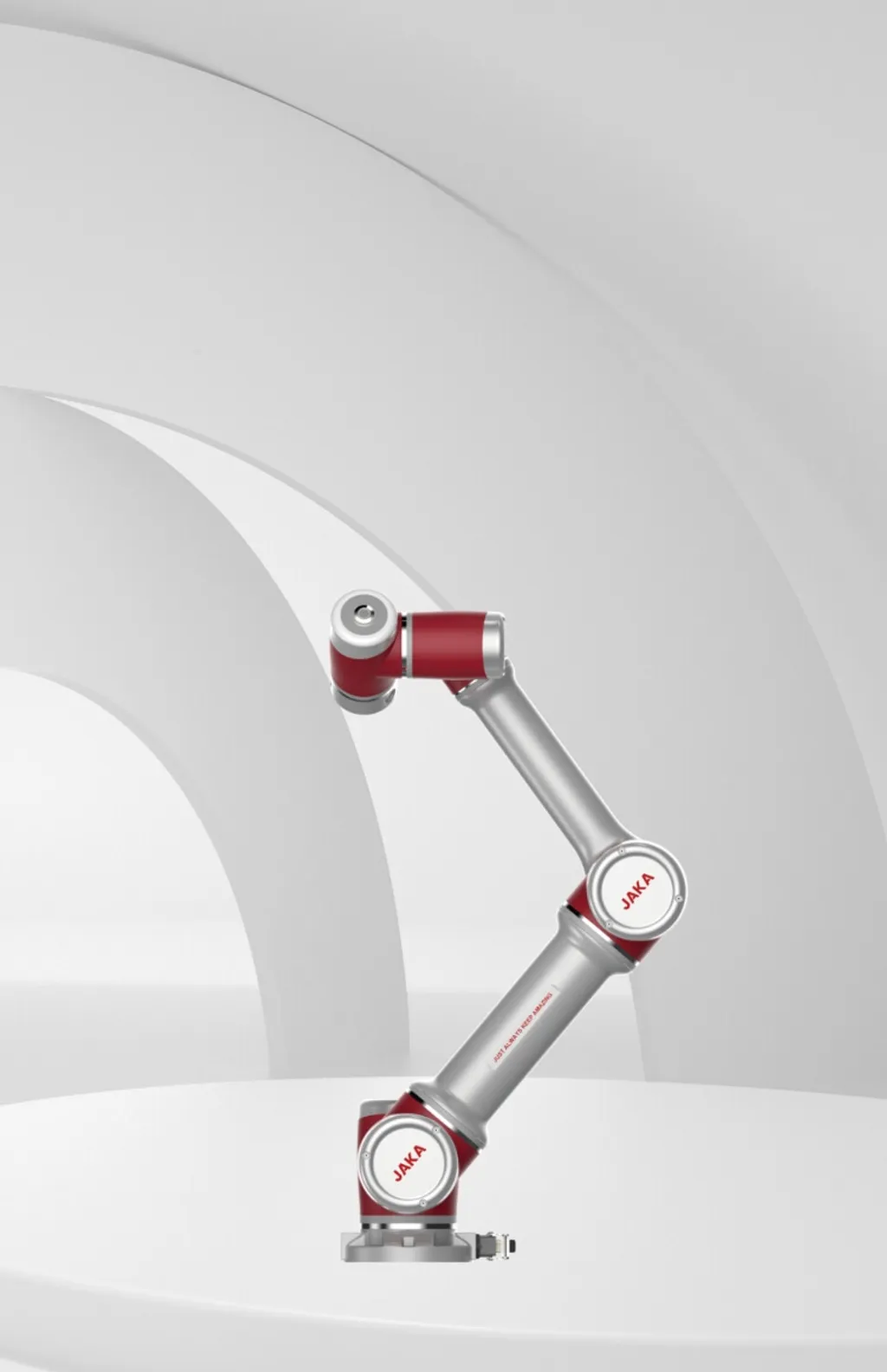
JAKA’s pitch is straightforward: you deploy a cobot from your phone, skip the teach pendant, and get the cell running faster. The hardware mostly backs that up. The gap is not in the arm — it is in what happens six months later when you need a replacement harmonic drive in Michigan.
JAKA Robotics was founded in 2014 in Shanghai, spun out of research at Shanghai University. The company builds cobot-only; there is no industrial-arm product line. Twelve robots in the Industrial Robotics Hub database, all collaborative, spanning 1 kg (MiniCobo) to 30 kg (Zu 30).
What does JAKA actually make?
Two product lines cover the catalog:
Zu series — the workhorse cobots. Six models from Zu 3 to Zu 30. The Zu 12 (12 kg / 1,327 mm reach / ±0.03 mm) and Zu 18 (18 kg / 1,350 mm) are the most deployed in Western integration projects. The Zu 30 at 1,780 mm reach is one of the longest-arm cobots in the market under 35 kg.
Pro series — the compact and mid-range tier. Four models: Pro 5, Pro 12, Pro 16, and the MiniCobo (1 kg, 580 mm reach, ±0.02 mm — desktop-grade). The S 5 is a sealed variant aimed at light washdown environments.
| Model | Payload (kg) | Reach (mm) | Repeatability (mm) | IP rating |
|---|---|---|---|---|
| MiniCobo | 1 | 580 | ±0.02 | IP54 |
| Zu 3 | 3 | 626 | ±0.02 | IP54 |
| Zu 5 | 5 | 819 | ±0.02 | IP54 |
| Zu 7 | 7 | 954 | ±0.02 | IP54 |
| Zu 12 | 12 | 1,327 | ±0.03 | IP54 |
| Zu 18 | 18 | 1,350 | ±0.03 | IP54 |
| Zu 20 | 20 | 1,713 | ±0.05 | IP54 |
| Zu 30 | 30 | 1,780 | ±0.05 | IP54 |
| Pro 5 | 5 | 954 | ±0.02 | IP54 |
| Pro 12 | 12 | 954 | ±0.03 | IP54 |
| Pro 16 | 16 | 1,073 | ±0.03 | IP54 |
| S 5 | 5 | 954 | ±0.10 | IP65 |
Source: IRH database, JAKA product pages. All specs rated per manufacturer.
Browse the full JAKA lineup at /brands/jaka/.
What are JAKA’s hardware strengths?
Payload range. The Zu series covers 3-30 kg in six models, which is a wider cobot ladder than most Western brands offer in a single product line. The Zu 30 is genuinely unusual — a 30 kg cobot at 1,780 mm reach competes with AUBO’s iS20 and Techman’s heavier models for large-part assembly and machine tending on full-size machining centers.
Programming simplicity. JAKA’s tablet/phone-based JAKA App is the best-documented version of the no-teach-pendant pitch. Hand guiding, graphical drag-and-drop, and app-based deployment work well for simple pick-and-place and palletizing cycles. The offline programming tool (JAKA Studio) supports PC-side simulation. For straightforward deployments this genuinely reduces commissioning time.
Fieldbus coverage. PROFINET, EtherNet/IP, Modbus TCP, and Modbus RTU are all supported. Most Western European and North American PLCs integrate without a gateway. In our database, JAKA’s fieldbus breadth matches Dobot and exceeds Han’s Robot on EtherNet/IP specifically.
Repeatability at price point. ±0.02 mm on the light Zu models and ±0.03 mm on the mid-range is competitive with UR e-Series numbers (UR5e: ±0.03 mm). The spec is manufacturer-rated; it is not independently verified under load at full reach, but the same caveat applies to every arm in the market.
What are the honest gaps?
Service network. JAKA sells in the US and EU through authorised distributors. There are no JAKA-owned service centers outside China as of Q2 2026. When a joint module fails, the repair path runs through the distributor — and if the distributor does not stock the part, it ships from China. Lead times of 4-12 weeks are documented in JAKA’s own brand notes for spare parts outside China. For low-uptime applications that is tolerable. For a line running two shifts six days a week, it is a material risk.
IP54 across most of the line. IP54 is splash-resistant, not washdown-safe. The S 5 reaches IP65 (dust-tight, jet-resistant). No JAKA model hits IP67 (full immersion). For food processing, dairy, pharmaceutical, or chemical applications that require regular washdown, JAKA is not the right choice without a careful enclosure design.
Software ecosystem depth. JAKA’s integration marketplace is small compared to UR+. Custom gripper and vision integrations are doable but typically require integrator-written drivers rather than certified plug-and-play packages. If your process needs a Cognex vision system and a Schunk gripper talking directly to the controller, budget extra engineering time.
US Section 301 tariff. A 25% import tariff on Chinese-origin industrial goods applies to JAKA arms entering the US market. A rough estimate: a Zu 12 at a notional $35,000 list price lands at approximately $43,750 before integration. The tariff does not apply in the EU.
ROS support. Listed as none or unofficial for current JAKA products in our database. For research, pilot, and flexible-manufacturing deployments that depend on ROS 2 for perception and motion planning, this is a gap. UR and FANUC both have maintained ROS 2 drivers.
Who should buy JAKA?
Good fit: EU manufacturers in light-to-mid assembly or machine tending who want a wide payload ladder at a competitive base price, have in-house electrical engineering, and are comfortable managing a slightly longer parts-logistics tail. Small to mid-size shops deploying one or two arms where programming simplicity matters more than ecosystem depth.
Poor fit: US buyers who have not modelled the tariff-adjusted landed cost. High-uptime North American production lines where downtime is very expensive. Any washdown application above IP65. Deployments where the integration team expects UR+-style certified peripheral integrations out of the box.
How does JAKA compare to UR in the same payload range?
The natural comparison is JAKA Zu 12 (12 kg / 1,327 mm / ±0.03 mm) versus Universal Robots UR10e (12.5 kg / 1,300 mm / ±0.03 mm). Specifications are a near-match. The UR10e has a 27 mm reach disadvantage but wins on ecosystem: UR+ has 1,000+ certified integrations; JAKA has a growing but much smaller certified peripheral library. JAKA’s advantage is simpler programming entry (phone/tablet app vs Polyscope) and a lower base price in EU markets (no Section 301 tariff).
For the Zu 30 (30 kg / 1,780 mm), the comparison is against AUBO iS20L (20 kg / 2,000 mm) and ROKAE xMate CR35 (35 kg / 2,246 mm). At 30 kg, JAKA’s ceiling is higher than any UR model; the question becomes whether the ecosystem trade is acceptable for the application.
The Zu 12 and Zu 18 are competitive arms. The question is never the arm in isolation — it is the full cell, the spare-parts strategy, and the integration ecosystem. Build a realistic total cost of ownership before the comparison ends at the arm price.
Back to the hub: Chinese Industrial Robots in 2026 — A Western Buyer’s Reality Check. Full JAKA lineup: /brands/jaka/.