The 4-6x Rule: What Robot Integration Really Costs
The 4-6x rule says integration costs 4-6x the arm price. But 98.9% of robots publish no price. Here is what that multiplication actually looks like in dollars.
$210,000. That is what a $35,000 cobot arm costs when you include integration. Or $140,000 if your integrator is efficient. The 4-6x rule gives you a range, not a number, and it only works if you know the arm price to begin with. We checked 264 robots in our database: 261 of them (98.9%) publish no price at all. So when the industry tells you “integration costs 4-6x the arm,” the first question is 4-6x of what, exactly?
What is the 4-6x integration multiplier?
The 4-6x rule is shorthand for a well-documented cost ratio in the robotics industry: the total installed cost of a robotic cell typically runs 4 to 6 times the base price of the arm itself. The arm is the smallest line item. The rest is engineering, guarding, tooling, programming, and the first year of keeping it running.
The ratio exists because buyers consistently underestimate the gap between “arm price” and “robot cell running in production.” You do not install an arm. You install a system: mechanical integration, safety infrastructure, programming, commissioning, and training. Each of those components carries a budget range of its own.
What the multiplier does not tell you is where in that 4-6x range your project will land. A simple cobot picking parts off a conveyor is a different project from a dual-robot welding cell with custom fixturing, safety guarding, and vision-guided path correction. The multiplier covers both scenarios with the same 4x-to-6x label, which is why the range matters more than the midpoint.
What does integration actually include?
The line items below are standard for any robotic cell. A simple cobot pick-and-place application lands at the low end of each range. A custom welding, painting, or palletizing system lands at the high end or beyond it.
| Integration component | Typical cost range | Notes |
|---|---|---|
| End-of-arm tooling | $5,000 - $50,000 | Gripper, sensor, force/torque |
| Safety guarding | $10,000 - $80,000 | Skip for certified cobots; add risk assessment |
| Cell design and engineering | $20,000 - $100,000+ | CAD, simulation, integration hours |
| Programming and path teaching | $5,000 - $30,000 | 1-4 weeks of integrator time |
| Commissioning and runoff | $5,000 - $20,000 | On-site testing and cycle validation |
| Operator and maintenance training | $2,000 - $10,000 | 1-5 days on-site |
| Year-1 support contract | 5-10% of system cost | Varies by vendor |
Typical integration cost components. A simple cobot pick-and-place cell lands at the low end; a custom welding or palletizing system lands at the high end or beyond.
A few things worth noting. For certified collaborative robots, you can skip the hard fencing and light curtains, but you cannot skip the ISO/TS 15066 risk assessment. That assessment still costs money and integrator time. Safety guarding for a traditional articulated arm can easily hit the top of the $80,000 range when you need full perimeter fencing, interlock gates, and light curtains on multiple access points. Cell design and engineering is the line item most buyers underestimate: it is billed by the hour, integrator hours run $100-$250/hour depending on market, and complex cells can consume 400-600 hours of engineering time before a single program is loaded.
What does it look like in real dollars?
Our database has only three robots with published price estimates: Universal Robots, which is the only brand in our analysis of robot pricing across 264 arms that publishes figures at all. The UR5e runs approximately $35,000 and the UR10e approximately $45,000 (both configured, price on application).
Apply the 4-6x rule to those figures and the range becomes visible:
| Arm price | 4x total project | 6x total project | Range |
|---|---|---|---|
| UR5e ~$35,000 | $140,000 | $210,000 | $70,000 |
| UR10e ~$45,000 | $180,000 | $270,000 | $90,000 |
| Heavy arm ~$200,000 | $800,000 | $1,200,000 | $400,000 |
4-6x integration multiplier applied to the only arm prices in our database. Heavy arm price is a typical market estimate. Our database shows 98.9% of robots publish no price (see our analysis).
The $70,000 range on a $35,000 arm is not a rounding error. That is the difference between a project that returns its investment in 18 months and one that takes 30 months. At the heavy-articulated level, the $400,000 range on a $200,000 arm is the difference between a project that makes the capital committee meeting and one that does not.
The range widens with arm price in absolute terms. That is arithmetic, not coincidence. The high-end integrations, custom EOAT, safety cells, multi-robot coordination, are the same scenarios that justify high-payload arms. A heavy articulated arm buyer and a complex integration project are the same buyer. The multiplier skews toward 6x exactly when the arm price is highest.
Why does the multiplier vary so much?
The 4-6x rule was built for light cobots in straightforward pick-and-place cells. Move outside that scenario and the multiplier climbs. Custom welding cells or painting systems can run 8-10x the arm price without any project-management failures, just physics and safety requirements.
The primary drivers of where your project lands:
Application complexity. A cobot picking one SKU from a fixed location is genuinely a 4x project. A vision-guided bin-picking cell with variable SKUs and reject handling is not. The difference is in programming hours and EOAT cost, both of which scale with the complexity of the task, not the price of the arm.
Safety zone requirements. The cobot category earns its premium partly on safety simplification. A certified cobot cell can skip fencing, which removes $10,000-$80,000 from the integration budget. A traditional articulated arm at full speed cannot be safely deployed without a full safety cell, which adds that cost back and then some.
Integrator availability and geography. Integrator rates vary by region, by specialty, and by current backlog. A market-scarce specialist in automotive welding charges differently than a general-purpose integrator doing pick-and-place. This is not in the arm spec sheet, but it is in your total project cost.
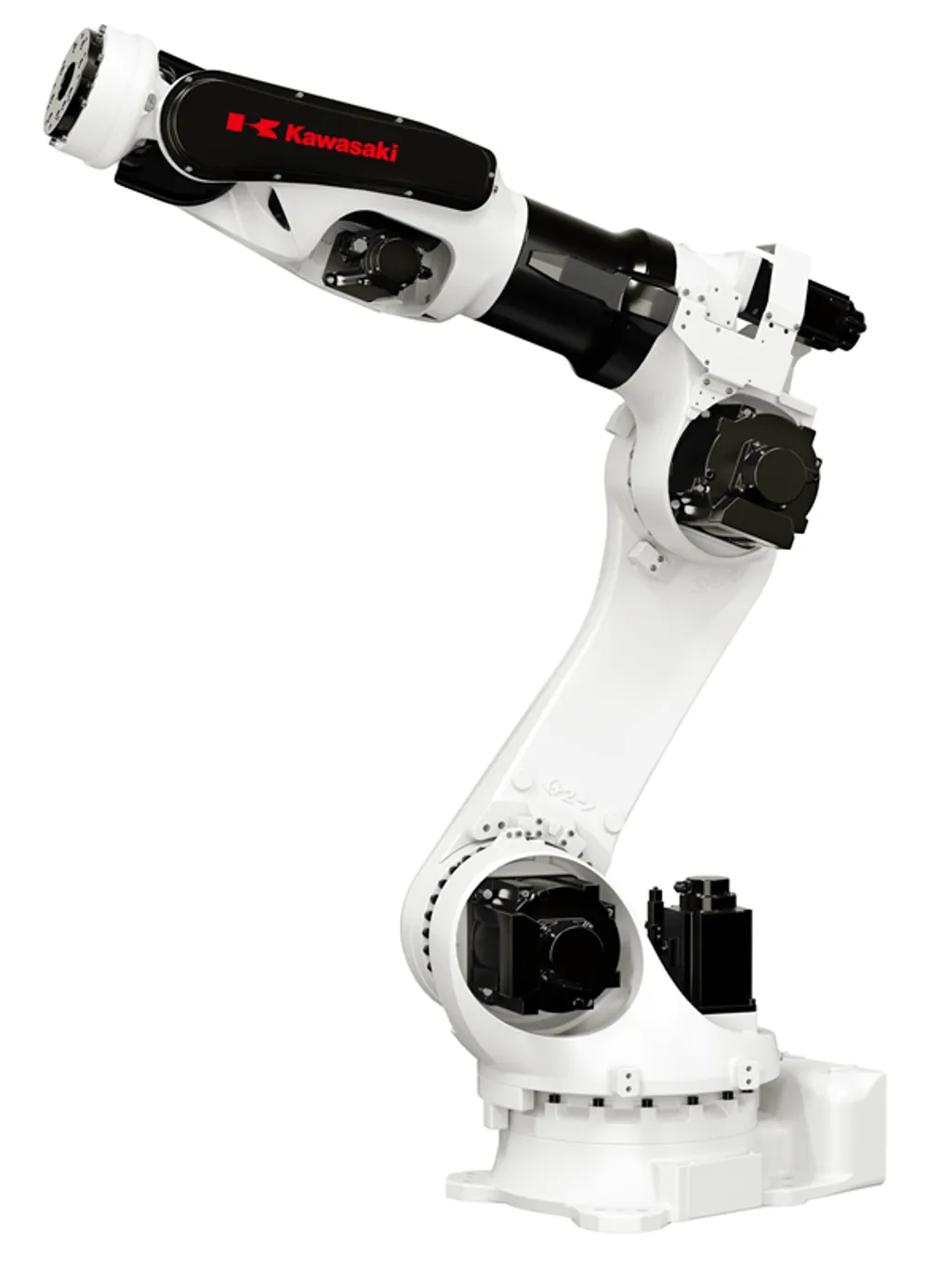
The Kawasaki BX100N, a 100 kg payload articulated arm, is a good illustration. A mid-range articulated arm like the BX100N is not a cobot deployment. It requires a full safety cell, likely custom EOAT for its payload class, and integrator time that reflects the complexity of 100 kg applications. The arm price is one budget line. The project budget is the real conversation.
According to data from IFR World Robotics 2024, integration cost rather than arm price is the primary barrier cited by SME buyers entering robotics. The arm is what they research. The integration bill is what stops the project.
Cobot adoption patterns in manufacturing reflect this: cobots gained market share partly because their safety simplification genuinely reduces integration cost, not just arm cost. The 4x vs 6x question is partly a question of which robot class you are deploying.
What this means when you build your business case
The standard buying mistake: find the arm you want, get the arm price, and then apply a multiplier to estimate total cost. The problem is that 98.9% of arms have no published price. You are multiplying a number you do not have by a range you cannot narrow until you have an integrator quote.
The correct sequence is the reverse. Get the RFQ first, not the arm spec.
Before you commit to an arm vendor or an arm model, get at least one integration quote for your specific application. That quote will tell you where your project falls on the 4-6x range, which line items dominate your budget, and whether you are actually buying a $140,000 project or a $210,000 project. The arm is interchangeable at that point. The integration scope is not.
For budgeting before you have a quote: plan for $150,000-$250,000 minimum for a cobot cell before you have committed to anything. For a heavy articulated arm in a full safety cell with custom EOAT, plan for $800,000-$1,200,000. Then work backwards from labor savings. If the labor cost you are displacing does not justify those numbers over a 3-5 year horizon, the ROI case does not close, regardless of what the arm costs.
The arm price is the number that fits on a slide deck. The integration cost is the number that fits in your capital budget. They are not the same number, and our pricing analysis across 264 arms shows that for 98.9% of the market, you cannot even start the multiplication until you have an RFQ. Start there.
Compare these robots