Robot Repeatability by Type: SCARA Hits 0.01 mm
We checked repeatability on 167 robots in our database: SCARA medians 0.01 mm, cobots 0.05 mm, and articulated arms span a 27x internal range.
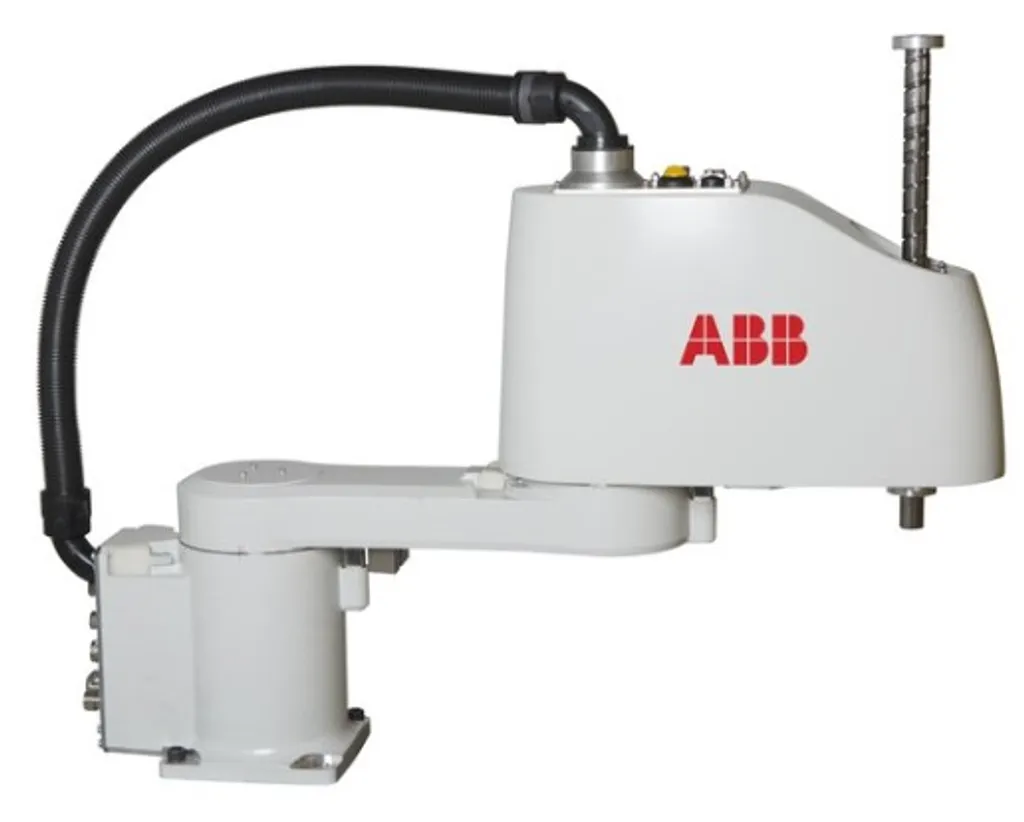
The most precise class in our database is also the cheapest, and the most expensive arm carries a 27x accuracy penalty over the smallest one in its own class. We ran repeatability across 167 robots in the Industrial Robotics Hub database (9 of 176 publish no figure) and the result is not what the class labels suggest. SCARA robots median 0.01 mm - five times tighter than cobots at 0.05 mm - but that lead disappears the moment you understand why: every SCARA happens to be small. Buy a small arm of any type and you land near 0.01 mm. Buy a 1700 kg articulated giant and you drift to 0.27 mm, the same measurement that puts it 27x behind a 3 kg SCARA.
Which robot type is the most repeatable?
SCARA, with a median of 0.01 mm. But the table below shows the full picture, and the real story is in the last column of the articulated row.
Repeatability here means pose repeatability, per ISO 9283: how tightly the robot returns to the same taught point, cycle after cycle. It is not accuracy (how close the robot gets to a programmed coordinate). A robot can be extremely repeatable and still land in the wrong spot if it was calibrated poorly. Repeatability is the number that governs real production - once you teach the point, you want the arm back to that point every cycle.
| Robot type | Robots (n) | Best (mm) | Median (mm) | Worst (mm) |
|---|---|---|---|---|
| SCARA | 26 | 0.01 mm | 0.01 mm | 0.04 mm |
| Welding | 4 | 0.01 mm | 0.025 mm | 0.03 mm |
| Articulated | 74 | 0.01 mm | 0.03 mm | 0.27 mm |
| Cobot | 52 | 0.01 mm | 0.05 mm | 0.10 mm |
| Delta | 5 | 0.05 mm | 0.10 mm | 0.10 mm |
| Painting | 1 | 0.15 mm | 0.15 mm | 0.15 mm |
| Palletizer | 5 | 0.05 mm | 0.50 mm | 0.50 mm |
Source: our analysis of 167 robots in the Industrial Robotics Hub database (9 robots publish no figure). Palletizers and painting arms are loose by design, not failure.
A few things to call out before moving on. Palletizers at 0.50 mm median and painting arms at 0.15 mm are not embarrassments - they are engineered for throughput and path consistency, not micron-level precision. A palletizer dropping a 10 kg box into a slot does not need 0.01 mm; it needs speed and force capacity. Pull those two classes out and the precision-relevant comparison is SCARA vs. articulated vs. cobot.
Why do SCARA robots win on repeatability?
Because every SCARA is planar and small. The SCARA geometry - two horizontal joints and one vertical axis - minimizes the lever-arm effect that amplifies joint error at the tool tip. Shorter reach and lower payload mean less structural flex under load and less thermal drift in the joints. Of the 26 SCARA robots in the 26 SCARA robots in our database, 14 (54%) hit 0.01 mm flat. The ABB IRB 910SC is one of them: 0.01 mm, 3 kg payload, 450 mm reach. The ABB IRB 920 (0.01 mm, 6 kg), Epson G3 (0.01 mm, 3 kg), and Epson LS3-B (0.01 mm) all sit in the same slot.
None of those arms is doing something special. They are all just small and planar. That geometry is a gift when you are press-fitting, PCB-populating, or handling watch components. It is useless when you need a 2-meter reach.
Why do articulated arms span a 27x range?
Because the articulated class is not a single category - it is a label that covers everything from a 1.5 kg micro-arm to a 1700 kg structural crane. Looking at every articulated arm we track, the spread runs from 0.01 mm at the small end to 0.27 mm at the large end. That is a 27x internal range within the same product category.
The tightest articulated arm is the ABB IRB 1010 at 0.01 mm - but it carries 1.5 kg at 370 mm reach. It competes with SCARA robots, not with the FANUC M-2000iA/1700L. The FANUC M-2000iA/1700L carries 1700 kg at 3734 mm reach and measures 0.27 mm repeatability. That number is documented across FANUC’s heavy-arm product line. The KUKA KR 1000 TITAN (1000 kg) sits at 0.10 mm; the FANUC M-900iB/400L (400 kg) at 0.15 mm.
The mechanism is straightforward: more reach means more lever arm. A 0.01 mm joint error at the motor becomes a larger positional error at the tool tip when the arm is 3.7 meters long. Add structural compliance at 1700 kg of hanging load and thermal expansion in a large cast iron joint, and 0.27 mm is not a defect - it is physics.
Only 3 of 74 articulated arms (4%) in our database hit 0.01 mm, all of them sub-2 kg payload units. Compare that to SCARA: 14 of 26 (54%) hit 0.01 mm. Same number on paper, completely different physical conditions producing it.
Are cobots really less precise than industrial arms?
It depends entirely on which cobot and which industrial arm you are comparing. The cobot category spans 0.01 mm to 0.10 mm across the cobot category in our database. The median is 0.05 mm, which is worse than the articulated median of 0.03 mm - but that articulated median is pulled down by dozens of small-to-mid arms that compete directly with cobots on payload.
The cobot distribution is bimodal in practice. ABB SWIFTI CRB 1100 hits 0.01 mm; it is a high-speed arm that happens to carry a collaborative safety rating. KUKA LBR iiwa 7 R800, Techman TM12, and Yaskawa Motoman HC10 all sit at 0.10 mm - a 10x gap within the cobot label alone. The spread across all 167 robots with published figures is 50x total, from the SCARA best of 0.01 mm to the palletizer worst of 0.50 mm.
The “cobots are less precise” conclusion is too broad. A 0.01 mm cobot exists. The question is whether you need it, and whether the cobot safety wrapper costs you cycle time you cannot recover.
What this means when you spec a robot
Do not buy a robot class for precision. Buy the size band.
The practical decision rule: look at the repeatability figure at your target payload and reach. Not the class name, not the best-case figure in the product headline, the number in the spec sheet at the payload you are actually carrying. The correlation runs through size, not type. A small arm, whether it is branded as SCARA, articulated, or cobot, will deliver 0.01 to 0.03 mm. A large arm will drift toward 0.10 to 0.27 mm, and no software correction fixes structural compliance at 3.7 meters of reach.
SCARA wins as a class because every SCARA happens to be small and planar. If a SCARA could be built at 1700 kg payload, it would not hit 0.01 mm either. The class label is a proxy for the size pattern that actually matters. When you are speccing for tight-tolerance assembly, the decision is: do I need a large arm (which means accepting 0.03-0.27 mm depending on payload), or can I redesign the cell to stay inside the size envelope where any arm type hits 0.01 mm?
For the 54% of SCARA buyers and the 4% of articulated-arm buyers who land at 0.01 mm, the number is the same on paper. The engineering reality - mass, reach, joint compliance, lever arm - is not. For buyers speccing tight-tolerance tasks by use case, the welding application page and the assembly application page filter the full database by those tags, with repeatability sortable.
Compare these robots