ROKAE Robots Buyer Guide: 45 kg IP67 Cobots and Industrial Arms
ROKAE builds the heaviest IP67-rated cobot in the Chinese market at 45 kg, alongside IP67 articulated arms. The xMate CR45 hits a payload ceiling no other Chinese cobot reaches.
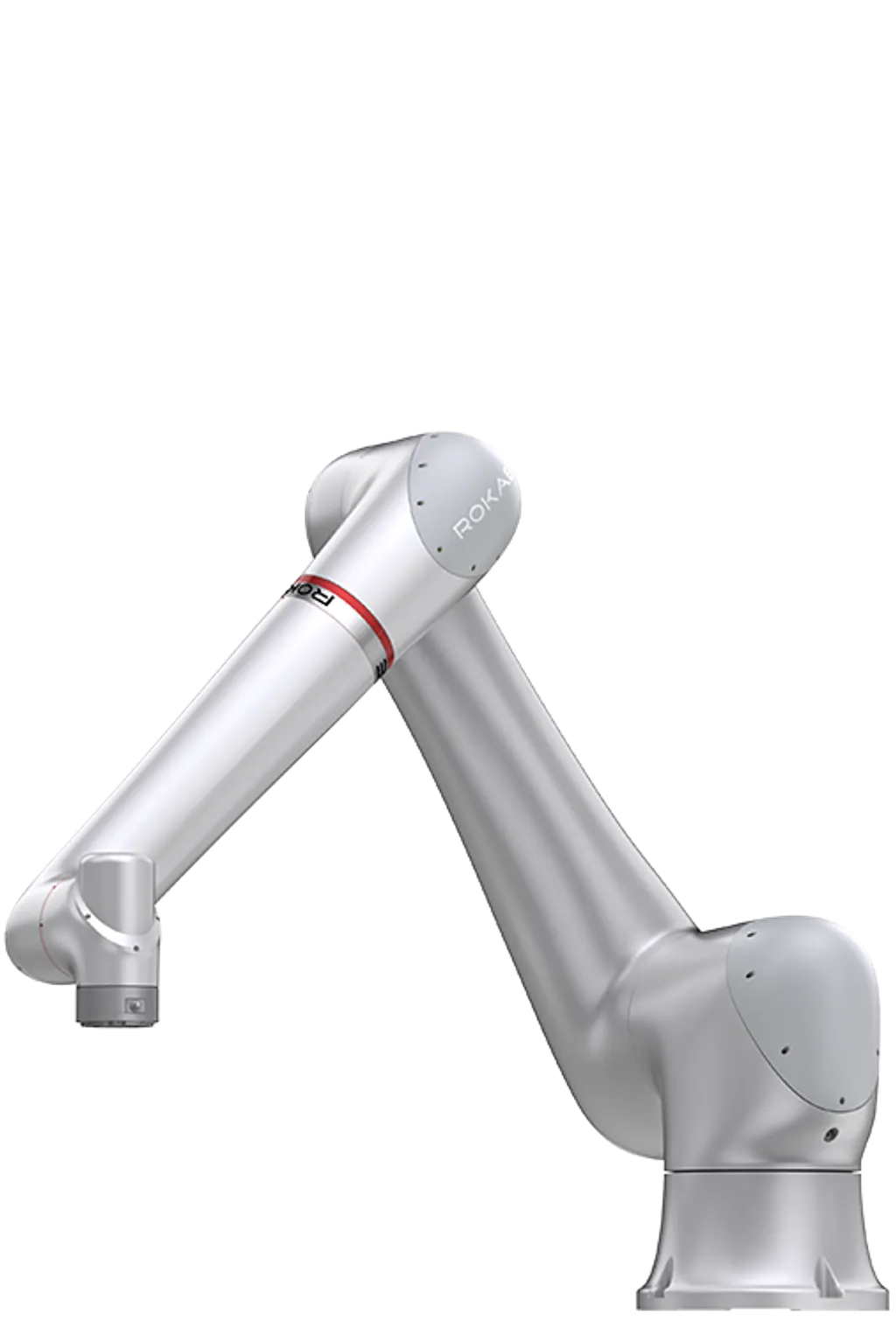
Forty-five kilograms. IP67. Collaborative. That is the ROKAE xMate CR45 — a specification that sits above every other Chinese cobot in the market on payload, rated for washdown environments, and certified for collaborative operation with force limiting active. If your application needs more than 35 kg payload in a cobot and washdown protection, the short list gets very short.
ROKAE was founded in 2015 in Beijing, spun out of the Robotics Institute at Tsinghua University. Unlike most Chinese cobot brands, ROKAE builds both collaborative and industrial articulated arms. Fourteen robots in the Industrial Robotics Hub database: the XB series (compact industrial arms), the xMate CR series (cobots), and the xMate ER and SR series (extended-reach and standard-reach cobot variants).
What does ROKAE actually make?
XB series — compact industrial articulated arms. IP67-rated, 4-7 kg payload, designed for tight-space machine tending and high-cycle electronics assembly. The XB7 and XB7L both carry PROFINET and EtherNet/IP fieldbus support.
xMate CR series — heavy cobots. IP67 rated across the line. The range runs from CR7 (7 kg / 988 mm / ±0.02 mm) up to CR45 (45 kg / 1,947 mm / ±0.05 mm). CR35 at 2,246 mm reach is the longest-arm cobot in the ROKAE catalog.
xMate ER and SR series — standard cobots. ER3, ER7, ER7 Pro at IP rating unspecified (early-market variants, not IP67). SR3 and SR5 at IP54. Lower entry price point.
| Model | Type | Payload (kg) | Reach (mm) | Repeatability (mm) | IP rating |
|---|---|---|---|---|---|
| XB4 | Industrial arm | 4 | 596 | ±0.02 | IP67 |
| XB7 | Industrial arm | 7 | 707 | ±0.02 | IP67 |
| XB7L | Industrial arm | 7 | 906 | ±0.03 | IP67 |
| xMate CR7 | Cobot | 7 | 988 | ±0.02 | IP67 |
| xMate CR12 | Cobot | 12 | 1,434 | ±0.03 | IP67 |
| xMate CR18 | Cobot | 18 | 1,062 | ±0.03 | IP67 |
| xMate CR20 | Cobot | 20 | 1,798 | ±0.05 | IP67 |
| xMate CR35 | Cobot | 35 | 2,246 | ±0.05 | IP67 |
| xMate CR45 | Cobot | 45 | 1,947 | ±0.05 | IP67 |
| xMate ER3 | Cobot | 3 | 760 | ±0.03 | - |
| xMate ER7 | Cobot | 7 | 850 | ±0.03 | - |
| xMate ER7 Pro | Cobot | 7 | 850 | ±0.03 | - |
| xMate SR3 | Cobot | 3 | 705 | ±0.03 | IP54 |
| xMate SR5 | Cobot | 5 | 919 | ±0.03 | IP54 |
Source: IRH database, ROKAE product pages.
Browse the full ROKAE lineup at /brands/rokae/.
What are ROKAE’s hardware strengths?
CR45: the heaviest Chinese IP67 cobot. The xMate CR45 at 45 kg / 1,947 mm reach carries a payload that exceeds AUBO’s iS35 (35 kg), JAKA’s Zu 30 (30 kg), and Universal Robots’ UR20 (20 kg). For heavy-part machine tending, large-component assembly, and pallet handling where collaborative operation (no fixed guard) is required in a washdown environment, the CR45 is a specification that very few arms can match from any manufacturer.
IP67 across the XB and CR series. The fact that ROKAE’s IP67 rating extends to its compact industrial arms (XB4, XB7) as well as its heavy cobots is unusual. Most brands that offer IP67 do so on a subset of the cobot line; ROKAE applies it across both the industrial and collaborative families.
Tsinghua University lineage. ROKAE’s origin in the Tsinghua Robotics Institute gives it a stronger R&D foundation than many pure-commercial Chinese cobot startups. The xMate series design reflects academic-grade mechanical and control engineering.
Extended-reach CR35 at 2,246 mm. For applications that need both collaborative-rated operation and a long reach — automotive body panel handling, aerospace assembly fixtures — the CR35’s 2,246 mm arm length is a competitive specification.
What are the honest gaps?
Western distribution is early-stage. Of the six brands in this guide, ROKAE has the thinnest Western distributor network. The brand is well-established in Chinese and Asian markets; European and North American presence is building but limited as of Q2 2026. Service response times and spare-parts availability in Western markets are harder to benchmark than for JAKA or AUBO, which have been building Western distributor relationships longer.
Fieldbus documentation gaps. The XB7 and XB7L document PROFINET and EtherNet/IP support clearly. The xMate CR series fieldbus documentation in the Western-facing spec sheets is less complete — our database shows no fieldbus entries for most xMate CR models. Integrators report that CAN-based internal communication is used; verify PLC integration path with ROKAE’s distributor before specifying.
US Section 301 tariff (25%). The same tariff math applies as for all Chinese-origin robots entering the US market.
ER series IP rating. The xMate ER3, ER7, and ER7 Pro do not have documented IP ratings in the Western-facing specs. These are older or entry-tier variants; if environmental protection matters, specify the CR or XB series and verify explicitly.
Software ecosystem. ROKAE provides programming tools and an SDK, but the third-party peripheral ecosystem (grippers, vision, safety scanners with certified integrations) is the smallest of the six brands covered in this guide. Plan for custom integration work on all peripheral devices.
Who should buy ROKAE?
Good fit: European manufacturers who need a heavy (20-45 kg) IP67-rated cobot and have found that no other brand reaches the combination of payload and washdown protection they need. Applications where the CR45 or CR35 fills a genuine specification gap — heavy collaborative handling in a washdown environment — and where the buyer has either in-house ROKAE experience or can identify a qualified ROKAE distributor in their region.
Poor fit: North American buyers who have not modelled the tariff-adjusted landed cost and service-network risk. Applications that need a deep PLC integration ecosystem from day one. Any deployment where fieldbus protocol must be verified before committing, and the local distributor cannot provide clear documentation. Buyers evaluating ROKAE should push harder for a certified service commitment before signing than they would for JAKA or Dobot, where the Western infrastructure is more established.
ROKAE’s CR45 is a genuine technical achievement and fills a real payload gap in the cobot market. The challenge for Western buyers is that infrastructure credibility has to be built by the distributor, not the spec sheet. Ask for reference installations in your country before the contract is signed.
Back to the hub: Chinese Industrial Robots in 2026 — A Western Buyer’s Reality Check. Full ROKAE lineup: /brands/rokae/.