Robot IP Ratings: Only 21% Survive a Washdown
We checked the IP rating on all 264 robots in our database: only 52 (21%) are rated IP67 or higher, and just two reach the IP69K washdown standard.
Two. Out of 264 robots in our database, exactly two carry IP69K - the high-pressure, high-temperature steam washdown standard required in meat, dairy, and pharmaceutical primary packaging. Both are delta robots. The broader washdown picture is only slightly more generous: 52 of the 242 robots that publish an IP rating (21%, roughly one in five) are rated IP67 or higher for immersion. The other 79% either cap out at water-jet resistance or carry no meaningful liquid protection at all. An IP rating is an environment spec, not a quality spec. It tells you what cleaning chemistry your robot can survive, and for food and beverage lines that run a daily caustic washdown, buying the wrong class puts a $60,000 arm into a $300 corrosion repair in year two.
What does a robot’s IP rating actually tell you?
IP stands for Ingress Protection, defined in IEC 60529. The two digits mean different things. The first digit (0-6) covers solid particles - dust and debris. The second digit (0-9K) covers liquids, and that second digit is the one that matters on a production floor with a hose.
The practical ladder runs like this. IP54 is splash protection - you can drip on it and hit it with low-pressure water from any direction, but you cannot hose it down. IP65 adds water-jet resistance (a 6.3 mm nozzle, 12.5 liters per minute). IP67 means 30 minutes of immersion at up to 1 meter depth - this is the threshold most systems integrators use as the practical floor for washdown duty. IP68 extends that to sustained immersion. IP69K, the outlier at the top, means the robot survives high-pressure hot water at 80 degrees Celsius from a distance of 10-15 cm - the rotating spray nozzle standard used in meat and dairy processing.
Most food and beverage buyers ask for IP65 minimum and IP67 preferred. Almost nobody asks for IP69K because almost nobody realizes how few robots actually carry it.
How many industrial robots are washdown-rated?
Of the 242 robots in our database that publish an IP rating, the distribution breaks down as follows:
| Protection level | IP code(s) | Robots (n) | Share |
|---|---|---|---|
| Steam washdown | IP69K | 2 | 0.8% |
| Immersion | IP67-IP68 | 50 | 20.7% |
| Water jets | IP65-IP66 | 44 | 18.2% |
| Splash only | IP54 and similar | 94 | 38.8% |
| No water rating | IP20-IP40 | 52 | 21.5% |
Source: our analysis of the 242 robots in the Industrial Robotics Hub database that publish an IP rating (22 do not). Washdown-capable means IP67 or higher: 52 robots, about one in five.
The single most common rating in our database is splash-only (IP54 and similar), at 38.8%. That number should concern any food-industry buyer who picked a robot off a catalog page without checking the second digit. More than a third of the robots tracked here cannot handle a direct hose, let alone a daily hot caustic cycle.
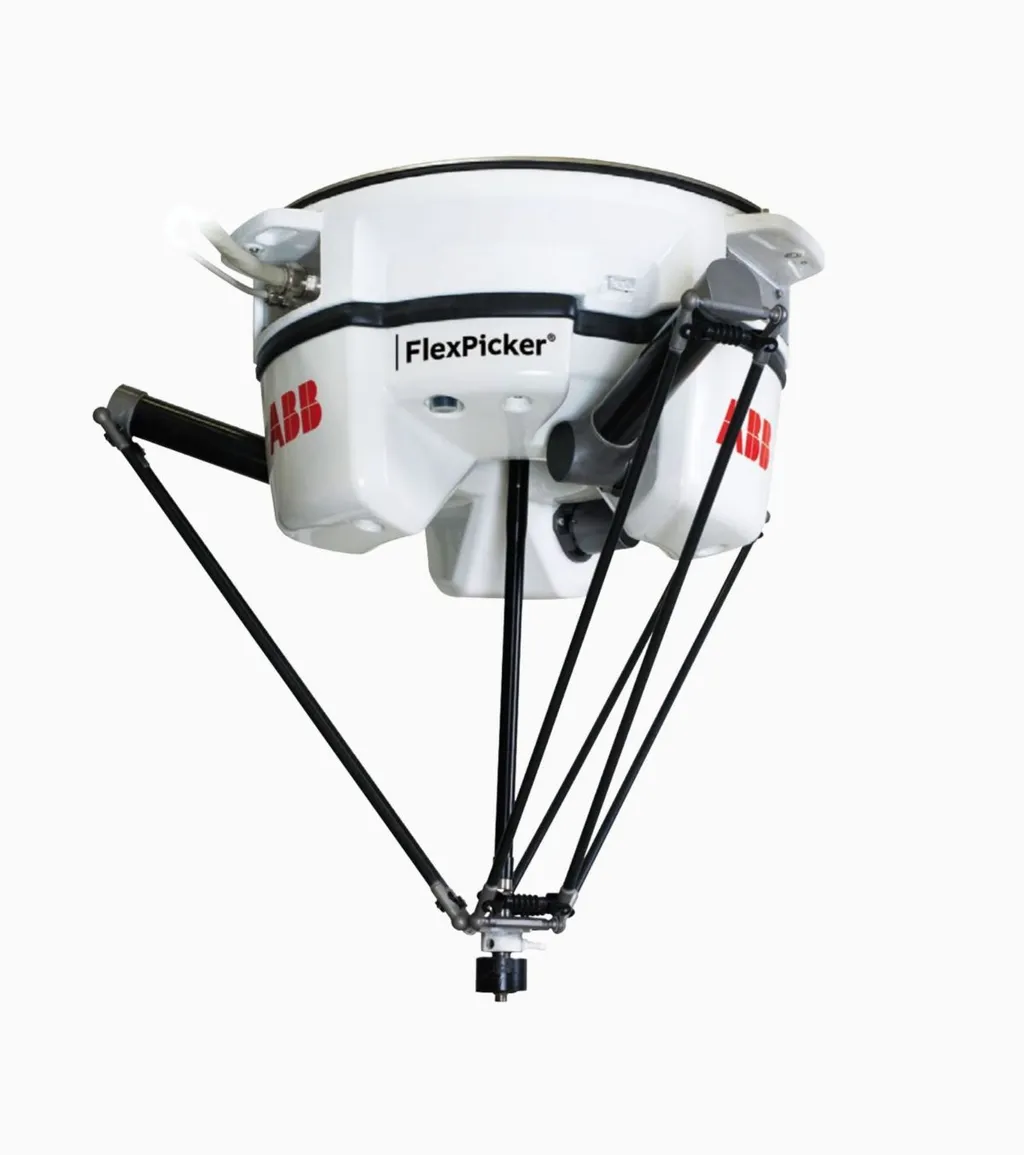
The two IP69K robots are both delta format and both designed specifically for food primary packaging:
- The ABB IRB 360 FlexPicker - 8 kg payload, the standard washdown delta for wet food picking.
- FANUC’s M-3iA delta picker - 6 kg payload, IP69K rated per FANUC’s own M-3 product page.
The delta geometry appears twice at IP69K and nowhere else in the database. That is not a coincidence.
Which robot types can take a washdown?
The chart below tells the full story. Delta robots lead at 60%. Every other type is below 30%, and two types - SCARA and AMR - are at 0%.
The delta result makes sense once you know why every delta robot we track is built for food picking. The parallel-linkage geometry keeps the motor housings far above the work zone, which simplifies sealing dramatically. According to the standard delta robot design rationale, the actuators sit on a fixed upper platform - a configuration that makes IP69K sealing far more tractable than sealing a traditional 6-axis arm with motors at every joint.
The SCARA result is the counter-intuitive finding. The SCARA class is the most precise robot type in our database by repeatability, yet it is the worst by washdown readiness. Not one of the 31 SCARA robots in our database that publish an IP rating reaches IP67. The best any SCARA achieves is IP65 - water jets, but not immersion. SCARA robots live in dry electronics assembly, PCB population, and clean-room pharmaceutical tableting. They are built for horizontal planar precision, not for stainless-steel hygiene enclosures. The same geometry that gives SCARA its precision (planar joints, enclosed horizontal structure) also makes deep sealing complex, and the market has never demanded it.
AMRs at 0% is less surprising. Mobile platforms running on standard warehouse floors have no business case for IP69K, and most buyers are not asking for it.
Which brands build for washdown?
The brand picture is not evenly distributed. Two brands - FANUC and Yaskawa - stand out as systematic washdown suppliers, not bolt-on offerings.
| Brand | Washdown-rated (IP67+) | Robots tracked with a rating |
|---|---|---|
| FANUC | 13 | 16 |
| Yaskawa | 11 | 18 |
| Rokae | 9 | 11 |
| ABB | 7 | 24 |
| AUBO | 6 | 11 |
Source: our analysis of 264 robots in the Industrial Robotics Hub database. AUBO’s entire iS cobot series is rated IP67.
FANUC’s 13 of 16 ratio (81%) is the standout. That is not a food-specific product line - that is a company-wide design standard. The same is directionally true for Yaskawa at 11 of 18 (61%). Both companies sell into automotive, welding, and logistics, but they built the washdown capability into the hardware rather than treating it as a specialty option.
Rokae (9 of 11, 82%) is the third brand by ratio, though with a smaller database sample. ABB’s 7 of 24 (29%) reflects a wide product portfolio where some arms (heavy articulated, painting) have no washdown application - the SCARA and delta units pull the washdown count lower as a share of the whole range.
AUBO is the cobot outlier. All six iS-series collaborative arms in our database - the iS3, iS7, iS10, iS20, iS20L, and iS35 - carry IP67 as standard. If you are speccing a collaborative cell in a food or pharma environment, AUBO’s washdown-rated iS10 cobot is worth a look - it is one of the few cobots where the washdown rating is not an add-on but the default.
What this means when you spec for food, beverage, or pharma
The IP rating is an environment spec. It answers one question: can this arm survive your cleaning process? The answer depends on your cleaning process, not on the brand name on the arm.
A dry electronics cell running pick-and-place with an air wipe does not need IP67. An articulated arm in that cell at IP54 is not deficient - it is correct for the environment. Paying for IP69K in a clean dry cell is waste.
The reverse error is more expensive. A the cobot category robot at IP54 installed in a meat processing line that runs a 70-degree caustic washdown twice per shift will develop seal failures within months. The seal failure is not a warranty issue - it is a specification error. The spec sheet said IP54 and the buyer installed it in an IP67 application.
The buying decision reduces to three questions. First, what is your cleaning protocol - dry wipe, water spray, full hose-down, or pressure steam? Second, does your protocol match or exceed the robot’s second IP digit? Third, if you need IP67 or above, have you checked that the specific payload and reach you need is available in that rating - because as this data shows, 79% of the market does not offer it?
Delta at 60% and articulated at 26% give food and beverage buyers two viable paths. SCARA, despite being the precision leader, is not one of them. Know your cleaning process before you write the spec. The arm comes second. The machine tending application page covers IP requirements specifically for CNC environments where coolant (not washdown) is the exposure.
Compare these robots