Payload vs Reach: 258 Robots, One Efficient Frontier
We plotted payload against reach for 258 robots in our database. Palletizers carry 7x more per mm than cobots, and the FANUC M-2000iA tops the chart at 455 g/mm.
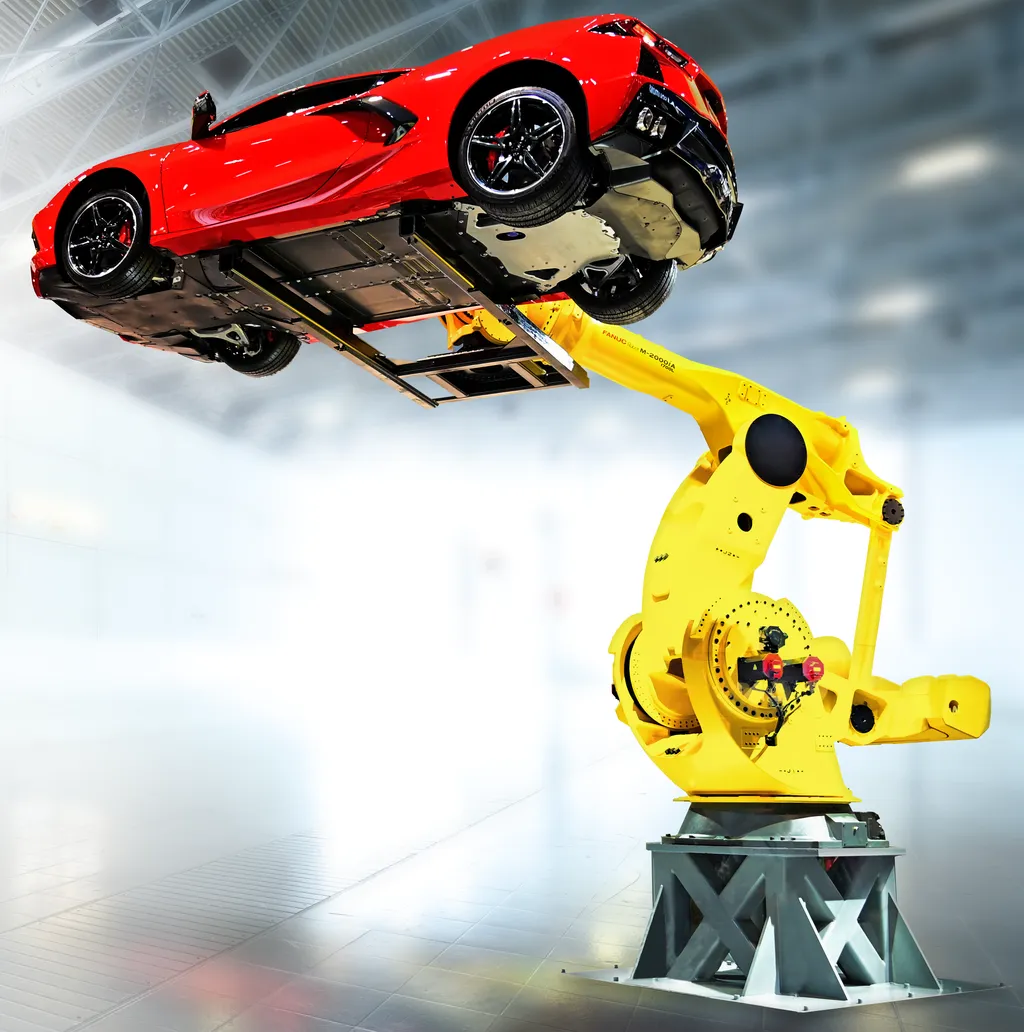
Of 258 robots in our database with both payload and reach published, palletizers carry a median of 58.86 grams per millimeter of reach - 7x more than cobots at 8.24 g/mm - and the FANUC M-2000iA/1700L sits at 455.3 g/mm, 55 times the cobot median. The efficient frontier is not where most engineers look: it is occupied entirely by heavy articulated arms and palletizers. No cobot appears in the top 20. The buying implication is simple and ignored constantly: stop comparing robots by payload alone. Compare payload at your required reach.
What is payload-to-reach ratio, and why does it matter?
Payload-to-reach ratio is grams of rated payload per millimeter of rated reach. A robot rated for 10 kg at 400 mm delivers 25 g/mm. A robot rated for 10 kg at 1300 mm delivers 7.7 g/mm. On paper, both are “10 kg robots.” In practice, the first one will do your job at a fraction of the structural stress the second arm faces at full extension.
Here is the catch most buyers miss: almost every manufacturer publishes rated payload at full reach - the worst case. If the datasheet says 10 kg, that number is measured with the arm fully extended, not at the elbow. Some manufacturers publish payload curves showing how capacity increases as reach shortens. Most do not. When you see a rated payload figure, assume it is at full extension.
That matters because if your actual pick point is 600 mm from the robot base but you bought a 1300 mm arm to “have room,” you are not running the robot at rated payload - you are running it at reduced structural stress. The spec sheet does not show you that advantage. The payload-to-reach ratio gives you a normalized comparison that the headline number hides.
Which robot type carries the most per millimeter of arm?
Palletizers, by a wide margin. Their median across 9 robots in our database is 58.86 g/mm - more than 5x the next class. Cobots are last among arm types at 8.24 g/mm across 108 robots.
| Robot type | Robots (n) | Median payload/reach (g/mm) |
|---|---|---|
| Palletizer | 9 | 58.86 |
| Articulated | 96 | 11.11 |
| SCARA | 35 | 10.00 |
| Welding | 4 | 8.33 |
| Cobot | 108 | 8.24 |
| Delta | 5 | 4.44 |
Source: our analysis of 258 robots in the Industrial Robotics Hub database with both payload and reach published. Painting (n=1) omitted.
None of this is a flaw on the cobot side. Palletizers are purpose-built for end-of-line stacking: long reach, high payload, repeatability requirements that a cereal box cannot tell the difference from. Engineers have spent decades optimizing palletizer arms for structural rigidity under heavy load at full extension, and the ratio shows it. Cobots are optimized for something else entirely: small safe collaborative cells, compliance with force limits, and deployment without a safety cage. Their low ratio is not a structural deficiency - it is a design specification. You are trading reach efficiency for ISO/TS 15066 force compliance and the ability to run the arm next to a person.
Delta arms bottom out at 4.44 g/mm because they are built for speed over distance, not load over distance. Pick-and-place at 120 cycles per minute with a 1 kg payload at 600 mm reach is a different machine than a palletizer stacking 700 kg at 3 meters.
Which individual robots sit on the efficient frontier?
The top five by payload-to-reach ratio across all 258 robots are:
| Robot | Type | Payload | Reach | Ratio (g/mm) |
|---|---|---|---|---|
| FANUC M-2000iA/1700L | Articulated | 1700 kg | 3734 mm | 455.3 |
| KUKA KR 1000 TITAN | Articulated | 1000 kg | 3202 mm | 312.3 |
| Estun ER700-2800 | Articulated | 700 kg | 2800 mm | 250.0 |
| FANUC M-410iB/700 | Palletizer | 700 kg | 3143 mm | 222.7 |
| ABB IRB 7600-500/2.55 | Articulated | 500 kg | 2550 mm | 196.1 |
Source: our analysis of 258 robots in the Industrial Robotics Hub database. All five are heavy-duty arms or palletizers. No cobot appears in the top 20.
The FANUC M-2000iA/1700L is the efficiency outlier of the entire database. At 455.3 g/mm, it carries 55x more per millimeter of reach than the median cobot. That figure comes from FANUC’s heavy-arm range - 1700 kg at 3734 mm reach - and it is not an anomaly, it is what happens when you engineer structural rigidity at automotive-press scale. The KUKA KR 1000 TITAN follows at 312.3 g/mm, 1000 kg at 3202 mm. Both arms are used for lifting automotive body sections, press-tending, and casting extraction - applications where reach efficiency is not a nice-to-have, it is the whole design brief.
Mid-tier: the Kawasaki BX100N at 100 kg and 2200 mm reach delivers 45.5 g/mm - a strong mid-tier result that sits above the articulated median of 11.11 by a factor of 4. It is on the frontier for its reach band, and it is 5x more efficient per millimeter than a cobot at similar reach.
Why do bigger arms have a higher ratio?
This is the counter-intuitive part. You might expect a longer arm to be less efficient: more weight to move, more structure to deflect, more joint compliance. The ratio says the opposite. Heavy-payload arms at long reach score higher, not lower.
The reason is engineering investment. A 1700 kg arm is not just a scaled-up 10 kg arm - it is a fundamentally different structural calculation. Heavy articulated arms are designed to carry rated payload at full extension with minimal structural flex, because that is the only environment they operate in. The joint diameters, the casting geometry, the bearing sizes - all of it scales to keep deflection within spec at maximum load. The result is an arm that maintains its rated capacity efficiently across the full reach envelope.
Cobots take the opposite path. Lightweight carbon-fibre-style construction keeps the arm mass low to satisfy the kinetic energy limits in ISO/TS 15066. The joint actuators use torque sensing for safety stops, not brute structural rigidity. At 10 kg payload and 1300 mm reach, a cobot arm flexes more per unit payload than a heavy industrial arm at 1000 kg and 3200 mm - not because cobots are worse engineered, but because they are optimized for a safety constraint the heavy arm never has to meet. The result is the cobot category sitting at 8.24 g/mm median, correct for what the category is.
The upshot: bigger arms carry more per millimeter because the engineering investment in rigidity goes up faster than the reach does. You cannot build a 3.7 m arm rated for 1700 kg without solving for structural rigidity first.
What this means when you spec a robot
The practical reframe for the spec sheet: your required reach is a harder constraint than your required payload. Start with reach, then filter on payload.
If your required reach is 800 mm and your payload is 5 kg, the cobot category at 8.24 g/mm is fine - that reach band is designed for collaborative cells and the safety wrapper costs you nothing in structural performance at that scale. If your required reach is 2500 mm and your payload is 200 kg, you are looking at a part of the curve where cobots do not exist. The efficient frontier at 2500 mm is articulated heavyweights, and the engineering reason is above.
See also our earlier post on robot pricing - the reach-band constraint also determines which tier of integration cost you are buying into. A cobot at 800 mm reach might carry a 4x integration multiplier; a heavy articulated arm at 2500 mm reach carries a 6x multiplier and a full safety cell. The ratio does not capture that cost, but the reach band predicts it.
The efficient frontier robots - FANUC M-2000iA at 455 g/mm down to ABB IRB 7600 at 196 g/mm - are not competing for the same work as the cobots at 8 g/mm. They are different machines answering different questions. The number this analysis gives you is a way to sanity-check your shortlist: if you need X kg at Y mm of reach, find the robot that delivers that with a ratio your structural analysis can support. A robot that cannot make the efficient frontier at your required reach is carrying dead weight in its joint stack - and you will feel it in cycle time, maintenance intervals, and the spec sheet revision at year two.
Compare these robots