Best Cobots for Machine Tending in 2026 (Ranked by Real Specs, Not Marketing)
We ranked 10 collaborative robots for CNC machine tending on the two specs that actually decide the job: coolant survivability (IP rating) and payload headroom. Only 22% of cobots survive flood coolant.
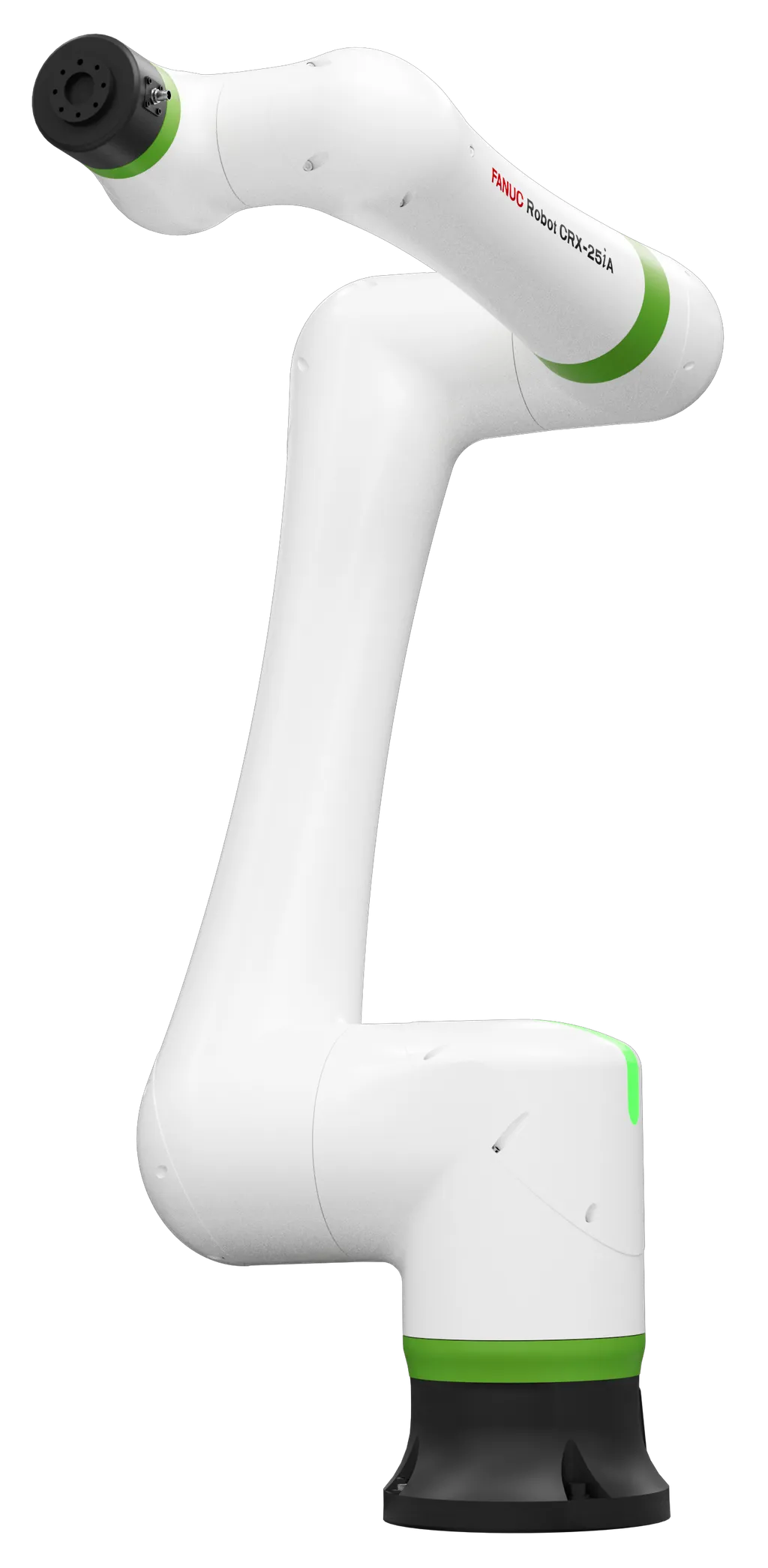
The single best cobot for general CNC machine tending in our database is the FANUC CRX-25iA: 30 kg payload, 1,889 mm reach, ±0.04 mm repeatability, and an IP67 rating on both the arm and the wrist. That combination is rare. Most “machine tending cobot” pages you will find are written by the company that makes one arm and conclude that the one arm is best. This ranking is built from the specs of 107 collaborative robots in the Industrial Robotics Hub database, scored on what a machine-tending cell actually demands rather than on a marketing brief.
Two specs decide a tending job, and most shortlists underweight both. The first is the IP rating, because a CNC enclosure throws coolant mist and a lathe with the door open throws coolant. The second is payload headroom, because a chuck-mating gripper or a dual-gripper changeover tool eats 3 to 6 kg before the part is even in hand. Get either wrong and the cell either corrodes or stalls at the chuck.
How we ranked these
There is no single “machine tending score” on a datasheet, so we built one from the fields that matter, weighted in this order:
- Coolant survivability (IP rating). Light mist tolerates IP54. Flood coolant or an open-door wet process needs IP67. This is the most commonly ignored spec on a tending shortlist and it is the one that quietly kills arms in year two.
- Payload headroom. Rate the part, then add the gripper. A 5 kg billet behind a 4 kg dual gripper needs a robot rated well above 9 kg, not exactly 9 kg. Higher headroom also covers the inertia penalty of holding a part off the flange.
- Reach. The arm must reach into the machine envelope and back out to a part buffer, conveyor, or in-feed tray without repositioning.
- Repeatability. Chuck and fixture loading wants ±0.05 mm or tighter so the part seats without a search routine eating cycle time.
Speed matters too, but for tending it is rarely the binding constraint, and the collaborative speed tax applies the moment a human shares the cell. We cover that trap in detail in the cobot speed reality check. What follows is the ranked shortlist, all data pulled straight from our spec database.
The ranking
| # | Cobot | Payload | Reach | Repeatability | IP (arm) | Best for |
|---|---|---|---|---|---|---|
| 1 | FANUC CRX-25iA | 30 kg | 1,889 mm | ±0.04 mm | IP67 | All-round wet tending |
| 2 | Yaskawa HC30PL | 30 kg | 1,700 mm | ±0.05 mm | IP67 | Tending plus palletizing |
| 3 | FANUC CR-35iB | 50 kg | 1,813 mm | ±0.08 mm | IP67 | Heavy castings, big chucks |
| 4 | AUBO iS35 | 35 kg | 2,100 mm | ±0.05 mm | IP67 | Long-reach heavy tending, value |
| 5 | Rokae xMate CR35 | 35 kg | 2,246 mm | ±0.05 mm | IP67 | Deepest machine envelopes |
| 6 | Universal Robots UR20 | 20 kg | 1,750 mm | ±0.1 mm | IP65 | Ecosystem and fast integration |
| 7 | JAKA Pro 12 | 12 kg | 1,327 mm | ±0.02 mm | IP68 | Coolant-proof small-part value |
| 8 | Techman TM25S | 25 kg | 1,300 mm | ±0.05 mm | IP54 | Built-in vision, dry/mist cells |
| 9 | Doosan H2515 | 25 kg | 1,500 mm | ±0.1 mm | IP54 | Payload value, light mist |
| 10 | KUKA LBR iisy 15 R930 | 15 kg | 930 mm | ±0.05 mm | IP54 | Compact precision cells |
Every robot listed is tagged for machine tending and verified in our database. Pricing for these arms is “price on application” across the board, which is its own problem we have written about elsewhere. The ranking below explains the reasoning by buyer scenario rather than reciting the table.
The all-round wet-tending picks (1-2)
The FANUC CRX-25iA earns the top slot because it is the rare cobot that refuses to compromise. The IP67 rating covers both the arm and the wrist, which matters because the wrist sits closest to the coolant plume when the arm reaches into an open machine. At ±0.04 mm it is also the most repeatable arm in the 25 kg-plus class we track, so chuck and fixture seating is clean without a vision search. The 30 kg payload leaves real headroom for a dual gripper doing load-and-unload in one cycle. If you are speccing a single arm to tend a flood-coolant lathe or mill and you want to stop thinking about it, this is the default.
The Yaskawa HC30PL is the close second and the better choice if the same arm also has to palletize finished parts. The “PL” variant is built for the tending-plus-stacking duty cycle, carries the same IP67 protection on arm and wrist, and posts a 2,000 mm/s tool-center-point speed that helps on the longer palletizing moves. Yaskawa is also one of two brands that build washdown protection in as a company-wide standard rather than a specialty option, which we documented in the robot IP ratings analysis. For a cell that tends a machine and then builds a pallet, the HC30PL does both jobs wet.
Heavy parts and big chucks (3-5)
When the part is a casting, a billet, or a large chuck assembly, payload becomes the binding constraint and the field narrows fast.
The FANUC CR-35iB is the heavyweight, the only cobot in this shortlist rated for 50 kg, and it keeps IP67 protection at that payload. The ±0.08 mm repeatability is looser than the lighter CRX arms, which is the expected trade at the top of the payload curve, but it is still tight enough for most heavy-part chucking. If your part plus tooling crosses 30 kg, this is effectively the cobot answer.
The AUBO iS35 and Rokae xMate CR35 are the value plays in the heavy class, both Chinese-built, both 35 kg, both IP67. The AUBO reaches 2,100 mm and the Rokae stretches to 2,246 mm, the longest reach of any cobot in this ranking. That extra reach matters when the arm has to load a deep machine envelope and still serve an in-feed tray without a track. The trade with both is the one that applies to all Chinese cobots: competitive hardware against a thinner Western service network and spare-parts logistics tail. We break that calculus down in the Chinese industrial robots buyer’s reality check. For a European buyer without the US Section 301 tariff exposure, the iS35 and CR35 are genuinely strong heavy-tending hardware.
The ecosystem pick and the coolant-proof value play (6-7)
The Universal Robots UR20 is here for a reason that is not on the spec line. At IP65 it handles coolant mist but not a flood, and its ±0.1 mm repeatability is the loosest in the top tier. What it brings instead is the UR+ ecosystem of over a thousand certified grippers, vision systems, and tending-specific application kits, plus the fastest commissioning of any arm on this list. If your tending cell is a dry or light-mist process and you value plugging in a pre-tested machine-tending package over squeezing out the last spec point, the UR20 is the lowest-risk integration on the list. Just do not put it in front of a flood-coolant lathe with the door open.
The JAKA Pro 12 is the surprise of the ranking. It carries an IP68 rating, the best sealing of any cobot here, and posts ±0.02 mm repeatability, the tightest of any arm on the list. At 12 kg payload it is built for smaller parts, but for a high-mix shop tending compact lathes and mills in a wet environment on a budget, an IP68 arm at this price band is hard to argue with. The ecosystem and service caveats for Chinese brands apply, but the hardware here is excellent for the money.
The IP54 group: capable, but know the coolant limit (8-10)
These three are strong arms that earn their place on payload, vision, or precision, with one shared caveat: at IP54 they are rated for splash and mist, not for a hose-down or a flood-coolant plume.
The Techman TM25S is the standout for one reason: vision is built into the robot, not bolted on. For machine tending that means part-presence checks, bin location, and fixture verification without a separate camera integration project. At 25 kg it has the payload for most chucked parts. Keep it to dry or light-mist cells and it is a fast cell to stand up.
The Doosan H2515 is the payload-value pick at 25 kg and 1,500 mm reach, well suited to a light-mist tending cell where the budget matters more than the last spec point. The KUKA LBR iisy 15 R930 is the compact-precision option, German-built, ±0.05 mm, ideal for a tight cell tending a single small machine where reach is not the priority. Both are correct choices for their environment. Neither belongs in front of flood coolant.
What this data says about the market
Across all 107 cobots we track, only 24 (22%) are rated IP67 or higher, the threshold for flood-coolant duty. More than half, 61 arms (57%), top out at IP54, splash and mist only. The chart makes the gap plain.
The takeaway for a machine-tending buyer is that the popular default arms are mostly the wrong protection class for a wet process. The cobots that are genuinely built for flood coolant are a minority, and they cluster around FANUC, Yaskawa, AUBO, Rokae, and a handful of JAKA Pro models. If your process is wet, your shortlist is shorter than the catalog suggests.
How to use this list
Start with your process, not the brand. Answer three questions in order. First, is the coolant flood, mist, or effectively dry? That sets your IP floor and immediately cuts the field. Second, what is the part weight plus the full tooling weight, and does the rated payload clear it with at least 25% headroom? Third, can the reach serve both the machine envelope and the part buffer without a track or a reposition?
If you want to put two or three of these arms side by side on every spec, the compare engine does it with live data, and the cobot vs industrial picker helps if you are still deciding whether a collaborative arm is the right tool for the cell at all. The machine tending application page lists all 174 robots in our database tagged for this use case, filtered and sortable. The arms above are the ones the data points to. The right one for your cell is the one whose IP rating matches your coolant and whose payload clears your part with room to spare. The marketing comes second.
All specifications sourced from the Industrial Robotics Hub database of 107 collaborative robots, current as of June 2026. IP ratings reflect manufacturer-published arm ratings. Payload and reach are headline manufacturer figures; effective payload at full reach is lower and varies by model. Pricing is “price on application” for all arms listed; consult the vendor for landed cost.
Compare these robots