How to Choose a Palletizing Robot by Payload (3-700 kg Decision Guide)
Spec payload to part plus gripper plus slip sheet. Dedicated palletizers: 80-700 kg. Cobots: under 30 kg useful load. Heavy articulated: above 700 kg.
The first number to calculate before you open any robot catalog is your total system payload — not the product weight, but the product plus the end-of-arm tool plus any slip sheet the gripper carries. On a typical palletizing cell that tool is a vacuum head or a clamp plate, and it commonly runs 15 to 40 kg before a single case is lifted. Spec to the bare product weight and you will be undersized at installation. Every payload recommendation below is built around that corrected number.
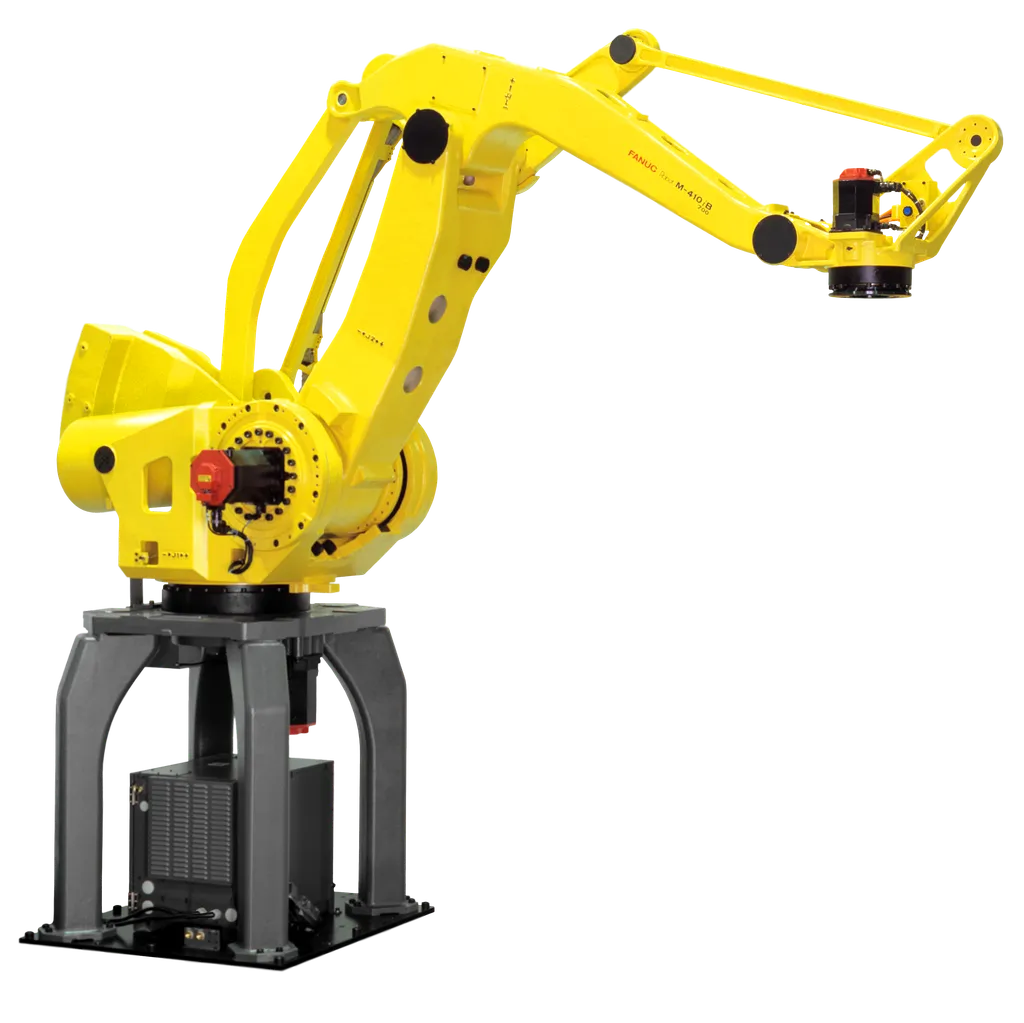
The dedicated palletizer category exists precisely because the end-of-line stacking motion is repetitive and predictable enough to optimize for. The FANUC M-410iB/700 — the ceiling of the dedicated palletizer class in our database at 700 kg and 3143 mm reach — illustrates the trade-off cleanly: a 4-axis wrist locked in the vertical plane, faster cycle times than an equivalent 6-axis articulated arm, and a lower price point. The flexibility you give up is wrist rotation, which matters only when pallet layers are not uniform boxes. Know which you need before you shortlist.
Why total payload is the only number that matters
A dedicated palletizing gripper for a standard case-stacking cell typically weighs between 15 and 50 kg depending on the format — vacuum cup arrays for corrugated cases, clamp plates for bags and irregular loads. Add a slip-sheet gripper fork and the tool weight climbs further. If the product weighs 20 kg and the gripper weighs 30 kg, you need a robot rated for at least 50 kg of payload at the relevant reach, and that is before any safety margin.
Standard practice is to apply at least a 20-25% headroom factor on top of the total system payload. This accounts for dynamic loading during acceleration and deceleration, wrist moment (the load is almost never centered on the flange), and the payload-at-reach derating that all manufacturers publish in their payload-reach curves but that headline spec sheets obscure.
The reach calculation is equally non-negotiable. The arm must reach from the infeed conveyor or transfer point to the top corner of the completed pallet stack. For tall pallet builds — 1800 to 2000 mm finished height is common in food and beverage — the required reach can exceed 2500 mm before you account for conveyor height offset. Every robot in the table below includes its published reach; use it as a starting constraint, not a finishing one.
The full palletizer database: 9 dedicated models ranked by payload
The table below covers all nine dedicated palletizers currently in our database. These are purpose-built 4-axis palletizing robots — not general-purpose articulated arms reconfigured for stacking duty.
| Robot | Payload | Reach | Axes | Link |
|---|---|---|---|---|
| FANUC M-410iB/700 | 700 kg | 3143 mm | 4 | View |
| Kawasaki CP500L | 500 kg | 3255 mm | 4 | View |
| Yaskawa PL320 | 320 kg | 3159 mm | 4 | View |
| Yaskawa PL190 | 190 kg | 3159 mm | 4 | View |
| FANUC M-410iC/185 | 185 kg | 3143 mm | 4 | View |
| Kawasaki CP180L | 180 kg | 3255 mm | 4 | View |
| Estun ER120-2400-PL | 120 kg | 2400 mm | 4 | View |
| Yaskawa PL80 | 80 kg | 2061 mm | 4 | View |
| Doosan P3020 | 30 kg | 2000 mm | — | View |
Source: Industrial Robotics Hub database, all dedicated palletizers tracked as of June 2026.
The Kawasaki CP500L reaches 3255 mm — the longest reach in this class in our data — which matters when the cell geometry puts the infeed conveyor far from the pallet position. The Yaskawa PL series runs from 80 to 320 kg across three models, giving a Yaskawa-standardized factory a single-brand ladder through most of the mid-tier without switching platforms.
Band 1 — Collaborative palletizing (effective payload up to ~30 kg)
The collaborative tier earns its place at the low end of the palletizing market for a specific scenario: low throughput, small cases, limited floor space, and a requirement to operate without full guarding. These arms run under collaborative speed limits the moment a person enters the cell, which cuts throughput significantly.
The useful palletizing payload for cobots is realistically 20 to 30 kg after accounting for the EOAT. The Yaskawa HC30PL is purpose-designed for the tending-plus-palletizing duty cycle and is the standout in this tier — 30 kg rated, IP67 washdown protection, and a kinematic layout that handles stacking moves cleanly. The Doosan P3020 (30 kg, 2000 mm) is the dedicated palletizer entry in this tier, a compact unit suited to small-format case stacking. The FANUC CR-35iB (50 kg rated) and AUBO iS35 (35 kg) can cover slightly heavier loads but must be derated in practice under collaborative operation.
For anything above 30 kg effective system payload, or any throughput requirement above a few dozen picks per minute, the collaborative tier cannot keep up. The robot payload gap between 35 and 50 kg is a known pressure point in this class — if your corrected payload calculation lands above 30 kg, move to the light dedicated palletizer tier below.
Band 2 — Light dedicated palletizers (80-185 kg)
This band covers the most common small-to-mid-volume palletizing cells: single-SKU case stacking, bag palletizing, and secondary packaging lines. The 4-axis wrist keeps the case face consistently oriented, which is exactly what uniform layer palletizing requires.
The Yaskawa PL80 (80 kg, 2061 mm) is the entry point for this band. At 2061 mm reach it is the shortest-reach dedicated palletizer in our database, which suits compact cells but limits pallet stack height. If your finished pallet height runs above 1600 mm, the reach becomes a constraint before the payload does.
The Estun ER120-2400-PL (120 kg, 2400 mm) steps up both payload and reach. Estun occupies a value-tier position in the market — the brand payload ladder analysis shows Estun covering 4 kg to 700 kg across 13 robots in our database, the third-widest spread we track, at pricing that typically undercuts the Japanese majors. For a buyer building a first palletizing cell on a constrained budget, the ER120 is the honest answer if 2400 mm reach covers the cell geometry.
At the top of this band sit the Kawasaki CP180L (180 kg, 3255 mm), FANUC M-410iC/185 (185 kg, 3143 mm), and Yaskawa PL190 (190 kg, 3159 mm) — three arms from three Japanese majors with near-identical payload ratings and very similar reach figures. The 3143-3255 mm reach range here is the practical maximum for dedicated palletizers in this class and covers tall pallet builds comfortably. The differentiation at this tier is integrator relationships, controller platform, and spares availability rather than spec-sheet differences. All three are well-proven platforms for food, beverage, and consumer goods stacking lines.
Band 3 — Mid-tier dedicated palletizers (320-500 kg)
This band covers heavy case stacking, drum palletizing, full-bag lines, and any product where the EOAT and product combined weight puts the corrected payload above 150 kg.
The Yaskawa PL320 (320 kg, 3159 mm) is the mid-tier entry. At 3159 mm reach it handles tall pallet builds. The Kawasaki CP500L (500 kg, 3255 mm) is the longest-reaching dedicated palletizer in our database — 3255 mm — and the second-highest payload in the dedicated palletizer class. For a cell stacking 25 kg cement bags four per layer onto 2000 mm tall pallets, the CP500L is the direct answer: the corrected payload (bags at 25 kg times however many the gripper handles in one pick, plus the gripper itself) clears the 500 kg rating, and the reach covers the stack without repositioning.
This band is also where the 4-axis-versus-6-axis decision becomes meaningful. A 4-axis dedicated palletizer handles any stack pattern where the case face orientation stays consistent across layers. If your cell stacks mixed-case layers, irregular shapes, or runs rainbow palletizing with different SKU orientations per layer, a 4-axis machine cannot physically execute the wrist rotation required. That is when you move to the articulated arm category.
Band 4 — Heavy dedicated palletizers (700 kg)
The FANUC M-410iB/700 is the only dedicated palletizer in our database at this payload: 700 kg, 3143 mm, 4-axis. This is the ceiling of what the dedicated palletizer format currently covers in our tracked data. Applications here include heavy drum handling, large bag stacking, and high-throughput lines where the gripper itself is a substantial mechanism.
At 700 kg payload and dedicated palletizer kinematics, this arm is built for one job done fast. If your payload exceeds 700 kg, or if you need wrist flexibility beyond what a 4-axis machine provides at this weight class, the next step is the super-heavy 6-axis articulated tier.
Band 5 — 6-axis articulated arms for palletizing (500-1700 kg)
When the payload exceeds what the dedicated palletizer class covers, or when mixed-case or irregular-layer palletizing demands wrist freedom the 4-axis format cannot give, heavy articulated arms take over. These are general-purpose 6-axis robots, not purpose-built palletizers, and they cost more per pick at equivalent payload — but they are the only answer when the application demands it.
The relevant heavy articulated arms in our database for palletizing:
| Robot | Payload | Reach | Link |
|---|---|---|---|
| FANUC M-2000iA/1700L | 1700 kg | 3734 mm | View |
| KUKA KR 1000 TITAN | 1000 kg | 3202 mm | View |
| ABB IRB 8700-550/4.2 | 550 kg | 4200 mm | View |
| ABB IRB 7600-500/2.55 | 500 kg | 2550 mm | View |
| KUKA KR 500 R2830 | 500 kg | 2826 mm | View |
| FANUC M-900iB/400L | 400 kg | 3704 mm | View |
| Kawasaki MX350L | 350 kg | — | View |
| Yaskawa GP280 | 280 kg | — | View |
| Estun ER220B-2650 | 220 kg | — | View |
| KUKA KR 210 R2700-2 | 210 kg | — | View |
Source: Industrial Robotics Hub database, heavy articulated arms used in palletizing applications, June 2026.
The ABB IRB 8700-550/4.2 stands out in this table for one spec: 4200 mm reach at 550 kg, the longest reach of any arm in either palletizer table. When cell geometry is the binding constraint rather than payload, the IRB 8700 solves it. The FANUC M-2000iA/1700L at 1700 kg is not a palletizer in the conventional sense — it is a structural crane in articulated-arm form, used for moving entire pallet loads or industrial sub-assemblies, not individual cases.
For a buyer in the 200-500 kg range considering 6-axis over dedicated palletizer: the dedicated palletizer is faster and cheaper if your pattern is uniform. The 6-axis arm costs more to integrate but handles anything. Run the throughput math against your SKU variety before committing.
The 4-axis versus 6-axis palletizing decision
The distinction is worth stating plainly because integrator quotes often gloss it over.
A 4-axis dedicated palletizer — the M-410, CP, and PL series above — keeps the wrist pointing straight down at all times. Every case lands flat. Every layer is uniform. That constraint is a feature, not a limitation, when your palletizing pattern consists of uniform corrugated cases from a single SKU line. The arm is faster, simpler to program, and lower cost than an equivalent 6-axis arm at the same payload.
A 6-axis articulated arm adds the three wrist axes that the dedicated palletizer lacks. You can rotate a case, tilt a bag, angle an irregular item, or change the gripper orientation mid-layer. That capability is required for mixed-case rainbow palletizing, for products that must be oriented on their side, or for any palletizing pattern where case orientation varies across the layer. You pay for it in cycle time and in acquisition cost.
If in doubt, map your palletizing pattern first. Uniform layers from a single infeed: 4-axis dedicated. Mixed orientation, multiple SKUs, or irregular shapes: 6-axis articulated.
How to spec your palletizing cell
Work through these five steps in order:
1. Calculate total system payload. Weigh or estimate the heaviest product plus the full EOAT mass (vacuum head, clamp plate, mounting frame, cabling). Add any slip sheet mass the gripper carries. Apply a 25% safety margin on top. This is your minimum robot payload rating.
2. Establish reach. Measure from the robot base center to the farthest point the tool center must reach: the top-far corner of the completed pallet stack at maximum height. Add 100-150 mm margin. This is your minimum reach rating.
3. Decide 4-axis versus 6-axis. If your pattern is uniform layers of consistent cases from a single SKU, 4-axis is faster and cheaper. If you run mixed cases, irregular shapes, or varied orientations, you need 6-axis. This decision alone reduces the field dramatically.
4. Calculate throughput. Estimate picks per minute required (cases per hour divided by 60). Cross-check against published cycle times for shortlisted arms. For high-throughput lines above 20 picks per minute, the collaborative tier is not viable and even the light dedicated palletizer tier may require a dual-robot layout.
5. Map the payload band to the right models. Use the tables above as your starting shortlist. Run the compare engine to put two or three candidates side by side on the specs that matter for your cell. The payload band determines the category; reach, throughput, and pattern type determine the final model.
The dedicated palletizer class — all nine models in the first table — is the right starting point for the vast majority of end-of-line stacking applications. The collaborative tier is correct for low-throughput, space-constrained cells under 30 kg. The articulated arm tier covers everything the dedicated palletizer class cannot: payloads above 700 kg, mixed-case flexibility, and reach requirements above 3255 mm. The palletizing application page lists every robot in our database tagged for palletizing, with full filterable specs.
All specifications sourced from the Industrial Robotics Hub database, current as of June 2026. Payload figures are headline manufacturer ratings; effective payload at full reach is lower and varies by model. Reach figures reflect manufacturer-published maximum reach. No figures in this article are extrapolated or estimated — robots listed without a reach figure in the second table do not have reach data confirmed in our database.
Compare these robots