Cobot Orders Hit 28.6%. Catalogs Are Already at 42%.
42.5% of our 273-robot database is cobots, but buyers put only 28.6% of Q4 2025 order volume there. Catalog breadth is running ahead of the market.
Forty-two and a half percent. That is the share of our 273-robot database now catalogued as a cobot, near-parity with fenced arms. Twenty-eight point six percent. That is the share of North American robot order volume that actually went to cobots in Q4 2025, the best quarter for collaborative robots on record. The catalog has moved faster than the buyer. If you are shopping for a robot right now and assuming “cobot” is the default order because it feels like the default product listing, the order data says otherwise: fenced arms still take roughly seven of every ten dollars.
How many robot orders actually went to cobots in 2025?
Fewer than the catalog trend would suggest, though the trajectory is real. According to the Association for Advancing Automation’s 2025 North American robot order report, the robotics market ordered 36,766 robots worth $2.25 billion across all types last year, up 6.6% in units and 10.1% in revenue over 2024. Of that total, collaborative robots accounted for 7,212 units, 19.6% of the year’s order volume, and $241 million, 10.7% of revenue. A3 executive vice president Alex Shikany described the rebound as “renewed confidence in automation as a long-term solution to competitive pressures,” and non-automotive industries, food and consumer goods, semiconductors and electronics, and life sciences, led the demand growth.
Momentum concentrated late in the year. Q4 2025 alone saw 10,325 robots ordered for $579 million, and cobots took 2,953 of those units, 28.6% of Q4 volume and $85 million, 14.7% of Q4 revenue. That 28.6% figure is the highest quarterly cobot share since A3 began tracking cobots as a separate category in Q1 2025. Nineteen point six for the full year climbing to 28.6 in the most recent quarter is a real acceleration, not noise. But it is still not close to parity with fenced arms.
| Period | Total units | Cobot units | Cobot unit share | Total revenue | Cobot revenue | Cobot revenue share |
|---|---|---|---|---|---|---|
| Full-year 2025 | 36,766 | 7,212 | 19.6% | $2.25 billion | $241 million | 10.7% |
| Q4 2025 | 10,325 | 2,953 | 28.6% | $579 million | $85 million | 14.7% |
Source: A3, via The Robot Report and Modern Materials Handling, North American robot orders, 2025.
Revenue share always trails unit share for cobots, and the gap is the tell: cobots are cheaper per unit than fenced arms, so even 28.6% of order volume converts to only 14.7% of dollars. A buyer paying attention to unit counts alone will overstate how much of the market’s actual capital is flowing into collaborative robots.
Are robot catalogs ahead of the market?
Yes, by a wide margin, at least in our own database. Our analysis of the 273 robots in the Industrial Robotics Hub database finds 116 of them, 42.5%, catalogued as robotType: "cobot". Compare that to Q4 2025’s 28.6% order share, the best quarter cobots have ever had, and the catalog is still running about 14 points ahead of even the most favorable buying quarter on record. Compare it to the full-year 19.6% order share and the gap widens to nearly 23 points.
robotType.This is not a knock on cobots. The order-share trend is genuinely accelerating, and a manufacturer that lists a cobot next to a fenced arm today is reading the room correctly on where the next five years of orders are headed. But a catalog reflects what manufacturers have decided to build and list. An order reflects what a buyer actually signed a purchase order for. The two numbers do not have to move together, and right now they are not. If you are researching robots today and every second product page you land on is collaborative, that is a catalog artifact, not proof that most buyers around you are choosing collaborative.
Which brands are betting on cobots?
Unevenly, and the split tells you something about each brand’s actual strategy. Six brands in our database sell a 100% cobot-only lineup, no fenced-arm fallback at all: AUBO (12 of 12), Dobot (11 of 11), Han’s Robot (8 of 8), JAKA (12 of 12), Techman (11 of 11), and Universal Robots (9 of 9), 63 robots total. These are pure-play collaborative bets: every dollar of revenue from these brands rides on the collaborative category’s continued growth.
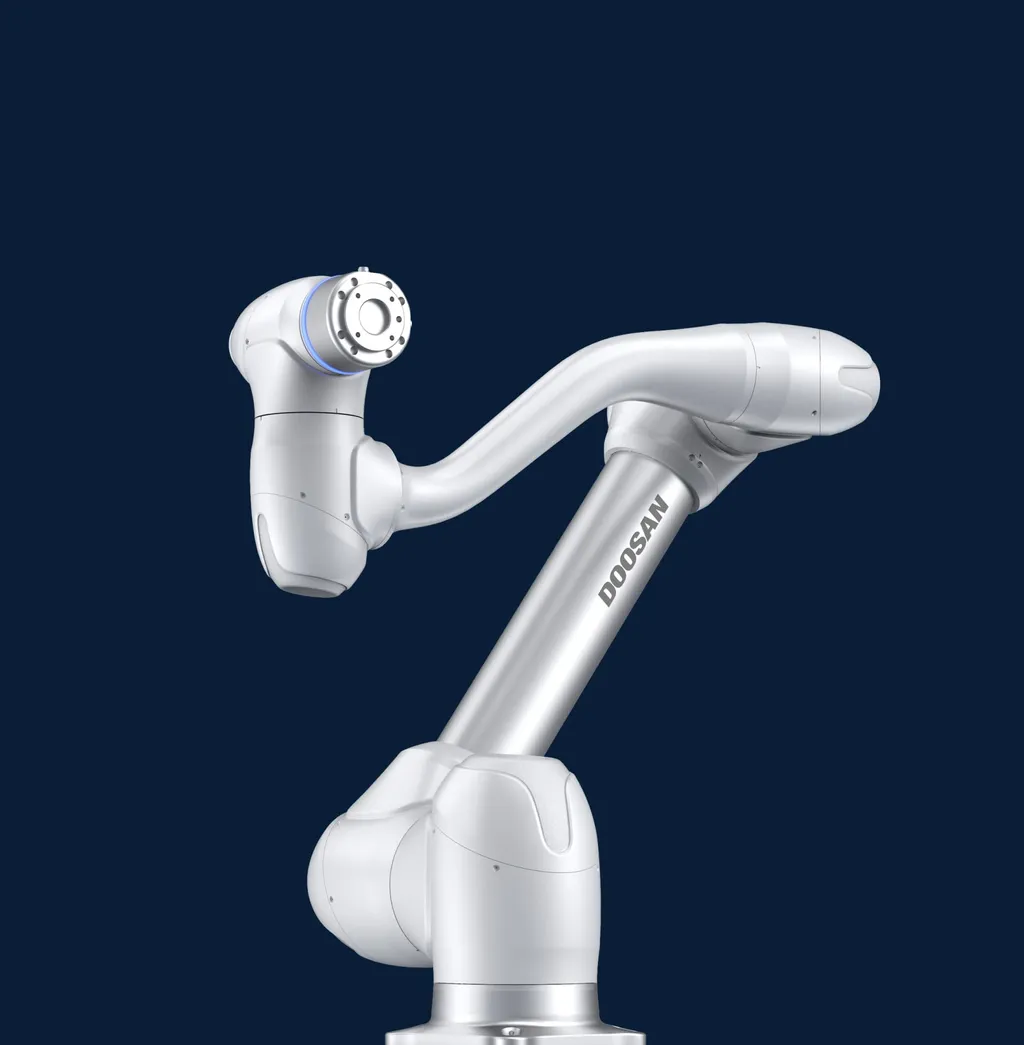
Ten brands sell a mix of cobots and traditional fenced arms, a hedged bet rather than an all-in one. Doosan leads this group at 91.7% cobot (11 of 12), practically a pure-play brand that happens to keep one fenced arm on the books. ROKAE follows at 78.6%. Then the split gets genuinely mixed: SIASUN at 36.4%, FANUC at 29.4%, KUKA at 26.3%, ABB at 25.0%, Kawasaki at 25.0%, Yaskawa at 19.0%, Staubli at 9.1%, and Mitsubishi at 9.1%. For these last six brands, cobots are a minority line item inside a much larger fenced-arm business, the reverse of the pure-play brands above.
Four brands carry zero cobots in our database: Epson, Estun, Inovance, and Omron, a combined 50 robots across fenced articulated arms, SCARA, and mobile platforms. These brands are not hedging quietly, they are simply not chasing the collaborative trend at all, at least not in the product lines we track.
What does this mean for a buyer choosing a brand?
It reframes the decision from “which cobot” to “which kind of vendor relationship.” Buy from a pure-play cobot brand like AUBO, Dobot, Han’s Robot, JAKA, Techman, or Universal Robots and you get a vendor whose entire roadmap, service network, and integration ecosystem is built around collaborative robots. That is a strength if your application genuinely fits within cobot speed and payload limits (ISO/TS 15066 power-and-force-limited operation caps how fast and how heavy these arms can safely run around people). It is a constraint if your production plan might later need a caged, high-speed cell: there is no same-vendor upgrade path, you would be starting a new vendor relationship from zero.
Buy from a hedged brand, especially one like Doosan sitting at 91.7% cobot with one fenced arm still in the lineup, or from the ABB, KUKA, FANUC, Yaskawa, or Kawasaki group where cobots are a smaller line inside a much bigger fenced-arm catalog, and you get the opposite tradeoff. You can start collaborative and graduate into a faster, heavier, caged cell later without switching controllers, programming languages, or service contracts. The four zero-cobot brands, Epson, Estun, Inovance, and Omron, are telling you plainly where they stand: if your application is settled on a fenced articulated arm or SCARA and you have no interest in a collaborative option down the line, that is not a gap in their lineup, it is a deliberate choice.
None of this changes the headline finding. Cobot orders are growing, 19.6% for the year climbing to 28.6% in Q4 is real momentum and worth watching into 2026. But right now, in the best quarter cobots have ever had, fenced arms still took roughly seven of every ten order dollars in North America. Shop the catalog, but buy against the order data, not the shelf space.
Compare these robots