How Much Floor Space Does a Robot Cell Really Need?
A robot cell is not the size of its base plate. It is the swept circle of the arm's reach plus a clearance band, and because floor area grows with reach squared, a 50% longer arm needs more than double the floor. By type, that runs from roughly 1 square metre for a benchtop SCARA to 30-plus for a heavy palletizer, before a single fence goes up.
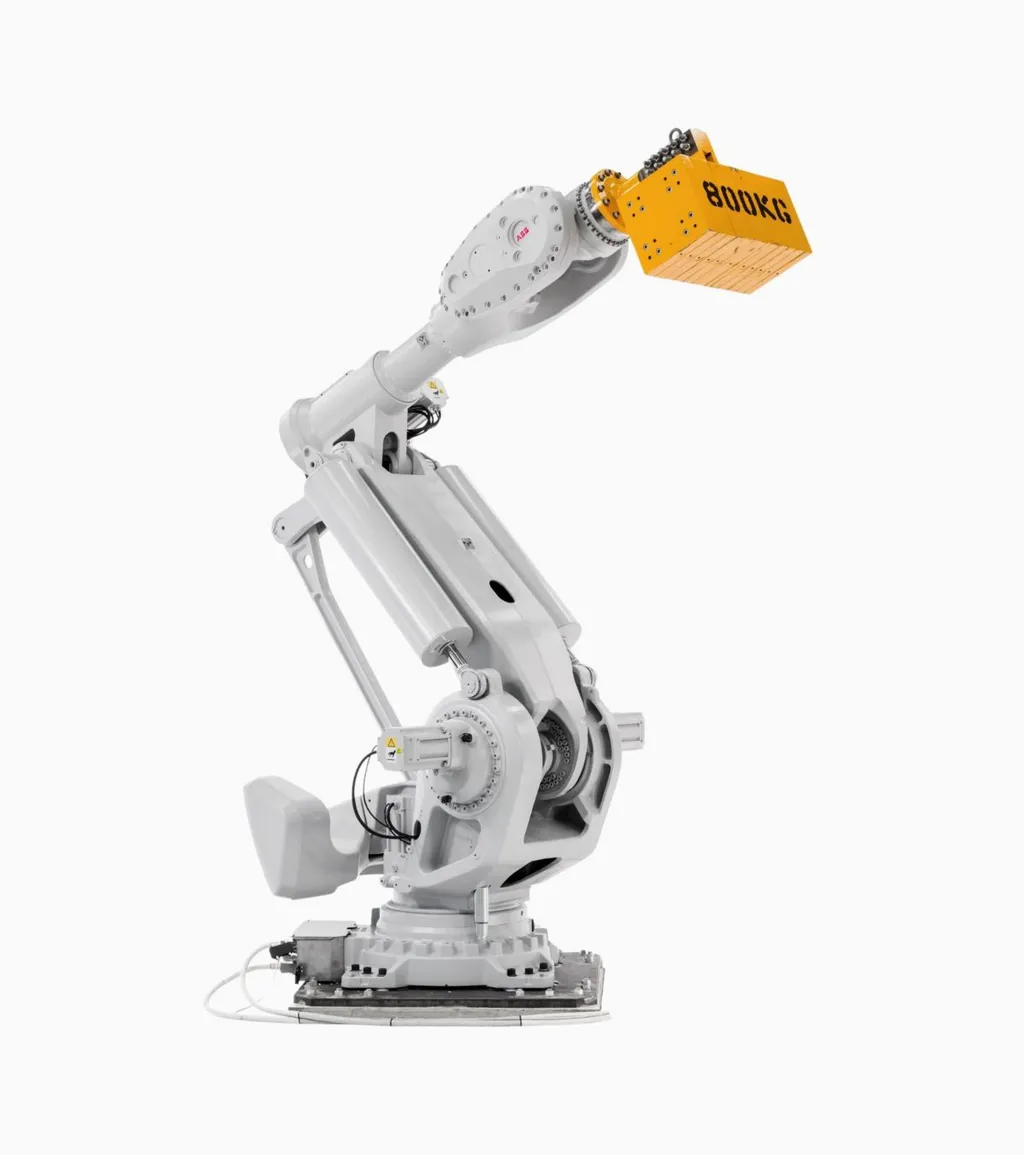
The number that decides how much floor a robot eats is not on the base plate and it is not the arm’s weight. It is the reach. An arm sweeps a circle whose radius equals its reach, so the raw work envelope is pi times reach squared, and everything else in the cell, the fence, the aisle, the staging, gets added around that circle. A Universal Robots UR10e bolts to a mounting circle you could cover with a dinner plate, but its 1300 mm reach sweeps 5.3 square metres of floor before a single guard goes up. Planning a cell around the base dimension is the fastest way to design a layout that does not fit.
Across the 267 robots in the Industrial Robotics Hub database that publish a reach figure, the swept envelope by type runs from about 1 square metre for a benchtop SCARA to over 30 for a heavy palletizer. Here is what that looks like by category, and why the cobot on the end of the table can often shrink its own number by dropping the fence.
The square law: a bit more reach costs a lot more floor
Reach feels like a linear spec. Floor space is not. Because the arm sweeps a circle, the area grows with the square of the reach, so small differences in reach turn into large differences in floor.
The cleanest way to see it is within a single product family. A UR5e has an 850 mm reach and sweeps 2.3 square metres. Its bigger sibling the UR10e reaches 1300 mm and sweeps 5.3. That is a 53% longer arm but 2.3 times the floor. Push to the top of our database and the ABB IRB 8700 at 4200 mm reach sweeps 55 square metres on its own, the area of a small apartment, from one arm.
The rule of thumb worth remembering: double the reach, quadruple the floor. It means the single most expensive layout decision is picking a reach longer than the job needs. Over-reaching by 30% for a bit of margin is not a rounding error on the floor plan, it is a nine-square-metre articulated cell becoming a fifteen-square-metre one.
Swept floor area by robot type
The table below takes the median-reach robot in each category and reports two numbers. The first is the swept circle, pi times reach squared, which is pure geometry off the published reach figure with nothing added. The second is an illustrative guarded cell: a square fence drawn around the swept circle with a 0.8 metre clearance band on every side to stand in for tooling, stopping distance, and an access aisle. The swept circle is data. The guarded-cell column is a planning estimate, labelled illustrative, not a compliance value; the real perimeter comes from your tool length and the manufacturer’s stopping distance, which is what the safety-clearance math and the Factory Layout Planner are for.
| Robot type | Median reach (mm) | Swept circle (m²) | Illustrative guarded cell (m²)* |
|---|---|---|---|
| SCARA | 650 | 1.3 | 8 (usually less; benchtop, partial arc) |
| Cobot | 1,000 | 3.1 | 13 fenced / ~3-4 fenceless |
| Delta | 1,200 | 4.5 | frame-mounted overhead, see note |
| Articulated | 1,510 | 7.2 | 21 |
| Welding | 1,831 | 10.5 | 28 |
| Palletizer | 3,143 | 31.0 | 62 |
Median reach per type across 267 robots in the Industrial Robotics Hub database. Swept circle = pi x reach squared, pure geometry. *Illustrative guarded cell = a square of side (2 x reach + 1.6 m), the 1.6 m standing in for an 0.8 m clearance band per side; this is a planning estimate, not a compliance figure. Add your real tooling extension, manufacturer stopping distance, and access clearance to size an actual cell.
The visual spread is the point. Charted as swept floor area, the categories are nowhere near each other:
Swept floor circle (pi x reach squared) for the median-reach robot in each type. A median palletizer sweeps roughly 24 times the floor of a median SCARA. Source: Industrial Robotics Hub database, median reach per category.
A median palletizer sweeps about 24 times the floor of a median SCARA. This is why “how much space does a robot need” has no single answer: the honest reply is another question, which is what kind of robot and for what reach. A pick-and-place SCARA and a 3143 mm FANUC M-410iB palletizer are both “one robot,” and one of them needs the floor of a parking space while the other needs the floor of a studio flat.
The cobot exception: fenceless can halve the number
Look at the cobot row again. Fenced, a median 1000 mm cobot cell lands near 13 square metres, in the same range as a small articulated arm. Fenceless, it can drop to roughly the swept circle, 3 to 4 square metres. That is the single biggest floor-space lever in the table, and it has nothing to do with the arm being physically small.
A power-and-force-limited collaborative robot is designed to share space with people, so where a risk assessment allows it, the cell can run without a perimeter fence and, crucially, without the access aisle that fence would require. Removing the fence removes the guarded-square penalty, and the footprint collapses back toward the circle the arm actually sweeps. For a line that is floor-constrained, choosing a cobot is often a floor-space decision as much as a safety one.
The honest caveat, the same one in our clearance guide: fenceless is an operating mode you earn through an ISO 10218-2:2025 risk assessment, not a property stamped on the nameplate. Power-and-force limiting caps contact force for the whole end-effector assembly, tool and payload included. Bolt a sharp gripper or a 10 kg part on the flange, or run the arm fast, and the application can exceed the contact limits regardless of the collaborative rating, which pushes you back toward a scanner setback or a light curtain and gives some of the floor back. Plan the fenceless footprint only after the risk assessment agrees the application is actually collaborative.
Delta and SCARA break the full-circle model
Two categories do not fit the swept-circle picture cleanly, and it is worth saying so rather than letting the table mislead.
Delta robots are mounted overhead on a frame, working down into a cell below them. Their “reach” describes a shallow inverted-cone workspace, not a floor circle the arm sweeps at bench height, so the floor footprint that matters is the frame legs and the conveyor beneath, not pi times reach squared. Treat the delta row as the working volume, not the floor plate.
SCARAs are the opposite kind of exception. A SCARA’s first joint is a horizontal boom with a deliberately limited swing, often a plus-or-minus 132 degree arc rather than a full circle, and they usually sit on a bench over the work rather than on the floor. So the real SCARA cell is frequently a fraction of the full 1.3 square metre circle, a partial arc over a fixture. The table’s 1.3 is a conservative ceiling for a SCARA, not a typical footprint.
Sizing the floor before you buy the arm
The layout question comes down to a short sequence, and doing it in this order avoids the classic failure of buying an arm that does not fit the floor you have.
Measure the swept circle first, not the base. Take the reach, square it, multiply by pi. That is the floor the arm touches before anything is added. If that number already exceeds your available bay, stop and choose a shorter arm.
Match reach to the floor before you match payload to the part. Reach and payload are independent specs, and it is easy to select by payload and discover the reach does not fit, or fits only by over-reaching and burning floor. Pull up the reach-by-type ranges and pick the shortest reach that covers the work.
Ask whether fenceless is realistic. If a cobot can do the job and the application passes a collaborative risk assessment, the fence-free footprint may be half the fenced alternative. If a sharp tool or heavy part rules out true power-and-force limiting, budget the fenced footprint instead.
Add the four real addends last. Tool extension past the flange, manufacturer stopping distance, and access clearance turn the swept circle into the guarded cell. The Factory Layout Planner computes that footprint from your reach and tool length, which is the fastest way to sanity-check a bay before you commit to a floor plan or a purchase order.
The base plate is the smallest number in a robot cell. The reach is the one that sets the floor, and because it works through a square law, it is the one worth getting right on day one rather than on commissioning day.
Frequently asked questions
How do you calculate the floor space a robot needs? +
Start from the arm's reach, not its base plate. The arm sweeps a circle of radius equal to its reach, so the raw work envelope is pi times reach squared. A 1000 mm cobot sweeps about 3.1 square metres; a 3143 mm palletizer sweeps about 31. Then add a clearance band for tooling that extends past the flange, the arm's stopping distance after an e-stop, and an access aisle, which turns the circle into a larger guarded square. Our Factory Layout Planner does this from your reach and tool length.
Does the base footprint tell you how much floor space a robot needs? +
No, and this is the most common planning mistake. A Universal Robots UR10e bolts to a mounting circle a couple of hundred millimetres across, but its 1300 mm reach sweeps a 5.3 square metre circle, and its guarded cell is larger still. The base plate is the smallest number in the layout. Plan around the swept envelope.
Do collaborative robots need less floor space than industrial arms? +
Often yes, but not because the arm is smaller. A power-and-force-limited cobot that passes a risk assessment can run without a perimeter fence and the access aisle that fence requires, so its cell footprint can approach the swept circle itself instead of swept circle plus fence plus aisle. That can roughly halve the floor area versus an equivalent fenced arm. Fenceless is an operating mode earned by risk assessment, though, not a nameplate feature: a sharp tool, a heavy part, or higher speed can still force a scanner setback.
Why does a longer reach need so much more floor space? +
Because floor area scales with the square of reach. Going from a 850 mm UR5e to a 1300 mm UR10e is only a 53% longer arm, but the swept circle grows from 2.3 to 5.3 square metres, roughly 2.3 times the floor. Double the reach and you need about four times the floor. That square law is why choosing the right reach for a tight floor plan matters more than any other single spec.
Compare these robots