Reach Isn't a Sphere: What Robot Axis Limits Do to Your Work Cell
The reach number on a data sheet describes a sphere the robot can never fully fill. Across 194 robots that publish per-axis rotation limits, only 68% can spin their base a full turn, and 31 of 74 traditional arms carry a blind wedge behind the base. Here is how axis limits, not reach, decide the shape of the space you can actually automate.
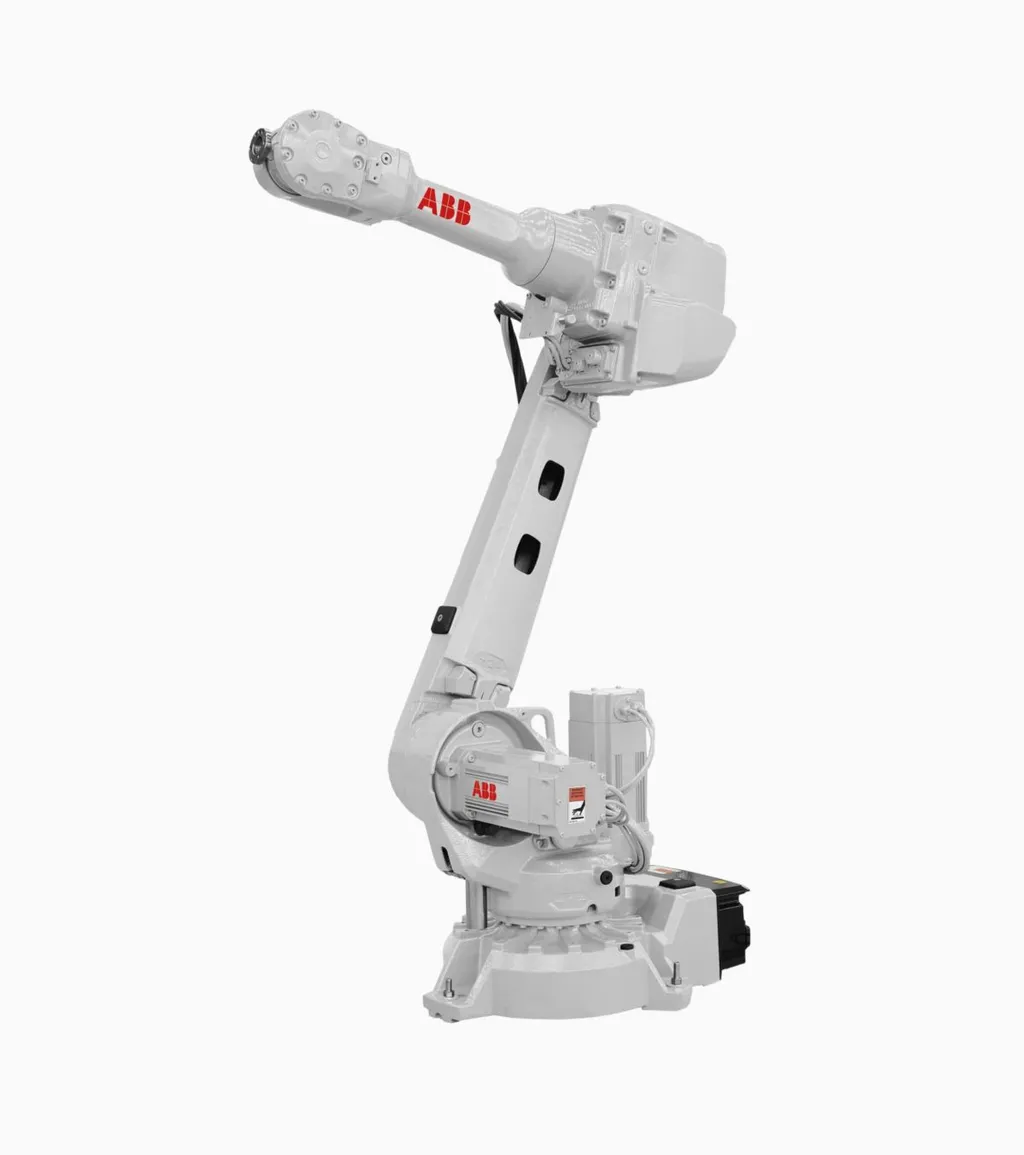
Ask a vendor how far a robot reaches and you get one number, in millimeters, from the base to the tool flange. It is the headline spec on every data sheet, and it quietly sells you a lie: that the robot can reach anywhere inside a sphere of that radius. It cannot. The reachable space is a partial sphere with a hole in the middle and, on a large share of traditional arms, a wedge cut out of the back. What decides that real shape is not reach at all. It is the rotation limit of each joint.
Those limits sit a level below the reach number, in the per-axis ranges (J1 through J6) that most buyers skim past. Across the 194 robots in the Industrial Robotics Hub database that publish a full set of them, the ranges tell a cleaner cell-layout story than reach ever does. The short version: reach tells you how big the envelope is, but axis limits tell you what it is shaped like, and the shape is what a station either fits into or does not.
Only two-thirds of arms can spin all the way around
Start with the base joint, J1, the one that swings the whole arm left and right. You would assume any industrial robot can rotate its base a full circle to service stations arranged around it. Most cannot.
Share of each type whose base joint (J1) can sweep a full 360 degrees or more. Source: analysis of the 194 robots in the Industrial Robotics Hub database that publish a J1 rotation range. Overall, 131 of 194 (68%) can.
The divide is structural. Collaborative robots are built to work in the open with parts and people all around them, so 92% of them can rotate the base a full turn, and many go further: every Universal Robots arm in our data sweeps J1 through plus or minus 360 degrees, two full turns. Traditional articulated arms are the opposite mixed bag, with only 58% clearing a full circle. SCARAs barely feature at 15%, because a SCARA’s first joint is a horizontal boom with a deliberately limited swing (a plus or minus 132 degree arc is typical), which is fine for the tabletop assembly they are built for and useless for reaching behind themselves.
The blind arc behind the base
When J1 stops short of a full turn, the missing degrees do not vanish evenly. They become a wedge of floor directly behind the base that the arm cannot swing into, no matter how much reach it has. Of the 74 traditional arms in our data, 31 carry one. Here is how wide the wedge gets.
| Robot | J1 range | Blind arc behind base | What it means |
|---|---|---|---|
| KUKA KR 1000 titan | +/- 150 deg | 60 deg | A wide dead wedge on this heavy arm |
| Kawasaki BX200L | +/- 160 deg | 40 deg | Body-in-white arm, plan the back |
| ABB IRB 8700 | +/- 170 deg | 20 deg | Narrow wedge, still a no-go zone |
| ABB IRB 1410 | +/- 170 deg | 20 deg | Common welding arm, same 20 deg |
| Epson C4 | +/- 170 deg | 20 deg | Small arm, same geometry |
| Universal Robots UR10e | +/- 360 deg | none | Two full turns, no blind arc |
Blind arc equals 360 degrees minus the total J1 sweep. Ranges as published by each manufacturer and recorded in the Industrial Robotics Hub database.
Twenty degrees sounds small until you draw it on a cell layout. On a 1.8 meter reach arm, a 20-degree wedge behind the base is roughly a 0.6 meter gap at the working radius, wide enough to swallow an infeed conveyor, a fixture, or an operator station you assumed the robot could tend. The fix is not subtle: you either orient the robot so its blind arc faces a wall or an area nothing needs to happen in, or you pick a model that can rotate past the obstruction. Either way it is a decision you want to make on paper, during the shortlist, not after the pedestal is bolted down.
This is exactly the kind of constraint that surfaces late and expensively. As one integrator field note puts it, axis limits constrain individual joint positions and are what safety systems supervise, but they are also what quietly decide whether a station you drew inside the reach circle is actually serviceable.
The hole in the middle of the sphere
The blind arc is the back of the envelope. There is a second missing region in the center. A 6-axis arm cannot fold tight enough to reach the column of space right next to and below its own base, so the work envelope is a partial sphere or torus with an inner dead zone close to the base and an outer limit set by the link lengths. The joint that governs how big that hole is is J3, the elbow: a robot with limited J3 travel has a more restricted inner zone, which matters most for confined installations where you were hoping to work close to the pedestal.
The counterweight to the dead zone is how far the arm can lean back. In our data, 59 of 74 articulated arms can pivot the shoulder (J2) past vertical, folding backward over their own base to reach up and behind. That is what lets a well-placed arm tend a machine mounted higher than its own shoulder. It is also why mounting orientation and axis limits have to be read together: a ceiling or wall mount trades one part of the envelope for another, and the axis ranges tell you which trade you are making.
None of this changes the reach radius on the data sheet. Two arms with an identical reach figure can enclose very different reachable volumes depending on their J1, J2, and J3 limits. Reach sizes the envelope; the axis ranges shape it.
The wrist that spins forever, until the cable says stop
At the far end of the arm the story flips from constraint to capability. The wrist twist joint, J6, is the most generous axis in the database. Of the 166 robots that publish a J6 range, 126 (76%) can rotate the tool through two full turns or more (720 degrees of total travel), and the widest go further: several FANUC arms reach 900 degrees and a run of ABB IRB arms hit 800.
That multi-turn wrist is not a spec-sheet flex. It is what makes whole applications practical. Driving a long screw, laying a spiral bead of adhesive, running a circular weave in welding, or winding a wire all want the tool to keep turning in one direction rather than stop and reverse every half turn. A wrist that only swings plus or minus 180 degrees forces an unwind move mid-cycle; one that turns two or three full turns just keeps going.
The catch is physical, and it is the reason true endless rotation is almost always a separate software option rather than a default. The dress-out (the cables, air lines, and signal wires routed through the wrist to feed the tool) can only twist so far before it binds. As practitioners on the FANUC forum describe it, continuous J6 rotation is possible only if there are no cabling restrictions and it needs the manufacturer’s software option to enable it. FANUC markets exactly this on its collaborative arms, noting the CRX-30iA offers a J6 continuous rotation capability aimed at dispensing and screw-driving work. So the published J6 number tells you the hardware ceiling; whether you can actually spin endlessly depends on the dress-out you design and the option you buy.
Read the axis ranges before you draw the cell
Reach gets you a first-pass yes or no on whether a robot is big enough. The axis ranges get you the answer that actually holds up when the cell is built. Three checks are worth doing off the data sheet, in order:
- Can the base reach every station? Check the J1 range. If it is less than a full 360 degrees, there is a blind wedge behind the base. Decide now which direction it faces, or pick a model that clears the arc. Cobots almost always clear it; roughly four in ten traditional arms do not.
- Is anything sitting in the inner dead zone? Nothing should need servicing in the column right next to and below the base. If your layout puts a fixture there, the reach circle lied to you, and a tighter-folding arm (more J3 travel) or a different mount is the fix.
- Does the tool need to keep turning? If the application dispenses, drives screws, or welds circular paths, read the J6 range and confirm the continuous-rotation option and a dress-out that can take the twist. A 720-degree wrist with a cable that binds at 200 is still a 200-degree wrist.
Reach is the number everyone quotes because it fits on a spec line. The axis ranges are the numbers that decide the shape of the space you can automate, and they are sitting right there under the reach figure on the same data sheet. Read them before you commit to a layout, and use a reach and envelope calculator or a cell layout planner to check a station against the real envelope, not the sphere the reach number implies.
Analysis based on the 194 of 273 robots in the Industrial Robotics Hub database that publish a full set of per-axis rotation ranges (J1 through J6), and the 166 that publish a J6 range. Blind arc is computed as 360 degrees minus the total J1 sweep; multi-turn is a J6 total travel of 720 degrees or more. Axis ranges are recorded as published by each manufacturer. Continuous wrist rotation depends on a software option and cable routing, so treat the J6 figure as a hardware ceiling and confirm the dress-out for your tool.
Frequently asked questions
Can every industrial robot rotate its base a full 360 degrees? +
No. Across the 194 robots in the Industrial Robotics Hub database that publish a per-axis rotation range, only 131 (68%) can sweep their base (J1) through a full 360 degrees or more. It splits hard by type: 92% of collaborative robots can, but only 58% of traditional articulated arms and just 15% of SCARAs. The rest carry a blind arc behind the base, a wedge of floor the arm cannot swing into, which is a cell-layout constraint, not a rounding error.
What is a robot's blind arc or dead zone? +
Two different things. The blind arc is the angular wedge behind the base that the arm cannot rotate into when J1 (base rotation) stops short of a full turn. For example, an ABB IRB arm with a J1 range of plus or minus 170 degrees leaves a 20-degree wedge it can never point at. The inner dead zone is separate: a 6-axis arm cannot fold tight enough to reach the column of space right next to and below its own base, so the working envelope is a partial sphere with a hole in the middle, not a solid ball.
Does robot reach tell you the whole working envelope? +
No, and this is the common trap. The reach figure is a single radius, the maximum distance from the base to the tool flange. The actual working envelope is bounded by the rotation limit of every joint, so it is a partial sphere with an inner dead zone near the base and, on many arms, a blind wedge behind it. Two robots with identical reach can have very different reachable volumes depending on their J1, J2, and J3 limits, which is why a reach radius alone is not enough to confirm a station is serviceable.
Which robots can rotate their wrist continuously? +
Multi-turn wrists are common. Of the 166 robots in our database that publish a J6 (wrist twist) range, 126 (76%) can rotate the tool through two full turns or more (720 degrees), and some FANUC and ABB arms reach 900 to 800 degrees of total travel. True endless continuous rotation is usually a separate software option and depends entirely on cable management, because the dress-out (cables, air, and signal lines) routed through the wrist can only unwind so far before it binds.
Compare these robots