Robot Axis Speed: The Wrist Beats the Base by 25%
180 robots publish per-axis rotation speed. Wrist joints hit a median 225°/s vs 180°/s at the base, a 25% gap that almost never reverses.
A robot’s spec sheet gives you one headline speed number, usually in mm/s at the tool point. Underneath that number are up to six or seven independent joints, each with its own rotational speed rating in degrees per second, and they are not built to spin at the same rate. Across 180 of the 273 robots in our database that publish per-axis speed, the outer wrist joints (J4, J5, J6) run at a median 225°/s while the base, shoulder, and elbow joints (J1, J2, J3) run at a median 180°/s, a 25% gap. This is not a marketing choice. A wrist motor spins a light tool flange. A base motor swings the entire arm plus whatever is bolted to the end of it. The heavier the load a joint has to move, the slower it turns.
How much faster is a robot’s wrist than its base?
Twenty-five percent faster, measured across the whole database. Pooling every robot that publishes axis speed, the base axes (J1 through J3 combined, n=461 readings) come in at a median 180°/s. The wrist axes (J4 through J6 combined, n=445 readings) come in at a median 225°/s. That is the headline number: (225 - 180) / 180 = 25.0%.
The per-axis breakdown is where the pattern gets sharper. This covers 180 serial-kinematics robots (articulated, cobot, SCARA, palletizer, welding) that publish performance.axisSpeeds; one delta robot with axis-speed data is excluded here and handled separately below, because delta kinematics are not comparable joint-for-joint to a serial arm.
| Axis | Role | Median speed | Min | Max | Robots publishing |
|---|---|---|---|---|---|
| J1 | Base rotation | 175°/s | 58°/s | 555°/s | 156 |
| J2 | Shoulder | 175°/s | 50°/s | 720°/s | 156 |
| J3 | Elbow | 180°/s | 50°/s | 585°/s | 149 |
| J4 | Wrist roll 1 | 225°/s | 60°/s | 1,575°/s (serial-arm max; excludes the FANUC M-3iA delta robot’s 4,000°/s J4, covered below) | 160 |
| J5 | Wrist pitch | 225°/s | 60°/s | 1,135°/s | 144 |
| J6 | Wrist roll 2 | 225°/s | 72°/s | 1,575°/s | 142 |
Source: our analysis of 180 robots in the Industrial Robotics Hub database publishing performance.axisSpeeds.
Same-robot comparisons tell the same story with almost no exceptions. Of 142 robots that publish speeds for both J1 (base rotation) and J6 (outer wrist roll), J6 is strictly faster in 127 (89.4%). In the remaining 15 (10.6%), J6 exactly equals J1. Zero robots in the database have a wrist J6 speed slower than their own base J1 speed. This is the six degrees of freedom distinction in practice: J1-J3 position the arm in space against real inertia, J4-J6 only orient the tool once the arm is already there.
Why do some robots have identical wrist and base speeds?
Fifteen robots publish an identical J1 and J6 rating, meaning the manufacturer specced uniform axis speed across the whole arm rather than tapering it from base to wrist: aubo-i16 (178°/s both), dobot-nova2 (135°/s), dobot-nova5 (100°/s), kuka-kr-10-r900-sixx (450°/s), kuka-kr-3-agilus (450°/s), kuka-kr-6-r700-sixx (450°/s), kuka-lbr-iisy-11-r1300 (150°/s), kuka-lbr-iisy-15-r930 (150°/s), kuka-lbr-iisy-3-r760 (150°/s), rokae-xmate-sr3 (180°/s), rokae-xmate-sr5 (180°/s), siasun-gcr3 (225°/s), universal-robots-ur3e (180°/s), universal-robots-ur5e (180°/s), universal-robots-ur7e (180°/s).
Look at what these have in common. Six are Universal Robots-style small cobots, three are KUKA LBR iisy cobots, three are compact KUKA Agilus articulated arms, two are Rokae cobots, one is an AUBO cobot, one is a Siasun cobot. Almost all of them are compact cobots or small arms, the class where every joint uses a similarly sized harmonic-drive actuator. On a machine like that, the base motor is not dramatically bigger than the wrist motor the way it is on a heavy industrial arm, so there is no engineering reason to taper the speed rating from one end to the other. The gap only opens up once the base has to swing real mass.
Does the gap hold across every robot type?
It holds everywhere, but the size of the gap depends heavily on robot class. Here the measure changes slightly: for each robot, take the ratio of its average wrist speed (J4, J5, J6) to its average base speed (J1, J2, J3), then find the median of those ratios within each type.
SCARA robots show the widest gap by far, a median 3.94x. That tracks with how a SCARA arm is built: J1 and J2 sweep a horizontal arm through a big, heavy stroke, while the wrist axis (typically just a vertical Z-travel and a roll) is comparatively unconstrained and cheap to spin fast. Palletizers sit at 2.67x, still stacking heavy base motion against a light wrist. Articulated arms land at 1.77x, a real but more moderate gap. Cobots come in narrowest at 1.29x, which lines up exactly with the tie-list above: cobots are where uniform-actuator design is most common, so the base-to-wrist gap compresses the most.
What’s the fastest, and slowest, single axis in the database?
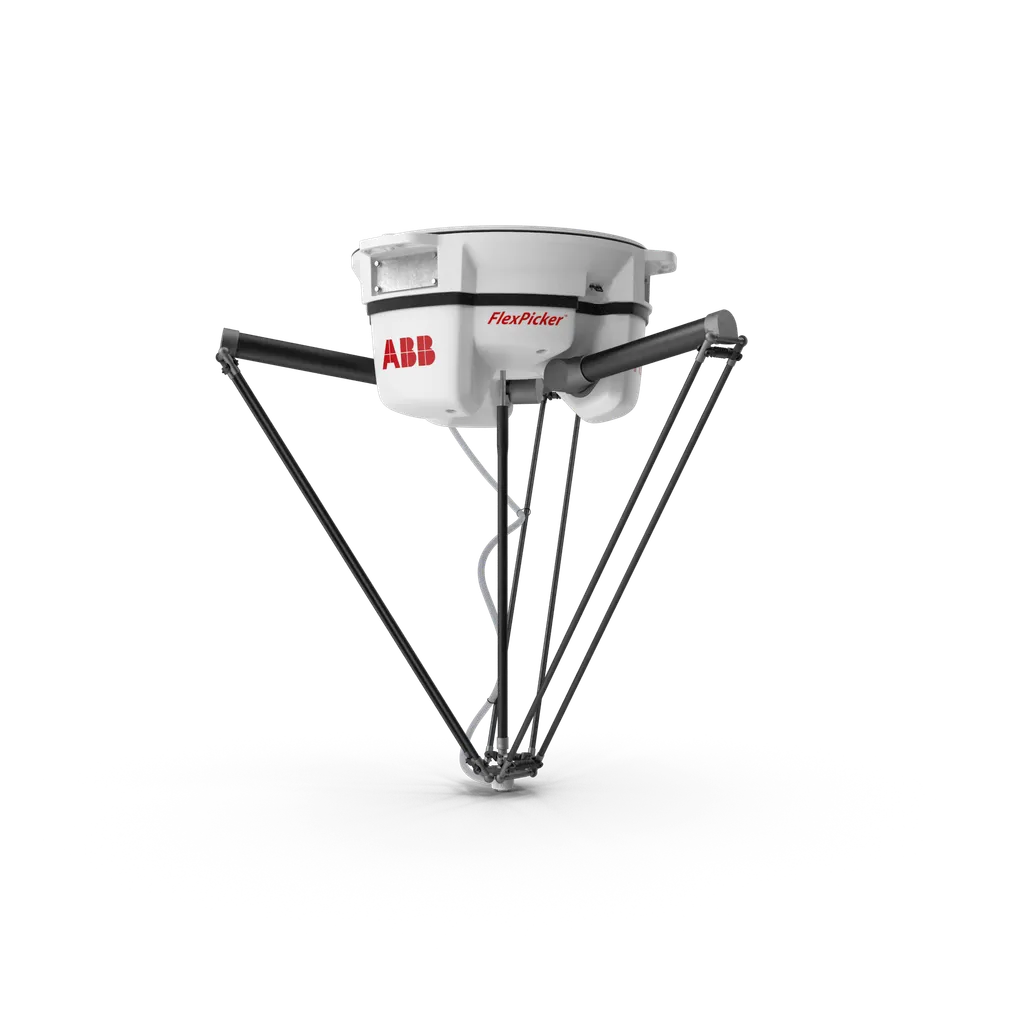
The fastest single axis in the entire database belongs to the FANUC M-3iA, a delta robot whose J4 axis is rated at 4,000°/s. That number needs a footnote before you compare it to anything above: delta robots use parallel-linkage kinematics, not the serial joint chain every other type in this analysis relies on, so their “axis speed” figures are not directly comparable to a six-axis arm’s joint speeds. That is exactly why the M-3iA was excluded from the base-versus-wrist analysis above and gets called out here as a standalone fact rather than folded into the J1-J6 medians.
The slowest single axis in the database belongs to the KUKA KR 1000 titan, whose J2 (shoulder) axis is rated at just 50°/s. This is a 1,000 kg-payload arm. Moving that much mass, plus whatever is gripped on the end of it, means the shoulder joint has no choice but to turn slowly. Treat this as expected physics, not a flaw: heavy-payload arms trade joint speed for load capacity, the same tradeoff that drives the whole base-versus-wrist pattern above, just expressed at the brand-and-model level instead of the joint level.
What does this mean for buyers?
Axis speed is a joint-level ceiling, not the number that determines your cycle time. That number is the coordinated multi-axis TCP speed vendors quote in mm/s, which we broke down by robot type separately. A robot can have a blazing-fast J6 and still be limited by how quickly J1 and J2 can reposition the whole arm between pick and place points.
Where per-axis speed actually matters is when your task stresses one joint disproportionately. A small-parts orientation task, where the tool is mostly rotating in place at a fixed position, leans hard on wrist speed and barely touches the base. A big pick-and-place sweep across a wide work envelope leans on the base axes instead, and that is where the 25% gap between wrist and base becomes a real constraint on throughput, not just a spec-sheet curiosity. We touched on this distinction once before, and the axes themselves are the starting point: how many axes a robot actually has determines which of these joints exist at all before you ever get to how fast they spin.
Know which joints your application actually taxes before you buy on the single flashy TCP number. A robot that looks identical on paper can hide a base that is 25% slower than its wrist, and if your cycle spends most of its time repositioning rather than orienting, that is the number that decides your throughput, not the one on the spec sheet’s front page.
Compare these robots