UR AI Trainer: Closing Robotics' Lab-to-Factory Data Gap
Universal Robots and Scale AI's leader-follower cobot system captures real factory data to train robot AI models. The promised dataset has not shipped yet.
Universal Robots and Scale AI unveiled a system in March called UR AI Trainer that captures real factory data, not simulator output, to train the next generation of industrial robot AI. Four months later, the two companies’ promised follow-through, a public industrial dataset built from that captured data, still has not shipped. That gap between the launch pitch and the delivery is the actual story now.
What was announced
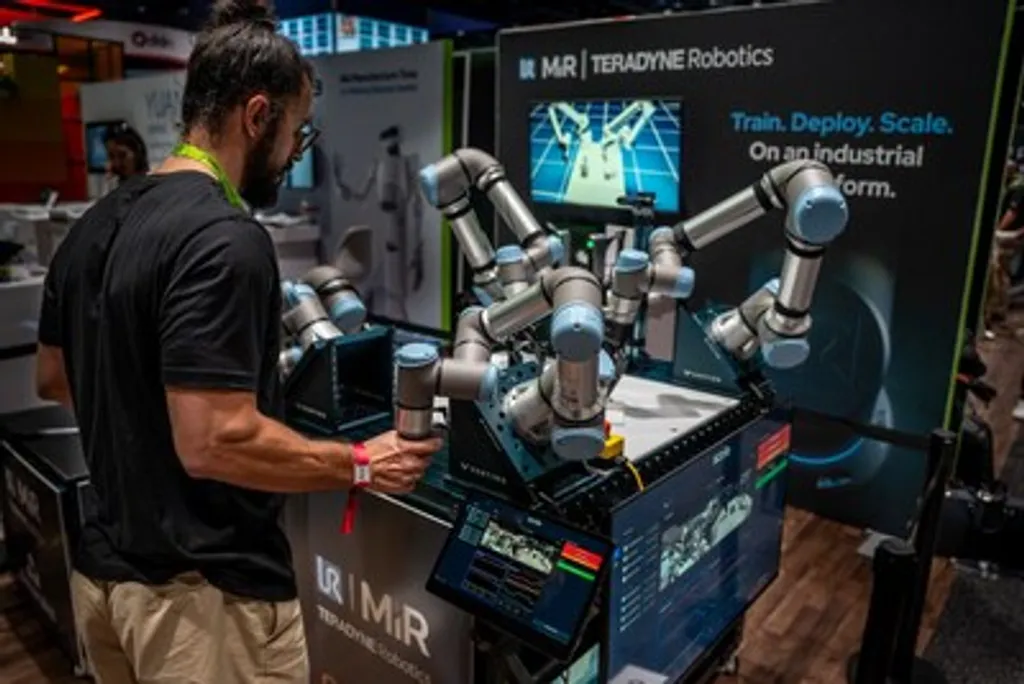
At NVIDIA’s GTC 2026 conference in San Jose in mid-March, Universal Robots (UR), the Danish cobot maker owned by Teradyne, and Scale AI, the AI data-infrastructure company, jointly unveiled UR AI Trainer. It is a leader-follower imitation-learning rig: a human operator physically grabs and guides a “leader” UR3e cobot through a task, while a synchronized “follower” UR7e cobot mirrors the same motion in real time. As the demonstration runs, the system simultaneously records three data streams: force-torque feedback at the joints, motion trajectories (joint position and velocity), and visual data from RGB cameras mounted on the gripper and overhead. Scale AI’s software, layered on top of UR’s existing AI Accelerator platform, ingests and curates that multimodal capture into structured training sets for fine-tuning Vision-Language-Action (VLA) models, the class of AI models that map camera input and spoken or written instructions directly to robot motion commands.
At GTC, visitors could try it themselves: guide a UR3e leader robot through packing a smartphone into a box, then watch a UR7e follower execute the learned sequence autonomously, with the captured data replaying live on Scale AI’s platform on a screen next to the booth.
The problem this targets
AI models trained purely in simulators or curated lab setups have a well-documented failure mode once they hit a real production line: lighting shifts through the day, materials vary batch to batch, tooling wears down, and fixtures are never quite where the simulator assumed. UR calls this the “lab-to-factory gap,” and it’s a real bottleneck the whole industry is chasing, not a UR-specific marketing term. Anders Beck, UR’s VP of AI Robotics Products, put the underlying logic plainly in the launch materials: robot builders need high-fidelity, synchronized robot and vision data captured on the same hardware a customer intends to deploy, not proxy data from a different rig or a synthetic environment. Ben Levin, Scale AI’s General Manager for Physical AI, described the joint effort as an “integrated robotics data flywheel,” pairing UR’s installed base (UR cites more than 100,000 industrial deployments as context for why real production-floor data at scale is even possible) with Scale AI’s data-curation pipeline.
The pitch is straightforward: instead of a robot-AI developer building a synthetic twin of a factory and hoping it generalizes, they capture a human doing the task on the actual robot hardware, on an actual production floor, and train on that instead.
What’s confirmed, and what hasn’t shipped
The launch itself is not in question, it was covered independently by UR’s own newsroom, the trade press outlet Control Design, PR Newswire, and Robotics & Automation News, all within days of each other in mid-March 2026. The mechanics of the leader-follower rig, the UR3e/UR7e pairing, and the multimodal data capture are consistent across all four accounts.
What is not yet confirmed is the follow-through. At launch, UR said a large-scale industrial dataset built using this system would be released “later in 2026.” As of today, July 10, 2026, roughly four months after the GTC unveiling, neither UR’s newsroom nor Scale AI’s public channels show that dataset as published. That doesn’t mean the project has stalled, mid-year is still comfortably within a “later in 2026” window, but it does mean the most substantive, checkable claim from the launch remains an open promise rather than a delivered product. Buyers and researchers evaluating this platform today are still working from the demo and the press materials, not from released data they can inspect themselves.
Why it matters for buyers and integrators
For plant engineers and system integrators, the near-term takeaway is narrower than the headline. UR AI Trainer today is a data-capture and model-training pipeline aimed at robotics AI developers and UR itself, not a shipping product an integrator buys off the shelf to add “AI” to an existing cell. The more relevant near-term question is what downstream products get built on top of the resulting VLA models, whether that’s improved autonomous task-generalization on existing UR cobots, faster deployment for new SKUs without full re-programming, or something UR productizes later. None of that has been announced yet as a discrete, purchasable offering.
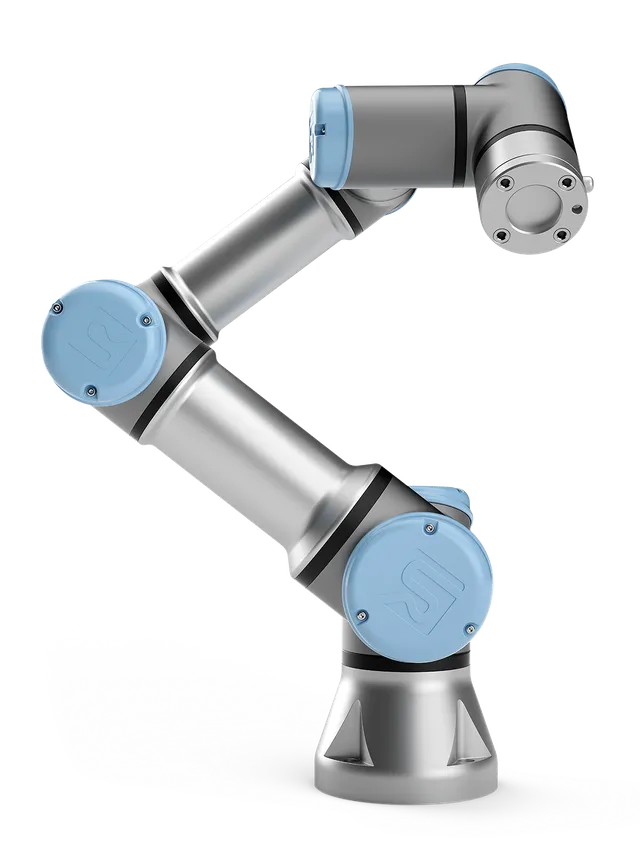
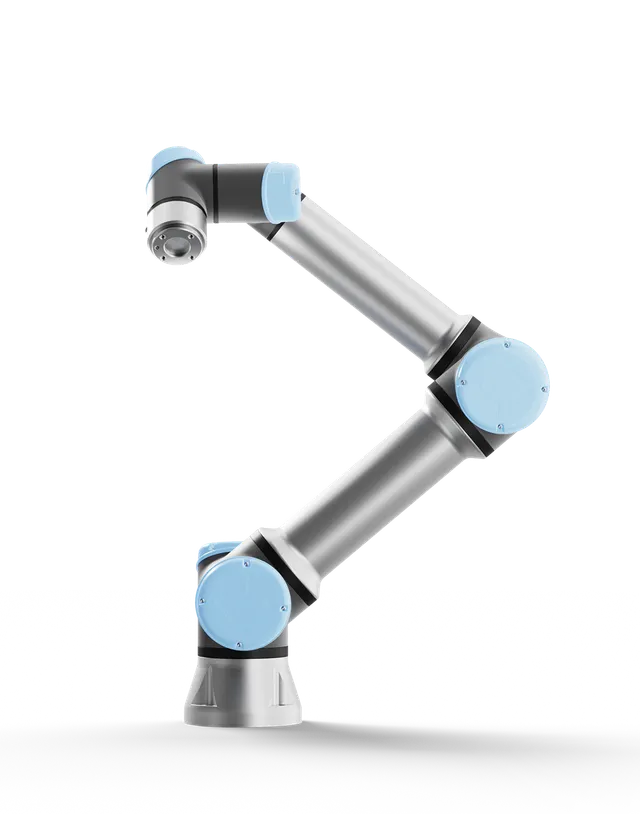
The UR3e (3 kg payload, 500 mm reach) and UR7e (7.5 kg payload, 850 mm reach) used in the leader-follower rig are both standard, currently shipping e-Series cobots, not special hardware built for this demo, which is itself notable: the same class of robot an integrator can buy today is the one generating the training data.
For more on the cobot class this platform is built around, see the full specs for the UR3e and UR7e in our database.
Sources
- Universal Robots, Scale AI Launch Imitation Learning System to Accelerate AI Training, Bridging the Lab-to-Factory Gap — Universal Robots, Mar 19, 2026
- Universal Robots and Scale AI's UR AI Trainer Captures Data for Robotics AI Development — Control Design, Mar 17, 2026
- Universal Robots and Scale AI Launch Imitation Learning System to Accelerate AI Model Training, Bridging the Lab-to-Factory Gap — PR Newswire, Mar 19, 2026
- Universal Robots and Scale AI Launch Imitation Learning System for Training Industrial Robots — Robotics & Automation News, Mar 17, 2026
Robots mentioned
Tap a card to open the full spec sheet.
Frequently asked questions
How is UR AI Trainer different from training robots in a simulator? +
Simulators generate synthetic training data in curated, idealized conditions. UR AI Trainer instead captures motion, force-torque, and visual data from a real UR cobot performing a task on the actual production floor, including the lighting, material variance, and wear that simulators typically smooth over. Universal Robots and Scale AI frame this as closing the 'lab-to-factory gap' that causes simulator-trained models to underperform on the shop floor.
What's the commercial availability of this platform? +
Universal Robots and Scale AI unveiled UR AI Trainer at NVIDIA's GTC 2026 conference in March 2026 as an integrated hardware-software offering built on UR's AI Accelerator platform, using a UR3e as the leader robot and a UR7e as the follower. As of this writing, the companies have not published a public price sheet or a general-availability date distinct from the initial launch.
When is the promised industrial dataset supposed to be released, and has it shipped yet? +
At launch, Universal Robots said it would release a large-scale industrial dataset collected on UR robots later in 2026. As of July 10, 2026, neither company's official channels show that dataset as published. The gap between announcement and delivery is the open question this story tracks.
How does this fit into the broader race to train general-purpose robot AI models? +
UR AI Trainer targets Vision-Language-Action (VLA) models, the class of AI systems that map camera input and language instructions directly to robot motion. Every major robotics and AI player, from NVIDIA's own Isaac platform to competing cobot and humanoid makers, is racing to solve the same real-world data bottleneck. UR and Scale AI's bet is that data captured directly on deployed production hardware, rather than in a lab, produces models that transfer better to new factories.
More news