Techman Robots: 9 AI-Vision Cobots From 4 to 25 kg
Techman builds the world's first cobots with a built-in AI vision system, and all 9 models in our database span just 4 to 25 kg payload, 700-1900 mm reach.
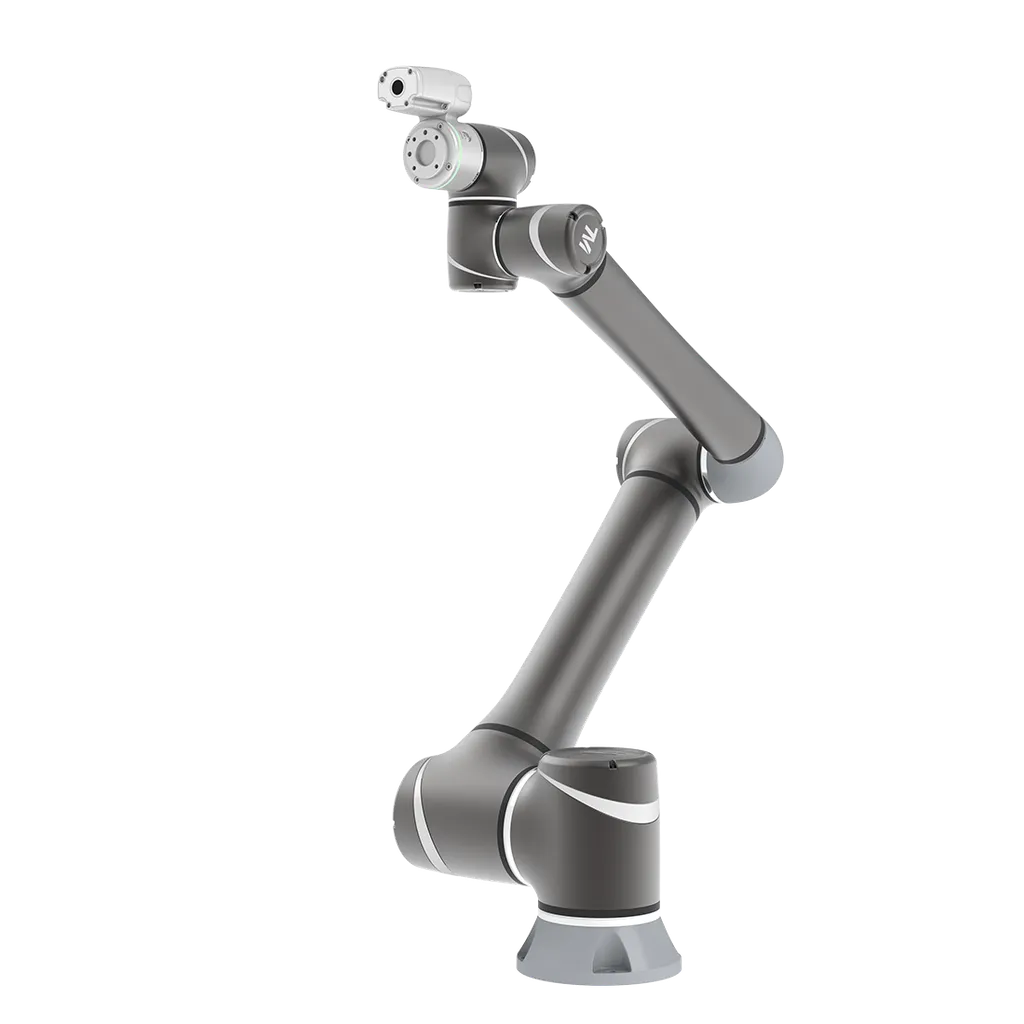
Every one of Techman’s 9 robots is a collaborative arm, and unlike its rivals each ships with an AI-powered vision camera baked right into the wrist, not bolted on as an afterthought. That is not a marketing claim - it is a hardware design decision that changes how you integrate these machines, because the eye-in-hand camera eliminates a separate vision system, a separate mounting bracket, a separate calibration routine, and a separate software stack. The tradeoff is a narrower payload range than you get from a multi-architecture vendor: Techman’s lineup runs from 4 kg to 25 kg, which covers most electronics assembly, machine tending, and pick-and-place applications but leaves heavy press tending and palletizing off the table entirely. Understand that boundary going in, and the nine-model catalog becomes a very focused decision.
This guide covers all nine Techman cobots in the Industrial Robotics Hub database - payload landscape, performance specs, application fit, and a buying reframe at the close. No filler.
Who makes Techman Robot?
Techman Robot did not start as an independent robotics company. Its roots are inside Quanta Storage, a subsidiary of Quanta Computer - the Taiwanese contract manufacturer that builds the majority of the world’s laptops for Apple, Dell, HP, and others. Around 2011-2012, a robotics lab and business division took shape within Quanta Storage under Shi-chi Ho, focused on applying the precision manufacturing know-how Quanta had developed for consumer electronics to industrial arm design. That heritage is material: Quanta’s engineering depth in optics, controls, and electronics fabrication gave the robotics team access to capabilities that a pure-play robot startup would have had to source externally.
Techman Robot Inc. was established as an independent entity under the Quanta umbrella around 2015-2016, and the first commercial product - the TM5 - shipped at the end of 2016. The TM5 carried the defining feature that the brand has led with ever since: an integrated eye-in-hand camera that is part of the arm itself, not a third-party add-on clamped to the flange. According to Wikipedia’s Techman entry, that positioning made Techman the world’s first cobot brand to ship an AI vision system as standard hardware. The claim has held up commercially - by 2018 Techman had become the world’s number two cobot brand by market share, a remarkable ramp for a company less than three years old at the time.
The geographic footprint reflects how seriously Techman is pursuing scale. Headquarters are in the Hwa Ya Technology Park in Taoyuan, Taiwan, with overseas branches in Shanghai, Shenzhen, Chongqing, Busan (South Korea), and Alblasserdam in the Netherlands. Primary markets are electronics and EV assembly, machine tending, pick-and-place, packaging, palletizing, inspection, and welding - the same applications where the built-in vision system delivers the clearest advantage over a conventional cobot. In 2025, Techman moved toward a public listing, billed as Taiwan’s first cobot brand to list on a major exchange, which is a meaningful signal for buyers evaluating long-term support continuity.
What types of robots does Techman Robot make?
All nine Techman robots in our database are cobots. There is no articulated industrial arm variant, no SCARA, no delta picker. Techman is a pure cobot vendor, and every machine in the lineup is designed for human-collaborative operation under ISO 10218-1 and ISO 13849-1 (PL d Cat.3) safety standards.
A 100% cobot lineup is unusual at this scale - most brands that reach nine or more models mix in at least one traditional caged arm or a SCARA for high-speed small-parts work. Techman’s decision to stay pure-cobot reflects a deliberate market focus: every model ships with the same TMflow no-code programming environment, the same built-in camera, and the same collaborative safety architecture. That consistency reduces integration overhead significantly if you are deploying across multiple cells or multiple sites. The downside is obvious - if you need a 50 kg arm or a delta picker, Techman cannot help you, and mixing vendors introduces the programming fragmentation Techman’s ecosystem is designed to avoid.
Payload range: 4 kg to 25 kg
The nine models cluster into three informal bands: the 4 kg TM5 pair for precision light assembly, the 7-16 kg mid-range for machine tending and general pick-and-place, and the 20-25 kg heavy end for palletizing and heavier part handling. The bar chart below shows where each model sits.
Source: Industrial Robotics Hub database, 9 Techman Robot robots.
The median payload across all nine models is 12 kg, which sits squarely in the machine-tending and assembly sweet spot. The two TM5 variants at 4 kg are the outliers on the light end - both carry the same payload but differ in reach (700 mm vs 900 mm), which is the only differentiator between them. At the heavy end, the TM25S at 25 kg is the current ceiling for the catalog in our database. Techman has announced models beyond this range - notably the TM30S at 35 kg - but those are not yet in our database.
One observation worth noting before you build a shortlist: the reach-to-payload ratio is not uniform across the lineup. The TM20 is remarkable on this metric, combining 20 kg payload with 1900 mm reach - the longest arm in the catalog by a significant margin. If your application involves a robot reaching across a wide conveyor or into a deep machine enclosure, the TM20 is the first model to evaluate, regardless of whether you actually need all 20 kg of payload.
Techman Robot performance specs at a glance
| Type | Robots | Payload median | Repeat median | Speed range | IP67+ |
|---|---|---|---|---|---|
| Cobot | 9 | 12 kg | 0.05 mm | 1000-1400 mm/s | 0% |
A few things jump out of this table. First, the speed band of 1000-1400 mm/s is respectable for cobots operating under collaborative safety limits - the slower end (1000 mm/s) applies to the two heaviest models, TM20 and TM25S, while the lighter 4 kg and 7 kg arms run at the 1400 mm/s ceiling. Second, the median repeatability of 0.05 mm is solid for general-purpose cobot work, though the two TM5 models and the three TM7-series arms achieve 0.02 mm, which is competitive with precision SCARA specs. Third, the IP67+ figure of 0% is notable - none of the nine models in our database carry an IP67 or higher ingress protection rating, which means Techman is not targeting washdown food processing or heavy coolant environments with this lineup.
Complete Techman Robot lineup
| Model | Type | Payload (kg) | Reach (mm) | Repeat (mm) | Max Speed (mm/s) | IP |
|---|---|---|---|---|---|---|
| TM5-700 | Cobot | 4 | 700 | 0.02 | 1400 | - |
| TM5-900 | Cobot | 4 | 900 | 0.02 | 1400 | - |
| TM7 | Cobot | 7 | 900 | 0.02 | 1400 | - |
| TM7S | Cobot | 7 | 900 | 0.02 | 1400 | - |
| TM12 | Cobot | 12 | 1300 | 0.10 | - | - |
| TM14 | Cobot | 14 | 1100 | 0.05 | 1100 | - |
| TM16 | Cobot | 16 | 900 | 0.05 | 1100 | - |
| TM20 | Cobot | 20 | 1900 | 0.05 | 1000 | - |
| TM25S | Cobot | 25 | 1300 | 0.05 | 1000 | - |
The TM12’s missing speed figure is a data gap in our database, not a Techman specification problem. The TM7 and TM7S share identical payload, reach, repeatability, and speed figures in our database - the S-suffix in Techman’s naming convention typically signals a revised safety certification or updated sensor package rather than a change in basic kinematics. Confirm with a Techman distributor if the distinction matters for your compliance paperwork.
Which Techman Robot robot fits your application?
Electronics PCB assembly or small-component placement. The TM5-700 is the right choice if your work envelope fits inside 700 mm radius. Its 0.02 mm repeatability ties for the best figure in the lineup, and the built-in camera means you can pick directly from a presented tray without a separate vision system calibration step. If your reach requirement is closer to 900 mm - common for two-tray setups or wider conveyor spans - use the TM5-900 instead; the kinematic specs are identical, only the reach changes.
CNC machine tending, single-machine cell. The TM7 covers most milling and turning machine tending tasks in this weight class. Seven kilograms handles a typical workpiece plus gripper weight without leaving much margin, so measure carefully before committing. If your parts routinely run 5-6 kg with gripper, step up to the TM12 for headroom. The TM12’s 1300 mm reach is also more comfortable for reaching into a deep machine enclosure than the 900 mm TM7.
Packaging and palletizing, moderate throughput. The TM20 is the obvious choice here. Its 1900 mm reach is the longest in the lineup and gives you the workspace geometry to handle pallet layer building without repositioning the base. At 20 kg payload it can manage a fully loaded case or a tool-change with end effector weight included. The 1000 mm/s speed is the slowest in the lineup, but for layer-palletizing cycle times the limiting factor is usually pallet height accumulation, not joint speed.
Heavy sub-assembly or tote handling in an automotive or EV plant. The TM25S is the ceiling in the current database at 25 kg. With 1300 mm reach and 0.05 mm repeatability it is capable of positioning heavy sub-assemblies accurately, but its 1300 mm reach is shorter than the TM20 - a tradeoff Techman made to keep the arm stiff at higher payloads. If you need both 20+ kg payload and extended reach, this is a genuine constraint. In that scenario, either the TM20 (longer reach, lower payload) or a different vendor entirely becomes the answer.
Inspection and vision-guided bin picking. Any model in the lineup can run vision-guided picking via the built-in camera and Techman’s TM AI+ Training Server - that is the core differentiator against every other cobot brand. The choice between models here is driven entirely by part weight and reach envelope, not by vision capability. The camera is the same across all nine models.
The bottom line
Techman makes a focused, coherent product: nine collaborative robots with the same software platform, the same integrated vision system, and a payload range that covers the 4-25 kg band without exception. If your application sits in that band and involves vision-guided operation - inspection, bin picking, flexible assembly - Techman’s integrated camera stack eliminates a real integration cost that you would otherwise pay in hardware, calibration, and software licensing with any other cobot brand. That advantage is genuine and not trivially replicated by bolting a camera onto a competing arm.
The buying reframe from the spec table above is straightforward. The 0.02 mm repeatability models (TM5 series, TM7 series) are precision light-assembly machines. The 0.05 mm repeatability models (TM14 through TM25S) are general-purpose tending and handling machines. The TM20 is the reach outlier at 1900 mm and the right answer any time workspace geometry is the constraint. The TM25S is the payload ceiling and the answer when part weight is the constraint. If you need both maximum reach and maximum payload simultaneously, the TM20 and TM25S are mutually exclusive options and you will have to compromise on one dimension - or look at a vendor with a heavier lineup.
Who should not buy Techman: any plant that needs washdown capability (no IP67 in the lineup), heavy press tending above 25 kg, or a machine architecture other than a 6-axis collaborative arm. Techman does not build SCARA machines for high-speed small-parts cycling, delta pickers for confectionery or pharma lines, or caged industrial arms for high-force operations. Those gaps are not weaknesses - they are the cost of building a focused portfolio well instead of a sprawling one adequately. Know what you need before you evaluate the catalog, and Techman’s nine-model range becomes a very efficient shortlist exercise.
Compare these robots