The True Cost of an Industrial Robot: the 2-5x Rule
The arm is 25-50 percent of the project. Integration, fencing, EOAT and commissioning are the rest, and most buyers budget only the robot.
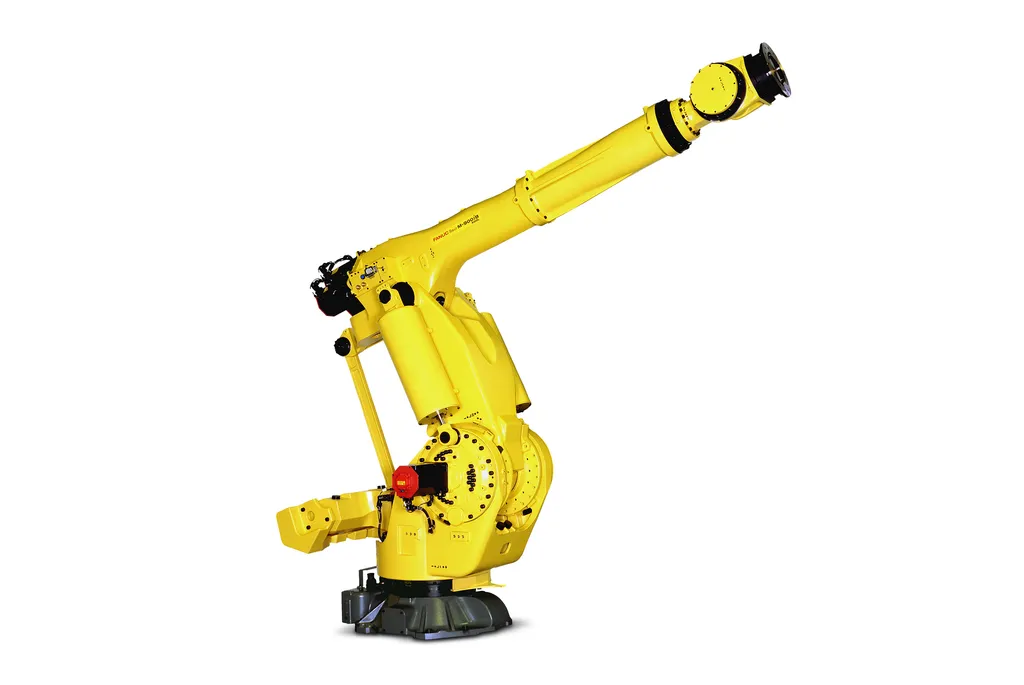
The robot sticker price is the wrong number. A $60,000 articulated arm sitting in a catalog is not a $60,000 project. It is a $120,000 to $300,000 project once you account for integration, end-of-arm tooling, safety fencing, commissioning, and the first year of maintenance. That ratio - total installed cost running 2x to 5x the hardware price - is consistent enough across cell types and industries that it functions as a planning rule, not a rough estimate.
Most procurement teams budget the robot. Most overruns come from everything else.
What does the hardware actually cost?
A mid-range 6-axis articulated arm - payload 10 to 20 kg, reach around 1,400 mm - runs $40,000 to $80,000 from a tier-one vendor. Cobots from Universal Robots, Fanuc, or ABB sit in the $35,000 to $55,000 range for comparable specs. High-payload arms (60 kg and above) push $100,000 to $200,000. SCARA robots for pick-and-place start lower, around $15,000 to $30,000, but their total cell cost follows the same multiplier.
Browse the full robot catalog at /robots/ to cross-reference list prices and specs before you call an integrator.
The hardware is not the expensive part. It is the tractable part - you can look up the number. The rest of the project is where budgets dissolve.
What is integration, and why does it cost more than the arm?
Integration covers everything required to make the robot do your specific job: cell design, fixture engineering, robot programming, system integration with your PLC or conveyor, safety validation, and commissioning. That work is billed at integrator day rates of $100 to $200 per hour, and a typical cell takes 150 to 400 hours to complete - a figure documented by integration specialists at Inbolt.
Run the math: 250 hours at $150/hr is $37,500 in labor alone, before any hardware. A complex cell with multiple stations, vision, or force sensing can exceed 400 hours. Integration labor as a share of total project cost commonly lands between 30% and 50%.
Programming is its own line item. A standard palletizing cycle might take 20 to 40 hours to program and test. A welding cell with complex path tolerances and seam tracking can take 100 hours or more. Every time you change the product you run, you pay to reprogram - unless you budgeted for offline programming software, which adds another $5,000 to $20,000.
How much does safety fencing cost?
A fully compliant safety cell - perimeter guarding, interlocked access gates, light curtains on the entry point, area scanners if you need human access during operation - runs $15,000 to $40,000 for a standard installation. Collaborative robot deployments without full guarding sit at the lower end, though a cobot operating at rated speed with a real gripper and payload almost always triggers a risk assessment that requires additional guarding anyway.
The fencing cost is largely independent of the robot cost. A $40,000 cobot and a $120,000 articulated arm need roughly the same perimeter if the cell footprint is similar. That makes fencing a flat cost that hits smaller projects proportionally harder.
What does end-of-arm tooling add?
End-of-arm tooling (EOAT) is the gripper, welding torch, dispenser nozzle, or vacuum cup array that makes the robot useful. Generic pneumatic grippers start around $500. A custom vacuum cup array for irregular parts might cost $3,000 to $8,000. Force-torque sensors for assembly applications add $5,000 to $15,000. A servo-driven adaptive gripper can exceed $20,000.
EOAT for a mid-range cell typically runs $3,000 to $25,000 depending on application complexity. It also wears out. Budget for at least one replacement set in year two.
What does the full cell actually cost? An itemized breakdown
This table covers a realistic mid-size articulated arm cell: 6-axis robot, 15 kg payload, welding or machine-tending application, standard safety perimeter, moderate programming complexity.
| Line item | Low estimate | High estimate | Notes |
|---|---|---|---|
| Robot hardware | $40,000 | $80,000 | 6-axis, 10-20 kg payload, tier-one vendor |
| End-of-arm tooling | $5,000 | $20,000 | Custom gripper or torch; wear parts extra |
| Safety fencing + guarding | $15,000 | $40,000 | Perimeter, gates, light curtains |
| Integration labor (150-400 hrs) | $22,500 | $80,000 | At $100-$200/hr blended rate |
| Electrical + controls | $8,000 | $20,000 | Control cabinet, cabling, I/O |
| Civil / mechanical (base, utilities) | $3,000 | $12,000 | Concrete anchor, compressed air, power drop |
| Training | $2,000 | $8,000 | Operator + maintenance tech |
| Commissioning and validation | $5,000 | $15,000 | FAT, SAT, safety sign-off |
| Total installed | $100,500 | $275,000 | 2.5x to 3.4x the robot price |
| Annual maintenance (yr 1+) | $3,000 | $12,000 | 3-15% of installed system cost |
Sources: AMD Machines TCO analysis, Standard Bots robot cost guide.
The 2-5x rule holds across the table. At the low end, a simple cobot task with off-the-shelf tooling and minimal fencing might come in at 2x. At the high end, a complex multi-station cell with vision, force sensing, and extended commissioning can hit 5x without any single line item being unreasonable.
What does ongoing maintenance cost?
Annual maintenance typically runs 3% to 15% of total system cost depending on operating hours and application severity. For the mid-range cell above, that is $3,000 to $41,000 per year. The wide range reflects real differences: a robot running one shift doing light palletizing has very different wear patterns from one running three shifts doing high-cycle welding.
Maintenance costs include preventive service contracts (joint grease, battery replacement, software updates), unplanned downtime repairs, and periodic EOAT replacement. Most manufacturers offer service contracts in the $3,000 to $8,000 per year range for a single arm; third-party service can be 20-30% lower. Standard Bots documents a similar range in their cost breakdown.
The maintenance line is also where many first-time buyers get surprised. The robot works for three years, then needs a major service. If you have not budgeted for it, you are looking at an unplanned capital outlay at the worst possible time.
How does this affect the ROI calculation?
Payback period math that uses only robot hardware cost will always look better than reality. A $60,000 robot saving $80,000 per year in labor looks like a 9-month payback. A $180,000 installed project saving $80,000 per year is a 27-month payback. Both numbers might be accurate for the same robot - the difference is what you include.
Payback periods vary widely by application and cannot be reduced to a single trustworthy range from a secondary source. Run your own numbers with full project cost, not hardware-only — see our ROI payback guide and the ROI calculator below. If your internal model is showing 12-month payback, check whether integration and maintenance are in the denominator.
Use IRH’s ROI calculator at /tools/roi-calculator/ to run your own numbers with full TCO inputs. The calculator lets you enter installation cost separately from hardware and factors in maintenance as a recurring annual expense.
Cost breakdown by share of total project
The proportions matter as much as the absolute numbers.
Which robot type shifts the multiplier?
The multiplier is not fixed. It moves with application complexity and robot type.
Cobots (collaborative robots) have a reputation for lower integration cost because they can often operate without full perimeter guarding and are programmed by demonstration rather than teach pendant. That reputation is partly earned. A simple cobot task - pick-and-place, machine tending with a human nearby - can come in at 1.8x to 2.2x the hardware cost. But a cobot doing precision assembly with force feedback, multiple product variants, and formal risk assessment climbs back to 3x or higher. Compare cobot models at /compare/ to understand spec differences that affect integration complexity.
High-payload articulated arms doing arc welding or heavy palletizing tend toward the upper end of the multiplier range - 3x to 5x - because they require robust fixturing, more complex programming, and full perimeter guarding regardless of collaborative designation.
SCARA robots for fast, flat pick-and-place are often the most predictable: lower absolute cost, lower multiplier, less complex cells. They are also the least flexible if your application changes.
What should buyers do differently?
Get three things before you approve a capital request.
First, a line-item budget that includes integration, EOAT, and fencing as separate entries. If your integrator gives you a single number, ask them to break it out. If they will not, find a different integrator.
Second, a maintenance cost estimate for years 1 through 5, not just year 1. Robots have service intervals. Gearboxes wear. EOAT wears faster.
Third, a payback model that uses total installed cost as the investment, not hardware cost. A model that inflates IRR by excluding 60% of the project cost is not a model - it is a justification.
The robot catalog is where the project starts. It is not where the project is costed. Browse the full robot database at /robots/ to understand the hardware side, then build the rest of the budget from there.
The arm is the tractable part. Budget the rest as carefully as you specify the payload.