Robot Axes: Why 79% Have 6 and Only 5 Have a 7th
We checked the axis count of 257 robots in our database: 79% have exactly six, 19% have four, and only five cobots carry a redundant seventh axis.
Of the 257 robots in our database that publish an axis count, 203 of them, 79%, have exactly six. Four-axis robots cover 19%, one palletizer claims five, and a mere five robots carry a seventh axis. Six is not the default because robot engineers lack imagination. Six is the minimum number of joints required to put a tool at any position and any angle in 3D space, and once you can reach everywhere at any orientation, adding a joint buys you something different: elbow flexibility around obstacles. Almost nobody needs it.
| Axes | Robots | Share | Where you find them | What the joints buy you |
|---|---|---|---|---|
| 4 | 48 | 19% | SCARA, delta, palletizer | XY plane + vertical Z + one wrist rotation. Fast top-down work, no tool tilt. |
| 5 | 1 | 0.4% | one palletizer | A stacking-only compromise (Yaskawa PL80). |
| 6 | 203 | 79% | articulated arms, most cobots, welding, painting | Full 6-DOF: any position, any tool orientation. |
| 7 | 5 | 2% | cobots only | A redundant joint: move the elbow around an obstacle while the tool stays put. |
Why do 79% of robots have exactly six axes?
Three axes to move the tool through space, three axes to orient the tool in space. That is the whole story. Position in XYZ requires three translational degrees of freedom. Orientation, meaning roll, pitch, and yaw, requires three rotational degrees. Six joints, arranged correctly, cover all six. This is what physicists call six degrees of freedom, and it is the minimum for a robot that can weld at an angle, turn a fastener on an awkward face, or load a machine from any approach direction.
Articulated arms are uniformly six-axis. Every one of the 96 articulated arms in our database has six joints. Most cobots are also six-axis: 101 of the 107 cobots that publish a count are six-axis. Welding and painting arms, where tool orientation determines weld quality and paint coverage, are all six-axis. Once the task requires full orientation control, the design answer is always the same.
Median payload across six-axis robots is 12 kg, median reach 1,300 mm. They cover the widest application range in the database because six axes is a general-purpose answer to a general-purpose question.
What can a four-axis robot do that a six-axis cannot?
Nothing more. It does less, faster and cheaper. A four-axis arm moves in a horizontal plane, lifts vertically, and rotates the wrist on one axis. That last rotation lets it flip parts or orient labels, but it cannot tilt the tool. The technical label for this architecture is SCARA, and every one of the 35 SCARA robots in our database is exactly four-axis. Delta robots, the tripod designs hanging over packaging lines for rapid pick-and-place, are also four-axis, all five of them. Our delta robot type page has the full specs.
SCARA robots and delta designs are not compromised six-axis robots with two joints removed. They are purpose-built for a specific motion profile: down to pick, up, translate, down to place. No re-orienting the tool. No approaching from an angle. That constraint eliminates the cost of two wrist joints, tightens the kinematic chain, and produces repeatability and speed numbers that six-axis arms at the same price point cannot match. Median payload for four-axis robots in our database is 8 kg, median reach 800 mm. Smaller, lighter, faster, cheaper.
Palletizers mostly run four axes too: 7 of the 9 palletizers in the database are four-axis. The geometry makes sense when you think about it: a pallet stacker picks a box from a fixed conveyor and places it at a fixed pallet position. The box always arrives top-up, the pallet stays flat, and a 90-degree wrist rotation covers every orientation you need. The Yaskawa PL80 is the single five-axis outlier in the database, a stacking-only compromise between four and six.
Which robots have a seventh axis, and why are there only five?
A seventh joint is redundant kinematics. The arm already has full 6-DOF with six joints. What the seventh joint buys is elbow repositionability: the tool stays put at its target position and orientation while the elbow swings around a fixture, a machine guard, or another robot. Think of how your own elbow can move without your hand moving. That is exactly what a seven-axis cobot does in a cluttered shared workspace.
In our database, exactly five robots carry a seventh axis, and all five are cobots:
| Robot | Payload | Reach | Why the 7th axis |
|---|---|---|---|
| ABB YuMi IRB 14000 (dual-arm) | 0.5 kg | 559 mm | Human-like dexterity for small-parts assembly |
| ABB YuMi IRB 14050 (single-arm) | 0.5 kg | 559 mm | Same wrist, single arm |
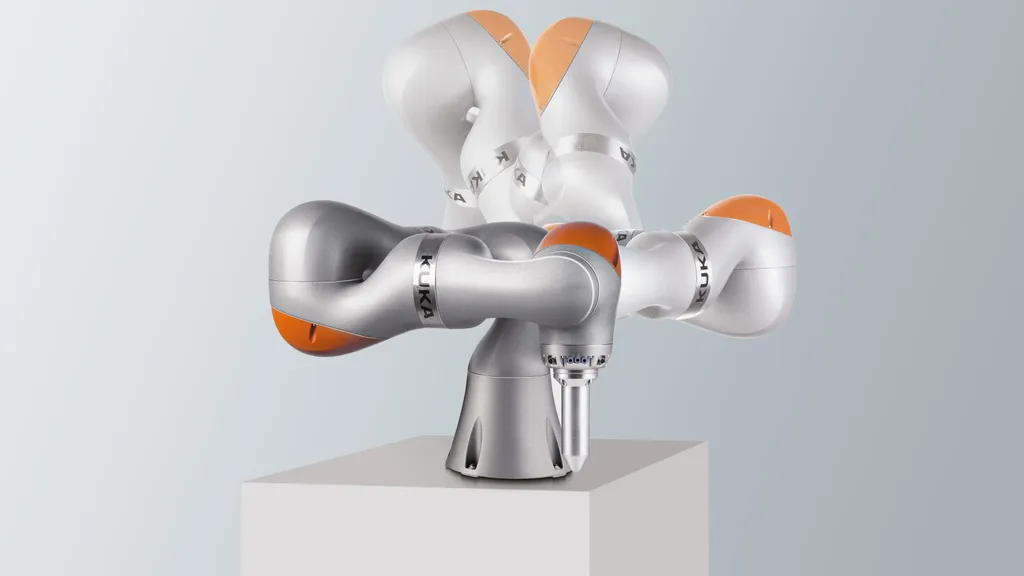
| KUKA LBR iiwa 14 R820 | 14 kg | 820 mm | Sensitive assembly, reach around fixtures |
| KUKA LBR iiwa 7 R800 | 7 kg | 800 mm | Lighter LBR iiwa |
| ROKAE xMate ER7 Pro | 7 kg | 850 mm | Torque-sensing redundant cobot |
The pattern is clear. Every seven-axis robot in the database is a cobot, because the redundant elbow is only useful in shared workspaces where you cannot redesign the fixture layout to give the arm a clear approach path. Median payload for seven-axis robots is 7 kg, median reach 800 mm. The KUKA LBR iiwa 14 is the outlier at 14 kg. The ABB YuMi variants cap at 0.5 kg, the price of mounting two full arms on a single base with torque sensors on every joint.
Redundancy costs money in two places: the extra joint itself and the controller complexity required to solve the inverse kinematics when there are infinitely many elbow positions for a given tool pose. That control overhead is one reason you do not see seven-axis arms in high-throughput lines where cycle time is the primary metric. The elbow flexibility that makes them elegant in a laboratory assembly cell becomes a scheduling headache at 1,500 picks per hour.
What does axis count mean for your buying decision?
Match the axes to the task, not to an abstract notion of capability.
If the work is top-down into a tray, a bin, or onto a pallet, a four-axis SCARA or delta arm is faster, cheaper, and will hold tighter repeatability than a six-axis arm at the same budget. You are not giving anything up on the application; you are eliminating joints you would never use. SCARA median repeatability in our database is 0.01 mm. Most six-axis cobots run 0.05 mm. For electronic component placement, that gap matters.
If the task requires reaching a surface at an arbitrary angle, welding a curved seam, loading a machine from multiple faces, or placing parts that arrive in varying orientations, six axes is the right answer. That covers the overwhelming majority of automation tasks, which is why 79% of the database is six-axis. Six-axis articulated arms span the widest payload and reach range in the database: median 12 kg and 1,300 mm reach, versus the four-axis median of 8 kg and 800 mm.
If you are integrating cobots into a cluttered shared workspace where the arm has to reach around a fixture without redesigning the cell, the five seven-axis options exist for you. All are cobots by definition, all carry torque sensing, and none will lift more than 14 kg. The KUKA LBR iiwa series and the ROKAE xMate ER7 Pro are the practical choices above the ABB YuMi’s 0.5 kg limit. Budget for the controller licensing that comes with redundant-kinematics planning, and verify that your integrator has experience solving the null-space motion problem on the specific arm you choose.
More axes is not more robot. It is a different robot, built for a different constraint. The question is not how many axes you can afford, but how many axes the task actually requires.
Compare these robots