Inspection Robots in 2026: Why Cobots Dominate and How to Choose by Vision Integration
71 inspection-tagged robots -- 63% are cobots, the highest share of any application in our database. How to choose by vision architecture and repeatability.
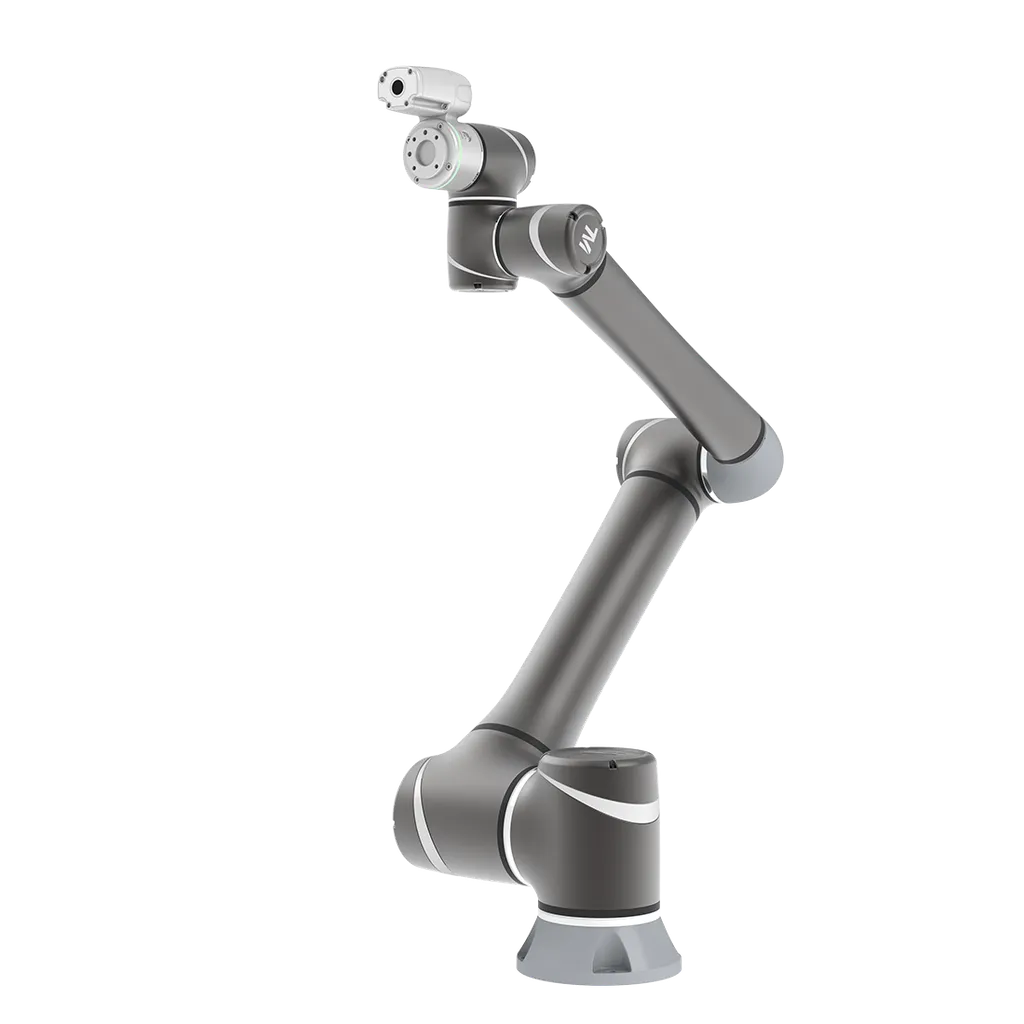
Inspection is the one robot application in our database where cobots are the clear majority. Of the 71 robots tagged for inspection in the Industrial Robotics Hub database, 45 are collaborative — 63%. No other application comes close to that cobot concentration.
The reason is structural: inspection inherently involves a human at some point. A person must review flagged defects, approve borderline parts, or clear false-positive stops. When a human is in the loop, the case for guarding diminishes. A cobot carrying a camera or a structured-light scanner can run inspection passes between human review steps without requiring the human to leave the workspace, open a guard door, and re-enter. The guarding cost — in floor space, changeover time, and operator friction — is eliminated.
That structural reason also explains what cobots trade away for it: speed. An inspection cobot running at ISO/TS 15066 power-and-force-limiting speed near a human is slow compared to a fenced SCARA or articulated arm doing the same scan path. For low-volume quality inspection of complex parts, the cobot trade is correct. For high-throughput 100% visual inspection on a fast line, a fenced system with a fixed camera or a high-speed SCARA is faster.
The Techman advantage: built-in vision
Techman is the only brand in our database where every robot has an integrated camera in the wrist — not an optional add-on, but a factory-installed machine-vision system. 9 Techman cobots are tagged for inspection in our database, covering payloads from 4 to 25 kg and reaches from 700 to 1,900 mm.
| Techman cobot | Payload | Reach | Repeatability |
|---|---|---|---|
| Techman TM5-700 | 4 kg | 700 mm | ±0.02 mm |
| Techman TM5-900 | 4 kg | 900 mm | ±0.02 mm |
| Techman TM7 | 7 kg | 900 mm | ±0.02 mm |
| Techman TM7S | 7 kg | 900 mm | ±0.02 mm |
| Techman TM14 | 14 kg | 1,100 mm | ±0.05 mm |
| Techman TM16 | 16 kg | 900 mm | ±0.05 mm |
| Techman TM20 | 20 kg | 1,900 mm | ±0.05 mm |
| Techman TM25S | 25 kg | 1,300 mm | ±0.05 mm |
What built-in vision eliminates: the camera-to-robot calibration step. When the camera is mounted separately on a bracket and the robot carries a part past it, any relative motion between camera and bracket — vibration, thermal drift, a tool change that shifts the mount — invalidates the calibration. With Techman’s wrist-integrated camera, the camera moves with the wrist, so part-to-camera geometry is always consistent.
The trade-off is resolution and flexibility. A dedicated high-resolution industrial camera mounted on a fixed bracket or a robot-carried camera arm can achieve resolutions that the Techman integrated unit cannot, and can be swapped for a different sensor (thermal, structured light, hyperspectral) without replacing the robot. For surface-defect inspection on painted automotive panels or pharmaceutical tablet coating inspection, the external camera approach usually wins on image quality.
Precision inspection: SCARA and small articulated
When inspection requires repeatable positioning of a sensor at a fixed distance from a part surface — laser triangulation, structured light, confocal measurement — the arm’s repeatability directly affects measurement uncertainty. A robot that repositions to ±0.05 mm introduces that much variation in the sensor-to-surface distance, which flows directly into measurement error.
The highest-precision inspection robots in our database:
| Robot | Payload | Reach | Repeatability | Type | IP |
|---|---|---|---|---|---|
| Staubli TS2-40 | 8.4 kg | 460 mm | ±0.01 mm | SCARA | IP65 |
| Staubli TS2-60 | 8 kg | 600 mm | ±0.01 mm | SCARA | IP65 |
| KUKA KR SCARA R600 | 8 kg | 600 mm | ±0.01 mm | SCARA | IP40 |
| Yaskawa GP7 | 7 kg | 927 mm | ±0.01 mm | Articulated | IP67 |
| ABB IRB 920-6/0.55 | 6 kg | 550 mm | ±0.01 mm | SCARA | IP20 |
| Epson G3 | 3 kg | 350 mm | ±0.01 mm | SCARA | IP20 |
| ABB IRB 1010 | 1.5 kg | 370 mm | ±0.01 mm | Articulated | IP40 |
The Staubli TS2-40 and TS2-60 are the standouts: ±0.01 mm SCARA repeatability combined with IP65. Most SCARA arms for precision inspection are IP20 (clean dry only), which limits them to clean-room electronics environments. The IP65 rating on the Staubli TS2 series opens pharmaceutical manufacturing and food-adjacent environments where periodic spray cleaning occurs.
The Yaskawa GP7 at IP67 and ±0.01 mm is the best option when the inspection cell gets full washdown and requires a 6-axis geometry (angled sensor positioning, curved surface inspection). No other arm in our database combines IP67, ±0.01 mm, and 6-axis flexibility at this payload class.
Long-reach inspection: large part surfaces
Most inspection robots in our database have reach under 1,500 mm — suited for compact parts. For large-part inspection (automotive body panels, wind turbine blades, aircraft structural sections), reach becomes the limiting spec:
| Robot | Payload | Reach | Repeatability | Notes |
|---|---|---|---|---|
| Techman TM20 | 20 kg | 1,900 mm | ±0.05 mm | Built-in vision, longest Techman reach |
| Doosan M0617 | 6 kg | 1,700 mm | ±0.05 mm | Long-reach cobot for large-panel scan paths |
For inspection of surfaces larger than 1.5 m in any dimension, a single-arm solution is often replaced by a multi-arm or arm-on-track configuration, or by a coordinated arm-plus-turntable setup. The robot’s job is consistent sensor positioning; the fixturing’s job is to rotate or translate the large part through the arm’s reach envelope. Attempting to cover a 3-meter surface with a single 1.9-meter arm requires the robot to move closer to reach the edges and farther to reach the center, varying the sensor-to-surface distance if the part is not precisely fixtured.
Vision integration: three architectures
Built-in (Techman). Camera in the wrist, factory-calibrated. Best for: general inspection, label verification, barcode reading, basic surface checks. Integration time is shortest; resolution is constrained by the wrist camera spec.
Robot-carried external camera. Robot carries the camera on the flange; camera is separate from the robot. The camera can be any industrial vision sensor — high-resolution, structured light, thermal, hyperspectral. Robot repeatability directly limits where the camera can consistently point; ±0.01 mm arms are preferred. Best for: surface-defect inspection, dimensional measurement, specialist imaging.
Fixed external camera, robot carries part. Robot picks the part and presents it to a fixed camera at a consistent position. The camera is stationary; the robot positions the part. This approach achieves the best image quality (fixed camera, fixed lighting, no robot vibration in the image) but requires the robot to handle the part accurately enough to present it within the camera’s field of view. Best for: small precision parts where optical bench quality is required.
The architecture choice precedes the robot choice. Techman makes sense for architecture 1. Any ±0.01 mm arm (SCARA or small articulated) makes sense for architectures 2 and 3. Cobot format makes sense for 1 and 3 when a human is in the review loop.
IP rating for inspection
Inspection robots are mostly in clean or controlled environments — clean rooms, quality labs, production lines without washdown. The cobot majority in this category reflects that: cobots are IP20 to IP65, which is adequate for most inspection environments.
Where IP matters:
- Pharmaceutical inspection under IPA spray cleaning: IP65 minimum. The Staubli TS2 series is the only SCARA reaching IP65. Cobots with IP67 (AUBO iS7, Rokae xMate CR7) cover it at the cobot format.
- Food-grade inspection in wet zones: IP67 or IP69K. Rare for inspection robots; most food inspection happens in dry packaging zones where IP54 is adequate.
- Machine-shop dimensional inspection: coolant splash is a risk if the robot inspects parts that are wet from machining. IP54 is the minimum; IP67 is preferred. The Yaskawa GP7 (IP67, ±0.01 mm) is well-suited here.
Building your inspection robot shortlist
- Identify the vision architecture first. Built-in (Techman), robot-carried external camera, or robot-carries-part-to-fixed-camera. This filters the format before you look at specs.
- Set the repeatability requirement from the measurement uncertainty budget. If you need ±0.02 mm measurement uncertainty, the robot’s positional repeatability should be ±0.01 mm or better.
- Decide cobot vs fenced based on whether a human is in the review loop during the inspection cycle. If yes, cobot format eliminates guarding cost.
- Set the reach from the largest part dimension you need to scan, plus margin.
- Set the IP floor from the cleaning protocol, not the production environment.
The full list of 71 inspection robots with specs is at the inspection application page. The compare tool lets you put Techman, SCARA, and articulated options side by side.
Data: Industrial Robotics Hub database, 71 robots tagged for inspection across 18 brands. Specs sourced from manufacturer datasheets. Last verified June 2026.
Frequently asked questions
Why do inspection cells use cobots more than any other application? +
Inspection inherently involves a human reviewing flagged defects or clearing stops. When a person is in the loop, collaborative format eliminates guarding -- the human works alongside the robot without opening a safety door. 45 of the 71 inspection-tagged robots in our database are cobots.
Which robot brand has built-in vision for inspection? +
Techman is the only brand in our database where every robot includes a factory-installed wrist camera. 9 Techman models are tagged for inspection, covering 4 to 25 kg payload and 700 to 1,900 mm reach.
What repeatability do I need for dimensional inspection? +
The robot's repeatability sets the positioning error of the sensor. If your inspection requires ±0.02 mm measurement uncertainty, the robot should hit ±0.01 mm or better. The Staubli TS2 series and Yaskawa GP7 both reach ±0.01 mm.
Which inspection robot is best for pharma or food environments? +
The Staubli TS2-40 and TS2-60 are the only SCARA robots in our database rated IP65 -- adequate for IPA spray cleaning. For cobots in washdown zones, AUBO iS7 and Rokae xMate CR7 carry IP67.
Compare these robots