JAKA Robots: 12 Cobots From 1kg to 30kg Payload
JAKA builds nothing but cobots: all 12 models in our database are collaborative arms spanning a 1kg desktop unit to a 30kg palletizer, reaching up to 1780mm.
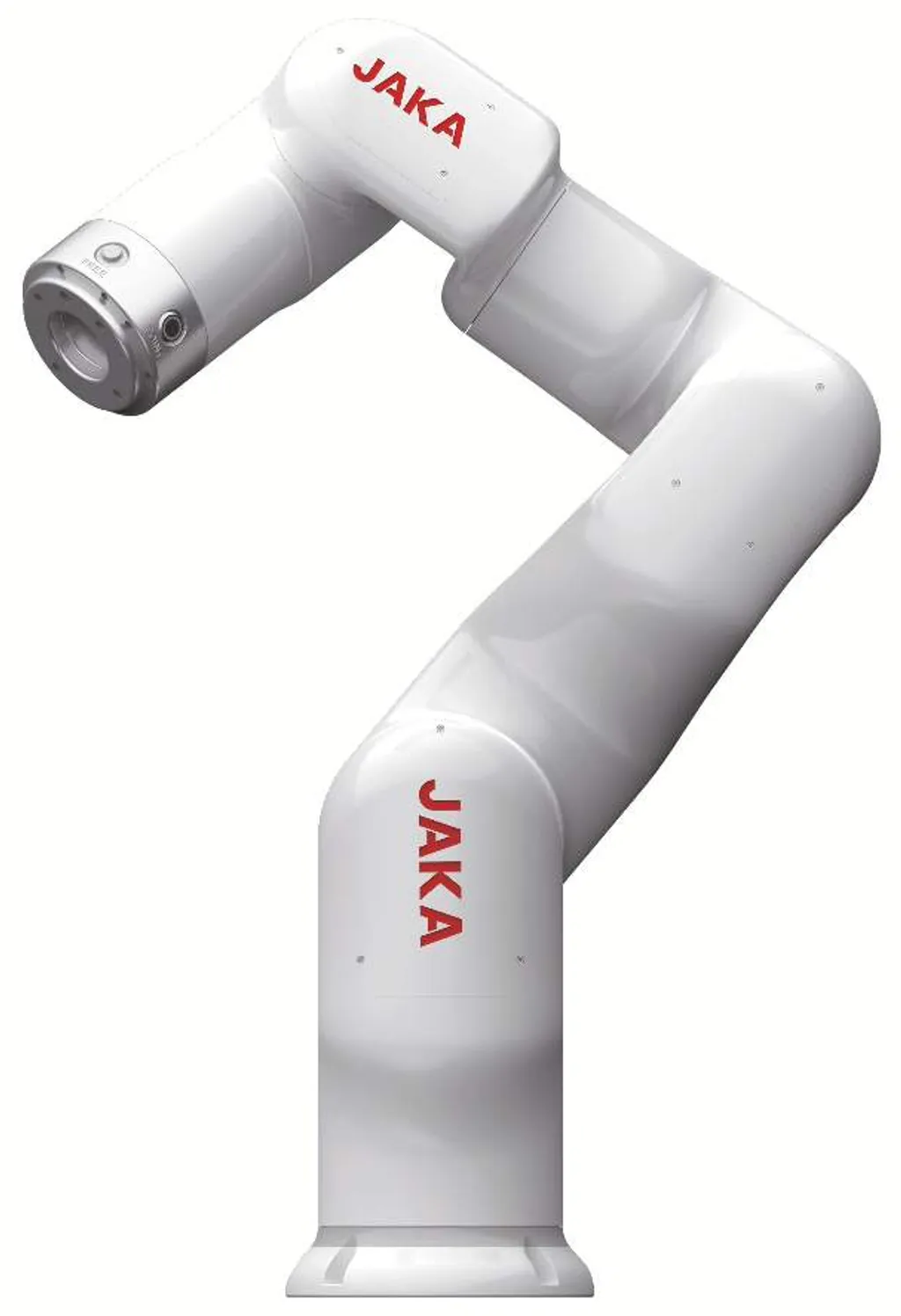
JAKA is the rare robot maker with zero industrial arms in our database: every one of its 12 models is a collaborative robot, from a 1 kg desktop MiniCobo to a 30 kg Zu 30. That is not a portfolio gap - it is a deliberate product strategy, and it makes JAKA one of the cleanest apples-to-apples lineups you will ever compare inside a single brand.
Who makes JAKA?
JAKA Robotics was founded in 2014 in Shanghai, with technology lineage that traces back to robotics research at Shanghai Jiao Tong University. The company’s name is stylized as “JAKA” and informally expanded to “Just Always Keep Amazing” - a marketing flourish you can ignore. What matters on the floor is their focus: factory automation via cobots for assembly, machine tending, palletizing, and light material handling across electronics, automotive, food and beverage, and medical-device sectors.
The funding picture tells you how serious the growth ambition is. JAKA has raised roughly $148 million from backers including SoftBank Vision Fund, Temasek, and Prosperity7 Ventures - the investment arm linked to Saudi Aramco. (TechCrunch, July 2022.) That capital has fueled a global expansion push beyond China. The differentiating hardware claims are torque-feedback technology, integrated force sensors, and optional built-in 2D cameras - features aimed at reducing the integrator work needed to deploy a cobot for contact-heavy tasks.
The company does not make a traditional industrial arm. That commitment to the cobot segment is either an advantage (if your application fits cobots) or a full disqualifier (if you need hard fencing and 100% duty cycle at high speed). There is no middle ground in JAKA’s catalog.
What types of robots does JAKA make?
Short answer: only one type. Every robot JAKA sells is a collaborative robot. There are no articulated industrial arms, no SCARA units, no delta robots. The entire portfolio of 12 models falls into a single category.
A 100% cobot composition is genuinely unusual among robot brands. Most manufacturers that reach 12 or more catalogued models have diversified into at least one industrial-arm line. JAKA has not. That purity simplifies the buying decision, but it also sets a hard ceiling: if your cell requires fencing, hard-stop safety, or sustained high-speed cycling without force-limiting interruptions, JAKA has nothing to offer you. If you are inside the cobot envelope - lower payloads, human-adjacent work, flexible redeployment - the lineup is wide enough to cover most applications.
Payload range: 1 kg to 30 kg
Source: Industrial Robotics Hub database, 12 JAKA robots.
The 1 kg to 30 kg span is wide for a cobot-only brand. The median payload across all 12 JAKA models sits at 9.5 kg, which puts the sweet spot firmly in the assembly and light machine-tending range. Three models cluster at 5 kg (the Zu 5, Pro 5, and S 5), meaning JAKA has differentiated within payload classes by performance tier rather than just by rated capacity.
At the heavy end, the Zu 30’s 30 kg payload is an outlier for the cobot category. Most cobots stop at 20 kg or below. Whether a 30 kg cobot makes practical sense for your application depends on whether ISO/TS 15066 speed and force limits are compatible with your cycle time. A 30 kg payload arm running at cobot-reduced speeds is not a palletizer in the industrial-robot sense of the word.
JAKA performance specs at a glance
| Type | Robots | Payload median | Repeatability median | Speed range | IP67+ |
|---|---|---|---|---|---|
| Cobot | 12 | 9.5 kg | 0.025 mm | 1500-3900 mm/s | 0% |
The repeatability figure is the number that earns attention here. A median of 0.025 mm across 12 models, with the best units hitting 0.02 mm, puts JAKA’s line in the same precision territory as established cobot players. The MiniCobo is the outlier at 0.1 mm repeatability - acceptable for a 1 kg desktop unit doing simple pick-and-place, but not appropriate for close-tolerance work.
The IP rating picture is stark: zero models in our database carry a published IP67 or higher rating. For food and beverage or washdown environments, that is a significant gap. JAKA markets into those sectors, so either the specs are unpublished or the lineup genuinely lacks ingress protection. Verify directly with the distributor before specifying for a wet environment.
Complete JAKA robot lineup
| Model | Type | Payload (kg) | Reach (mm) | Repeatability (mm) | Max Speed (mm/s) | IP |
|---|---|---|---|---|---|---|
| MiniCobo | cobot | 1 | 580 | 0.1 | 1500 | - |
| Zu 3 | cobot | 3 | 626 | 0.02 | - | - |
| Pro 5 | cobot | 5 | 954 | 0.02 | 3000 | - |
| S 5 | cobot | 5 | 954 | 0.03 | - | - |
| Zu 5 | cobot | 5 | 954 | 0.02 | - | - |
| Zu 7 | cobot | 7 | 819 | 0.02 | - | - |
| Pro 12 | cobot | 12 | 1327 | 0.02 | 3000 | - |
| Zu 12 | cobot | 12 | 1327 | 0.03 | - | - |
| Pro 16 | cobot | 16 | 1713 | 0.02 | 3900 | - |
| Zu 18 | cobot | 18 | 1073 | 0.03 | - | - |
| Zu 20 | cobot | 20 | 1780 | 0.05 | - | - |
| Zu 30 | cobot | 30 | 1350 | 0.05 | - | - |
Speed data is published for only 4 of the 12 models. The Pro series publishes TCP speed; the Zu and S series generally do not. That is worth noting when you are trying to model cycle time: you may need to request the full motion profile from the distributor rather than reading it off a datasheet.
The reach column also reveals a non-obvious tradeoff at the heavy end. The Zu 18 reaches only 1073 mm at 18 kg, while the Zu 20 reaches 1780 mm at 20 kg - a 707 mm difference in reach for 2 kg more payload. If your cell geometry requires long reach at heavy payload, the Zu 20 is the only option in the lineup before you hit the Zu 30’s shorter 1350 mm arm.
Which JAKA robot fits your application?
Electronics assembly, small components, tight tolerance. The Zu 3 is the call. At 3 kg payload and 0.02 mm repeatability with a 626 mm reach, it fits a benchtop or small-cell layout and holds position precisely enough for connector insertion and PCB handling. The MiniCobo’s 0.1 mm repeatability is too loose for most electronics work.
Desktop or portable demonstration, light screwdriving, education. The MiniCobo weighs just 9.4 kg total, which makes it genuinely portable - you can carry it between workstations or set it up on a table for a demo. (JAKA MiniCobo product page.) The 1 kg payload and 580 mm reach are limiting, but if portability and footprint are the real requirements, nothing else in the lineup competes.
Machine tending, CNC loading, mid-size parts. The Pro 12 or Zu 12 cover the 5-12 kg range that represents most machine-tending work. The Pro 12 publishes a 3000 mm/s TCP speed and 0.02 mm repeatability, making it the better choice when cycle time matters. (JAKA Pro 12 product page.) The Zu 12 trades speed data transparency for a slightly lower price point, typically.
Long-reach work, large-format assembly, automotive interior. The Pro 16 reaches 1713 mm and leads the lineup at 3900 mm/s TCP speed. (JAKA Pro 16 product page.) If you need to reach across a wide fixture or work on a large panel without repositioning the base, it is the most capable arm in the JAKA catalog on combined reach and speed.
Contact-sensitive work, insertion, polishing, deburring. The S 5 is the one model in the lineup marketed around integrated force-torque sensing. At 5 kg payload and 954 mm reach, it shares its physical envelope with the Zu 5 and Pro 5 but adds sensing at the wrist. If your application involves controlled contact force rather than pure position control, the S 5 is the natural starting point before you look at adding external sensors to the other models.
Heavy payload, palletizing, end-of-line handling. The Zu 30 is the only option. Treat the 30 kg rating carefully: at full reach you will see payload reduction, and the 1350 mm arm is shorter than what you get from the Zu 20. Run the moment-of-inertia numbers with your gripper before committing. Browse JAKA cobots on our cobot type page to cross-reference against competing brands at this payload class.
The bottom line
JAKA has built a coherent, well-bracketed lineup. Twelve models, one type, payloads from 1 kg to 30 kg, and a repeatability median of 0.025 mm that holds across the range. The Pro series adds published speed data and tighter repeatability versus the base Zu series; the S series adds integrated force-torque sensing. Those are clean, legible differentiators within a single brand. You are not comparing apples to aircraft carriers here.
The gaps are real, though. No published IP ratings in a lineup that targets food and beverage. Speed specs published on only four of twelve models. The Zu series does not tell you its TCP speed - and cycle-time models do not work without it. Before you write a purchase order, extract the full motion profile and the IP documentation from the local distributor, not just the product page.
Who should buy JAKA: buyers who want a full cobot range from a single vendor, value the Pro series speed data for cycle-time modeling, and operate in dry environments where the missing IP rating is not a barrier. The SoftBank-Temasek-Prosperity7 funding base suggests the company will be around and will invest in channel support - that matters for a 5-10 year automation asset.
Who should look elsewhere: buyers who need washdown or IP67 protection, need published speed data across the full lineup for rigorous cycle-time modeling, or whose applications genuinely require the speed and duty-cycle performance of a traditional industrial arm. No amount of cobot payload at 30 kg changes the fundamental ISO/TS 15066 speed limits that govern how fast a collaborative arm can run near a person.
The spec table is not a decision. The decision is: does your application live inside the cobot envelope, and does JAKA’s specific combination of payload, reach, and repeatability match the geometry of your cell? If the answer to both is yes, JAKA offers one of the cleaner lineups to specify from.
Compare these robots