Mitsubishi Robot Lineup: 11 MELFA Models, 0.01mm Precision
Mitsubishi's 11 MELFA robots span 2-20 kg payloads, but the real story is its SCARA line: 0.01 mm repeatability and 5,000 mm/s speed.
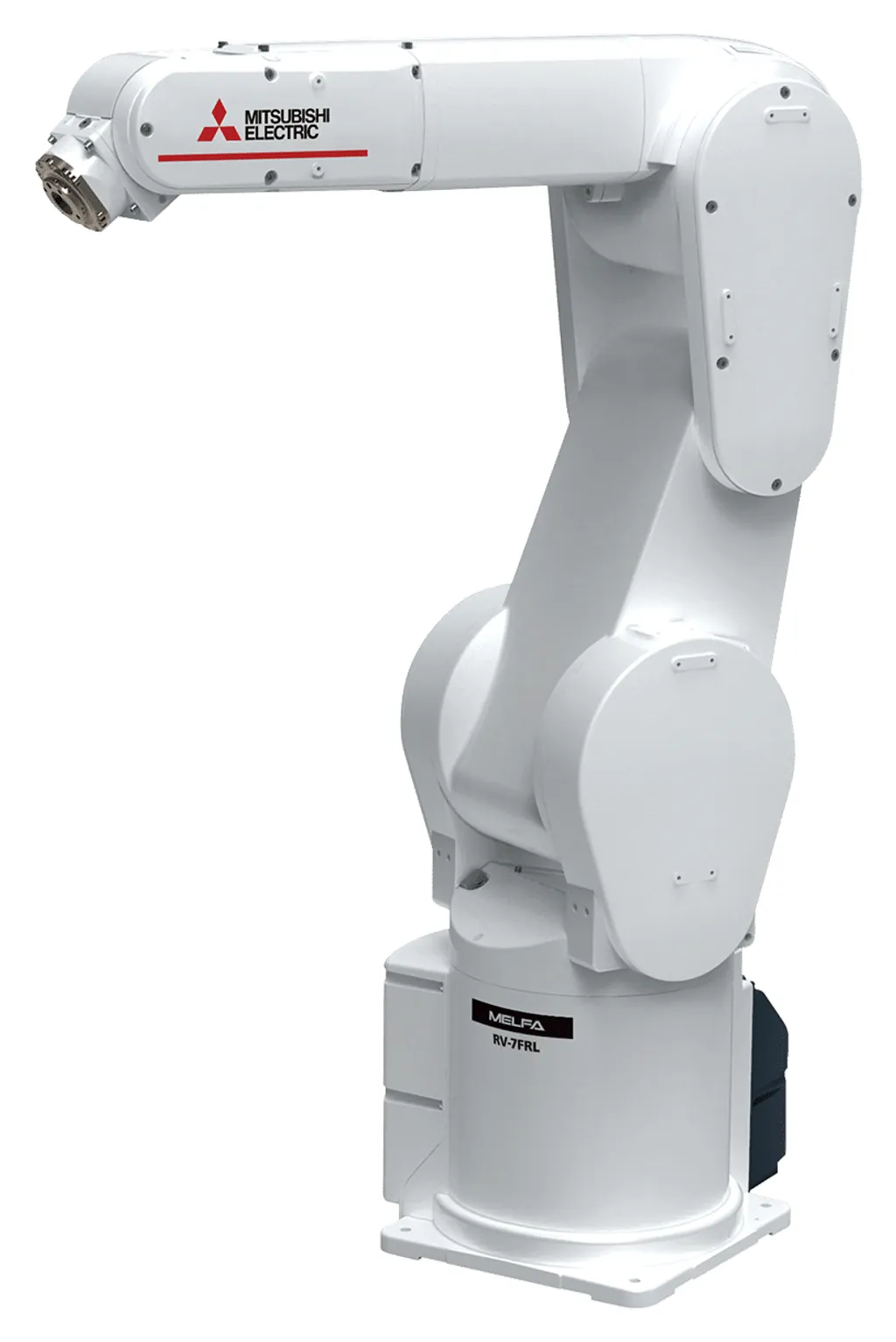
Mitsubishi Electric has built robots since well before most rivals existed, yet its 11-model MELFA lineup tops out at just 20 kg payload, a deliberate bet on speed and 0.01 mm precision over brute force. That number - 0.01 mm - is the SCARA side of this lineup’s identity. The articulated RV-FR series trades that level of precision for reach and speed, pushing TCP velocities to 10,000 mm/s, which is among the fastest in any comparable catalog. Eleven robots, two architectures, one cobot, and a payload ceiling most buyers hit before they need to - that is the full shape of what Mitsubishi Electric offers in factory automation.
This guide works through the MELFA lineup systematically: brand background, fleet composition, payload spread, consolidated performance numbers, a full model table, concrete application scenarios, and a buying decision close that reframes the spec table as a selection tool. If you already know you need a Mitsubishi robot and are choosing between models, jump to the complete lineup table. If you are still deciding whether MELFA belongs on your shortlist at all, start at the top.
Who makes Mitsubishi Electric robots?
Mitsubishi Electric Corporation is a Japanese multinational electronics and electrical-equipment manufacturer headquartered in Tokyo. It was established in 1921 as a spin-off from the electrical-machinery division of Mitsubishi Shipbuilding at the Kobe Shipyard. That founding date matters in the robotics context: Mitsubishi Electric entered the industrial automation space with decades of electrical-equipment manufacturing experience already behind it, and the company’s robot line - branded MELFA - reflects that heritage in its deep integration with Mitsubishi’s own programmable logic controllers and FA infrastructure.
The MELFA brand is the robot-specific face of Mitsubishi Electric’s broader factory automation division, which also produces MELSEC PLCs, MELSERVO servo systems, variable-frequency drives, and HMI hardware. That in-house ecosystem is a defining characteristic of the brand. Engineers programming a MELFA robot inside a cell controlled by a MELSEC iQ-R or iQ-Q series PLC are working in a single vendor stack with a single communication protocol and a single support channel. The CR800 and CR860 controllers that ship with current MELFA robots are designed from the ground up for tight integration with that PLC family, and Mitsubishi Electric publishes FA-IT integration libraries specifically for that pairing. For an integrator already committed to the Mitsubishi Electric automation ecosystem, adding MELFA robots is a natural extension rather than a separate procurement decision.
Primary end markets for MELFA include electronics and semiconductor assembly, automotive component manufacturing, food and pharmaceutical packaging, palletizing, and machine tending. The decision to cap the lineup at 20 kg payload is a product strategy choice, not a manufacturing limitation. Mitsubishi Electric is clearly targeting precision-critical, high-cycle applications - PCB handling, small-part assembly, dispensing, and inspection - rather than heavy press-tending or large-structure welding. Buyers who need robots above 20 kg are outside the MELFA scope entirely and will need to look elsewhere.
One feature worth noting separately: the RV-FR articulated series integrates with a 3D simulation environment that runs inside SolidWorks CAD. For engineering teams that already use SolidWorks, that integration shortens the cell-design validation cycle by eliminating the round-trip between CAD and a separate robot simulation package. Engineers can validate reach envelopes, interference zones, and approximate cycle times directly in the CAD environment before any physical hardware is ordered. It is a niche advantage, but a real one for the integrators it fits - and it reflects Mitsubishi Electric’s broader strategy of reducing the software friction between its robot line and the tools engineers already use.
The MELFA ASSISTA cobot line - currently represented by the RV-5AS-D in the MELFA catalog - uses a teach-by-hand direct-guidance workflow rather than the teach-pendant programming that dominates the RV-FR and RH-FRH series. Mitsubishi Electric pairs it with RT VisualBox software, a graphical environment that lowers the programming skill threshold compared with MELFA-BASIC. This matters for deployment contexts where cell operators rather than robot programmers are expected to modify tasks - a growing requirement in mix-variety, low-volume manufacturing environments where product changeovers happen weekly rather than annually. The ASSISTA is a targeted offering for that specific operational model, not a general-purpose robot with a speed limit bolted on.
What types of robots does Mitsubishi Electric make?
The 11 MELFA robots in our database split across three architecture types. Articulated 6-axis robots make up the majority of the lineup, followed by SCARA 4-axis robots, with a single collaborative robot rounding out the catalog.
The 54.5/36.4 split between articulated and SCARA tells you what Mitsubishi Electric is actually selling: two specialized robot families aimed at different ends of the precision-speed trade-off, not a diversified catalog trying to address every automation niche. The articulated RV-FR series (6 models, 2-20 kg) handles general-purpose assembly, machine tending, and pick-and-place tasks that require full 6-axis dexterity. The SCARA RH-FRH series (4 models, 3-20 kg) handles flat-plane assembly and high-throughput pick-and-place at 0.01 mm repeatability - half the deviation of the articulated series. The MELFA ASSISTA RV-5AS-D sits alone as the lone cobot in the lineup, occupying a 5 kg, 910 mm reach envelope suited to small-part assembly with humans in the loop.
The absence of delta pickers and painting robots is consistent with MELFA’s positioning. Mitsubishi Electric is not trying to be a full-spectrum robot supplier. It is a precision-automation specialist with a focused portfolio.
Payload range: 2 kg to 20 kg
The MELFA lineup spans a 10-to-1 payload ratio from the lightest articulated model at 2 kg up to the tied leaders at 20 kg (one articulated, one SCARA). The median payload across all 11 robots is 7 kg. That median is low compared with many catalogs, confirming again that MELFA is engineered for light-duty, high-precision work rather than heavy-payload automation.
| MELFA RH-20FRH | 20 kg | |
| MELFA RV-20FR | 20 kg | |
| MELFA RV-13FR | 13 kg | |
| MELFA RH-12FRH | 12 kg | |
| MELFA RV-8FR | 8 kg | |
| MELFA RV-7FRL | 7 kg | |
| MELFA RH-6FRH | 6 kg | |
| MELFA ASSISTA RV-5AS-D | 5 kg | |
| MELFA RV-4FR | 4 kg | |
| MELFA RH-3FRH | 3 kg | |
| MELFA RV-2FR | 2 kg |
The two 20 kg leaders are not twins. The MELFA RH-20FRH is a SCARA with 0.01 mm repeatability and 5,000 mm/s max speed, suited to high-throughput flat-plane assembly. The MELFA RV-20FR is a 6-axis articulated arm with 0.02 mm repeatability and 10,000 mm/s max speed, suited to general-purpose assembly that requires dexterous axis movement. Same payload ceiling, fundamentally different machines.
The payload curve from 2 kg to 20 kg is not evenly distributed. There are four robots at or below 5 kg and five robots between 6 kg and 20 kg. The lower half of the range - the RV-2FR, RH-3FRH, RV-4FR, ASSISTA, and RH-6FRH - covers electronics assembly and light component handling where part weights are measured in grams or light ounces. The upper half covers packaging, machine tending, and batch handling where parts are heavier but still within the 20 kg hard ceiling.
Mitsubishi Electric performance specs at a glance
| Type | Robots | Payload median | Repeat median | Speed range | IP67+ |
|---|---|---|---|---|---|
| Articulated | 6 | 6.5 kg | 0.02 mm | 6,000-10,000 mm/s | 0% |
| SCARA | 4 | 9 kg | 0.01 mm | 4,000-5,000 mm/s | 0% |
| Cobot | 1 | 5 kg | 0.02 mm | 1,500 mm/s | 0% |
| All MELFA | 11 | 7 kg | 0.02 mm | 1,500-10,000 mm/s | 0% |
Three things stand out in this table. First, the SCARA series doubles down on precision - 0.01 mm is half the deviation of the articulated series and the cobot. For electronics assembly applications where position error maps directly to defect rate, that difference is not abstract. A 0.01 mm SCARA at 5,000 mm/s is a different machine from a 0.02 mm articulated at 10,000 mm/s, and the right choice between them depends on whether your process constraint is positional accuracy or cycle time. Second, the articulated series trades that precision for speed, reaching 10,000 mm/s on the RV-13FR and RV-20FR. That speed figure is competitive with any industrial robot in this payload class regardless of brand. Third, the IP67+ column shows zero across the entire lineup. No MELFA robot in the current database is rated for washdown or immersion. If your process involves water, cleaning fluids, or significant particulate contamination exposure, MELFA as currently configured is the wrong answer unless Mitsubishi Electric offers custom environmental protection packages outside the standard specification sheet.
The SCARA median repeatability of 0.01 mm is consistent across all four RH-FRH models - it does not degrade as payload or reach increases within that sub-family. The RH-20FRH holds 0.01 mm at 20 kg and 1,200 mm reach. The RH-3FRH holds the same 0.01 mm at 3 kg and 300 mm reach. That consistency is a meaningful engineering claim because larger SCARA machines typically trade some positional accuracy for the structural compliance required to support heavier payloads. If the published numbers hold in practice at your process conditions - temperature, acceleration profile, tooling mass distribution - the SCARA consistency is a genuine differentiator.
The cobot’s 1,500 mm/s speed limit is a deliberate safety parameter, not a mechanical limitation. ISO/TS 15066 collaborative operation requirements constrain TCP velocity to limits that vary by body-part contact zone. The MELFA ASSISTA’s 1,500 mm/s cap reflects those constraints in a safe-speed operating mode. In a robot operating without humans in the collaborative zone, the speed ceiling could in principle be higher, but that defeats the purpose of deploying a cobot rather than a standard robot in a guarded cell.
Complete Mitsubishi Electric robot lineup
| Model | Type | Payload (kg) | Reach (mm) | Repeat (mm) | Max Speed (mm/s) | IP |
|---|---|---|---|---|---|---|
| MELFA RH-20FRH | SCARA | 20 | 1,200 | 0.01 | 5,000 | - |
| MELFA RV-20FR | Articulated | 20 | 1,503 | 0.02 | 10,000 | - |
| MELFA RV-13FR | Articulated | 13 | 1,388 | 0.02 | 10,000 | - |
| MELFA RH-12FRH | SCARA | 12 | 1,200 | 0.01 | 5,000 | - |
| MELFA RV-8FR | Articulated | 8 | 727 | 0.02 | 9,000 | - |
| MELFA RV-7FRL | Articulated | 7 | 908 | 0.02 | - | - |
| MELFA RH-6FRH | SCARA | 6 | 600 | 0.01 | 5,000 | - |
| MELFA ASSISTA RV-5AS-D | Cobot | 5 | 910 | 0.02 | 1,500 | - |
| MELFA RV-4FR | Articulated | 4 | 515 | 0.02 | 9,000 | - |
| MELFA RH-3FRH | SCARA | 3 | 300 | 0.01 | 4,000 | - |
| MELFA RV-2FR | Articulated | 2 | 504 | 0.02 | 6,000 | - |
The RV-7FRL is the only model in the lineup with a missing speed figure in the current database. The model name suffix “L” typically indicates a long-arm variant in Mitsubishi Electric’s naming convention, and its 908 mm reach - longer than the 727 mm RV-8FR despite a lower payload rating - is consistent with that pattern. Verify max speed directly with Mitsubishi Electric or the regional distributor before quoting cycle times for this model.
Reach spans 300 mm (RH-3FRH compact SCARA) to 1,503 mm (RV-20FR articulated). The 1,200 mm reach on both the RH-20FRH and RH-12FRH SCARA models is notable - long-reach SCARA capability at both 12 kg and 20 kg payloads gives system integrators working on large flat-surface assembly (solar panel handling, large PCB loading) two options depending on part weight.
Which Mitsubishi Electric robot fits your application?
High-throughput electronics assembly with tight tolerances. The RH-6FRH is the reference pick: 6 kg payload, 600 mm reach, 0.01 mm repeatability, 5,000 mm/s max speed. If your parts weigh under 6 kg and your process involves placing components at 0.02 mm-scale position requirements, this SCARA hits all three constraints simultaneously. The MELFA RH-6FRH is especially well-suited to PCB insertion, connector mating, and optical component placement where deviation costs are measured in scrap rates rather than mm.
Long-reach SCARA for large-format flat assembly. If part weight runs to 12 kg and the assembly surface spans more than 600 mm, the MELFA RH-12FRH extends reach to 1,200 mm while holding 0.01 mm repeatability and 5,000 mm/s speed. Solar panel sub-assembly, large LCD panel handling, and automotive trim operations that live in a flat plane are the core use cases. Step up to the MELFA RH-20FRH if parts reach 20 kg.
General-purpose machine tending, heavy-end MELFA. The MELFA RV-20FR carries 20 kg to 1,503 mm reach with 10,000 mm/s speed - the fastest machine in the lineup by TCP velocity. Machine tending on CNC lathes, loading injection mold machines, or presenting parts to CMM fixtures where cycle time directly determines throughput - these are the applications where the RV-20FR’s speed advantage over slower robots in the same payload class translates to measurable cost-per-part improvement.
Mid-range articulated for compact cells. The MELFA RV-4FR at 4 kg payload, 515 mm reach, and 9,000 mm/s is the compact-cell workhorse. It fits in cells where footprint is constrained and parts weigh a few kilograms. Dispensing, small-part transfer, and vision-guided pick-and-place where reach under 600 mm is sufficient are natural fits. The RV-8FR (727 mm reach, 8 kg, 9,000 mm/s) steps up the envelope if parts are larger or the cell geometry requires more reach.
Human-collaborative assembly with teach-by-hand programming. The MELFA ASSISTA RV-5AS-D is the only model in the MELFA lineup designed for human-robot collaboration without fixed safety barriers. At 5 kg payload and 910 mm reach, it covers most small-part assembly tasks that benefit from operator-adjacent deployment. Mitsubishi Electric’s RT VisualBox software accompanies the ASSISTA with a graphical programming interface - relevant for environments where programming staff with MELFA-BASIC experience is not the default assumption. The 1,500 mm/s safe-speed ceiling means cycle time will be longer than an equivalent caged robot. That is the compliance cost of collaborative operation, not a product deficiency.
Semiconductor and pharma where contamination control matters - but not standard IP protection. None of the 11 MELFA robots carries an IP67 rating in the current database. Cleanroom-specific or washdown-ready variants may be available through Mitsubishi Electric’s special-order or regional catalog - that is worth a direct inquiry - but buyers who need confirmed IP67 protection as a specification-locked requirement should verify before committing. The MELFA catalog as published here does not meet that bar.
The bottom line
Mitsubishi Electric’s MELFA lineup is a precision-automation specialist’s catalog that has deliberately passed on the heavy-payload and environmental-protection markets to stay sharply focused on what it does well: high-speed, high-repeatability light-duty automation integrated into a Mitsubishi Electric FA stack. The 0.01 mm SCARA repeatability is not marketing language - it is a published specification that holds across four models and makes the RH-FRH series one of the more capable options in flat-plane precision assembly at this payload level. The 10,000 mm/s articulated speed on the RV-13FR and RV-20FR is similarly concrete, and for any application where TCP velocity directly drives cycle time, those figures matter.
The lineup’s limits are equally concrete. Twenty kilograms is the hard ceiling - no exceptions, no heavy-lift variants in this catalog. Zero models carry confirmed IP67 protection. One cobot in an 11-model lineup means MELFA is not a serious play for buyers whose primary driver is collaborative deployment. And buyers who are not already in the Mitsubishi Electric automation ecosystem should weigh whether the PLC-integration advantage that MELFA offers is relevant to their specific installation. If your cell is controlled by a Siemens or Rockwell PLC, the CR800 controller’s MELSEC integration story does not add value. If your cell is already running on MELSEC iQ-R hardware, that same integration story is a real efficiency gain.
Buy MELFA if: your application sits between 2 kg and 20 kg payload, your accuracy requirements are at or below 0.02 mm for articulated work or 0.01 mm for flat-plane assembly, you are already in the Mitsubishi Electric FA ecosystem, or you specifically need SolidWorks-integrated simulation for cell design. The SCARA RH-FRH series in particular has very few direct competitors at 0.01 mm repeatability in this reach class at realistic volume pricing.
Look elsewhere if: your payload requirement exceeds 20 kg, your process environment requires washdown or immersion protection, your primary deployment model is collaborative operation at scale, or you need a robot catalog with deep environmental-protection options across multiple models.
The spec table at the top of this guide is not a menu - it is a process-requirements filter. Match your part weight, your reach envelope, and your repeatability requirement to the numbers, and the field of 11 robots narrows quickly to two or three real candidates. From there, pricing, lead time, and your existing control infrastructure complete the decision. Mitsubishi Electric publishes full documentation for the MELFA line at the official robot index; start there for datasheets and controller specifications before engaging a distributor.
Compare these robots