SCARA vs Delta vs 6-Axis: Which Is Actually Faster for Pick-and-Place?
The fastest format is not the one with the highest mm/s. Delta hits 120-300 picks per minute off a moving belt, SCARA owns short flat point-to-point, and a 6-axis arm is fastest only when the part has to be reoriented. Here is how to pick, using real specs from our database.
The single most common mistake buyers make when they shop for a pick-and-place robot is ranking candidates by TCP speed in mm/s. It feels rigorous, it is on every datasheet, and it is nearly useless for choosing a picking robot. A pick-and-place cycle is short, sharp, and repetitive: down, grip, up, across, down, release. It never reaches top speed. What decides your throughput is how fast the arm accelerates and settles a light mass over a short stroke, and that is a property of the robot’s geometry, not its headline velocity.
That is why the fastest format changes with the job. Across the pick-and-place robots in the Industrial Robotics Hub database, a delta delivers 120 to 300 picks per minute on light parts off a moving belt, a SCARA is fastest for short flat point-to-point moves with a part rotation, and a 6-axis articulated arm is fastest only when the part must be reoriented, which is a different question than throughput. Get the format right first, then compare specs inside the format.
Picks per minute, not mm/s, is the metric that matters
Peak TCP speed is the highest Cartesian velocity the tool center point can reach. In a picking cell it is a vanity number. The tool spends its life accelerating from a dead stop, decelerating into a grip, and settling before release. Over a 300 mm stroke the arm may never hit half its rated speed. What you actually pay for in cycle time is acceleration and the settling time after each move, and both are governed by how much mass the robot swings.
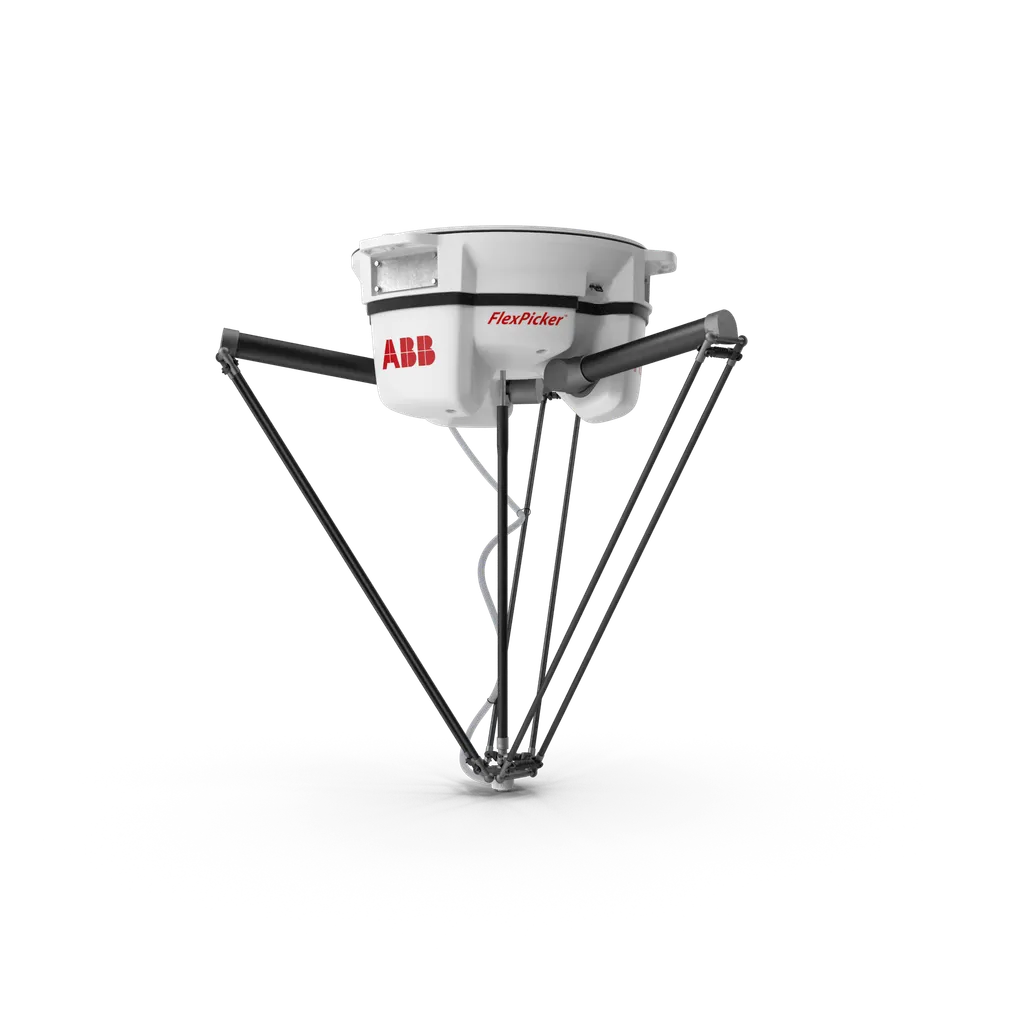
This is where geometry decides everything. A delta robot mounts all three motors on the fixed base and moves only thin carbon-fiber links and the tool, so the moving mass is tiny and the acceleration is brutal. A SCARA carries its motors partway out the arm but moves in a rigid horizontal plane, which suits short flat strokes. A 6-axis arm carries wrist motors all the way out at the end of the reach, so it swings the most mass and accelerates the slowest, and it earns its keep on flexibility rather than raw rate. Engineering.com’s format comparison and Patsnap’s high-speed picking analysis both land on the same conclusion: match the kinematic profile to the motion, then talk speed.
What the numbers say across the three formats
Two things are true at once, and holding both is the whole point. By peak TCP speed our fastest robots are SCARAs and 6-axis arms. By real picks per minute on light parts, deltas win. The table below pairs the peak-speed figures from our database with published picks-per-minute figures from manufacturers, so you can see the gap between the two metrics.
| Format | Peak TCP speed (our DB) | Real picks/min (light parts) | Payload sweet spot | Best motion profile |
|---|---|---|---|---|
| Delta | 10,000 mm/s (FANUC M-3iA, KUKA KR DELTA) | 120-300 ppm | 1-8 kg | High-volume sorting off a moving belt |
| SCARA | 11,000 mm/s (Epson G20) | 60-200 ppm | 5-20 kg | Short flat point-to-point + one rotation |
| 6-axis | 10,900 mm/s (Staubli TX2-90) | slower, orientation-limited | 3-50 kg+ | Tilt, flip, angled approach |
The picks-per-minute figures come from manufacturer data: the FANUC M-2iA delta is documented running 182 parts per minute on packaging lines, the ABB FlexPicker family reaches roughly 150 picks per minute at 1 kg, and the OMRON Adept Quattro is rated up to 300 picks per minute, per Patsnap and EVS International. Conventional SCARAs sit at 60 to 70 picks per minute, while a purpose-built high-speed SCARA like the Staubli TP80 is rated at 200 picks per minute in our own database summary. Our peak-TCP figures are pulled directly from the robots’ spec records; where a robot does not publish a figure it shows ”—” and is excluded, never estimated.
Delta: fastest when parts arrive light and moving
Delta is the correct format when you are sorting a stream of light parts arriving on a conveyor and cycle time is the whole game. The parallel-linkage geometry gives it the highest real pick rate of any format, 120 to 300 picks per minute, because it accelerates almost no moving mass. AMD Machines’ high-speed picking guide frames delta as the format built specifically for this duty.
The price you pay is payload and workspace. Every one of the five delta robots in our database caps at 15 kg or below, and most sit at 1 to 8 kg: the Staubli TP80 at 1 kg, the KUKA KR DELTA at 3 kg, the FANUC M-3iA at 6 kg, and the ABB IRB 360 FlexPicker at 8 kg. The reachable volume is a shallow truncated cone, not a hemisphere, so delta suits flat conveyor picking, confectionery, blister-pack filling, and FMCG sorting where parts arrive in a known lane. It is the wrong answer the moment the part gets heavy or the tool has to tilt.
SCARA: fastest for short flat point-to-point with a rotation
SCARA owns the motion profile that dominates electronics, small-parts assembly, and tray loading: reach to a flat pick point, grip, lift, translate a short distance, rotate the part, and set it down. Its rigid planar geometry makes those short strokes very fast, which is why our SCARA field holds the highest peak TCP speed in the database, the Epson G20 at 11,000 mm/s, and the fastest published cycle, the Omron i4-850 at 0.39 seconds (tied with the i4-750).
SCARA also covers the payload band delta cannot reach. Of the 35 SCARA robots in our database, models run from the 6 kg Epson G6 up to the 20 kg Epson G20, and large SCARAs from other vendors reach 50 kg. That 5 to 20 kg window is exactly where delta runs out of payload and a 6-axis arm is overkill. If your part arrives flat, needs a rotation but no tilt, and weighs more than a delta can handle, SCARA is almost always the fastest and cheapest fit. A conventional SCARA runs 60 to 70 picks per minute, and a high-speed model closes most of the gap to delta.
6-axis: fastest only when the part must be reoriented
A 6-axis articulated arm is not competing for top pick rate, and buying one for throughput alone is a mistake. What it does that neither SCARA nor delta can is present the tool at any angle. When the part has to be tilted, flipped in flight, picked off an inclined conveyor, or placed into an angled pocket, the two wrist joints a SCARA and delta lack become the reason the cell works at all.
Our fastest 6-axis arms are genuinely quick in a straight line, the Staubli TX2-90 at 10,900 mm/s and the Mitsubishi MELFA RV-13FR at 10,000 mm/s, but they carry the most mass at the wrist and accelerate the slowest over a picking stroke, so their real pick rate trails delta and high-speed SCARA. EVS International’s format guide makes the same call: choose 6-axis for orientation and reach flexibility, not for raw picking speed. The payoff is range: our articulated field spans 3 kg to well over 50 kg, so when a picking job also needs orientation and heavy payload, the 6-axis arm is the only format that covers both.
The decision in one pass
Answer these in order and the format falls out:
- Does the part need to be tilted, flipped, or approached at an angle? If yes, you need a 6-axis arm. Stop here; SCARA and delta cannot do it.
- Is the part light (under about 8 kg) and arriving fast on a conveyor? If yes, and you need maximum picks per minute, choose a delta.
- Is the part flat, 5 to 20 kg, needing at most a rotation? Choose a SCARA. It is the fastest and cheapest fit for that profile.
- Do humans need to share the space? Then throughput is capped by ISO/TS 15066 regardless of format, and you are choosing a cobot, not competing on raw speed. See our pick-and-place buyer’s guide for that path.
Rank candidates inside the chosen format by picks per minute for your actual motion, not by mm/s. When you have a shortlist, put the finalists side by side on the compare tool and check payload-at-reach, repeatability, and IP rating together. For the type-level view of how speed varies across every robot class, see robot speed by type.
Speed figures in this article are drawn from the Industrial Robotics Hub database (peak TCP speed and cycle time as published by each manufacturer) and from the cited manufacturer and industry sources for picks-per-minute claims. Where a robot does not publish a figure, it is excluded rather than estimated.
Frequently asked questions
Is a delta robot faster than a SCARA for pick-and-place? +
For high-volume picking of light parts off a moving conveyor, yes. Delta robots reach 120 to 300 picks per minute because their parallel linkage keeps almost no mass moving with the arm. A conventional SCARA runs 60 to 70 picks per minute on the same duty, though a purpose-built high-speed SCARA like the Staubli TP80 matches delta at 200 picks per minute. For short flat point-to-point moves with a part rotation, SCARA is usually the faster and cheaper answer.
Does a higher TCP speed in mm/s mean more picks per minute? +
No. TCP speed is the peak Cartesian velocity the tool can reach, but a pick-and-place cycle is dominated by acceleration, deceleration, and settling over short strokes, not top speed. The Epson G20 SCARA in our database peaks at 11,000 mm/s and a FANUC delta at 10,000 mm/s, yet the delta still delivers more picks per minute on a belt because it accelerates a far lighter moving mass. Judge cycle rate by picks per minute for a defined motion, not by mm/s alone.
When is a 6-axis robot the right choice for pick-and-place? +
When the part has to be reoriented, tilted, or approached from a compound angle, a 4-axis SCARA or delta physically cannot do it. A 6-axis arm handles picking from an inclined conveyor, placing into an angled pocket, or flipping a part in flight. It pays a cycle-time tax for that freedom, so use it only when the geometry demands orientation control rather than raw throughput.
What is the fastest pick-and-place robot in your database? +
By peak TCP speed, the Epson G20 SCARA leads at 11,000 mm/s, with the Staubli TX2-90 6-axis at 10,900 mm/s and FANUC and KUKA deltas at 10,000 mm/s. By real picks per minute on light parts, the delta format wins: the Staubli TP80 is rated at 200 picks per minute and the FANUC M-2iA at 182 parts per minute.
Compare these robots