Best Pick and Place Robots in 2026: Delta vs SCARA vs Cobot by Speed and Application
145 pick-and-place robots: delta peaks at 10,000 mm/s, SCARA at 11,000 mm/s. How to choose between delta, SCARA, and cobot by speed, payload, and IP rating.
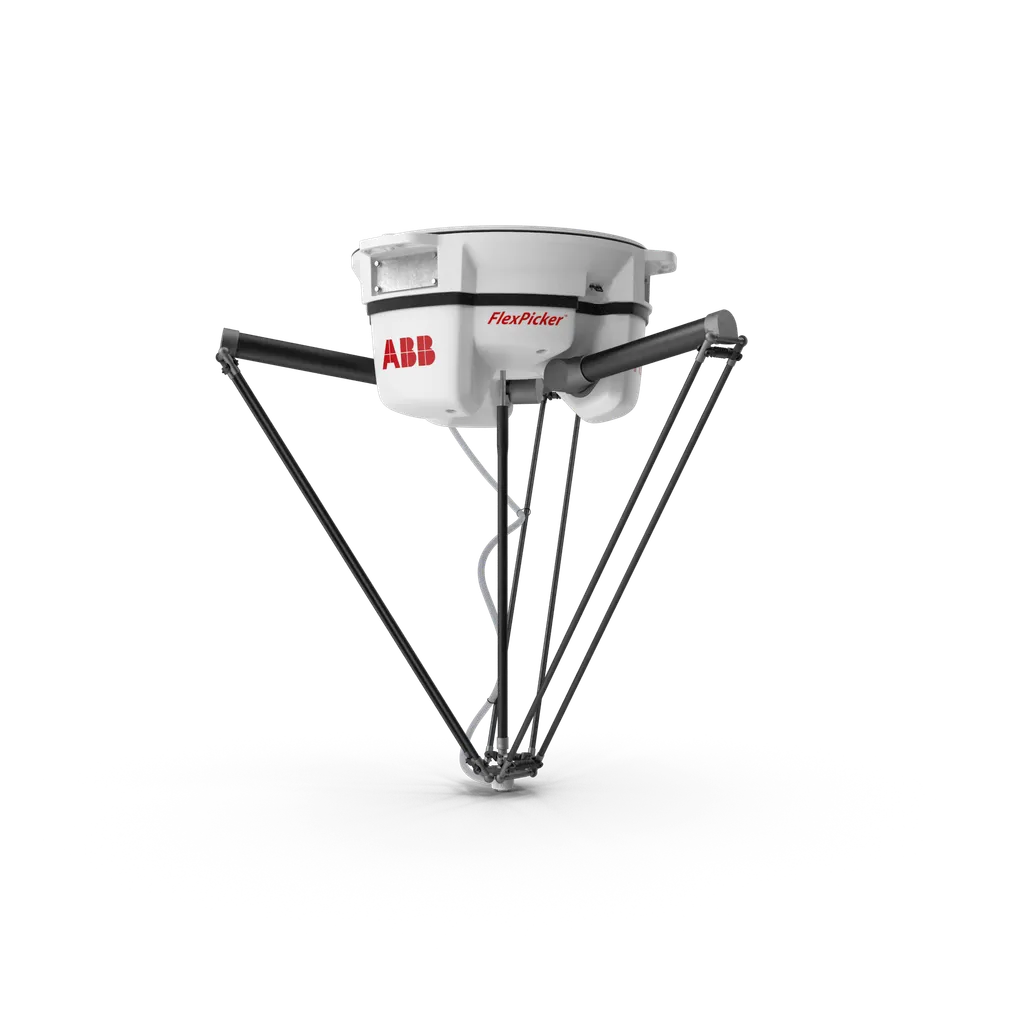
Pick and place is the one robot application where TCP speed is the primary spec. Payload matters — you have to lift the part. Repeatability matters — you have to place it accurately. But if the robot is too slow, you miss your cycle time, and nothing else compensates. Of the 145 robots tagged for pick and place in the Industrial Robotics Hub database, the fastest delta tops 10,000 mm/s and the fastest SCARA reaches 11,000 mm/s. No cobot approaches either figure under ISO/TS 15066 shared-space limits.
That gap in speed defines the format decision. High-volume fixed-cycle picking — food lines, pharma blister filling, electronics kitting, FMCG sorting — belongs to delta or SCARA. Low-volume flexible picking, bin-picking with vision, or cells where a human needs to be present belong to cobots. Getting the format right before comparing specs within a format saves months of integrator time.
The four pick and place formats and what drives the choice
Delta. The parallel-linkage geometry gives delta robots the fastest cycle times in our database: up to 10,000 mm/s TCP speed, with sub-0.4-second pick cycles on light parts. The tradeoff is payload — most deltas cap at 3 to 8 kg — and workspace geometry: the reachable volume is a truncated cone, not a hemisphere. Delta is the correct format for high-throughput light-part sorting, confectionery, blister-pack filling, and food conveyor picking where parts arrive in a known lane and move at speed.
SCARA. A 4-axis SCARA covers the 5 to 20 kg payload range where delta cannot go, with speed figures that still reach 11,000 mm/s. SCARA’s planar geometry suits parts that arrive flat, must be rotated, and are inserted from above — exactly the pick and place motion profile. When cycle time matters and the part weight exceeds what a delta handles, SCARA is usually the answer.
Articulated (6-axis). When the pick and place path requires tilting or presenting the part at a compound angle — picking from a conveyor belt at a 30-degree slope, for instance, or placing into a deep angled pocket — a 6-axis arm handles it where SCARA and delta cannot. Cycle time is slower, but geometric flexibility is higher.
Cobot. For flexible, low-volume, or bin-picking tasks where a human needs to refill the source bin or verify parts, a cobot removes the guarding requirement. Under ISO/TS 15066 PFL mode, TCP speed is capped well below what a SCARA or delta achieves. If your cell needs 120 picks per minute, cobots are not the format. If your cell needs 20 picks per minute with a human nearby, cobots are often the right trade-off.
Best delta robots for pick and place
Only 5 delta robots appear in the pick and place category of our database. That is a narrow field — delta is a niche format — but the two fastest models are industry standards:
| Robot | Payload | Reach | Repeatability | TCP Speed | IP |
|---|---|---|---|---|---|
| FANUC M-3iA/6S | 6 kg | 1,350 mm | ±0.1 mm | 10,000 mm/s | IP69K |
| KUKA KR DELTA | 3 kg | 1,200 mm | ±0.1 mm | 10,000 mm/s | IP65 |
The FANUC M-3iA/6S stands out for IP69K — full pressure-washdown protection. That rating matters enormously for food and pharmaceutical pick and place where the line runs a high-pressure hot-water wash at end of shift. IP65 on the KUKA KR DELTA covers spray but not the pressure-wash cycle. If your line gets hosed down nightly, the M-3iA/6S is the correct choice independent of brand preference.
Repeatability at ±0.1 mm for both units is looser than what assembly robots achieve, which is intentional: pick and place tolerances on food items or consumer packaging are measured in millimeters, not tenths. The trade was made deliberately for speed.
Best SCARA robots for pick and place
The SCARA category in our database has 33 pick-and-place tagged robots. The Epson series leads on raw speed:
| Robot | Payload | Reach | Repeatability | TCP Speed |
|---|---|---|---|---|
| Epson G20 | 20 kg | 850 mm | ±0.025 mm | 11,000 mm/s |
| Epson G10 | 10 kg | 650 mm | ±0.025 mm | 8,800 mm/s |
| Epson G6 | 6 kg | 650 mm | ±0.015 mm | 7,900 mm/s |
| KUKA KR SCARA R600 | 8 kg | 600 mm | ±0.01 mm | 6,200 mm/s |
| Mitsubishi MELFA RH-12FRH | 12 kg | 1,200 mm | ±0.01 mm | 5,000 mm/s |
| Mitsubishi MELFA RH-20FRH | 20 kg | 1,200 mm | ±0.01 mm | 5,000 mm/s |
The Epson G20 at 11,000 mm/s is the fastest pick and place robot in our entire database. The G-series also leads on repeatability for a speed-optimized SCARA: ±0.025 mm on the G20 and ±0.015 mm on the G6. The KUKA and Mitsubishi units are slower in peak TCP speed but hit ±0.01 mm — useful when the placement must be tighter than the Epson spec.
Note on reach: the Mitsubishi RH-12FRH and RH-20FRH both reach 1,200 mm, which is long for a SCARA. That suits pick and place cells with a wide conveyor or a large part pallet, where the arm must cover more horizontal distance than a compact 600 mm unit can serve.
Cobots for pick and place: flexible cells and bin-picking
When the pick source is unstructured — a bin of randomly oriented parts, a manual-feed tray that a human refills — a cobot with 3D vision handles it where a delta or SCARA (which assume parts in a known lane or fixed tray) cannot. Cobots are slower, but they do not require structured part presentation.
The fastest pick-and-place cobots in our cobot database:
| Cobot | Payload | Reach | Repeatability | TCP Speed | IP |
|---|---|---|---|---|---|
| Dobot CR10A | 10 kg | 1,300 mm | ±0.03 mm | 5,000 mm/s | IP54 |
| AUBO i10 | 10 kg | 1,350 mm | ±0.03 mm | 4,000 mm/s | IP54 |
| Dobot CR5A | 5 kg | 900 mm | ±0.02 mm | 4,000 mm/s | IP54 |
| JAKA Pro 16 | 16 kg | 1,713 mm | ±0.02 mm | 3,900 mm/s | IP68 |
The Dobot CR10A is the fastest cobot in our pick-and-place tag at 5,000 mm/s — significantly below what SCARA achieves, but competitive for low-throughput flexible cells. The JAKA Pro 16 at IP68 is the highest-IP cobot for pick and place in the database; relevant if the cell is in a food or pharma environment where the cobot gets spray exposure.
The speed gap visualised
The 2x speed gap between SCARA/delta and cobots is why format choice precedes spec comparison. A cobot running at its ISO 15066-limited speed in a shared-space cell can deliver perhaps 20 to 40 picks per minute on a well-optimised path. A SCARA or delta running at peak speed delivers 60 to 150 picks per minute for equivalent part and path geometry. If your throughput requirement is above 60 picks per minute, the format is delta or SCARA before you look at any other spec.
IP rating for pick and place: food and pharma vs dry environments
IP rating for pick and place is driven by the cleaning protocol, not the task itself.
- Food conveyor picking (baked goods, confectionery, meat): IP69K required if the robot is inside the hygiene zone. The FANUC M-3iA/6S is IP69K; the KUKA KR DELTA is IP65.
- Pharmaceutical blister filling: typically IP65 minimum (spray cleaning). Most SCARA arms are IP20 to IP40 — they need a clean, dry cell or a secondary enclosure.
- Electronics kitting and dry goods: IP20 or IP40 is correct. Buying IP67 for a dry electronics line is waste.
- Mixed food-and-robot zones: if the robot is on the periphery of a wet zone but not directly in it, IP54 is often acceptable and covers most cobots in our database.
Check the actual cleaning protocol before writing the IP spec. The robot’s IP rating needs to match the worst environment it will see in a cleaning cycle, not the environment during production.
How to build your pick and place shortlist
- Set the cycle time requirement (picks per minute). Above 80 ppm → delta or SCARA. Below 40 ppm with flexible part presentation → cobot may be correct.
- Identify the payload including gripper and any dual-head tooling. Most pick and place is sub-10 kg; the 20 kg bracket covers heavier consumer goods.
- Set the reach from the widest conveyor lane or pallet zone the arm must cover, plus 100 mm margin.
- Set the IP floor from your cleaning protocol, not your production environment.
- Filter for repeatability last — for most pick and place, ±0.05 mm is more than adequate. Only tighten if the socket or pocket the part lands in is a precision fit.
The full pick and place application list shows all 145 robots with specs. Use the compare tool to put any two format options side by side.
Data: Industrial Robotics Hub database, 145 robots tagged for pick and place across 17 brands. Specs sourced from manufacturer datasheets. TCP speed figures are manufacturer-published maximums; actual speed in shared-space collaborative mode is lower. Last verified June 2026.
Frequently asked questions
Which robot format is fastest for pick and place? +
SCARA leads: the Epson G20 reaches 11,000 mm/s -- the fastest pick-and-place robot in our database. Delta follows at 10,000 mm/s. Cobots are limited by ISO 15066 safety rules to a fraction of these speeds.
What IP rating do I need for food line pick and place? +
IP69K if the robot is inside the hygiene zone and receives high-pressure hot-water washdown. The FANUC M-3iA/6S is the only pick-and-place delta in our database rated IP69K. IP65 covers spray but not pressure-wash.
Can a delta robot handle heavy or bulky parts? +
No. Delta robots in our database cap at 6 kg and suit light fast sorting on conveyor belts. Heavier pick and place (5-20 kg) belongs to SCARA; above 20 kg, use a 6-axis articulated arm.
How many picks per minute can a SCARA deliver? +
A SCARA at 11,000 mm/s TCP speed delivers 60 to 150 picks per minute depending on path length and part weight. A cobot under ISO 15066 shared-space limits typically delivers 20 to 40 picks per minute for the same geometry.
Compare these robots