Universal Robots Lineup: 9 Cobots From 3kg to 35kg
Every one of Universal Robots' 9 arms is a cobot. Payloads span 3kg to 35kg, yet repeatability holds at a median 0.05mm across the whole line.
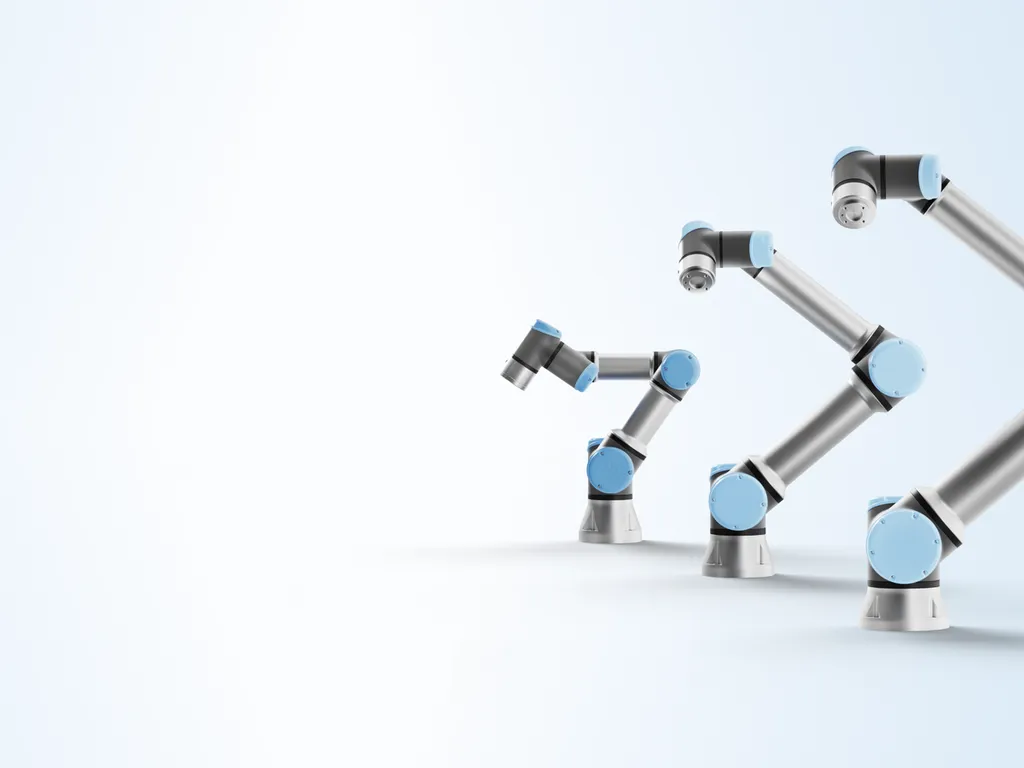
Universal Robots makes nine arms in our database and not one of them is a traditional caged industrial robot - every single model is a collaborative cobot. That is a deliberate product philosophy, not an accident of lineup planning, and it shapes every buying decision you will make with this brand. Payload runs from 3 kg to 35 kg, reach from 500 mm to 1750 mm, and repeatability holds at a median of 0.05 mm across all nine models. If your application sits outside that envelope - particularly if you need IP67 wash-down protection or speeds above 5000 mm/s - you should look elsewhere before reading further.
Who makes Universal Robots?
Universal Robots is a Danish cobot manufacturer headquartered in Odense, Denmark. Three researchers at the University of Southern Denmark - Esben Ostergaard, Kasper Stoy, and Kristian Kassow - founded the company in 2005 after recognizing that small and medium manufacturers had no realistic path to automation: traditional industrial robots required safety cages, specialist integrators, and capital budgets that SMEs could not justify. Their answer was to build arms that were safe enough to work alongside people without fencing, simple enough for shop-floor staff to program in hours, and cheap enough to deliver a payback in months rather than years.
The first product, the UR5, shipped commercially in 2008. It is widely credited as the world’s first commercially viable collaborative robot. The initial market reception was slow - the concept of a robot operating without a safety cage was unfamiliar territory for both manufacturers and regulators - but by the early 2010s the cobot category had proven itself in assembly, machine tending, and quality inspection. In 2015, US test-equipment maker Teradyne acquired Universal Robots for USD 285 million, providing the capital to scale manufacturing and global distribution. UR and Teradyne sister company Mobile Industrial Robots now share a 20,000 square meter campus in Odense. As of 2022, Universal Robots held an estimated 40 to 50 percent share of the global cobot market, making it the clear category leader. See the Universal Robots product pages and the Wikipedia entry for additional background.
The UR+ ecosystem - third-party end-effectors, sensors, and software certified to work with UR arms - now runs to hundreds of partners, which is one of the most concrete competitive advantages the brand holds. Programming is handled through the PolyScope teach pendant, designed from the start for operators without robotics training.
What types of robots does Universal Robots make?
The answer is simple and unusual in equal measure: Universal Robots makes only one type of robot.
All nine arms in our database are cobots. There is no articulated cage robot, no SCARA, no delta - the entire catalog is built around collaborative six-axis arms designed to share workspace with human operators. That 100 percent concentration is uncommon at this catalog size. ABB, FANUC, and KUKA all field traditional industrial arms alongside their cobot lines. UR does not. The strategic consequence is that UR’s integration teams, software roadmap, safety certifications, and partner ecosystem are all focused on one robot architecture, which tends to produce a more coherent product experience - but it also means UR is the wrong vendor if your process requires a sealed delta or a high-speed SCARA.
Payload range: 3 kg to 35 kg
UR’s nine cobots span a genuine 11.7x payload range. The chart below shows each model sorted by payload.
Three observations stand out. First, the UR10e and UR12e share the same 12.5 kg payload and 1300 mm reach - the spec difference between them is in cycle time and power consumption rather than raw capacity. Second, the UR15 and UR16e overlap in the 16-17.5 kg band, with the UR15 trading slightly higher payload boundary conditions for longer reach. Third, the UR30 stands alone at 35 kg, a figure that represents the boundary-condition value with end-effector included; the nameplate is 30 kg. UR unlocked the higher capacity via a free PolyScope software update (v5.19+), which means existing UR30 customers got a payload upgrade without replacing hardware.
Reach follows payload roughly but not perfectly. The UR20 at 20 kg payload has the longest reach in the lineup at 1750 mm, longer than the heavier UR30 at 1300 mm. If you need maximum envelope rather than maximum payload, the UR20 is the relevant ceiling.
Universal Robots performance specs at a glance
| Type | Robots | Payload median | Repeat median | Speed range | IP67+ |
|---|---|---|---|---|---|
| Cobot | 9 | 12.5 kg | 0.05 mm | 1000-5000 mm/s | 0% |
One number in that table deserves attention: 0% IP67+. Universal Robots does not publish IP ratings for any arm in our database. This is not a documentation gap - UR cobots are not sealed for wash-down or high-humidity environments. Food and beverage lines that require regular cleaning with water or chemicals need either a third-party IP67 sleeve/enclosure or a different vendor entirely. That is a hard constraint, not a preference.
Speed range runs from 1000 mm/s at the lower end of the e-Series to 5000 mm/s on the UR15 and UR20. Those top-end figures are competitive for cobots but well below what a caged high-speed articulated arm delivers in cycle-time-critical assembly. Cobots operate at reduced speed when humans are in the workspace anyway - the published maximum is a ceiling, not a typical operating value.
Complete Universal Robots robot lineup
| Model | Type | Payload (kg) | Reach (mm) | Repeat (mm) | Max Speed (mm/s) | IP |
|---|---|---|---|---|---|---|
| UR3e | cobot | 3 | 500 | 0.03 | 1000 | - |
| UR5e | cobot | 5 | 850 | 0.03 | 1000 | - |
| UR7e | cobot | 7.5 | 850 | 0.03 | 1000 | - |
| UR10e | cobot | 12.5 | 1300 | 0.05 | 1000 | - |
| UR12e | cobot | 12.5 | 1300 | 0.05 | 1000 | - |
| UR15 | cobot | 17.5 | 1300 | 0.05 | 5000 | - |
| UR16e | cobot | 16 | 900 | 0.05 | 3000 | - |
| UR20 | cobot | 20 | 1750 | 0.1 | 5000 | - |
| UR30 | cobot | 35 | 1300 | 0.1 | 4000 | - |
Two patterns are worth flagging in this table. Repeatability degrades at the top of the payload ladder: the UR3e, UR5e, and UR7e all publish 0.03 mm, the mid-range models hold at 0.05 mm, and the UR20 and UR30 drop to 0.10 mm. If you are running precision assembly at the upper payload range, factor that degradation into your tolerance budget. Also note that the UR16e’s 900 mm reach is shorter than the UR10e and UR12e at 1300 mm, despite the higher payload - the UR16e is a compact heavy-payload arm for tight cells, not a long-reach solution.
Which Universal Robots robot fits your application?
Benchtop assembly with sub-0.05 mm tolerances. The UR3e is the right choice. 500 mm reach keeps it entirely within a single workstation footprint, 3 kg payload handles screwdrivers, dispensing nozzles, and small grippers, and 0.03 mm repeatability is the tightest in the lineup. If you need more reach at the same precision, step up to the UR5e (850 mm reach, same 0.03 mm).
Machine tending with an 8-hour unattended window. The UR10e or UR12e covers the majority of CNC-tending applications. Both deliver 12.5 kg payload and 1300 mm reach - enough to handle most workpieces and span a standard machining center door opening. The UR12e is the newer model with a different power profile; check cycle-time specs against your machine’s door cycle before specifying one over the other.
Palletizing at the end of a packaging line. The UR20 or UR30 are the candidates. The UR20’s 1750 mm reach is the longest in the lineup, which matters when you need to place layers at the far edge of a pallet. The UR30 at 35 kg payload handles heavier boxes or a heavier gripper-plus-box combination. If your box weight plus gripper exceeds 17 kg, go to the UR30; if reach is the constraint, go to the UR20.
High-mix low-volume welding in a shared workspace. The UR10e with a cobot welding package from the UR+ ecosystem is a documented application. 1300 mm reach covers most weld paths on mid-size fabrications. The collaborative safety rating allows operators to load and fixture parts without stopping the cell, which is the main productivity argument for this configuration versus a caged MIG setup.
Compact heavy-payload in a tight footprint. The UR16e is the answer most buyers overlook. At 16 kg payload and only 900 mm reach, it is designed for dense workcells where a 1300 mm arm would conflict with neighboring equipment. The tradeoff is shorter reach; if your part handling or dispensing task fits within a 900 mm sphere, the UR16e delivers heavy-payload collaborative safety without the footprint penalty.
The bottom line
Universal Robots built the cobot category and still holds roughly half of it. The brand’s strengths are real: the PolyScope programming environment genuinely lowers integration time, the UR+ ecosystem means proven end-effectors exist for almost every application, and the payload ladder from 3 kg to 35 kg covers a wide range without forcing you to change vendors as you scale. The nine-arm lineup reviewed at the UR10e product page and across the broader catalog is coherent enough that engineers familiar with one arm can qualify another model quickly.
The constraints are equally real. No IP rating in the entire lineup means any wash-down application is out unless you add third-party enclosures, which adds cost and integration complexity. Repeatability degrades to 0.10 mm at the UR20 and UR30 - acceptable for palletizing and heavy assembly, but not for precision sub-assembly at those payload levels. And the 5000 mm/s speed ceiling, while competitive for cobots, will not satisfy cycle-time requirements in high-speed cap-seating or label-application operations where caged articulated arms run at 10,000+ mm/s.
The buying reframe: if you are choosing from UR’s nine arms, the decision logic simplifies to four variables: payload ceiling, reach envelope, repeatability requirement, and footprint constraint. Start with payload - subtract your heaviest gripper from the model’s rated payload value to get your actual part capacity. Then check reach against your furthest fixture point. Then check repeatability against your tightest tolerance class. If all three pass, choose the smallest model that clears all three thresholds - UR’s pricing correlates with size, and the smaller arms are also lighter, easier to mount, and simpler to redeploy. Only if you need IP67, speeds above 5000 mm/s, or payloads above 35 kg should you be looking at a different vendor catalog.
For Universal Robots cobots on our cobot type page, see the full filtered view across all brands.
Compare these robots