Dobot Robots: 9 Cobots From 2kg to 20kg Payload
Dobot's entire 9-robot catalog is collaborative — 100% cobots spanning 2 to 20kg payload, with repeatability as tight as 0.02mm. Here's the full lineup.
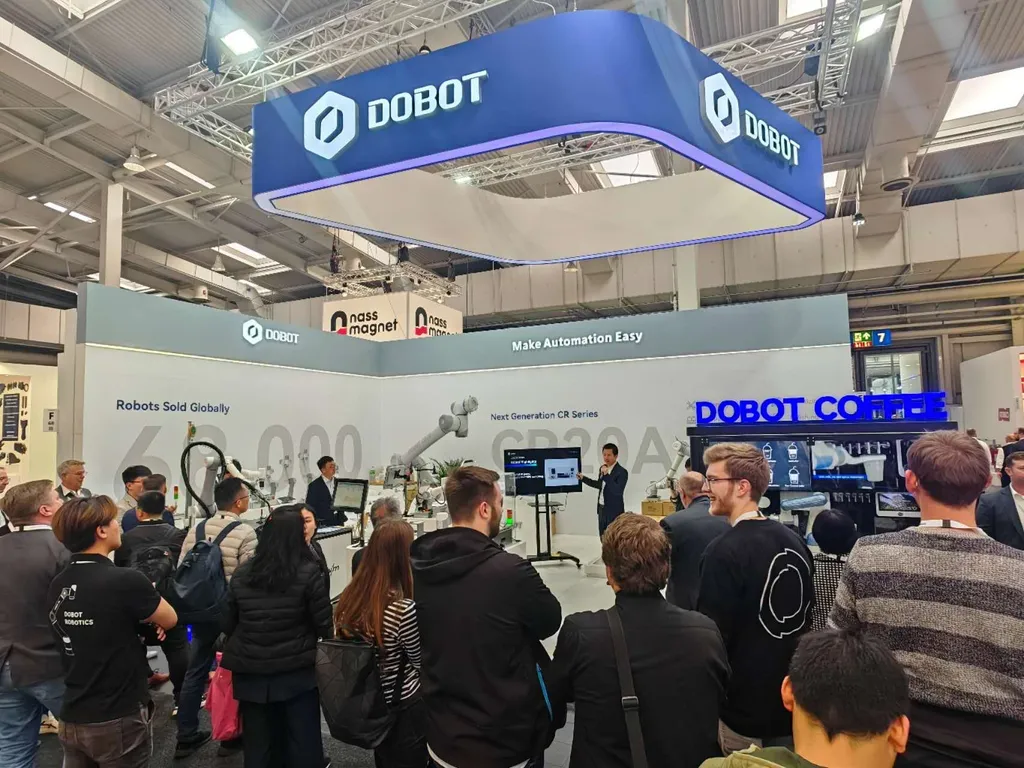
Every single one of Dobot’s 9 robots in our database is a cobot — this Shenzhen firm went all-in on collaborative arms and never built a traditional industrial robot. That is a deliberate product strategy, not a gap in the catalog. Payload runs from 2 kg on the Nova 2 up to 20 kg on the CR20A, reach spans 620 mm to 1700 mm, and the best units hit 0.02 mm repeatability. If you need a fenced, full-speed industrial arm, Dobot is not your vendor. If you need a safe, flexible cobot that can be redeployed without a safety integrator every time, read on.
Who makes Dobot?
Dobot is the commercial brand of Shenzhen Yuejiang Technology Co., Ltd., incorporated on 30 July 2015 by Liu Peichao (Jerry Liu) and six classmates, all graduates of the same robotics engineering program at Shandong University. Seven engineers, one founding team, one focus: collaborative arms. The company is headquartered in Nanshan District, Shenzhen, at Chongwen Park, Nanshan Zhiyuan, on Liuxian Avenue.
Dobot is credited with launching the world’s first desktop-grade robotic arm, which gave the company early visibility in education and light-automation markets before it moved into industrial cobots. Today the brand operates in 80-plus countries through a network of 350-plus partners, with a product line that spans 0.25 kg desktop arms at one end and 30 kg industrial cobots at the other. The 9 robots in our database cover the 2-20 kg six-axis range that matters most for shop-floor deployment.
In December 2024, Dobot listed on the Main Board of the Hong Kong Stock Exchange under stock code 2432.HK, marking its transition from a privately held robotics startup to a public company. That IPO puts financial disclosures on record and gives integrators a stable counterparty to evaluate when committing to a platform long-term. Citations: Dobot official site, Wikipedia - Dobot.
What types of robots does Dobot make?
The short answer: only one type. Every robot Dobot sells is a collaborative robot. There are no SCARA arms, no delta pickers, no Cartesian gantries, no traditional industrial six-axis with a fenced work cell required. The catalog splits into two sub-families — the CR/CRA industrial cobot series (CR3A through CR20A, seven models) and the Nova series (Nova 2 and Nova 5, two lighter-duty models) — but both sub-families are cobots designed to work alongside people without mandatory guarding under an appropriate risk assessment.
That 100% cobot composition is unusual at this price tier. Most Chinese robotics brands that have scaled past the startup phase sell at least one traditional industrial arm alongside their cobot lineup. Dobot does not. That means every integration story — software stack, safety controller, force/torque handling, teach pendant, end-of-arm tooling ecosystem — is built around collaborative deployment. The upside is coherence. The downside is that if an application genuinely requires full-speed, fenced operation for cycle-time reasons, Dobot’s catalog forces you to look elsewhere.
Payload range: 2 kg to 20 kg
The payload spread across the nine robots is wide enough to cover most light-to-medium assembly and handling tasks. Nova 2 at 2 kg handles camera or small gripper payloads; CR20A at 20 kg can manage full palletizing cycles or heavy subassembly transfers.
The CR/CRA series (CR3A through CR20A) is the workhorse family. These units use an EtherCAT joint servo bus, carry a dedicated safety controller rated PLd Cat.3 per ISO 13849-1 with more than 20 safety functions, and include an electromagnetic brake that engages within 18 ms on power loss. That is a complete safety package you can hand to a CE marking assessment without a lot of supplementary hardware. The Nova series trades raw payload and joint speed for lower cost and a simpler form factor suited to electronics assembly, education labs, and small-parts handling.
Reach correlates with payload here but not perfectly. The CR12A at 12 kg reaches 1200 mm; the CR16A at 16 kg reaches only 1000 mm. If you need extended reach at high payload, the CR20A at 1700 mm is the only option in the lineup.
Dobot performance specs at a glance
| Type | Robots | Payload median | Repeat median | Speed range | IP67+ |
|---|---|---|---|---|---|
| Cobot | 9 | 7 kg | 0.03 mm | 1600-5000 mm/s | 0% |
The repeatability median of 0.03 mm is competitive for collaborative arms in this payload class. The CR5A and CR3A go tighter at 0.02 mm — usable for precision electronics assembly without a vision correction loop. The speed range is wide: Nova 2 tops out at 1600 mm/s while CR12A and CR10A reach 5000 mm/s. Note that CR20A is missing a max TCP speed data point in our database, so the 1600-5000 mm/s range covers 8 of 9 robots.
No IP67 ratings in the database means none of these arms belong in a wash-down environment, a spray booth, or any application with consistent liquid or particulate exposure. That is a real constraint for food, beverage, and wet chemical applications.
Complete Dobot robot lineup
| Model | Type | Payload (kg) | Reach (mm) | Repeat (mm) | Max Speed (mm/s) | IP |
|---|---|---|---|---|---|---|
| CR20A | cobot | 20 | 1700 | 0.05 | - | - |
| CR16A | cobot | 16 | 1000 | 0.03 | 4000 | - |
| CR12A | cobot | 12 | 1200 | 0.03 | 5000 | - |
| CR10A | cobot | 10 | 1300 | 0.03 | 5000 | - |
| CR7A | cobot | 7 | 800 | 0.05 | 4000 | - |
| CR5A | cobot | 5 | 900 | 0.02 | 4000 | - |
| Nova 5 | cobot | 5 | 850 | 0.05 | 2000 | - |
| CR3A | cobot | 3 | 620 | 0.02 | 3000 | - |
| Nova 2 | cobot | 2 | 625 | 0.05 | 1600 | - |
The full lineup lives on Dobot’s product pages. The CRA series designation (CR3A, CR5A, and so on) indicates the generation with the dedicated safety controller, laser-tracker joint calibration, and EtherCAT bus — the industrially certified branch. If you are deploying in a regulated environment, target the CRA models and verify ISO 10218-1 and ISO 15066 compliance with your local integrator.
Which Dobot robot fits your application?
Light assembly or inspection on a shared bench. The CR5A is the first choice. At 5 kg payload, 900 mm reach, 0.02 mm repeatability, and 4000 mm/s max speed, it has enough precision for small component placement and enough speed to keep pace with a one-piece-flow cell. The CR3A at 0.02 mm repeatability is an alternative when a shorter 620 mm reach is acceptable and payload needs drop to 3 kg.
CNC machine tending with medium-weight workpieces. The CR10A handles 10 kg at 1300 mm reach and 5000 mm/s - the fastest arm in the lineup. For a lathe or milling center where the robot needs to reach into the spindle area and clear the door swing, 1300 mm is workable for most benchtop and mid-size CNC. The CR12A covers the same speed tier at 12 kg if part weight runs higher.
Palletizing or subassembly transfer at the heavy end. The CR20A is the only option in the Dobot catalog at 20 kg and 1700 mm reach. CRA series safety architecture applies. Note the missing max TCP speed value — verify cycle time against your actual trajectory before committing. The CRA series page and the CR20A product page have the most current kinematics data.
Electronics or light consumer-goods assembly with a tight footprint budget. The Nova series (Nova 2 at 2 kg, Nova 5 at 5 kg) is designed for bench-mounted deployment in small cells. Lower max speeds (1600 and 2000 mm/s respectively) mean these are not throughput-optimized arms — they trade cycle time for a lower acquisition price and simpler integration path. If cycle time matters, step up to the CR3A or CR5A.
High-speed pick-and-place where a cobot is still required. The CR12A at 5000 mm/s and CR10A at 5000 mm/s are the ceiling in this lineup. The CRA series also includes an optional CRAS variant with SafeSkin non-contact pre-collision detection covering 360 degrees within 15 cm, which lets the arm run at collaborative speed (up to 1 m/s per risk assessment) without hard stops from unexpected presence detection.
The bottom line
Dobot’s all-cobot strategy is coherent and, for the right buyer, genuinely useful. You get a single ecosystem — one safety controller architecture, one software stack, one teach pendant learning curve — across a payload range that covers the majority of assembly, handling, and machine-tending tasks on a modern shop floor. The CRA series safety credentials (PLd Cat.3, ISO 13849-1, ISO 10218-1, ISO 15066) are what a CE marking file needs. The 0.02 mm floor on repeatability is tight enough for electronics placement without a vision correction loop.
The problems are real, though. Zero IP-rated models means liquid and particulate environments are out entirely. The CR20A speed gap in our data is a flag — verify kinematics for any throughput-sensitive cell before you sign a purchase order. The Nova series is priced for cost-sensitive applications but gives up speed and reach relative to the CR/CRA equivalents at the same payload tier.
Who should buy Dobot: integrators and end-users who want a clean cobot platform across multiple payload sizes, need CE-compliant safety out of the box, and are running dry, clean environments — electronics assembly, light manufacturing, CNC tending, pick-and-place. The 80-country distribution network and public-company status as of late 2024 reduce vendor-risk concerns that often shadow Chinese robotics brands.
Who should not: anyone with wash-down requirements, anyone who needs a fenced high-speed traditional robot, or anyone whose cycle-time math requires more than 5000 mm/s TCP speed. The table above is the filter — sort by the spec that breaks your application first, and if any Dobot model survives, it deserves a serious RFQ.
Browse the full Dobot cobot lineup on our cobot type page or compare individual models in the spec tables linked above.
Compare these robots