Doosan Robots: 12 Cobots From 5kg to a 30kg Palletizer
Doosan holds ~72% of the 20kg+ cobot market, yet 11 of its 12 robots in our DB are cobots topping out at 30kg payload and 0.05mm repeatability.
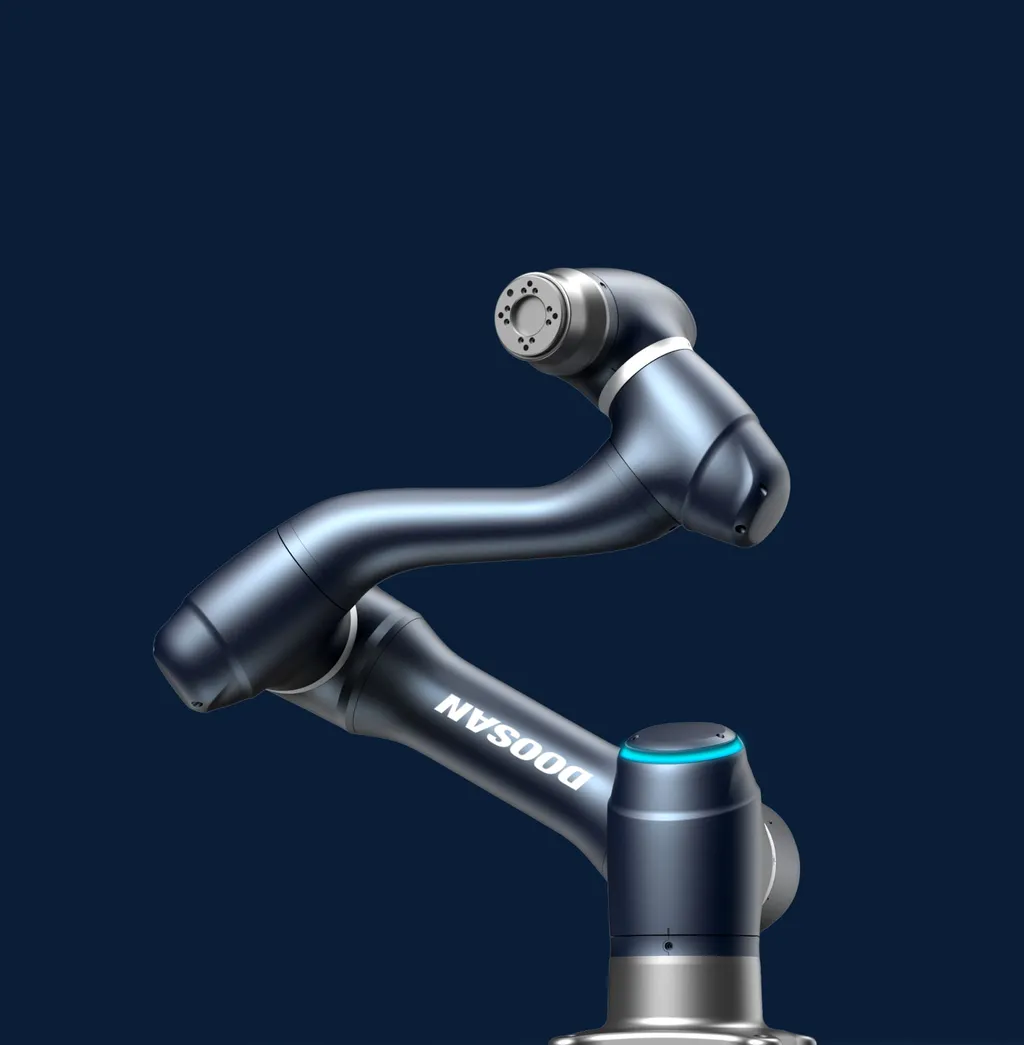
A company founded in 2015 now owns roughly 72% of the global market for heavy-payload cobots over 20 kg, and every one of Doosan’s 12 arms in our database hits 0.05 mm repeatability or better. That combination - dominant heavy-payload position, consistent precision, and a product line built almost entirely around collaborative operation - makes Doosan one of the more focused bets in industrial automation. Where ABB or FANUC offer dozens of robots spanning multiple architectures, Doosan has stayed narrow: six-axis cobots from 5 kg to 25 kg, one palletizing specialist at 30 kg, and a platform engineering philosophy that runs the same control architecture across all of them. This guide maps all 12 models, explains the fleet composition, and identifies which robot fits which application - starting with payload numbers, not marketing language.
Who makes Doosan robots?
Doosan Robotics was established in 2015 as a new growth subsidiary of the Doosan Group, a South Korean industrial conglomerate with roots going back to 1896. The robotics arm was built from scratch in Suwon-si, Gyeonggi-do, South Korea, where the company now operates a production facility with capacity around 10,000 units per year, alongside an Innovation Lab, Prototyping Lab, and dedicated R&D center. The choice to build a fresh robotics entity rather than acquire an existing one says something about the strategy: Doosan Robotics was engineered around a specific market gap, not assembled from legacy assets.
That gap was heavy-payload collaborative operation. When Doosan Robotics entered the market, most cobot vendors were competing in the 3 kg to 10 kg range - the territory carved out by Universal Robots and its imitators. Loads above 15 kg in a collaborative safety envelope were largely unaddressed. Doosan moved to fill that space with the H-series, delivering 20 kg and 25 kg cobots at a time when few manufacturers were willing to attempt it, and achieved first mass production in 2018. Within seven years of founding, the company had climbed to a top-five position globally in collaborative robots, a pace of market penetration that most robotics startups do not approach. The technical differentiator supporting that trajectory is the Master+ force-control system, which combines 6-axis torque sensing at every joint with compliance algorithms tuned for ergonomically demanding tasks - assembly, polishing, and human-guided positioning where load feedback matters more than raw speed.
Geographic expansion followed the product success. Doosan Robotics Americas opened in Plano, Texas in 2022, giving the company a North American sales and service presence. A European branch followed in Dusseldorf, Germany in 2024, with a service center in Heerhugowaard in the Netherlands. The expansion pattern is typical of Korean industrial brands entering Western markets: North America first for revenue scale, Europe for regulatory credibility and proximity to German-speaking machine-tool integrators who are often early adopters of cobot technology.
What types of robots does Doosan make?
Doosan’s portfolio is almost entirely collaborative robots. Eleven of the 12 robots in our database are cobots - six-axis arms with integrated force-torque sensing, built for operation without fixed safety fencing under appropriate risk assessment. One model, the P3020, is a dedicated palletizing configuration, optimized for layer-stacking with a 30 kg payload and 2,000 mm reach.
That 92% cobot concentration is deliberate product strategy, not portfolio incompleteness. Doosan is not trying to compete in welding robots, painting systems, or heavy articulated arms. The company has chosen to own a specific category - safe collaborative operation at higher-than-average payloads - and build depth within it rather than breadth across architectures. For a buyer who needs a cobot, that focus is an advantage: every engineering resource Doosan has is pointed at the problem you are trying to solve. For a buyer who needs anything other than a cobot, Doosan is the wrong vendor to call.
The palletizer P3020 sits slightly outside the cobot category in application terms, though it shares the same underlying collaborative architecture. Its 30 kg payload and 2,000 mm reach allow it to stack boxes over 4 feet high without requiring a floor-level lift mechanism, which is a meaningful installation cost reduction for food and beverage or e-commerce palletizing cells.
Payload range: 5 kg to 30 kg
Doosan’s payload range runs from 5 kg at the entry tier to 30 kg at the palletizing ceiling, with a median across the 12-robot fleet of 9 kg. The distribution skews light: eight of the 12 models carry 10 kg or under, which puts the typical Doosan robot firmly in the assembly, testing, and light machine-tending space. The three H-series models and the P3020 cover the upper range.
The 5 kg cluster at the bottom of the range - A0509, A0509S, and E0509 - all share the same 900 mm reach and 0.05 mm repeatability. The differentiation between them is in the specific use-case tuning and series engineering, not raw payload capacity. Similarly, the M0609 and M0617 share a 6 kg payload but differ significantly in reach: 900 mm versus 1,700 mm, which is the dominant variable for whether either model fits a given cell layout.
The upper end of the range is where Doosan distinguishes itself from the cobot mainstream. The H-series models at 20 kg and 25 kg, and the P3020 at 30 kg, occupy territory that most cobot manufacturers have not entered. That payload capacity allows Doosan arms to handle components and end-effectors that universal cobots from other brands simply cannot move safely. If your application involves heavy fixtures, dual-tool toolchangers, or bulky workpieces that push past 12 kg to 15 kg, the H-series is a short list by default.
Doosan performance specs at a glance
| Type | Robots | Payload median | Repeat median | Speed range | IP67+ |
|---|---|---|---|---|---|
| Cobot | 11 | 9 kg | 0.05 mm | 1000 mm/s | 0% |
| Palletizer | 1 | 30 kg | 0.05 mm | 1000 mm/s | 0% |
Two notes on this table. First, the IP column reads 0% because our database does not have IP ratings populated for Doosan models. Doosan’s published specifications list IP54 as standard on most models - that means protection against dust and splashing water. IP54 is adequate for general manufacturing environments, food-adjacent applications that do not involve direct washdown, and most light assembly contexts. It is not adequate for full washdown, submersion, or aggressive cleaning with high-pressure water. Buyers in food processing, pharma, or beverage who need IP65 or IP67 should verify the specific model spec against their cleaning requirements before committing.
Second, repeatability at 0.05 mm across all 12 models is unusually consistent. Most brands show repeatability variation across their range - lighter, faster models tend to be more precise, while heavy models accept slightly looser tolerances. Doosan’s decision to hold 0.05 mm across the full lineup, including at 25 kg and 30 kg, reflects the 6-axis torque sensor architecture that underpins the Master+ system. You get the same positional consistency whether you are moving a 5 kg component or a 25 kg assembly.
Complete Doosan robot lineup
| Model | Type | Payload (kg) | Reach (mm) | Repeat (mm) | Max Speed (mm/s) | IP |
|---|---|---|---|---|---|---|
| A0509 | Cobot | 5 | 900 | 0.05 | 1000 | - |
| A0509S | Cobot | 5 | 900 | 0.05 | 1000 | - |
| E0509 | Cobot | 5 | 900 | 0.05 | - | - |
| M0609 | Cobot | 6 | 900 | 0.05 | 1000 | - |
| M0617 | Cobot | 6 | 1700 | 0.05 | 1000 | - |
| A0912 | Cobot | 9 | 1200 | 0.05 | - | - |
| A0912S | Cobot | 9 | 1200 | 0.05 | - | - |
| M1013 | Cobot | 10 | 1300 | 0.05 | 1000 | - |
| M1509 | Cobot | 15 | 900 | 0.05 | 1000 | - |
| H2017 | Cobot | 20 | 1700 | 0.05 | 1000 | - |
| H2515 | Cobot | 25 | 1500 | 0.1 | - | - |
| P3020 | Palletizer | 30 | 2000 | 0.05 | 1000 | - |
One outlier worth flagging: the H2515 is the only model in the fleet with repeatability listed at 0.1 mm rather than 0.05 mm. At 25 kg payload, that degradation is modest and unlikely to matter for the heavy-assembly and machine-tending applications the H2515 targets. But if you are specifying the H2515 for precision inspection or tight-tolerance fastening, verify the spec against your tolerance stack before finalizing the cell design.
Which Doosan robot fits your application?
Assembly of medium-weight components at a fixed bench. If your parts run 6 kg to 10 kg and your workstation is a standard assembly bench with a footprint under 1,300 mm, the M1013 is the logical choice. Ten kilograms of payload leaves margin for an end-effector and part weight combined, and 1,300 mm reach covers a standard bench layout without requiring the arm to extend to its maximum angle. The 0.05 mm repeatability handles fastening and alignment tasks without additional calibration routines.
Long-reach light assembly or testing across a wide workcell. The M0617 pairs a 6 kg payload with 1,700 mm of reach - the longest reach in the light-payload tier. That combination suits inspection lines where the robot needs to traverse a long part surface, or test stations where probes need to reach across a wide fixture without repositioning the part. The tradeoff is that 6 kg limits your total end-effector plus workpiece budget, so weigh your tooling mass carefully.
Machine tending with heavy fixtures or dual-gripper setups. The H2017 at 20 kg payload and 1,700 mm reach is built for exactly this scenario. Heavy toolchangers, parallel grippers moving large billets, or setups where the tooling itself exceeds 8 kg all need payload headroom that most cobots cannot provide. The H2017 is the minimum-risk choice when total gripper-plus-part mass is pushing into the 12 kg to 18 kg range.
Palletizing in a space-constrained cell without a floor-level lift. The P3020 is the answer. At 30 kg payload and 2,000 mm reach, it can stack boxes above head height without requiring the cell to be elevated, which simplifies installation significantly in warehouses and food facilities where floor access for maintenance is a priority. The 0.05 mm repeatability is overkill for box-stacking, but it means the P3020 can do light kitting or mixed-pallet work alongside bulk palletizing without needing a separate arm.
High-value small-part assembly where force feedback matters. The A0509 or A0509S at 5 kg payload targets the lower end of the Doosan range, but the 6-axis torque sensing and Master+ force control run on the same platform as the H-series. For assembly tasks where you need to detect insertion resistance, monitor fastening torque in real time, or teach by demonstration without programming contact moves explicitly, the A-series cobots deliver those capabilities at a price point closer to the mainstream cobot market.
The bottom line
Doosan is a one-category company that has executed that category exceptionally well. If you need a cobot, particularly one that handles payloads other brands cannot touch in a collaborative envelope, Doosan belongs on your shortlist. If you need anything else - welding robots, painting systems, SCARA for high-speed pick, or delta pickers for line production - Doosan is not the right conversation.
The spec table above resolves to a fairly clean buying decision once you reduce it to three variables.
Payload below 10 kg, reach under 1,300 mm. The M-series and A-series cover this. The M0609 and M1013 are the workhorse options. The A0509 adds force-control depth if your application involves contact tasks.
Payload 10 kg to 20 kg, long reach. The M1509 covers the 15 kg tier at 900 mm reach. For longer reach at the same payload class, the H2017 at 20 kg and 1,700 mm is a better fit even though it overspecifies the payload, because the reach geometry is more important than the payload margin in most machine-tending layouts.
Payload above 20 kg. The H2515 and P3020 are the only options, and they serve different functions. H2515 is a general-purpose cobot for heavy assembly. P3020 is a purpose-built palletizer. Do not use the P3020 for precision assembly tasks - it is tuned for stacking, not tight tolerances, even though the spec sheet shows 0.05 mm repeatability.
The 72% market share claim for cobots over 20 kg is real, but it is also somewhat self-referential: the market for heavy-payload cobots is largely a market that Doosan created by entering it first. The competition in that tier is still thin compared to the 3 kg to 10 kg cobot space. That is an advantage for buyers who need heavy collaborative arms today - Doosan is not one of several options, it is usually the option. It is also a risk for long-term platform planning: a brand that dominates a niche that it largely invented is harder to benchmark on support quality, software roadmap execution, and spare-parts availability than a brand competing in a crowded market where those dimensions are tested continuously.
Buy Doosan if your application is collaborative, your payload requirement is above 12 kg, and you want a vendor whose entire engineering effort is pointed at the problem you are solving. Look elsewhere if you need anything outside the cobot category, or if you need IP67 protection and cannot confirm the specific model meets your ingress requirement before delivery.
Sources: Doosan Robotics A-Series - M-Series - H-Series - P-Series - Wikipedia: Doosan Robotics
Compare these robots