Fenceless Robots: 10.6 m/s Beats Every Cobot We Track
Mantis Robotics' fenceless MR-X runs at 10.6 m/s, 2.1x the fastest cobot in our 273-robot database. No cage. Here is what that actually changes.
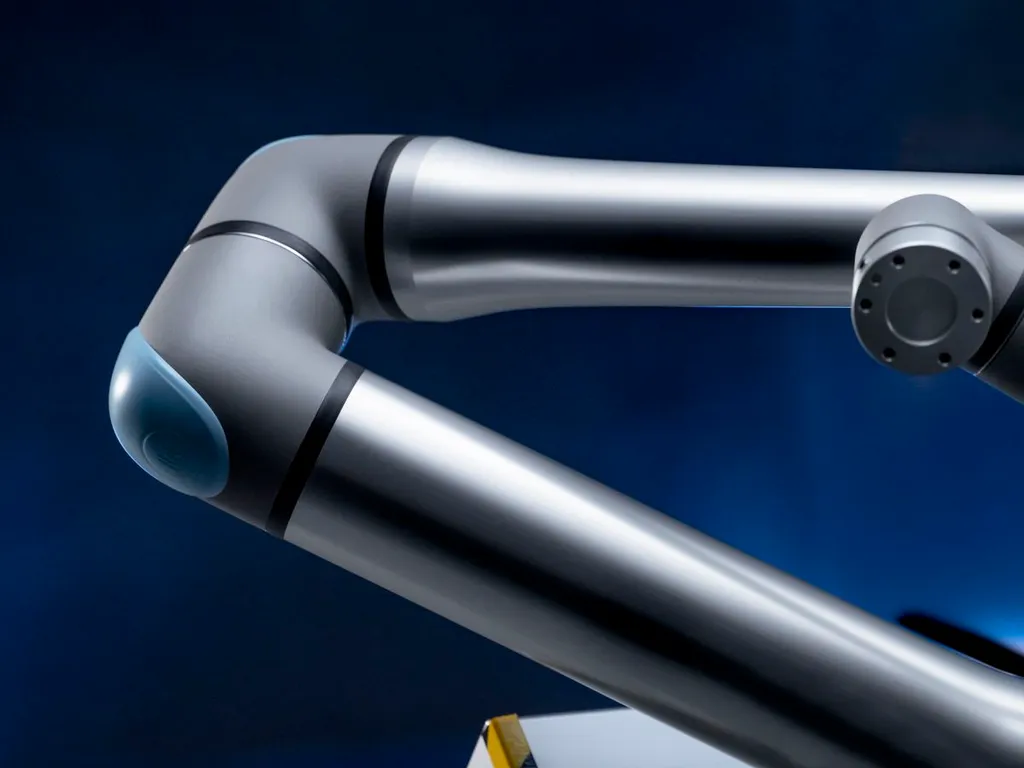
Mantis Robotics unveiled the MR-X at Automate 2026 in Chicago on June 22: a dual-arm robot rated to 10.6 m/s (10,600 mm/s) with no safety fence, no cage, and no laser scanner defining a keep-out zone. Run that number against our own database of 273 robots and the comparison is not close. The fastest cobot we track, a four-way tie at 5,000 mm/s, is beaten by 2.12x. The median cobot, at 1,500 mm/s, is beaten by 7.07x. Only 3 of the 112 robots in our entire database that publish a top speed match or exceed 10,600 mm/s, and every one of them is a guarded industrial arm behind a fence. The MR-X claims to run at that speed with people standing next to it.
What is a fenceless robot, and how is it different from a cobot?
Every collaborative robot in our database earns that label through one of the collaboration modes defined in ISO/TS 15066: power and force limiting (PFL), speed and separation monitoring (SSM), safety-rated monitored stop, or hand guiding. PFL is the mode that lets a cobot share space with a person continuously, and it works by capping the energy the robot can transfer on contact, which is exactly why PFL cobots top out around 150-250 mm/s in true collaborative operation and even their rated max speeds cluster at a fraction of a fenced arm’s. We covered that throughput tax in detail in a companion piece: it is not a marketing choice, it is the physics of a biomechanical force limit.
Mantis Robotics is not running PFL. The MR-X uses what the company calls SafetyCore, described in its launch announcement as a patented reflex system that processes the robot’s surroundings continuously and reacts autonomously the instant a person enters its path, rather than relying on an external area scanner or a pre-defined slow-down zone the way SSM does. That is a different safety architecture, not a faster version of the same one. Whether it holds up as broadly as PFL and SSM have across two decades of deployed cobots is the open question, not the marketing claim. The predecessor MR-1 is certified to ISO 10218 and ISO 13849 and has reportedly been running in Amazon facilities, so this is not a first-time claim untested outside a trade-show floor.
How does 10.6 m/s stack up against the robots we track?
Badly, if you are a cobot. Our database holds 112 robots that publish a maximum TCP speed. Fifty-six of them are cobots, and their speeds run from 1,000 to 5,000 mm/s with a median of 1,500 mm/s. The fastest cobots in the entire database, tied at 5,000 mm/s, are the Universal Robots UR20, the UR15, and Dobot’s CR10A and CR12A. The MR-X’s 10,600 mm/s is more than double that ceiling.
| Robot class | Speed (mm/s) | Fence required |
|---|---|---|
| Cobot, database median (n=56) | 1,500 | No |
| Cobot, fastest in database (4-way tie) | 5,000 | No |
| Mantis MR-X (claimed) | 10,600 | No |
| Fastest guarded robot in our database (Epson G20, SCARA) | 11,000 | Yes |
performance.maxTcpSpeedMms, cross-referenced against Mantis Robotics’ published MR-X specification. Only 3 of 112 database robots match or exceed 10,600 mm/s (Epson G20 at 11,000, Staubli TX2-90 at 10,900, Inovance IR-S20-100Z42S5 at 10,800), all guarded SCARA or articulated arms.The framing that matters here is not “fastest robot in the world.” It is not even close to that; our own database has SCARA and articulated arms rated faster. The framing is that the MR-X claims to hit a speed that, in our entire tracked database, has only ever belonged to fenced industrial arms, while requiring no fence at all. That is a different competitive set than any cobot on the market, and it is why the launch is being covered as a safety-architecture story rather than a speed-record story by The Robot Report and others.
Does payload keep pace with speed?
This is where the claim needs the most scrutiny. Mantis lists the MR-X’s capacity at up to 70 lbs, about 31.75 kg. The press materials do not specify whether that figure is per arm or combined across the dual-arm system, which matters a lot for a real integration decision and is the kind of ambiguity our own database’s performance.payloadKg field is built to eliminate.
Taking 31.75 kg at face value against our cobot data: the median cobot payload across 116 rated cobots is 10 kg, and only 5 of those 116 (4.3%) are rated at 31.75 kg or above — the AUBO iS35 and Rokae xMate CR35 at 35 kg, the UR30 at 35 kg, the Rokae xMate CR45 at 45 kg, and the FANUC CR-35iB at 50 kg. So even under the more generous reading, an MR-X-class payload sits at the very top of what today’s collaborative robot market offers, not in the middle of it. If 70 lbs turns out to be a per-arm figure or a peak rather than a continuous rating, that comparison gets weaker, not stronger. Buyers evaluating this machine should ask Mantis directly for a payload-at-reach curve, the same spec gap we have flagged in rated-vs-real payload comparisons across the rest of the industry.
Is this the first fenceless high-speed robot, or should buyers wait?
Neither answer is quite right. The MR-X is not first: it is the second generation of a platform. The MR-1 has reportedly been running fenceless at up to 10.6 m/s inside Amazon operations for a period of time before this launch, per RoboticsTomorrow’s coverage, and carries ISO 10218 and ISO 13849 certification rather than a trade-show demo status. That is a real deployment history, not a paper spec.
But “should you wait” is still the right question for most of the buyers we write for. Mantis is not in our structured database alongside the 20 brands we track, and that is not an oversight, it is because the company does not yet publish the kind of open, itemized spec sheet that ABB, FANUC, or Universal Robots do: no public price, no independently verifiable payload-at-reach curve, no repeatability figure, no IP rating. Every brand in our 273-robot database has a service network, a distributor list, and in most cases a decade or more of field data behind its numbers. A buyer choosing between a proven UR20 cell at 5,000 mm/s under PFL and an MR-X at 10,600 mm/s under SafetyCore is not choosing between two similar machines at different speeds. They are choosing between an established supply chain with a slower robot and a newer architecture with a faster one and a thinner track record. Both are legitimate choices depending on the application, but they are not the same choice, and the marketing framing around “no fence needed” should not obscure that the two options carry very different integration risk today.
The real story of the MR-X launch is not the speed number. It is that “collaborative” and “fenced-arm-fast” have historically been mutually exclusive categories in every robot we have ever catalogued, and a credible vendor is now claiming they no longer have to be. Whether that claim generalizes past one vendor’s press release into an industry-wide shift is exactly the kind of thing this column will be watching the database for.
Compare these robots