Robotics' Week: Real-World Data and the Move to Fleets
Two launches this week chase real-world data over curated setups, autonomy scales from cell to fleet, and the week's boldest promise still has not shipped.
Two stories carried this week’s desk, and both point at the same underlying bet: industrial robotics is done treating curated, idealized setups as good enough, and is now paying to learn from and sense the messy real world instead. Universal Robots and Scale AI’s UR AI Trainer captures live force, motion, and vision data on deployed cobots to train Vision-Language-Action (VLA) models. ABB’s Flexley Stack F712 uses onboard-camera visual SLAM to map its own surroundings on the fly rather than following pre-installed floor tape or reflectors. Different problems, training data versus navigation, but the same wager. Layered on top: autonomy is consolidating from single-cell products into coordinated fleets, capital is following the scaled model, and the week’s most checkable claim (UR’s promised dataset) still has not shipped.
Physical AI’s real-world data problem is the week’s throughline
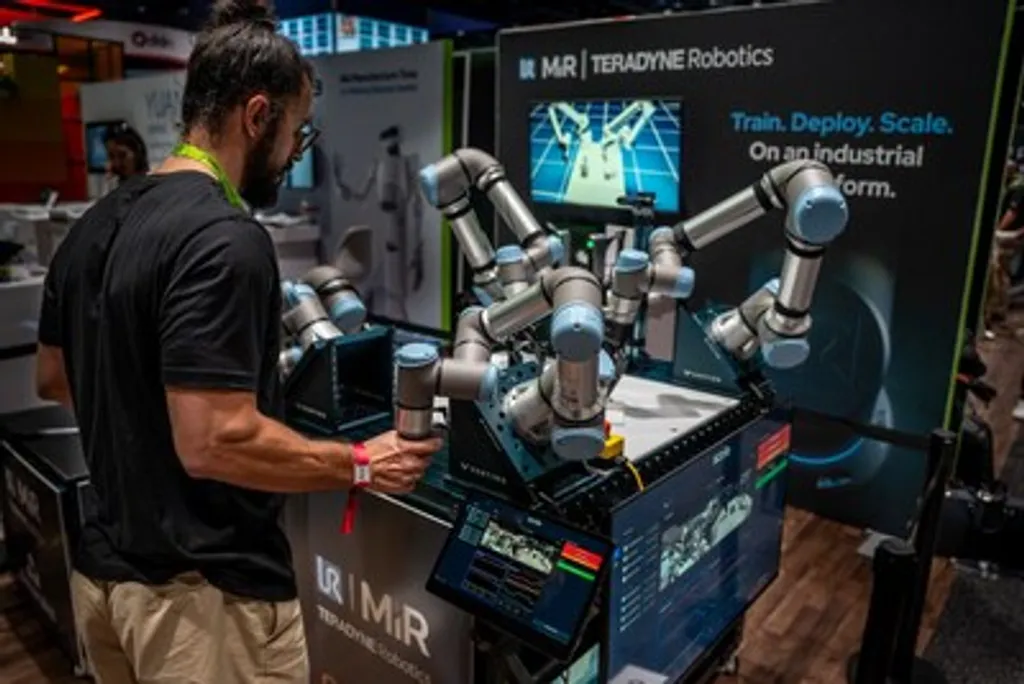
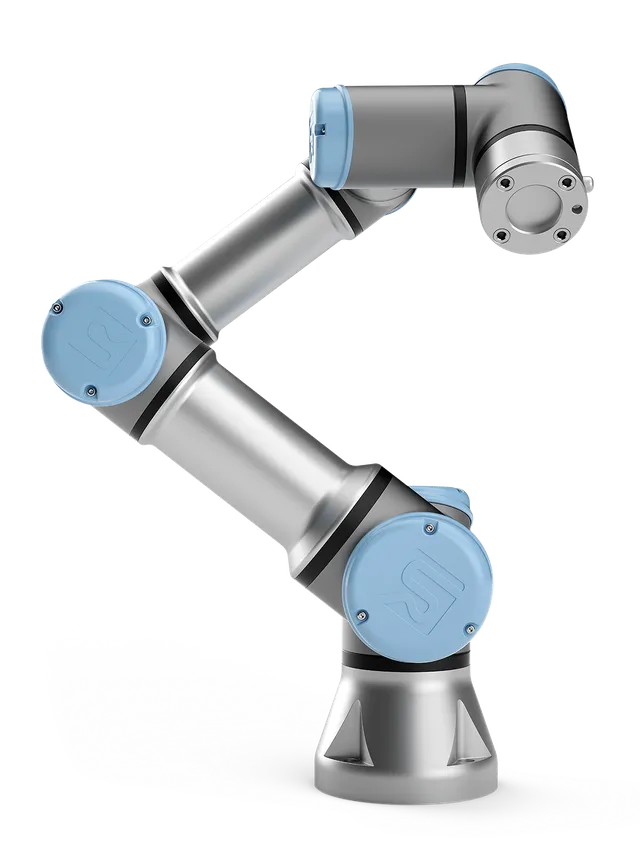
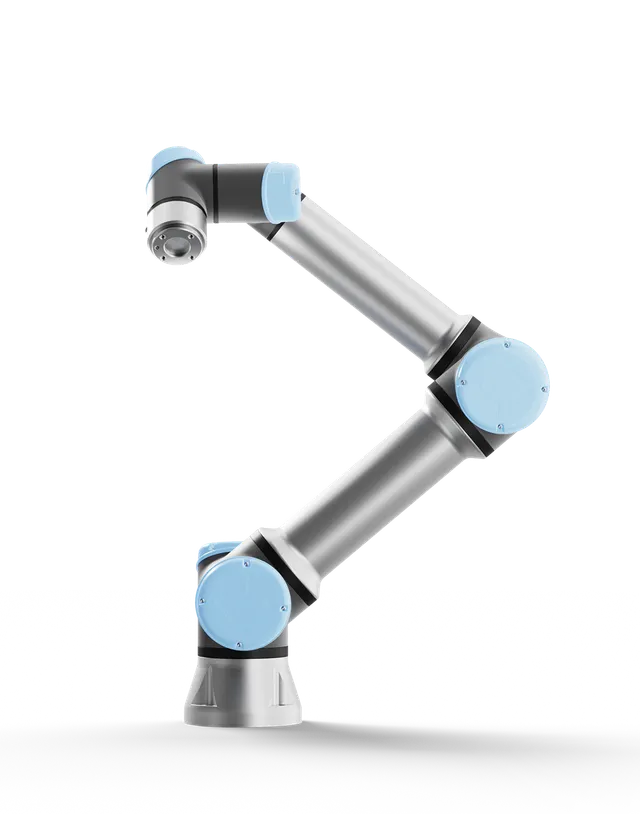
Both of this week’s launches attack the gap between a controlled demo and an actual factory floor. UR AI Trainer is a leader-follower rig: a human physically guides a UR3e cobot through a task while a synchronized UR7e mirrors it, recording force-torque, motion trajectory, and RGB vision data as it goes. That multimodal capture, built on real production-class hardware rather than a simulator, is meant to fine-tune VLA models that map camera input and instructions directly to robot motion, the class of AI every major robotics player is racing to get right.
ABB’s Flexley Stack F712 attacks a related but distinct problem: navigation. Conventional automated forklifts typically follow magnetic tape, floor-mounted QR codes, or wall reflectors, infrastructure that has to be installed and re-laid every time a warehouse layout changes. The F712 instead uses visual SLAM to build and continuously update a 3D map from onboard cameras alone, so it can go to work without a retrofit and keep adapting if aisles or racking move. Neither story is claiming general-purpose robot intelligence. Both are chasing the same narrower, more useful goal: get the robot’s information about the world from the world itself, not from a proxy someone built in advance. It’s established context across the whole VLA and AMR field that this real-world-data gap is the harder half of the problem, and it’s the throughline the two in-repo stories share.
Autonomy is shifting from the single cell to the coordinated fleet, and capital is following the scaled model
ABB’s story is explicitly fleet-level, not product-level. The F712 is the third piece, joining the existing Flexley Tug and Flexley Mover, in what ABB calls its completed visual-SLAM AMR portfolio: tug, mover, and now heavy-lift forklift, covering palletizing and pallet transport, tugging, and material handling duty. The consequential part isn’t any one robot’s spec sheet, it’s that all three run through ABB’s AMR Studio orchestration software and are VDA5050-compatible, the industry standard that lets AMRs from different lines, and in principle different vendors, coordinate traffic and task assignment as one mixed fleet rather than three siloed products.
Capital is following that same scaled-deployment logic. Teradyne, Universal Robots’ parent, announced a roughly $32 million US operations hub in Wixom, Michigan, opening in 2026 with more than 200 jobs, built to produce UR cobots closer to North American demand rather than shipping every unit from overseas. It’s a reshoring-and-scale bet that mirrors ABB’s fleet consolidation: both companies are betting the next phase of growth comes from deploying more units, more coherently, closer to the customer, not from a single flagship product. Worth one line of context: capital is also flowing into adjacent embodied AI, AI² Robotics raised roughly $735 million at a $2.8 to 3 billion valuation for wheeled humanoid robots this week, per The Robot Report, though that’s an adjacent humanoid bet, not a core industrial-automation story, and shouldn’t be read as part of the same fleet-consolidation trend above.
Announcement versus delivery: the recurring tension between the launch pitch and the shipped product
The most checkable claim from either story is also the one still unresolved. UR promised a large-scale industrial dataset “later in 2026” at the March GTC launch, built from the UR AI Trainer captures. As of July 10, 2026, roughly four months later, neither UR’s newsroom nor Scale AI’s public channels show that dataset as published. Mid-year still sits comfortably inside a “later in 2026” window, so this isn’t evidence the project stalled, but it does mean the training claims behind UR AI Trainer remain unverifiable by outside researchers today.
ABB’s F712, by contrast, is stated as “available now,” a clearer delivery claim than UR’s. But its headline numbers, ±10 mm positional accuracy and 20 percent faster commissioning when paired with AMR Studio, are ABB’s own published figures from launch coverage, not results independently confirmed in a deployed customer site. The pattern across both stories is the same for a buyer evaluating either platform this week: this was a week of things to watch land, not a week of two finished, independently verified results.
Sources
- ABB Robotics includes vSLAM navigation in F712 autonomous forklift — The Robot Report, Jul 7, 2026
- ABB Robotics completes Visual SLAM AMR range with autonomous forklift launch — Robotics & Automation News, Jul 8, 2026
- ABB Robotics completes its AI-powered visual SLAM AMR portfolio with new autonomous forklift — RoboticsTomorrow, Jul 7, 2026
- Universal Robots, Scale AI Launch Imitation Learning System to Accelerate AI Training, Bridging the Lab-to-Factory Gap — Universal Robots, Mar 19, 2026
- Universal Robots and Scale AI's UR AI Trainer Captures Data for Robotics AI Development — Control Design, Mar 17, 2026
- New US Operations Hub to Open in 2026 — Universal Robots, Jun 1, 2026
- Teradyne Robotics to Make Cobots in Michigan — ASSEMBLY Magazine, Jun 2, 2026
- Teradyne Robotics to Open U.S. Operations Hub in Wixom in 2026 — D!Business, Jun 3, 2026
- AI² Robotics Raises $735M at $2.8-3B Valuation for Wheeled Humanoid Robots — The Robot Report, Jul 9, 2026
Robots mentioned
Tap a card to open the full spec sheet.
Frequently asked questions
Why does real-world data matter for robot AI? +
Simulator-trained robot AI often fails on real production floors because lighting, material variance, tooling wear, and fixture tolerances never match idealized conditions. UR and Scale AI's UR AI Trainer captures force, motion, and vision data on deployed hardware to close this lab-to-factory gap, a bottleneck the whole VLA and imitation-learning field is chasing.
What does ABB's F712 completing its AMR portfolio mean for a buyer? +
ABB now offers three camera-navigated autonomous robots (tug, mover, forklift) coordinated through one software layer, AMR Studio, over the VDA5050 standard, so they run as one mixed fleet with no vendor silos. ABB claims up to 20 percent faster commissioning, a company figure not independently tested.
Has UR's promised industrial dataset shipped yet? +
No. UR said later in 2026 at the March launch, and as of 2026-07-10 neither UR nor Scale AI has published it, so its training claims cannot yet be independently inspected. It remains the open item to watch.
Why is Teradyne building cobots in Michigan? +
Teradyne, Universal Robots' parent, announced a US operations hub in Wixom, Michigan, opening in 2026 with 200-plus jobs, to build UR cobots closer to North American demand, a reshoring and scale bet as automation demand grows in the region.
More news