FANUC, Yaskawa, Kawasaki, Fujitsu Join NVIDIA Cosmos Coalition
FANUC, Yaskawa, Kawasaki Heavy Industries, and Fujitsu will integrate NVIDIA's Cosmos physical-AI stack, backed by Japan's ¥387.3B robotics AI investment.
FANUC, Yaskawa Electric, Kawasaki Heavy Industries, and Fujitsu each committed on July 15 to build products on NVIDIA’s Cosmos physical-AI stack, NVIDIA and the companies announced, layering a specific hardware and software commitment on top of a Japanese government robotics-AI investment this desk already covered in detail. The commitment rides on the same ¥387.3 billion ($2.39 billion) fiscal-2026 funding tranche behind Noetra, the government-backed AI infrastructure entity this desk profiled on July 15, but adds concrete numbers that weren’t public then: a 27,500-GPU order, a named executive, and a construction timeline stretching to 2028.
What’s new since the July 15 report
Industrial Robotics Hub’s July 15 story on Japan’s Noetra consortium covered METI’s up-to-¥1-trillion, five-year commitment to a SoftBank-, Sony-, NEC-, and Honda-backed physical-AI foundation model, with the ¥387.3 billion FY2026 tranche as its first guaranteed installment. That story described Noetra as national software infrastructure, not a product play. This announcement is the hardware and vendor layer sitting on top of it: Noetra Corp, led by president Hironobu Tamba, a former SoftBank AI large-language-model developer, is purchasing 27,500 NVIDIA Rubin GPUs and 13,750 Vera CPUs for a data center targeting 140 megawatts of capacity. Separately, and this is the genuinely new industrial-robotics angle, four manufacturers not named as Noetra’s core owners in the July announcement, FANUC, Yaskawa, Kawasaki Heavy Industries, and Fujitsu, are now on record committing to build on NVIDIA’s Cosmos world-model platform specifically, rather than simply benefiting from Noetra’s shared foundation model in the abstract.
The infrastructure timeline
Noetra Corp’s data center construction is scheduled to begin in April 2027, with operations targeted for June 2028, per NVIDIA’s own release. That is a multi-year gap between this week’s announcement and any hardware actually running production workloads, a detail worth holding onto against the more urgent-sounding “coalition” framing in the headline. In the interim, Noetra and Japan’s national research institute AIST are still separately targeting a first version of their shared foundation model within the current fiscal year, the same near-term milestone this desk flagged in the July 15 story as the thing worth watching most closely.
What FANUC, Yaskawa, Kawasaki, and Fujitsu are each doing
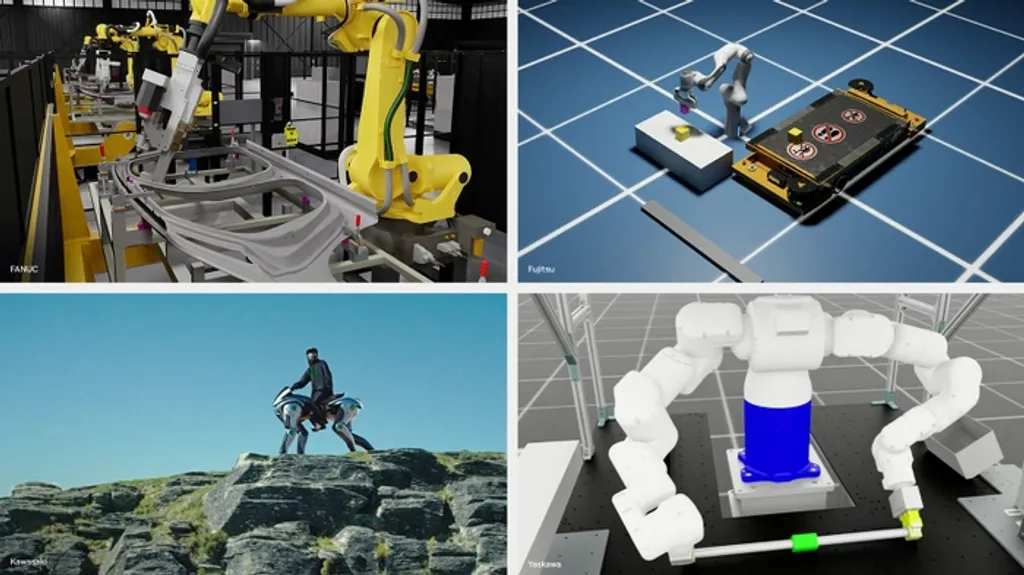
The four companies are not adopting NVIDIA’s stack identically. Fujitsu is building what NVIDIA describes as a collaborative control platform that integrates Isaac simulation, Omniverse digital twins, Jetson edge compute, and Cosmos world models into a single pipeline other manufacturers can plug into, positioning Fujitsu as the systems-integration layer rather than a robot maker itself. FANUC, the world’s largest industrial robot manufacturer by installed base, and Yaskawa, a leading motion-control and robotics supplier, are each applying the stack to their existing arm lines, with automotive assembly and precision manufacturing cited as the initial target applications. Kawasaki Heavy Industries, whose product range spans industrial arms to wearable exoskeletons, is the more unusual name on the list; NVIDIA’s own press imagery for the announcement shows a Kawasaki wearable device being tested outdoors on uneven terrain, alongside FANUC’s assembly-line arms and a simulated Fujitsu digital twin, suggesting the coalition’s scope runs wider than fixed factory-floor arms alone.
Why it matters
Japan’s government has stated a target of capturing 30% of the global AI-robotics market and building a ¥20 trillion domestic industry by 2040, the same ambition scale this desk’s July 15 story sized against Japan’s roughly 450,500-unit installed industrial robot base. This week’s announcement doesn’t change that target, but it does put four specific, well-known manufacturer names, rather than an abstract “Japanese industry,” behind the technology layer meant to get there. For buyers and integrators outside Japan, the practical near-term impact is limited: none of the four companies has announced a shipping product built on Cosmos, and Noetra’s own infrastructure is not operational until mid-2028. What the announcement does confirm is which manufacturers are placing early bets on NVIDIA’s physical-AI stack specifically, as distinct from competing approaches like Mistral AI’s single-camera Robostral Navigate system, which this desk covered on July 16, or in-house alternatives some of these same companies could pursue independently.
FANUC and Yaskawa’s existing product lines, both built around articulated arms, are cataloged in Industrial Robotics Hub’s own robot database; neither company has yet listed a Cosmos-specific model.
Sources
- Japan's Robotics and Manufacturing Leaders Build on NVIDIA Cosmos to Advance Physical AI Frontier — NVIDIA Newsroom, Jul 15, 2026
- Japan's Robotics and Manufacturing Leaders Build on NVIDIA Cosmos to Advance Physical AI Frontier — GlobeNewswire, Jul 16, 2026
- NVIDIA, Japan robotics and manufacturing leaders build physical AI coalition — Taipei Times, Jul 17, 2026
- Japan Ecosystem 2026 — NVIDIA Blog, Jul 15, 2026
Frequently asked questions
What is NVIDIA Cosmos, and why do FANUC, Yaskawa, and Kawasaki need it? +
Cosmos is NVIDIA's world foundation model platform for physical AI: software trained to predict and simulate how the real world behaves, so a robot can be trained and tested against realistic synthetic scenarios before it ever touches a real part. Paired with NVIDIA's Isaac simulation tools, Omniverse digital twins, and Jetson edge compute, it targets the same problem all three manufacturers face: teaching arms and mobile robots to handle variation, a part sitting a few millimeters off, a bin that isn't quite full, that rigid pre-programmed motion paths cannot.
Is this the same Japanese robotics program Industrial Robotics Hub covered on July 15? +
Yes, with new specifics. The ¥387.3 billion figure is the same fiscal-2026 tranche METI committed to the Noetra consortium in our July 15 coverage. What's new here is the NVIDIA-specific hardware buildout, Noetra Corp's 27,500 Rubin GPU and 13,750 Vera CPU order, a 140-megawatt data center, and named commitments from FANUC, Yaskawa, Kawasaki Heavy Industries, and Fujitsu to build products on NVIDIA's Cosmos, Isaac, Omniverse, and Jetson stack specifically.
When will factory robots running on this NVIDIA stack actually ship? +
Not soon on the infrastructure side. Noetra Corp's data center does not begin construction until April 2027 and is not targeted to be operational until June 2028. Separately, FANUC, Yaskawa, and Kawasaki already use NVIDIA Isaac simulation and Jetson edge hardware in current development work, so incremental Cosmos-linked tools could surface in existing product lines before Noetra's own infrastructure comes online, but neither NVIDIA nor the four companies have published a product ship date tied to this announcement.
How does this compare to humanoid-robot funding news like Agility Robotics' SPAC or AI² Robotics' $735 million round? +
Different targets. Agility and AI² Robotics are individual companies raising capital to build and sell specific humanoid robots. This is a national infrastructure and software-platform bet: Japan's government funding shared AI compute and a foundation model that FANUC, Yaskawa, Kawasaki, and Fujitsu can each build their own, separate products on top of, arms, mobile robots, and exosuits alike, rather than one company betting on one robot.
More news