Productive Robotics Brings 7-Axis OB7 Family to IMTS 2026
Productive Robotics will show its five-model OB7 collaborative robot line at two IMTS 2026 booths, pitching zero-programming setup and a 7th axis for CNC-heavy manufacturers.
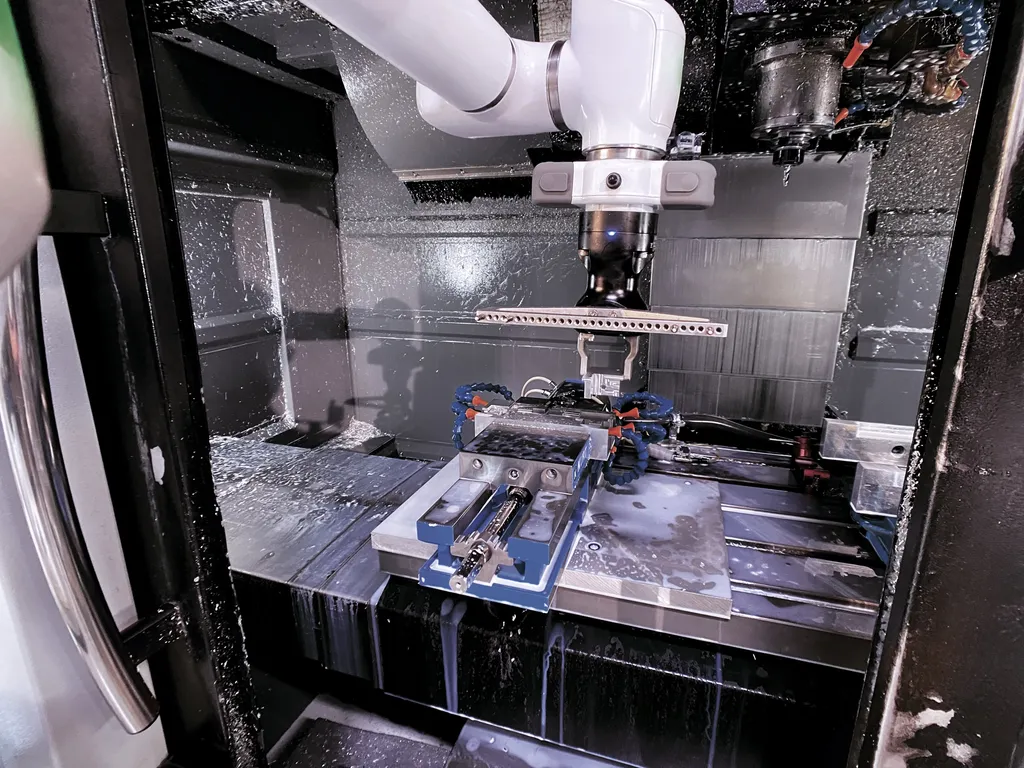
Productive Robotics, the Santa Barbara, California cobot maker, will exhibit its OB7 family of 7-axis collaborative robots at two booths at IMTS 2026 this September, pitching a “zero programming” setup process and an extra degree of freedom the company says no other US manufacturer currently builds into a collaborative arm. The July 1 announcement, made ahead of the September trade show, centers the pitch on CNC-heavy manufacturing, specifically shops serving defense, aerospace, and automotive customers, where Productive Robotics argues a persistent skilled-labor shortage makes code-free robot setup a bigger selling point than raw speed or payload.
What’s being shown
IMTS 2026, the International Manufacturing Technology Show, runs September 14-19 in Chicago, and Productive Robotics will occupy two booths built around different parts of the machining workflow. Booth #339186, in the south building, focuses on metal-removal-process automation. Booth #237138, in the north building, covers abrasive machining, sawing, and finishing, with a specific emphasis on gear production, a segment where consistent, repeatable tending matters as much as raw cycle time.
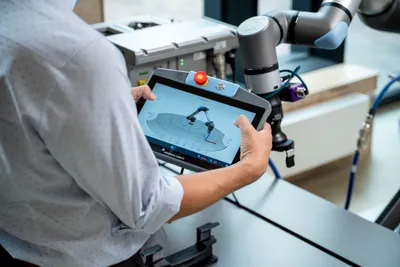
The centerpiece is the OB7 line, a five-model family of 7-axis cobots that Productive Robotics designs, manufactures, and services in the US, with the base OB7 model “field proven since 2017” according to the company’s own product page. All five models share the same core pitch: an operator physically grabs the arm and walks it through a task once, the robot records the motion, and it is ready to repeat the task within minutes, no programming language or robotics background required. A control tablet lets operators track, log, and pull performance reports on the running cell.
The 7th axis, and what the spec table actually shows
The feature Productive Robotics leans on hardest is the extra joint. “There are industrial 7-axis robots but we are currently the only US company to provide 7-axis collaborative robots,” said Zac Bogart, the company’s president, in the July 1 press release. “Our arms have seven degrees of freedom from the shoulder to the hand.” That 7th axis is framed as giving the arm human-like dexterity, letting it reach around fixtures and obstacles without redesigning the surrounding workspace, and the release specifically calls out how it benefits the company’s sister welding line, Blaze, by continuously re-orienting the torch along a weld path instead of requiring the whole arm to reposition between passes.
Pulled directly from each model’s own product page, the five-model spec table tells a more interesting story than the marketing framing alone:
Payload climbs in an orderly line from the 5 kg base OB7 up to the 16 kg OB7 Max 16. Reach does not. The OB7 Max 8 has the longest reach in the entire family at 1.7 meters (66.9 inches), despite carrying only a mid-tier 8 kg payload rating. The OB7 Max 16, the highest-payload model, has the shortest reach among the three Max variants at 1.0 meter (39 inches), tying the much lighter base OB7 on reach. The OB7 Stretch, as its name implies, trades payload down to 4 kg in exchange for a 1.25 meter reach, the second-longest in the line. In practice that means a buyer choosing by payload alone could land on a robot with a noticeably shorter working envelope than a lower-payload sibling, so reach and payload need to be checked independently against the actual cell geometry rather than assumed to move together.
Weight and mounting flange track with the payload tiers rather than the reach: the OB7 and Stretch both weigh 22 kg (58 lb) on a 220 mm flange, while all three Max models weigh roughly 58 kg (127-128 lb) on a larger 250 mm flange. The base OB7’s control computer runs on a 100-240 VAC, 50-60 Hz supply, communicates over Ethernet 100MB, EtherNet-IP, TCP/IP, and Modbus, and carries an IP30 enclosure rating.
Productive Robotics lists mill tending, lathe tending, deburring, welding, gluing, and packaging as core OB7 applications, with machine tending as the headline use case tying directly to the two IMTS booths’ focus on CNC and gear-production automation.
Why it matters for buyers
The pitch here is squarely aimed at small and mid-size CNC shops that cannot justify a dedicated robotics programmer on staff, a real and persistent gap in US manufacturing labor. A code-free teach process lowers the skill floor for getting a cobot running on a mill or lathe, and the 7th axis, if it performs as described, could reduce how often a cell needs to be physically redesigned to give the arm clearance. None of that is unique to Productive Robotics as a category, teach-by-demonstration and extra-DOF arms both exist elsewhere in the cobot market, but the specific combination, plus the company’s own-manufacture, own-service model, is the differentiation being pitched here.
Buyers evaluating the line should treat the payload and reach numbers as two separate decisions rather than a single scaling curve, given how they diverge across the five models, and should note that neither the manufacturer’s pages nor the July 1 release states a specific ISO 10218-1 compliance claim or arm speed figure, so those should be confirmed directly with the company before a purchase decision if they’re a requirement.
Productive Robotics is not currently represented in our robot database; for comparison, see our existing roundup of cobots built for machine tending, a use case directly at the center of the company’s IMTS pitch, and our overview of the cobot class more broadly.
Sources
- OB7 Collaborative Robot — Productive Robotics
- Productive Robotics Equips Manufacturers with Zero Programming, End-to-End Automation at IMTS — RoboticsTomorrow, Jul 2, 2026
- Productive Robotics Equips Manufacturers with Zero Programming, End-to-End Automation at IMTS — ManufacturingTomorrow, Jul 2, 2026
Frequently asked questions
What makes the OB7 different from a standard industrial cobot? +
Productive Robotics says the OB7 family uses 7 degrees of freedom, from shoulder to hand, versus the 6-axis design standard on most industrial and collaborative arms. The company states it is currently the only US company producing 7-axis collaborative robots, a company claim this desk has not independently verified against every competitor. The extra joint is meant to let the arm reach around obstacles and re-orient continuously without redesigning the workspace.
What does 'zero programming' actually mean on this robot? +
An operator with no coding or robotics background physically grabs the arm and guides it through a task once. The robot records that motion and can repeat it within minutes, without writing code. A control tablet then lets operators track, log, and generate performance reports on the running task.
Which OB7 model has the longest reach, and is it also the highest-payload model? +
No. The OB7 Max 8 has the longest reach in the family at 1.7 meters despite a mid-tier 8 kg payload rating. The highest-payload model, the OB7 Max 16 at 16 kg, has the shortest reach among the Max variants, at 1.0 meter, the same reach as the much lighter base OB7. Reach and payload do not scale together in one direction across the five-model line.
Where can people see the OB7 family in person, and when? +
Productive Robotics will exhibit at IMTS 2026 (International Manufacturing Technology Show), September 14-19, 2026, in Chicago, at two booths: #339186 in the south building, focused on metal-removal-process automation, and #237138 in the north building, focused on abrasive machining, sawing, and finishing, with an emphasis on gear production.
More news