Mistral's Robostral Navigate Guides Robots With a Single Camera
Mistral AI's first embodied-navigation model, Robostral Navigate, moves robots through complex spaces using only a plain RGB camera, no LiDAR or depth sensors required.
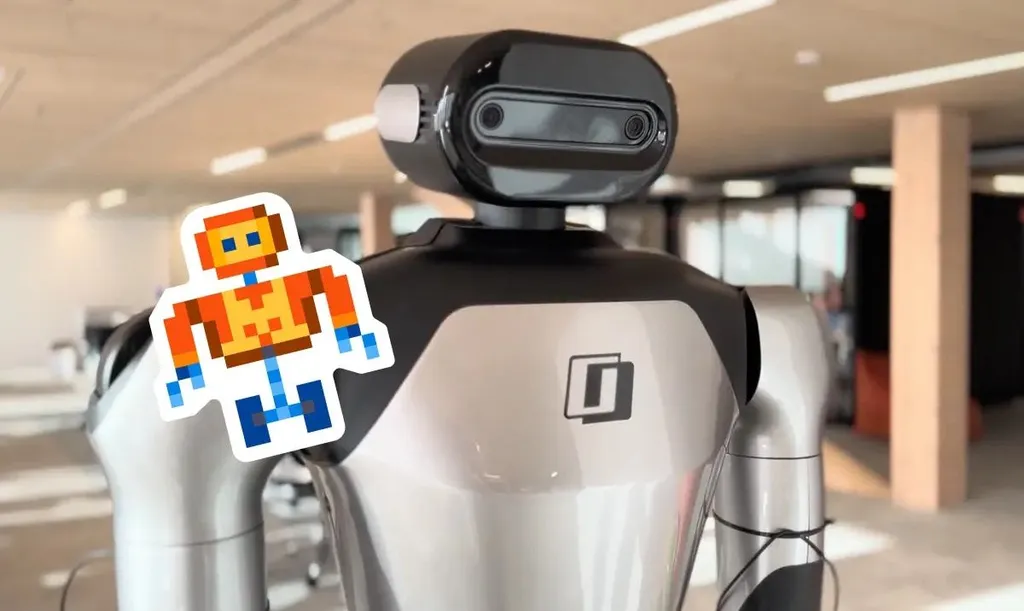
Mistral AI has released Robostral Navigate, its first model built for embodied robot navigation, and the headline number is what it leaves out: no LiDAR, no depth sensors, no multi-camera rig. The 8-billion-parameter model takes a stream of images from a single ordinary RGB camera plus a plain-language instruction, such as “leave the lobby, walk through the corridor, enter the supply room, and stop to face the second shelf,” and moves a robot through the space to complete it. That is the opposite of how most navigation stacks in commercial and research robotics are built today, and Mistral’s own benchmark numbers claim it still comes out ahead.
What Robostral Navigate does
The model is Mistral’s entry into a fast-moving corner of physical AI: instruction-following navigation, where a robot has to interpret a natural-language command and autonomously traverse an indoor or outdoor environment to satisfy it, without a human driving it step by step. Most competing approaches lean on depth cameras, LiDAR, or arrays of cameras to reconstruct a 3D or metric understanding of the space before deciding where to move. Robostral Navigate instead runs on a single RGB feed, the same category of camera found on a basic webcam or phone, and is initialized from Mistral’s own in-house vision-language model, the one it already uses for pointing, counting, and object-localization grounding tasks. Mistral says the navigation model does not rely on any existing open-source VLM as a base.
The company benchmarked the model on R2R-CE (Room-to-Room in Continuous Environments), the standard test for instruction-following navigation in environments the model has never seen during training. Mistral reports a 79.4% success rate on seen validation scenes and 76.6% on unseen ones. That unseen-environment figure, by Mistral’s own account, beats the best single-camera approach on the benchmark by 9.7 percentage points, and beats the best approach that does use depth sensors or multiple cameras by 4.5 points, despite Robostral Navigate using neither.
How it was built
Mistral trained the model entirely in simulation, using roughly 2.4 million trajectories collected across 350,000 simulated scenes. To make training on that volume of data tractable, the team used a technique it calls prefix-caching with tree-based attention masking: instead of training on one timestep of an episode at a time, an entire episode is compressed into a single sequence and trained on all timesteps in one forward pass. Mistral says this cuts training tokens by a factor of 22 compared to one-sample-per-timestep training, turning runs that would otherwise take months into ones that take days.
After that supervised stage, Mistral applied online reinforcement learning using its own algorithm, CISPO, so the model can learn from trial and error and recover from navigation failures rather than only imitating the training trajectories. Mistral says this RL stage alone improved the success rate by 3.2 percentage points, and that the team is not yet seeing the model’s performance plateau.
The navigation method itself is “pointing-based”: given the task instruction and its history of observations, the model predicts where to move next by pointing at pixel coordinates of the target location within the robot’s current camera view, plus a desired arrival orientation. That is a meaningfully different approach from systems that output metric displacement commands (move forward 2 meters, turn 25 degrees), which tend to be sensitive to differences in camera intrinsics and scale between the training setup and the deployed robot. Mistral says pointing at the image itself sidesteps that fragility. When the target location falls outside the robot’s current field of view, the model falls back to local-frame displacement commands as a secondary strategy.
Why it matters for industrial buyers
For plant operators and integrators evaluating mobile robots, the practical appeal of a single-camera navigation stack is cost and simplicity: RGB cameras are cheap and already standard equipment on most mobile platforms, while LiDAR units and depth-camera arrays add hardware cost, calibration overhead, and additional points of failure to a fleet. If a model can genuinely match or beat sensor-heavy competitors on instruction-following navigation using only a webcam-grade input, that lowers the hardware bar for deploying autonomous navigation across wheeled AMRs, legged inspection robots, and other mobile platforms already common on factory floors and in logistics operations.
Mistral frames Robostral Navigate as step one toward a broader “unified embodied agent,” a general-purpose robotics navigation capability rather than a narrow one-off demo, and says its robotics research group is actively expanding. The model runs, according to Mistral, across wheeled, legged, and flying robot platforms and generalizes across robot sizes, which if borne out would make it a candidate building block rather than a single-product release.
For a related look at how robot makers are closing the gap between demo-grade AI and factory-floor reality, see our earlier coverage of Universal Robots’ own lab-to-factory imitation-learning system, which targets a similar underlying problem, real-world data and reliability, from the manipulation side rather than navigation.
Sources
- Robostral Navigate — Mistral AI
- Mistral AI Releases Robostral Navigate: An 8B Model Enabling Robots to Navigate Complex Environments Using a Single RGB Camera — MarkTechPost, Jul 14, 2026
Frequently asked questions
What makes Robostral Navigate different from most robot navigation systems? +
Most instruction-following navigation stacks rely on LiDAR, depth sensors, or multi-camera rigs to build a 3D map of their surroundings. Robostral Navigate instead works from a single ordinary RGB camera and a plain-language instruction, with no depth or multi-camera hardware at all.
How well does Robostral Navigate actually perform? +
On the R2R-CE benchmark, the standard test for instruction-following navigation in environments held out of training, Mistral reports a 79.4% success rate on seen validation environments and 76.6% on unseen ones. The unseen-environment score beats the best single-camera approach by 9.7 points and the best depth/multi-camera approach by 4.5 points, according to Mistral's own reported figures.
How was the model trained, and is it available to customers yet? +
Robostral Navigate was trained entirely in simulation on roughly 2.4 million trajectories across 350,000 scenes, then refined with online reinforcement learning. Mistral describes manufacturing, delivery, logistics, and hospitality as target application areas the technology unlocks, but has not stated that the model is currently deployed with any named partner or customer.
What robot types can run it? +
Mistral says Robostral Navigate runs on wheeled, legged, and flying robot platforms and generalizes across robot sizes, since its core method points at target locations in the camera view rather than issuing hardware-specific motion commands.
More news