OMRON Expands LD Series AMRs: 150kg and 300kg Payloads for Q4 2026
OMRON's LD-150 and LD-300 AMRs bring 150kg/300kg payloads, 30-minute wireless charging, and ISO 3691-4 compliance to logistics floors in Q4 2026.
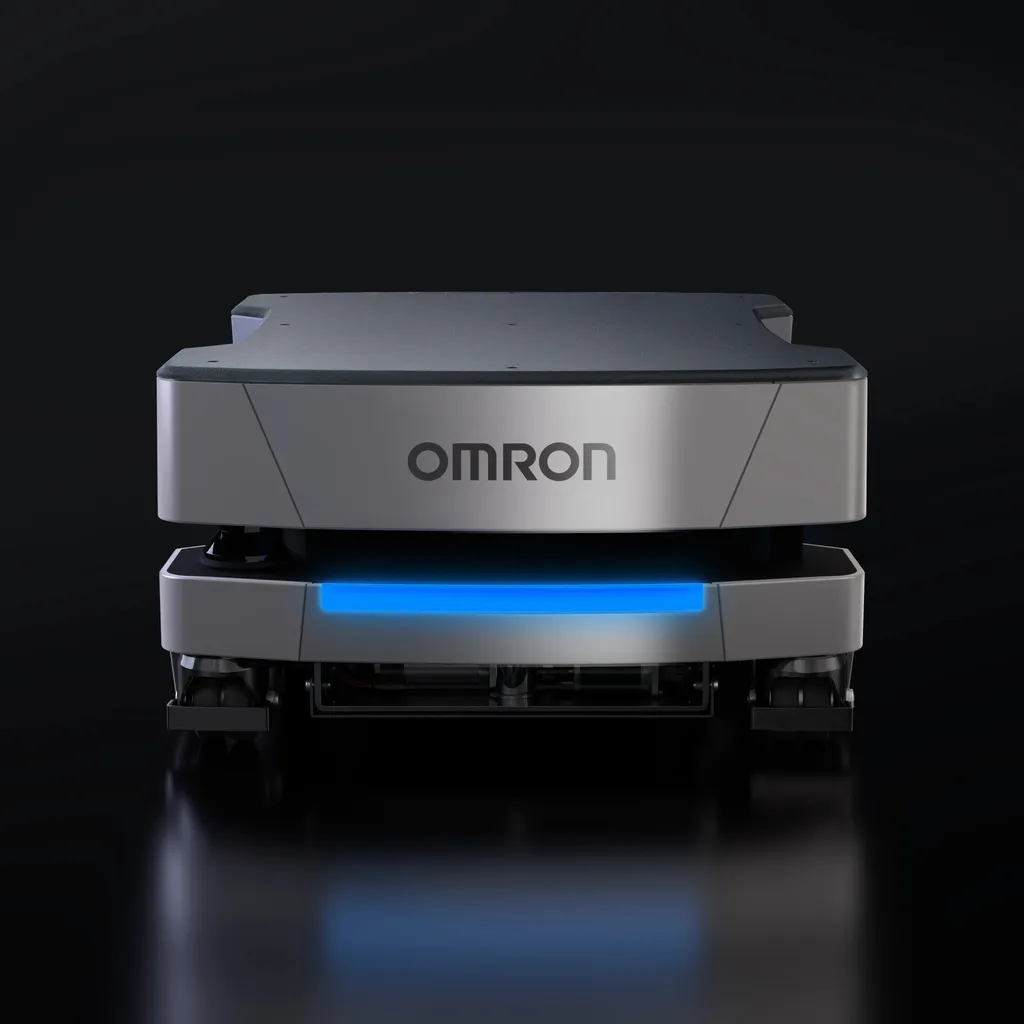
OMRON will begin shipping two new autonomous mobile robots, the LD-150 and LD-300, in the fourth quarter of 2026, the company announced July 15, extending its LD Series into two deployment gaps its existing lineup doesn’t cover: a narrower, lighter model for constrained spaces and a wider, higher-payload model for centralized logistics floors. Both new models add wireless inductive charging and ISO 3691-4:2023 safety compliance to a product line OMRON has sold since 2023, and both plug into the company’s FLOW Core software for managing them alongside its existing fleet.
Two models, two different jobs
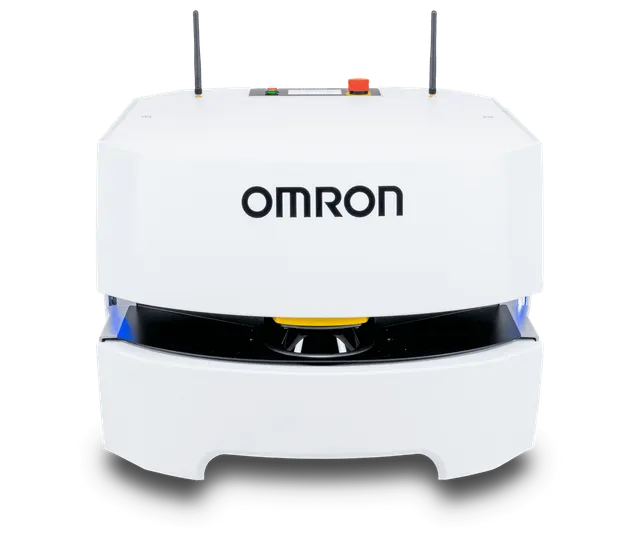
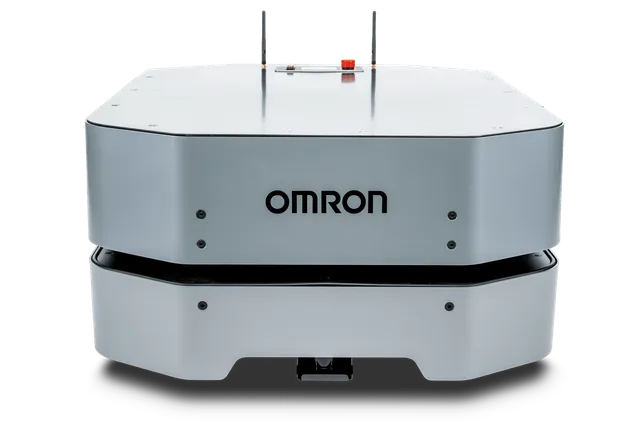
The LD-150 is built for tight quarters: 150 kg (330.7 lb) rated payload on a 500 mm (19.7 in) wide chassis, small enough for narrow-aisle work like lineside parts delivery on an automotive line or bin feeding in a constrained assembly cell. The LD-300 trades some maneuverability for capacity: 300 kg (661.4 lb) on a 580 mm (22.8 in) chassis, aimed at higher-volume case picking and sortation in larger distribution centers. Both share the same 2.1 m/s (4.7 mph) top speed and the same 5-degree grade ramp capability OMRON specifies for moving between facility levels.
Both robots carry OMRON’s 360-degree safety scanner coverage and are built to ISO 3691-4:2023, the current international standard for driverless industrial truck safety, a compliance detail that matters more to integrators than it might look: it signals OMRON designed both models against the same safety-certification bar large logistics operators already require for AMR procurement, rather than a lighter consumer- or pilot-grade spec.
Wireless charging as the real differentiator
The feature OMRON is leaning on hardest isn’t payload, it’s charging. Both the LD-150 and LD-300 use wireless inductive charging that completes in 30 minutes or less, letting a robot top up between tasks instead of parking at a dock for a full charge cycle. For a fleet operator, charging-dock congestion is a common bottleneck once a deployment scales past a handful of units; a fast, dockless top-up reduces how many charging stations a facility needs relative to the number of robots running. OMRON is pairing that with its FLOW Core orchestration software, which the company says supports mixed-fleet management, meaning LD-150s, LD-300s, and OMRON’s existing smaller LD-60, LD-90, and LD-250 models can run under one coordination layer rather than as isolated deployments.
What it means for buyers
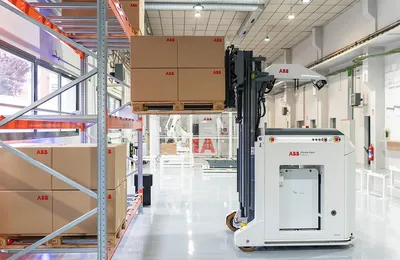
Neither the LD-150 nor the LD-300 is yet in Industrial Robotics Hub’s own robot database, since both are new-generation announcements rather than shipping products as of this writing; the closest entries on file are the existing LD-90 and LD-250, the mid-tier models these two new units sit around on the payload spectrum. Buyers weighing the LD-150 should look at automotive lineside delivery, pharmaceutical cold-chain tote movement, and electronics bin-feeding, use cases OMRON specifically calls out where 70-100 kg payloads and narrow-aisle maneuvering matter more than raw throughput. The LD-300 targets food and beverage case picking, consumer-goods sortation, and heavy appliance material transport, where a 250-300 kg per-trip capacity reduces how many shuttle runs a facility needs. Both fit within the broader AMR category and the material handling application space this desk has covered elsewhere, including ABB’s recently launched Flexley Stack F712 autonomous forklift, a heavier-payload AMR aimed at a different, higher-capacity segment of the same warehouse-automation trend.
Sources
- OMRON Debuts LD-150 and LD-300 AMRs at Automate 2026, Targeting Higher-Throughput Material Flow — MarketScale, Jul 15, 2026
- LD-150, LD-300 AMRs Boost Payload, Speed, Wireless Charging — New Equipment Digest
- Next-Generation Autonomous Mobile Robots at Automate 2026 — OMRON Robotics, Jul 15, 2026
- OMRON Robotics to Demonstrate Next-Generation Autonomous Mobile Robots at Automate 2026 — RoboticsTomorrow, Jun 9, 2026
Robots mentioned
Tap a card to open the full spec sheet.
Frequently asked questions
How do the LD-150 and LD-300 differ from each other? +
The LD-150 carries up to 150 kg (330.7 lb) on a 500 mm (19.7 in) wide chassis, built for tight, constrained spaces like lineside delivery or bin feeding. The LD-300 carries up to 300 kg (661.4 lb) on a wider 580 mm (22.8 in) chassis, aimed at higher-throughput picking and sorting in larger logistics centers. Both share the same 2.1 m/s (4.7 mph) top speed and 30-minute-or-less wireless inductive charging.
How do these compare to warehouse AMRs from other makers like MiR or Geekplus? +
OMRON is emphasizing payload density in a compact footprint, up to 300 kg in under 600 mm of width, alongside wireless charging and OMRON's own FLOW Core fleet-orchestration software. That is OMRON's own positioning against the category, not an independently benchmarked comparison; this desk has not tested either robot against a competing AMR directly.
When can a buyer actually get one? +
OMRON says shipping begins in Q4 2026, which would put the earliest customer deployments in October or November 2026, ahead of peak year-end logistics season. OMRON has not published a specific ship date within that quarter.
Do the LD-150 and LD-300 work alongside OMRON's existing AMRs? +
OMRON says both models integrate with its FLOW Core orchestration software for mixed-fleet deployments alongside the existing LD Series, which includes the smaller LD-60, LD-90, and LD-250 already in production. OMRON states third-party fleet or MES integration is supported through standard APIs, though full cross-brand fleet orchestration would still require additional integration work.
More news