AUBO Robot Lineup: 11 Cobots From 3 kg to 35 kg Payload
AUBO's entire catalog is collaborative: all 11 robots are cobots, spanning 3 kg to 35 kg payload and reaches up to 2,100 mm, with no traditional industrial arm in sight.
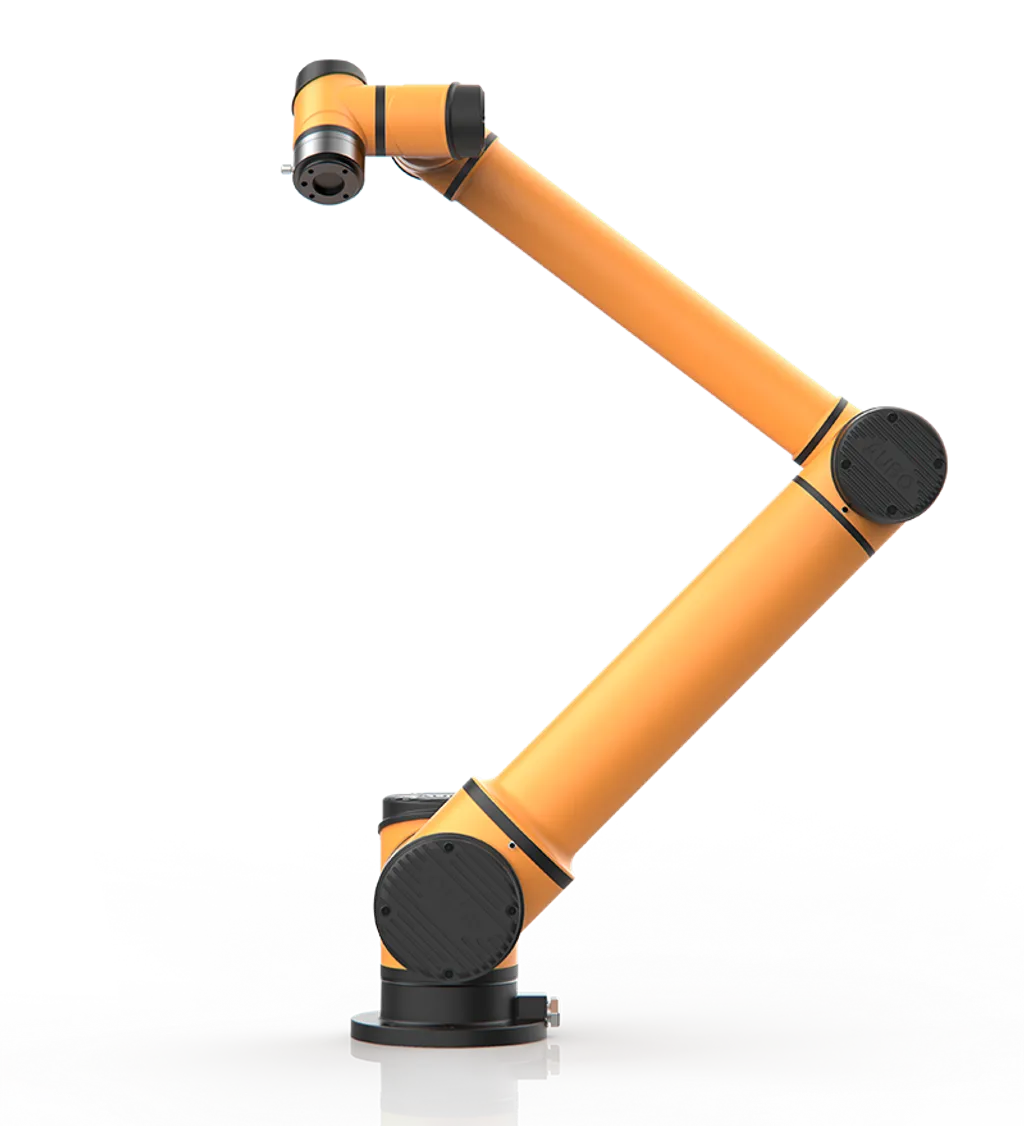
AUBO doesn’t make a single traditional industrial robot: every one of its 11 arms in our database is a collaborative cobot, from a 3 kg desktop helper to a 35 kg heavy-lifter. That is a deliberate product decision, not a gap in the lineup, and it shapes everything about how you evaluate this brand against more established names.
Most robot vendors hedge their bets. They build a cobot line to capture the collaborative market and keep their legacy articulated arms for the fenced cells. AUBO made a different bet from day one: go all-in on cobots, build the entire payload range inside that form factor, and compete on ease of deployment and precision rather than peak speed. Eleven robots in, that strategy is legible in the spec sheet.
This guide walks through all 11 AUBO arms using data from the Industrial Robotics Hub database. The point is not to sell you on the brand - the point is to show you exactly where each model sits in the lineup, where the gaps are, and which arm fits which application. If your job is selecting or recommending automation equipment, you should finish this post with a clear answer about whether AUBO belongs in your shortlist.
Who makes AUBO, and where did they come from?
AUBO Robotics has a backstory that is unusual for a robot manufacturer. The company was founded in 2010 as a collaboration between researchers at the University of Tennessee in Knoxville and engineering partners in China. Most of the modern robot industry grew out of automotive tooling firms - KUKA from welding equipment, FANUC from CNC machine tools, ABB from transformer manufacturing. Coming out of a research lab is a different origin, and it pushed the early team toward precision and lightweight design rather than raw torque.
The first commercial product was the i5, which shipped in 2015 and reached international markets in 2017. From there the company built out the i-Series across five payload classes (3, 5, 10, 16, and 20 kg) and then launched the iS-Series to address environments where washdown resistance matters. AUBO Robotics USA operates out of Detroit, Michigan - a deliberate choice that puts them inside the North American automotive supply chain where cobot adoption has been fastest. The company reports selling more than 15,000 units annually, which is a meaningful volume for a brand that doesn’t compete in the traditional industrial arm segment at all.
The open architecture is worth mentioning here because it affects integration cost. AUBO arms expose ROS compatibility and standard industrial interfaces. An integrator who has built on ROS for other cobots does not face a steep relearning curve. The company also claims operator-level setup in roughly 15 minutes without code. That figure is marketing language, but the underlying point - that the teach interface is accessible to non-programmers - is a genuine deployment advantage in facilities that can’t justify a dedicated robotics programmer for every line change.
Certifications cover the major global markets: EN ISO 13849-1:2015 (PL=d, CAT 3), ISO/TS 15066:2016, CE, UL, and SEMI S2 for semiconductor environments. These are not niche certifications. They open doors in automotive, electronics, pharma, and food manufacturing.
What types of robots does AUBO make?
Short answer: only one type. Every robot in the AUBO catalog is a 6-DOF collaborative cobot. There is no SCARA, no delta, no gantry, no traditional fenced articulated arm.
That 100% cobot composition is worth sitting with for a moment because it has real implications for what AUBO can and can’t do for you.
The cobot form factor means all 11 arms share the same basic engineering constraints. Force-sensing hardware at each joint lets the arm detect contact and stop before injuring a person. Torque limiting caps the joint acceleration profiles. These are the features that make collaborative operation possible without a safety cage, and they come at a cost: maximum TCP speed is lower than a traditional articulated arm by a factor of two to five depending on what you’re comparing. The fastest AUBO in our database reaches 4,000 mm/s. A traditional 6-axis arm running behind a fence typically exceeds 10,000 mm/s.
For most assembly, machine tending, and inspection applications, 4,000 mm/s is adequate. The cycle time difference only bites you when throughput is the dominant constraint. If you’re doing pick-and-place at three parts per second or welding a seam that needs sustained TCP speed, the cobot physics work against you regardless of brand. Know which problem you’re actually solving before you pick the robot type.
The upside of the focused catalog is that AUBO’s engineering has been concentrated on exactly one kinematic family for fifteen years. The repeatability figures across the lineup - median 0.03 mm in our database - reflect that. You’re not buying a robot from a company that split its R&D budget between eight different arm architectures.
Payload range: 3 kg to 35 kg - which AUBO carries the most?
The AUBO iS35 is the heaviest-payload arm in the lineup at 35 kg, with a reach of 2,100 mm. That combination is uncommon in the cobot market. Universal Robots tops out at 30 kg. ABB’s GoFa series caps at 10 kg for the collaborative line. Getting to 35 kg in a force-limited cobot package required AUBO to build a substantially heavier and larger arm than anything in the i-Series, and the iS35 sits alone at the top of the payload chart.
A few things stand out in this distribution. The 3 kg and 10 kg payload classes each have two entries - one i-Series and one iS-Series. The specs are close but not identical. The 20 kg class has three entries: the i20, the iS20, and the iS20L. These are meaningfully different arms despite sharing a nominal payload rating.
The i20 carries 20 kg at 1,650 mm reach, but its repeatability is 0.10 mm - significantly worse than every other AUBO robot in our database, which sit at 0.02 or 0.03 mm. The iS20 improves that to 0.05 mm at 1,647 mm reach. The iS20L extends reach to 2,000 mm and tightens repeatability to 0.03 mm, matching the best figures elsewhere in the lineup. If you need 20 kg payload, the choice between these three arms depends almost entirely on whether the application demands high repeat accuracy or long reach - or both, in which case the iS20L is the specific answer.
One spec that is notable by its absence: maximum TCP speed is only published for three of the 11 robots (i5, i10, i16). The entire iS-Series and the i3 and i20 do not have speed figures in our database. This is a data-coverage issue, not necessarily a product issue, but it limits direct comparison. When you’re sourcing, ask AUBO’s application team for the speed profile on any iS-Series arm you’re evaluating.
AUBO performance specs at a glance
| Type | Robots | Payload median | Repeat median | Speed range | IP67+ |
|---|---|---|---|---|---|
| Cobot (i-Series) | 5 | 10 kg | 0.03 mm | 2,800-4,000 mm/s | 0% (DB)* |
| Cobot (iS-Series) | 6 | 10 kg | 0.03 mm | not published | 0% (DB)* |
*The Industrial Robotics Hub database shows 0% IP67+ coverage for all AUBO robots. This is a data-coverage gap in our records, not a product limitation. AUBO’s published specs confirm IP67/68 sealing on the iS-Series. If IP rating is a hard requirement for your application, verify directly against AUBO datasheets - the database field should not be used as a definitive source here.
Repeatability is the standout spec for this brand. The median 0.03 mm across 11 robots is better than some competitors who publish 0.05-0.10 mm figures at comparable payload classes. For assembly applications where part-to-part variation is tightly controlled and the robot is not the tolerance bottleneck, 0.02 mm repeatability is more than adequate. For applications where the robot is the tolerance bottleneck - precision dispensing, small-feature inspection, electronics assembly - 0.02 mm gives you headroom.
The exception, again, is the i20 at 0.10 mm. That number does not fit the pattern of the rest of the lineup and suggests the i20’s design priorities were different - possibly optimized for payload-carrying capacity and reach rather than repeatability. The iS20 and iS20L correct this if you need 20 kg with tighter tolerances.
Complete AUBO robot lineup
All 11 robots from our database. A dash indicates the value is not published in our records.
| Model | Type | Payload (kg) | Reach (mm) | Repeat (mm) | Max Speed (mm/s) | IP |
|---|---|---|---|---|---|---|
| i3 | cobot | 3 | 625 | 0.02 | - | - |
| i5 | cobot | 5 | 886 | 0.02 | 2,800 | - |
| i10 | cobot | 10 | 1,350 | 0.03 | 4,000 | - |
| i16 | cobot | 16 | 968 | 0.03 | 4,000 | - |
| i20 | cobot | 20 | 1,650 | 0.10 | - | - |
| iS3 | cobot | 3 | 625 | 0.02 | - | - |
| iS7 | cobot | 7 | 886 | 0.02 | - | - |
| iS10 | cobot | 10 | 1,300 | 0.03 | - | - |
| iS20 | cobot | 20 | 1,647 | 0.05 | - | - |
| iS20L | cobot | 20 | 2,000 | 0.03 | - | - |
| iS35 | cobot | 35 | 2,100 | 0.05 | - | - |
Two columns deserve a closer look before you read the scenarios below.
Reach at the 16 kg tier: The i16 has 968 mm reach at 16 kg payload. That is notably shorter than the i10 at 1,350 mm for 10 kg. If you need 16 kg payload with a longer working radius, the i16’s reach may be a constraint. The next step up - the i20 at 1,650 mm - adds payload and reach but introduces the repeatability drop. There is no 16 kg option with 1,200+ mm reach in the current lineup.
Reach at the 20 kg tier: The three 20 kg options span a 353 mm reach range: 1,647 mm (iS20), 1,650 mm (i20), and 2,000 mm (iS20L). The iS20L’s 2,000 mm reach is the second-longest in the entire lineup, behind only the iS35 at 2,100 mm. If you’re working on a wide conveyor or need to reach across a large fixture, the iS20L is the only 20 kg option that gets you there.
Which AUBO robot fits your application?
The spec table answers “what,” but the buying decision answers “which one for my specific situation.” Here are five concrete scenarios drawn from the common application stack for cobots at this payload and reach range.
Benchtop assembly and electronics handling (under 5 kg)
The i3 and iS3 target PCB handling, small-parts kitting, connector insertion, and lab automation. A 625 mm reach covers a standard benchtop fixture, and 0.02 mm repeatability is well within the tolerance window for most electronics assembly. Both ship at IP54 standard - the iS3 is AUBO’s newer, modular-design generation of the same payload/reach class, with improved repeatability, absolute accuracy, and trajectory accuracy over the i3, and IP67 available as a customizable option on request rather than a standard difference between the two.
At 5 kg, the i5 adds 261 mm of reach and a published 2,800 mm/s TCP speed. That speed figure matters for cycle time estimation in pick-and-place with short moves. No washdown equivalent exists at exactly 5 kg - the iS7 steps up to 7 kg.
Machine tending on mid-size CNC equipment
The i10 is the most logically specified AUBO robot for standard CNC loading. Ten kilograms covers most part-plus-gripper weights in the mid-size machining range, 1,350 mm reach clears the machine door without awkward mounting positions, 0.03 mm repeatability handles part placement tolerances that matter in a machine tool context, and the published 4,000 mm/s speed gives you a number to plug into cycle time calculations. This is the arm that fills the i-Series volume slot.
If the machine is in a coolant-spray environment or gets washed down at shift change, the iS10 covers the same payload with IP67/68 sealing. The iS10 gives up 50 mm of reach compared to the i10 (1,300 vs 1,350 mm). In most machine-tending installations that 50 mm is absorbed by the mounting position, but verify your geometry before assuming they’re interchangeable.
Welding, dispensing, and process tasks with extended reach
The i20 at 1,650 mm reach covers larger workpiece envelopes, but the 0.10 mm repeatability figure needs honest evaluation before you write it into a welding spec. Automotive MIG welding can tolerate 0.5-1.0 mm bead placement variation in some joints, but aerospace or thin-sheet applications typically want tighter. If your welding process needs 0.05 mm or better at the tool center point, the iS20 at 0.05 mm or the iS20L at 0.03 mm are better choices even if the process environment doesn’t require washdown sealing.
For dispensing applications - sealant, adhesive, conformal coat - the iS20L at 0.03 mm and 2,000 mm reach is the longest-reach, highest-precision 20 kg option in the lineup. If your fixture is large and your bead placement tolerance is tight, that combination is difficult to match elsewhere in the AUBO catalog.
Food processing, pharmaceutical, and washdown environments
Any application that involves moisture, food-contact cleaning agents, or sterilization cycles belongs in the iS-Series. The iS7 covers the most common food-line payload range (grip weight typically 5-8 kg including the end effector) at 886 mm reach. The iS10 handles heavier packs or tool-change scenarios with the same IP67/68 sealing but adds reach and payload at a higher cost.
One important check before buying for a food application: IP68 rating means the robot body can tolerate submersion to a defined depth and duration. It does not mean the robot is food-safe or that all joints are sealed against aggressive chemical sanitizers. Verify the specific cleaning protocol against AUBO’s material and sealing specs, and check whether the mounting hardware and teach pendant are also rated for the environment.
Palletizing, heavy end-of-line handling, case erecting
The iS35 at 35 kg and 2,100 mm reach is in a narrow market segment. Most palletizing cobots top out at 20-25 kg. Getting to 35 kg in a collaborative envelope is the iS35’s specific proposition. At 35 kg nominal payload, the practical working payload with a heavy suction gripper or mechanical clamp will be lower depending on reach position and acceleration profile - this is true for every robot, not an AUBO-specific caveat. A rough working assumption is that 70-80% of the rated payload is available at full reach and rated speed. Budget 24-28 kg of actual pick weight if you’re spec’ing against the 35 kg figure.
At 0.05 mm repeatability, the iS35 is not a precision arm by assembly standards, but it doesn’t need to be. Pallet-pattern accuracy tolerances are measured in millimeters, not hundredths.
Applications where AUBO is not the answer
High-speed pick-and-place where cycle time drives ROI belongs in a delta or SCARA architecture. The fastest AUBO in our database publishes 4,000 mm/s. Delta robots running at 150+ picks per minute operate in an entirely different speed envelope. If you’re moving small parts at high rates and the robot is the cycle-time constraint, the cobot form factor - any cobot form factor - adds cost without adding throughput.
Similarly, if your process runs in a fully guarded cell and the collaborative-safe hardware is pure overhead, a traditional articulated arm behind a fence will give you better speed and lower cost per unit. AUBO’s open-architecture positioning doesn’t change the underlying physics.
The bottom line - who should buy AUBO, and who shouldn’t
The AUBO catalog is a clean product strategy. Build every arm as a cobot, cover the payload range from desktop (3 kg) to heavy palletizing (35 kg), offer a sealed iS variant for environmental robustness, and compete on repeatability and deployment speed rather than maximum TCP velocity. The spec sheet holds up across 11 robots with a median repeatability of 0.03 mm that beats several more expensive competitors at comparable payload classes.
The buying reframe comes down to four questions.
First: does your environment involve washdown or moisture? If yes, start at the iS-Series. If no, the i-Series is available and likely less expensive. Don’t pay for IP67/68 sealing if you’re never going to use it.
Second: what payload do you actually need after accounting for the gripper? The gripper and cabling regularly add 1-3 kg to the effective load on the robot. If your part weighs 8 kg and your gripper weighs 2 kg, a 10 kg robot is the right call, not a 7 kg robot. Size the arm to the real system, not the nominal part weight.
Third: do you need precision at 20 kg? The i20’s 0.10 mm repeatability is the outlier in the lineup. For applications where repeatability matters - assembly, precise welding, dispensing - the iS20 (0.05 mm) or iS20L (0.03 mm) are the right 20 kg choices even if you don’t need the IP sealing.
Fourth: are you solving a collaborative workspace problem or a speed problem? AUBO is the right answer for the first. It is not the right answer for the second, and no cobot from any manufacturer is. If you’re reading this because a systems integrator proposed a cobot as a cage-free alternative and you’re evaluating the brand, that framing is correct and AUBO is a legitimate contender. If you’re reading this because you need maximum throughput in a guarded cell, look at traditional articulated arms instead.
Browse all 11 AUBO robots in our database or use our compare tool to stack AUBO against Universal Robots, Fanuc CRX, or other cobots in the same payload class.
Compare these robots