Estun Robots: 13 Models From 4 kg to 700 kg Payload
Estun went from China's first homegrown servo drive in 2001 to #1 in China's robot market by 2025. Our 13-model database spans a 175x payload range, 4 to 700 kg.
Estun didn’t ship an industrial robot until 2012, yet by 2025 it had overtaken every traditional global rival to lead China’s robot market outright - the first domestic Chinese brand to claim that position. Thirteen robots in our database span a 175-fold payload range, from a 4 kg compact arm to the ER700-2800 heavy lifter, with a median payload of 30 kg that places Estun’s center of gravity squarely in medium-duty manufacturing rather than at either extreme. Repeatability across the 12 models where we have data ranges from 0.02 mm on the compact mini-series arms to 0.10 mm on the 700 kg flagship, which is consistent with what you would expect across that payload spread.
This guide covers the full 13-model lineup by payload, type, and application fit. The structure: brand history, fleet composition, payload landscape, consolidated performance table, complete model reference, application scenarios, and a buying reframe at the close. The goal is to help an automation engineer or procurement lead identify which Estun model belongs on their shortlist based on hard numbers, not distributor marketing.
Who makes Estun?
Estun Automation is headquartered in Nanjing, Jiangsu Province, China. The company was founded in 1993 by Wu Bo, a former lecturer at Nanjing Forestry University, and its early business had nothing to do with robots. Estun’s foundational work was in CNC systems and motion control - the kind of embedded engineering that drives machine tools, not articulated arms. That origin matters because the motion-control stack is now a core competitive asset, not an acquired capability.
The milestone that defined Estun’s trajectory came in 2001, when the company developed China’s first domestically produced AC servo drive. Until that point, servo drives in Chinese manufacturing were almost entirely supplied by Japanese and European vendors - Mitsubishi, Yaskawa, Siemens, Bosch Rexroth. Estun’s servo drive broke that dependency and established the company as a genuine component manufacturer rather than an integrator of foreign parts. That distinction matters for buyers evaluating supply chain risk: Estun makes its own servo drives, servo motors, and motion controllers in-house, which gives it cost control and supply-chain independence that most Chinese robot OEMs do not have.
Estun entered industrial robotics in 2012, listed on the Shenzhen Stock Exchange in 2015 (ticker 002747.SZ), and spent the following decade building out a lineup that by company sources spans roughly 76 models from 3 kg to 700 kg payload. The Nanjing “robots making robots” smart factory runs at an annual capacity of around 50,000 units. Frost & Sullivan has consistently ranked Estun first in shipments among domestic Chinese robot makers. In 2025 the company crossed a more significant threshold - it reached number one in China’s overall industrial robot market, surpassing FANUC, KUKA, ABB, and Yaskawa in domestic shipment volume. That is not a claim to global leadership; China’s home market is the context. But it is a meaningful signal about where the cost-competitiveness and vertical integration have taken the brand. Estun is also actively building a European presence, centered on a hub in Barcelona, targeting the same industrial segments it dominates at home: welding, metal fabrication, 3C electronics, photovoltaic, lithium battery, pharma packaging, and general assembly.
The full brand background is documented on Estun’s Wikipedia page.
What types of robots does Estun make?
The 13 robots in our database break across three architecture types. Articulated arms are an overwhelming majority, with SCARA and palletizer filling specialist roles.
Ten of the 13 models are articulated robots - the standard 6-axis configuration that covers welding, handling, machining, and general assembly. That 77% concentration tells you Estun is not a portfolio brand building specialist niches; it is an articulated-arm company with broad payload coverage that happens to also offer SCARA arms for flat-plane assembly and a palletizer for end-of-line stacking. The ER-MI compact mini series (ER4-550-MI, ER8-720-MI, ER20-1200-MI) and the ER-LI long-reach variants (ER30B-2700-LI) show that Estun is segmenting within the articulated category by workspace geometry, not just payload.
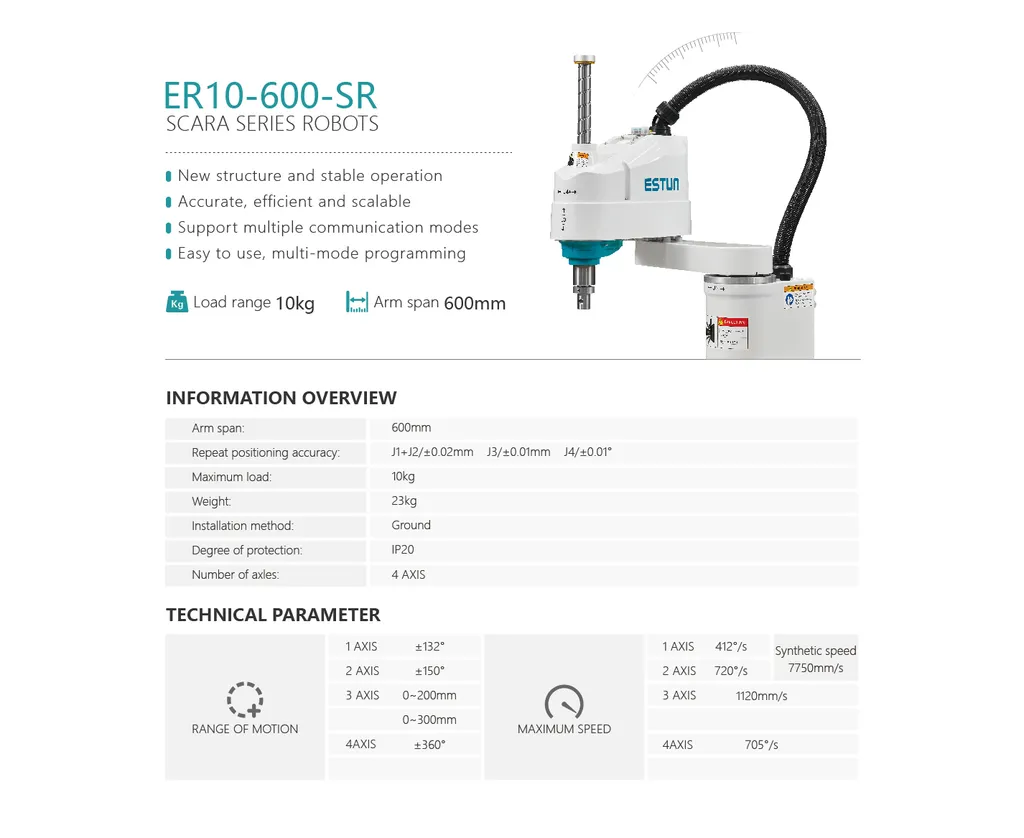
The two SCARA arms (ER10-600-SR and ER50-1200-SR) deserve separate framing. At 0.025 mm repeatability, they are the tightest-tolerance machines in this lineup - tighter than any of the articulated arms. The ER50-1200-SR at 50 kg payload is unusually heavy for a SCARA; most SCARA arms sit below 20 kg. That suggests Estun is targeting heavier tray-transfer and panel-assembly applications where SCARA kinematics are preferred for their flat-plane speed and stiffness. The single palletizer, the ER120-2400-PL, is a 4-axis machine optimized for layer-building at the end of a production or packaging line. It is not interchangeable with the 6-axis articulated arms and requires different integration planning.
Payload range: 4 kg to 700 kg
The median payload across the 13 Estun robots is 30 kg, and that number reflects a lineup deliberately weighted toward medium-to-heavy industrial work. Seven of the 13 models sit at or below 50 kg - manageable mid-range arms for welding, handling, and assembly. The remaining six cover from 50 kg to 700 kg, which is a heavy-duty spread that few brands outside the Big Four can match at this price point.
Source: Industrial Robotics Hub database, 13 Estun robots.
The chart reveals two things about Estun’s lineup structure. First, there is a significant gap between the ER50 tier (50 kg) and the ER100B-3000 (100 kg). If your application requires 60-95 kg payload, this database does not offer a native Estun fit, and you would need to either over-specify to the ER100B-3000 or source a model outside our current dataset - Estun’s full catalog does include models in this range, but they are not yet in our database. Second, the ER700-2800 sits far to the right of every other model. At 700 kg it is roughly 3x the payload of the next heaviest model in the lineup (ER220B-2650 at 220 kg). That gap is not unusual for a brand that offers a purpose-built heavy lifter; the ER700 is not a scaled-up version of the mid-range arms, it is a separate platform with different structural and drive architecture.
The ER100B-3000 at 100 kg and 3,000 mm reach is a notable outlier for its reach-to-payload ratio. Three metres of reach at 100 kg payload targets large-part handling - automotive body sections, structural weld positioners, large casting extraction. That is a long arm by any standard; for reference, the ABB IRB 6700 at 150 kg reaches 3,200 mm. The Estun ER100B-3000 delivers 67% of the ABB’s payload at 94% of the reach, which makes it an interesting cost-competitive option for applications that have been traditionally served by premium European arms.
Estun performance specs at a glance
This table summarizes the three architecture types in our database by their aggregate specifications. TCP speed is not recorded for any Estun model in our dataset. IP rating is not recorded for any Estun model; the manufacturer markets select variants as IP67 for certain environments, but we do not carry that data and it should be verified directly against specific model configurations.
| Type | Robots | Payload median | Repeat median | Speed range | IP67+ |
|---|---|---|---|---|---|
| Articulated | 10 | 26 kg | 0.04 mm | - | 0% |
| SCARA | 2 | 30 kg | 0.025 mm | - | 0% |
| Palletizer | 1 | 120 kg | 0.04 mm | - | 0% |
The articulated median at 0.04 mm repeatability is solid for the mid-range manufacturing applications Estun targets. Welding, handling, arc cutting, and general assembly in the 10-50 kg range typically require 0.03-0.06 mm, so the ER-B series sits inside that window for most use cases. The tightest figure in the articulated range is 0.02 mm, on the ER8-720-MI compact arm - a number that indicates attention to gearbox and joint quality that is not always present in lower-tier Chinese robot platforms.
The SCARA arms at 0.025 mm repeatability are the precision leaders in this lineup. That is tighter than any articulated arm in the Estun database and consistent with what SCARA kinematics can achieve in rigid flat-plane motion. The 0.10 mm on the ER700-2800 is the ceiling and is expected at that payload level; positioning variation at 700 kg is dominated by structural deflection under load, not joint accuracy.
One honest data gap: we do not have TCP speed figures for any Estun model. This is not a reflection on the machines’ speed - it is a gap in published specification data at the time of writing. For applications where cycle time is the primary spec criterion, verify current speed data directly with Estun or their regional distributor before selecting a model.
Complete Estun robot lineup
All 13 robots. Model links go to their individual data pages. Dashes indicate specs not recorded in our dataset.
| Model | Type | Payload (kg) | Reach (mm) | Repeat (mm) | Max Speed (mm/s) | IP |
|---|---|---|---|---|---|---|
| ER4-550-MI | articulated | 4 | 550 | - | - | - |
| ER8-720-MI | articulated | 8 | 727 | 0.02 | - | - |
| ER10-600-SR | scara | 10 | 600 | 0.025 | - | - |
| ER12B-1510 | articulated | 12 | 1510 | 0.03 | - | - |
| ER20-1200-MI | articulated | 20 | 1200 | 0.03 | - | - |
| ER20B-1760 | articulated | 20 | 1756 | 0.03 | - | - |
| ER30B-2700-LI | articulated | 30 | 2700 | 0.05 | - | - |
| ER50B-2100 | articulated | 50 | 2100 | 0.05 | - | - |
| ER50-1200-SR | scara | 50 | 1200 | 0.025 | - | - |
| ER100B-3000 | articulated | 100 | 3000 | 0.06 | - | - |
| ER120-2400-PL | palletizer | 120 | 2400 | 0.04 | - | - |
| ER220B-2650 | articulated | 220 | 2650 | 0.06 | - | - |
| ER700-2800 | articulated | 700 | 2800 | 0.1 | - | - |
Notes on the data:
- “Repeat” is +-mm ISO 9283 repeatability. The ER4-550-MI has no repeatability figure in our database.
- TCP speed is not recorded for any Estun model in this dataset. Do not compare Estun speed specs against brands that publish TCP speed without first verifying current Estun figures from the manufacturer.
- IP ratings are not recorded in our current database. Estun markets IP67-rated variants for certain models, particularly in washdown and clean-environment configurations. Verify availability for your specific model and application.
- Reach figures are maximum TCP reach in floor-mount orientation.
- The ER100B-3000 reach (3,000 mm) is the longest in the lineup and one of the longest in its payload class in this database.
Which Estun robot fits your application?
The spec table is a starting point. Here are four concrete application scenarios mapped to specific Estun models.
You are arc-welding fabricated steel assemblies in the 500 mm to 2 m reach envelope
This is the ER12B-1510 and ER20B-1760 territory. The ER12B-1510 at 12 kg / 1,510 mm handles a standard MIG torch, wire feeder, and mounting bracket at 0.03 mm repeatability - precise enough that weld seam quality will vary with fixturing and consumable quality long before robot positioning becomes the constraint. The ER20B-1760 steps up to 20 kg and 1,756 mm reach for welding jigs and torches with heavier cable assemblies or where the weld path needs to reach across a larger fixture. If your weld frames are structural - larger, heavier, with joints that require a 2+ metre reach - the ER30B-2700-LI at 30 kg and 2,700 mm reach extends the envelope without stepping up to the medium-heavy class. The “-LI” suffix denotes the long-reach variant.
You are assembling electronic components or small precision parts on a flat-plane layout
The two SCARA arms are the answer, and which one depends entirely on your payload requirement. The ER10-600-SR at 10 kg / 600 mm handles light component pick-and-place and small tray transfers at 0.025 mm - tight enough for connector insertion and small PCB assembly. The ER50-1200-SR at 50 kg / 1,200 mm covers heavier tray-transfer applications, panel loading, and assembly of larger sub-assemblies that need the rigidity and flat-plane speed of SCARA kinematics at a payload most SCARA arms cannot reach. If your application requires arbitrary 3D approach angles or work above a flat horizontal plane, SCARA kinematics are wrong for it regardless of payload - that is an articulated arm job.
You need to handle large automotive or structural parts in the 100-220 kg range
Two models cover this range: the ER100B-3000 at 100 kg / 3,000 mm and the ER220B-2650 at 220 kg / 2,650 mm. The ER100B-3000 is the reach leader in this lineup - 3,000 mm gives it access to very large workpieces or wide-span fixtures. The ER220B-2650 trades 350 mm of reach for more than double the payload, covering door panels, engine sub-frames, and large casting extraction. Repeatability at 0.06 mm for both arms is appropriate for these structural-handling applications where part positional tolerance is measured in fractions of a millimetre rather than microns. Both require floor mounting and appropriate structural base design; at these payload levels, base compliance becomes a real source of positioning error if the foundation is undersized.
You are building an end-of-line palletizing cell for bags, cases, or boxes up to 120 kg
The ER120-2400-PL is the only palletizer in this lineup and is the right choice for this application. At 120 kg / 2,400 mm reach and 0.04 mm repeatability, it handles standard pallet layer patterns for most bag, case, and corrugated-box products. The 4-axis palletizer architecture differs from the 6-axis articulated arms: it is optimized for horizontal layer-building motion, typically faster for this specific task than a 6-axis arm doing the same job. The 2,400 mm reach covers standard Euro-pallet and GMA pallet footprints with clearance on the approach. If your product is above 120 kg per pick or your pallet height plus product clearance exceeds what the 2,400 mm reach can manage, you would need to look at the ER220B-2650 in a 6-axis palletizing configuration - less optimized for pure layer-building, but capable of the higher payload and flexible enough to handle mixed-case patterns if your downstream line requires them.
The bottom line
Estun is a coherent industrial robot brand with a clear identity: vertically integrated, cost-competitive, and positioned for medium-to-heavy manufacturing work rather than the precision-cobot or specialty-architecture niches. The 13 models in our database are predominantly articulated arms because that is what Estun’s core industrial customers buy, and the payload range - 4 kg to 700 kg - is wider than most single-brand lineups outside the established Big Four.
What makes Estun a genuinely interesting purchase option in 2025-2026 is the component stack. A robot brand that designs and manufactures its own servo drives, servo motors, and motion controllers has meaningful advantages in unit cost, supply chain control, and product integration. Most Chinese robot OEMs buy those components from third parties - often the same Japanese or European suppliers that Estun displaced with its own servo drive in 2001. Estun’s vertical integration is not marketing copy; it is the reason the company can price aggressively and still maintain margins.
The service network outside China is the open question. Estun is building European presence via Barcelona, and its growth rate suggests distributor networks are expanding. But for a plant in central Europe or North America evaluating Estun against FANUC, KUKA, or ABB, the support infrastructure comparison is not yet in Estun’s favor. That gap narrows as Estun’s installed base grows, but it is a real factor for applications where downtime cost per hour is high and on-site service response time is part of the procurement specification.
Who should buy Estun. Metal fabrication shops, automotive component suppliers, and general manufacturing plants in markets where Estun has established distributor and service coverage. Buyers who are cost-constrained relative to the Big Four and are evaluating the ER-B and ER100-220 range for welding, handling, or structural assembly. Lines where in-house robot competence is sufficient to self-service or where a local Estun-trained integrator is available. Applications requiring the long-reach ER100B-3000 at competitive cost.
Who should look elsewhere. Applications requiring IP67 as a hard baseline specification without confirming specific variant availability from Estun’s current product pages. Plants where TCP speed data is a primary selection criterion and the comparison requires apples-to-apples numbers - our database does not carry Estun speed figures, and cross-brand speed comparisons without verified data are unreliable. Operations in regions where Estun’s service footprint is thin and response time to a production stoppage needs to be measured in hours, not days.
The buying decision from the spec table works like this. Set your payload requirement at worst-case gripper-plus-part mass at maximum acceleration in the wrist-loading orientation - not the nominal part weight. Check reach against your cell layout with a 15-20% margin. Then map repeatability against your tightest process tolerance, remembering that real-world performance is typically 2-3x worse than the ISO 9283 published figure in a production environment with temperature variation and mechanical wear. For Estun, that means a 0.03 mm published repeat should be treated as a 0.06-0.09 mm working tolerance for process design purposes. Run those three filters across the 13 models in the table above, and the right Estun for your application - if the application fits the lineup - becomes clear.
Data note: All specifications sourced from the Industrial Robotics Hub database. TCP speed is not recorded for any Estun model at the time of writing. IP rating data is not captured in our current dataset - verify IP-rated variant availability directly with Estun or their regional distributor. The ER4-550-MI repeatability figure is not recorded in our database. Estun’s full catalog spans approximately 76 models; this guide covers the 13 models currently in the Industrial Robotics Hub database.
Sources: Estun Automation - Wikipedia
Compare these robots