Germany's Automotive Robot Share Fell From 40% to 23%
Germany's robot demand shifted hard away from automotive in 2025, from a 40% share in 2020 to just 23%. KUKA's own catalog is still 83% automotive.
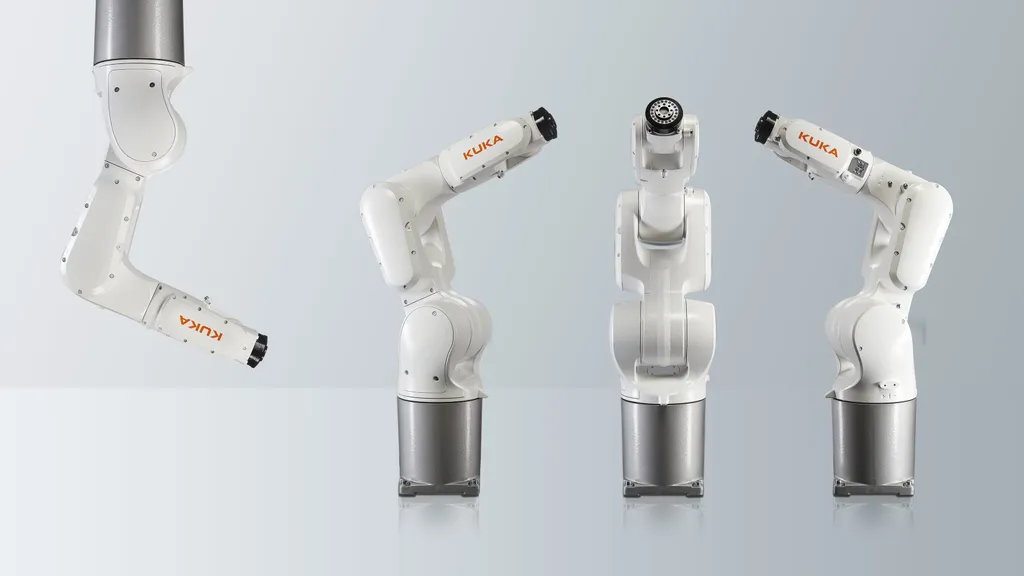
In 2020, automotive was 40% of Germany’s new robot installations. In 2025 it was 23%. That is not a slow drift, it is a customer base rearranging itself inside five years, and it happened while Europe’s whole robot market contracted 11% and Asia and the Americas each grew 14%. Germany still installed more robots than any other EU country (24,800 units, 41% of the entire EU-27 total), so this isn’t a story about Germany buying fewer robots. It’s a story about which factories are buying them.
How much did Europe’s robot market shrink in 2025?
The EU-27 installed 60,500 industrial robots in 2025, down 11% year over year, according to the International Federation of Robotics’ World Robotics 2026 report. Every other major region moved the opposite direction: Asia installed 457,315 units, up 14%, and the Americas installed 57,044 units, also up 14%. Europe was the only major region that contracted last year.
Zoom out and the picture is less bleak. The EU-27’s operational robot stock passed 700,000 units in 2025 (712,000, per IFR President Jane Heffner), up from 390,000 in 2015, an 82.6% gain over ten years, and the 2020-2025 installation trend still works out to a positive 3% compound annual growth rate. Germany, Italy, France and Spain are the top four EU markets by installations (24,800, 7,800, 4,500 and 4,300 units respectively), and Germany alone accounts for 41% of everything the EU installed. Growth isn’t dead here. It decelerated hard in a single year, and Germany’s own numbers show why.
Why is automotive’s share of Germany’s robot demand cratering?
Germany installed 24,800 new industrial robots in 2025, the world’s fifth-largest annual total behind South Korea, the United States, Japan and China, per IFR’s German-market release. That’s down 8% year over year even though the 2020-2025 trend is a positive 2% CAGR, a shorter-term dip inside a longer-term climb. The driver is manufacturing demand, and specifically automotive.
Germany’s automotive industry installed 5,800 new robots in 2025. That’s still the single largest customer segment, a 23% share, but it was 40% in 2020. IFR attributes the drop mainly to deferred investment in electric-vehicle production amid policy uncertainty, in a country that is the world’s fourth-largest passenger-car producer. Two other segments moved into the space automotive vacated. Metal-working installed 5,300 robots (down 13% year over year, but a 21% share, nearly closing the gap with automotive), and plastics and chemicals installed 3,000 robots, a 12% share.
| Segment | 2025 units | 2025 share | 2020 share |
|---|---|---|---|
| Automotive | 5,800 | 23% | 40% |
| Metal-working | 5,300 | 21% | n/a |
| Plastics & chemical | 3,000 | 12% | n/a |
Source: IFR World Robotics 2026, German-market press release.
Germany is still a major robot producer and exporter even as its own buying mix shifts: 23,700 units built domestically in 2025 (down 24%) and 15,100 units exported (down 37%), the export side hit twice, by weaker German production and by the same soft European demand it usually re-exports into. IFR expects German demand to fall again in 2026 before a broader recovery starting 2027, with SME adoption of easier-to-program, lower-cost and robots-as-a-service models flagged as the growth lever to watch.
Does KUKA’s own catalog reflect that shift?
KUKA is Germany’s own flagship robot maker, so it’s the natural place to check whether the catalog has caught up to where the country’s real demand has gone. Our analysis of the 29 KUKA robots in the Industrial Robotics Hub database found 24 (82.8%) carry an automotive application tag. Only 8 (27.6%) carry a metal tag.
KUKA catalog composition, automotive vs. metal application tags. Source: Industrial Robotics Hub database, 29 KUKA robots, recounted 2026-09-29.
One caveat has to be stated plainly: this is not a contradiction of IFR’s unit-sales data. A catalog application tag records what IRH’s structured data has a given model marketed or suited for, not how many units actually sold into that industry last year. So the honest finding here is narrower than “KUKA is failing to sell into metal,” which the data doesn’t show. What the numbers do show is that KUKA’s own published catalog framing, at least as reflected in our structured data, hasn’t caught up to where Germany’s real-world robot demand has already moved. A buyer scanning KUKA’s product line today would see a catalog still weighted more than 3-to-1 toward automotive relative to metal, in the same year Germany’s real automotive share fell below a quarter of national demand.
What about Germany’s other robot brands, ABB and Staubli?
KUKA isn’t the outlier. ABB, the largest single brand in our database at 48 robots, tags 33 (68.8%) automotive and 21 (43.8%) metal, a narrower but still automotive-leaning split. Staubli, at 14 robots, tags 8 (57.1%) automotive and zero metal, the widest gap of the three despite metal being one of the EU’s three largest customer industries.
| Brand | Robots in DB | Automotive-tagged | Metal-tagged |
|---|---|---|---|
| KUKA | 29 | 24 (82.8%) | 8 (27.6%) |
| ABB | 48 | 33 (68.8%) | 21 (43.8%) |
| Staubli | 14 | 8 (57.1%) | 0 (0%) |
| Catalog-wide (425 robots) | 425 | 298 (70.1%) | 128 (30.1%) |
Source: Industrial Robotics Hub database, recounted live 2026-09-29 against src/content/robots/*.json.
Zero metal-tagged Staubli robots is a real gap worth flagging on its own, not just a KUKA story. Catalog-wide, 70.1% of all 425 robots we track carry an automotive tag against 30.1% metal, so the same imbalance runs through the whole database, not just the German brands. It just happens that the country where the demand mix has shifted hardest also builds the flagship brand carrying the widest version of that imbalance.
What this means if you sell or integrate into the German market
Germany is still producing robots (23,700 units in 2025, even after a 24% drop) and still the EU’s largest single installer by a wide margin. What’s changed is who’s buying. Automotive fell from 40% to 23% of German demand in five years while metal-working closed to 21%, near-parity with automotive for the first time in this data. If your sales motion, application engineering, or marketing collateral is still built around automotive as the default German customer, the 2025 numbers say to start building the metal-fabrication pitch with the same weight. The catalog data suggests the vendors haven’t made that pivot yet either, which is either a gap to close or an opening, depending on which side of the sale you’re on.
For more on how this fits the broader European and global picture, see IRH’s own coverage of IFR’s World Robotics 2026 global figures and Marcus’s earlier look at how China’s electronics sector overtook automotive as the world’s top robot-buying industry.
Compare these robots