ANYmal Robots Can Now Badge Through Locked Doors
A dormakaba, ANYbotics and LEGIC pilot lets ANYmal robots trigger unlocked doors via radar and badge into secured ones with a digital, audited credential.
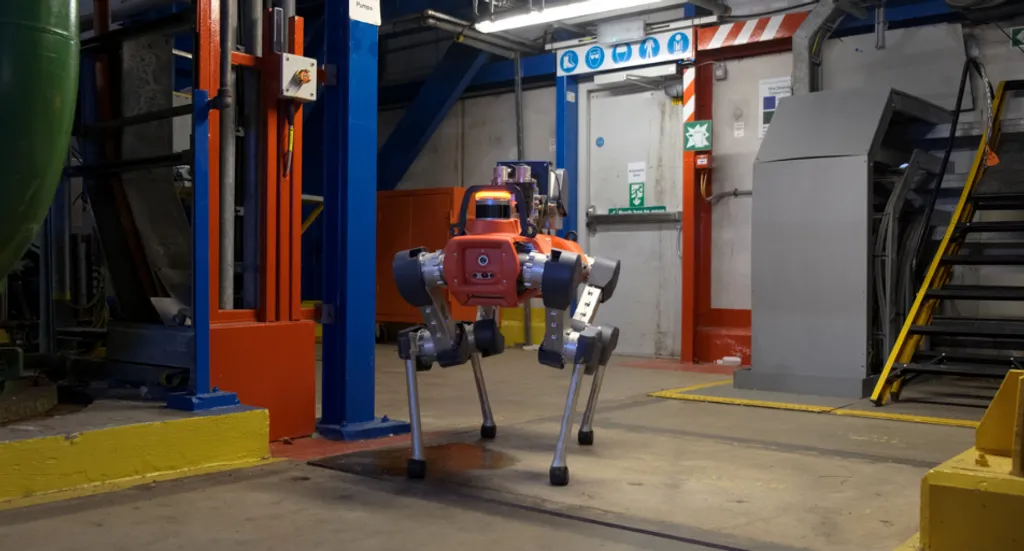
A closed door has been the one obstacle an autonomous inspection robot could never talk its way past. dormakaba, ANYbotics and LEGIC Identsystems say they have fixed that: a joint pilot, presented September 17 at LEGIC’s connect26 event in Zurich, lets ANYbotics’ ANYmal quadruped robot pass through access-controlled industrial doors on its own, using a radar trigger for unlocked doors and a digital credential, checked against the same permission system used for employee badges, for secured ones.
The pilot ran at GE Vernova’s Whitegate Power Station in County Cork, Ireland, where The Robot Report reported several weeks of continuous testing, with ANYmal reliably requesting access and completing inspection routes with no manual intervention. That detail comes from The Robot Report’s own September 24 reporting; dormakaba’s press release announces the pilot but does not name the test site.
Two doors, two mechanisms
The system splits into a low-tech half and a high-tech half, and the split is the point.
For unlocked doors, a radar sensor detects ANYmal approaching and triggers a retrofitted dormakaba ED 100 or ED 250 swing-door operator, the same automatic operators used on existing doors, including outdoor and fire-rated ones, with no structural modification required. The door opens, the robot passes, the door closes behind it: no new security infrastructure, no credential exchange, functionally identical to the automatic doors already common in hospitals and offices.
For secured or restricted doors, ANYmal carries what The Robot Report describes as a LEGIC security payload, a hardware/credential module that gives the robot a trusted digital identity. When it reaches a locked door, it requests access electronically from dormakaba’s exos access-management system, the same platform dormakaba uses to manage human badge permissions. exos grants or denies the request against predefined rules and logs a timestamped audit trail per scan and transit, matching the record-keeping dormakaba already provides for people.
That second half is the more consequential piece. ANYbotics’ own estimate, cited in The Robot Report’s reporting, puts 30 to 50 percent of critical equipment in a typical process facility behind fire doors or restricted barriers, exactly the terrain a wheeled or legged robot has never been able to reach without someone unlocking a path for it first. Treating the robot as a badge-holder inside the existing access-control system, rather than building a parallel permissions scheme just for robots, is the design choice that makes the pilot more than a novelty.
Why three companies, not one
dormakaba is a publicly listed Swiss access-control and security company; LEGIC Identsystems is a Swiss credential-technology firm supplying the secure-identity components behind many badge and access systems; ANYbotics is the Zurich-based maker of ANYmal, an autonomous legged robot built for industrial inspection work, already deployed across power, mining, oil and gas, and chemical facilities. None of the three needed to build the whole stack alone, which is presumably why this is a three-way collaboration rather than a single vendor’s product announcement.
“Autonomous robots are becoming part of the workforce in industrial environments,” said Till Reuter, dormakaba’s CEO, in the companies’ announcement. “Access management can become an important enabler for the next generation of industrial automation,” added David Fuller, dormakaba’s Chief Innovation Officer. LEGIC’s General Manager, Mehdi Elhaoussine, framed it in physical-AI terms: “With this first-of-its-kind project, we are taking a major step into physical AI.” Speaking separately to The Robot Report, he put the credentialing idea more plainly: “This is about authenticating autonomous systems: issuing a trusted identity, in effect a badge for the robot.”
ANYbotics’ side of the framing centers on what the limitation was actually costing customers. Jacob Euler-Rolle, an ANYbotics product manager quoted by The Robot Report, said “a closed door was the one obstacle that stopped our robots from covering the most critical parts of a plant.” ANYbotics co-founder and CEO Péter Fankhauser made the same point in dormakaba’s own release: “Every access-controlled door was a hard limit on that coverage.” In comments to The Robot Report, he added that customers “buy a solution to operational challenges: less unplanned downtime and fewer people in hazardous areas,” not a robot for its own sake.
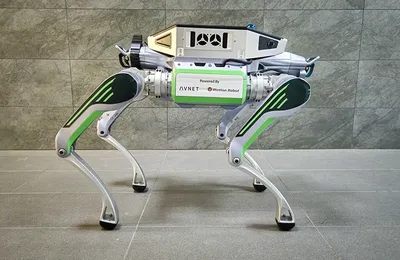
ANYmal itself is unchanged hardware: a roughly 10-kilogram expandable payload, about 90 minutes of runtime per charge, a 0.75 m/s walking speed, roughly 2 kilometers of range, dual eighth-generation six-core Intel i7 compute, WiFi and 4G/LTE connectivity, and an IP67 rating, per ANYbotics’ own specification page. Its sensor suite (20x optical zoom camera, thermal imaging from -40°C to 550°C, a pan-tilt spotlight, gas-leak sensors and 360-degree lidar) is built for reading gauges and finding leaks, not for opening doors. This pilot doesn’t add a capability to the robot; it removes a constraint on where its existing capabilities can be used.
Sources
- dormakaba, ANYbotics and LEGIC present a successful pilot of autonomous robots passing through access-controlled doors — dormakaba Group (official), Sep 17, 2026
- ANYbotics opens the door for inspections with ANYmal robots — The Robot Report, Sep 24, 2026
Frequently asked questions
What did dormakaba, ANYbotics and LEGIC actually demonstrate? +
A pilot letting ANYbotics' ANYmal quadruped inspection robot pass through access-controlled doors on its own: unlocked doors open automatically when a radar sensor detects the robot approaching, and secured doors are opened after ANYmal presents a digital access credential that dormakaba's system checks against the same permission rules used for employee badges.
How does ANYmal get through a locked, secured door specifically? +
ANYmal carries a LEGIC security payload that gives it a trusted digital identity. It requests access electronically from dormakaba's exos access-management system, which grants or denies the request based on predefined permissions and logs the transit with a timestamp, the same audit trail dormakaba keeps for human badge scans, according to The Robot Report's reporting on the pilot.
Where was this tested, and for how long? +
At GE Vernova's Whitegate Power Station in County Cork, Ireland, where The Robot Report reported several weeks of continuous testing with the robot reliably requesting access and completing inspection routes without manual intervention.
Is ANYmal a new robot, or existing hardware? +
Existing hardware. ANYmal is ANYbotics' established autonomous legged inspection robot, already deployed across power, mining, oil and gas, and chemical facilities. Nothing about the robot itself changed here; what changed is the access-control layer around it.
More news