KUKA vs Yaskawa Robots: A Spec-by-Spec Comparison (2026)
Yaskawa leads on IP67 and repeatability; KUKA counters with longer reach and the 1,000 kg KR TITAN. How to choose by payload, IP rating, and reach.
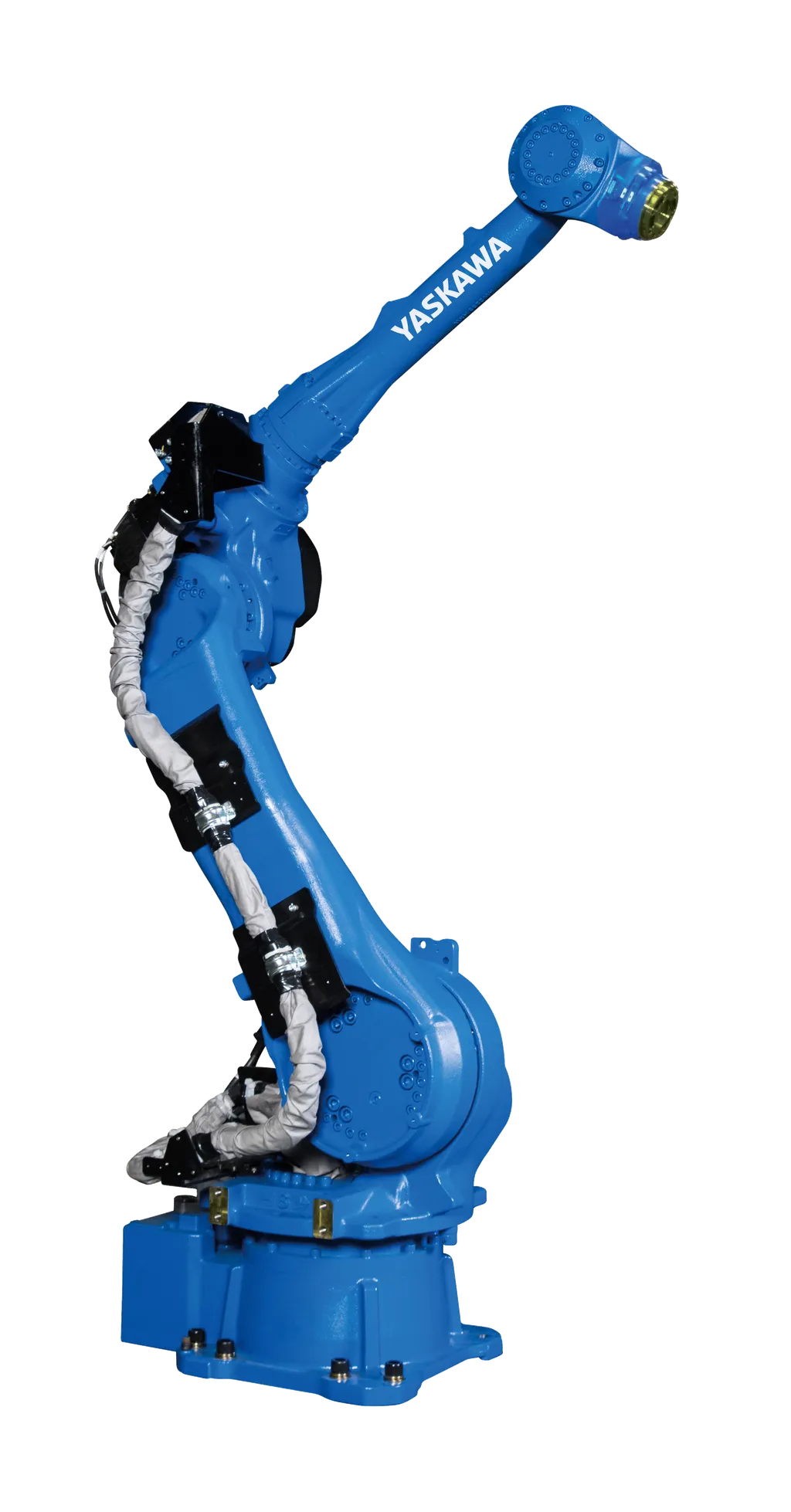
Neither brand wins outright. Across the six weight classes where KUKA and Yaskawa articulated robots go head to head in our database, the split is consistent but not one-sided: Yaskawa’s GP line runs IP67 on nearly every arm — including the 7 kg GP7 — and posts tighter repeatability in most classes; KUKA counters with notably long reach in the mid-heavy band and extends the payload ceiling far beyond Yaskawa’s articulated range, topping at 1,000 kg with the KR 1000 TITAN where Yaskawa’s GP series stops at 280 kg. In the workhorse class, for instance, Yaskawa’s GP25 beats the KUKA KR 20 R1810 on payload (25 kg vs. 20 kg), repeatability (0.02 mm vs. 0.04 mm), and IP rating (IP67 vs. IP54) — KUKA wins only on reach by 83 mm. But in the super-heavy class, Yaskawa’s articulated line has no answer for the KR 500 R2830 or the KR 1000 TITAN. The right choice comes down to your weight class, process environment, and reach envelope.
How we structured this comparison
All figures below come from the Industrial Robotics Hub database. No manufacturer marketing pages, no third-party databases. Every payload, reach, repeatability, and IP rating is sourced directly from our data; where a figure is not in the database it is omitted rather than estimated. The comparison pairs robots by weight class so you are always looking at like against like. You can build any custom side-by-side from live data at the compare engine.
The catalog in our database: KUKA 19 robots, Yaskawa 21 robots. Both brands field articulated 6-axis arms as their primary product. The classes covered here are: light (~6-8 kg), mid (~10-12 kg), workhorse (~20-25 kg), heavy (~50-88 kg), mid-heavy (~120-280 kg), and super-heavy (500 kg+). The KUKA brand page and Yaskawa brand page list the full sets with specs filterable by type.
Light 6-axis (~6-8 kg): KR 6 R700 sixx vs GP7
| Spec | KUKA KR 6 R700 sixx | Yaskawa GP7 |
|---|---|---|
| Payload | 6 kg | 7 kg |
| Reach | 706 mm | 927 mm |
| Repeatability | 0.02 mm | 0.01 mm |
| IP rating | IP54 | IP67 |
Yaskawa wins three of four specs in this class. The GP7 carries 1 kg more payload, reaches 221 mm further, posts twice the repeatability precision (0.01 mm vs. 0.02 mm), and seals to IP67 while the KR 6 R700 sixx sits at IP54. A 221 mm reach advantage in the light class is substantial — it often determines whether the arm can serve a conveyor and a fixture from a single mount point. The IP gap matters in any process that involves coolant mist, part washing, or regular wipe-down: IP67 means temporary full submersion survivability; IP54 means splash resistance only. If your cell is genuinely dry and 706 mm reach is adequate, the KR 6 R700 sixx is a proven arm with a strong KUKA controller ecosystem. If the environment involves any liquid or the reach is tight, the GP7 has the better spec on every dimension.
Mid 6-axis (~10-12 kg): KR 10 R900 sixx vs GP12
| Spec | KUKA KR 10 R900 sixx | Yaskawa GP12 |
|---|---|---|
| Payload | 10 kg | 12 kg |
| Reach | 901 mm | 1,440 mm |
| Repeatability | 0.02 mm | 0.02 mm |
| IP rating | IP54 | IP67 |
This is the widest reach gap in the entire comparison. At 1,440 mm, the GP12 reaches 539 mm further than the KR 10 R900 sixx at 901 mm — a difference that in cell design terms is the margin between a robot that can serve a machine envelope and a part tray from one position and one that cannot. Payload favors Yaskawa by 2 kg, repeatability is tied at 0.02 mm, and the IP rating again favors Yaskawa (IP67 vs. IP54). For integrators speccing a mid-class arm for a compact cell with tight reach constraints, the GP12 has no equivalent on the KUKA side in this payload band. The KR 10 R900 sixx is appropriate for very tight cells where 901 mm of reach is sufficient and the KUKA controller ecosystem is already in place.
Workhorse (~20-25 kg): KR 20 R1810 vs GP25
| Spec | KUKA KR 20 R1810 | Yaskawa GP25 |
|---|---|---|
| Payload | 20 kg | 25 kg |
| Reach | 1,813 mm | 1,730 mm |
| Repeatability | 0.04 mm | 0.02 mm |
| IP rating | IP54 | IP67 |
This is Yaskawa’s clearest sweep, with one important exception. The GP25 wins on payload (25 kg vs. 20 kg), repeatability (0.02 mm vs. 0.04 mm), and IP rating (IP67 vs. IP54). The KR 20 R1810 takes reach by 83 mm (1,813 mm vs. 1,730 mm) — the only spec where KUKA leads in the workhorse class. Whether 83 mm of additional reach is meaningful depends entirely on the cell geometry. A 5 kg payload difference is often decisive: a gripper handling a 18 kg casting has no headroom on a 20 kg arm, while a 25 kg arm clears it with a 7 kg margin. The repeatability difference (0.04 mm vs. 0.02 mm) matters for precision fixture loading and tight-tolerance assembly — double the positioning precision changes what the arm can do without a search routine. For machining and welding cells with any coolant exposure, the GP25’s IP67 rating removes a category of failure that IP54 does not cover. We analyzed that failure mode in the robot brand payload ladder.
Heavy (~50-88 kg): GP50 / GP88 vs KR 70 R2100
| Spec | Yaskawa GP50 | Yaskawa GP88 | KUKA KR 70 R2100 |
|---|---|---|---|
| Payload | 50 kg | 88 kg | 70 kg |
| Reach | 2,061 mm | 2,236 mm | 2,101 mm |
| Repeatability | 0.03 mm | 0.03 mm | 0.04 mm |
| IP rating | IP67 | IP67 | IP65 |
The heavy class is where Yaskawa’s portfolio structure gives it a structural advantage: the GP50 and GP88 bracket the KR 70 R2100 on both sides. If the application is a 50-60 kg part, the GP50 covers it at IP67 with 2,061 mm reach. If the part or tooling combination runs 70-88 kg, the GP88 handles it at IP67 with 2,236 mm reach — 135 mm more than the KR 70 R2100. The KUKA arm slots between the two at 70 kg with IP65 and 0.04 mm repeatability, compared to 0.03 mm for both GP models. IP65 protects against water jets but not temporary submersion; IP67 does. For a press-tending, spot-welding, or materials-handling cell where coolant or quench fluid is present, the Yaskawa options carry the better protection at every bracket. The KR 70 R2100 is the correct pick if your process is dry and the KUKA KRC5 controller ecosystem is already embedded in the plant.
Mid-heavy (~120-280 kg): KR 120 / KR 210 vs GP180 / GP280
| Spec | KUKA KR 120 R2700-2 | KUKA KR 210 R2700-2 | Yaskawa GP180 | Yaskawa GP280 |
|---|---|---|---|---|
| Payload | 120 kg | 210 kg | 180 kg | 280 kg |
| Reach | 2,701 mm | 2,700 mm | 2,702 mm | 2,446 mm |
| Repeatability | 0.06 mm | 0.06 mm | 0.05 mm | 0.05 mm |
| IP rating | IP65 | IP65 | IP67 | IP67 |
This class is genuinely split, with the decision hinging on whether payload ceiling or IP rating is the binding constraint. On reach, all four arms cluster tightly: 2,700-2,702 mm for the KUKA pair and GP180, and 2,446 mm for the GP280 — Yaskawa’s heaviest arm is the only outlier with a shorter envelope. On repeatability, Yaskawa is tighter at 0.05 mm versus KUKA’s 0.06 mm. On IP rating, Yaskawa again runs IP67 where KUKA is at IP65. On payload, Yaskawa goes higher: the GP280 at 280 kg exceeds both KUKA models (120 kg and 210 kg), which matters for large automotive stampings, heavy castings, and foundry applications where part mass consistently challenges the 210 kg ceiling. The practical read: if your part plus tooling clears 210 kg but stays under 280 kg, and your environment involves any liquid ingress, the GP280 is the only option between these two brands. If part mass stays well under 210 kg and reach is the primary constraint, the KR 120 or KR 210 at 2,700 mm reach matches the GP180 and does so in a controller ecosystem many European automotive plants already run. See both in the compare engine.
Super-heavy (500 kg+): KUKA’s exclusive territory
| Spec | KUKA KR 500 R2830 | KUKA KR 1000 TITAN |
|---|---|---|
| Payload | 500 kg | 1,000 kg |
| Reach | 2,826 mm | 3,202 mm |
| Repeatability | 0.08 mm | 0.10 mm |
| IP rating | IP65 | IP65 |
Above 280 kg, Yaskawa’s articulated range has no entries in our database. KUKA operates this territory alone, with the KR 500 R2830 at 500 kg and the KR 1000 TITAN at 1,000 kg. These are not direct competitors to anything in the Yaskawa GP line — they address vehicle body handling, large press feeding, heavy container logistics, and industrial casting applications where part mass rules out every other option. If your application is in this bracket, KUKA is the only answer between these two brands.
Class-by-class verdict
| Class | KUKA | Yaskawa | Verdict |
|---|---|---|---|
| Light (~6-8 kg) | KR 6 R700 sixx | GP7 | Yaskawa — more payload, reach, repeatability, IP67 vs. IP54 |
| Mid (~10-12 kg) | KR 10 R900 sixx | GP12 | Yaskawa — more payload, 539 mm more reach, IP67 vs. IP54 |
| Workhorse (~20-25 kg) | KR 20 R1810 | GP25 | Yaskawa — more payload, tighter repeatability, IP67; KUKA wins reach by 83 mm |
| Heavy (~50-88 kg) | KR 70 R2100 | GP50 / GP88 | Yaskawa — brackets the class, IP67, tighter repeatability |
| Mid-heavy (~120-280 kg) | KR 120 / KR 210 | GP180 / GP280 | Split — Yaskawa higher payload ceiling + IP67; KUKA reach matches GP180 |
| Super-heavy (500 kg+) | KR 500 / KR 1000 TITAN | No equivalent | KUKA — no Yaskawa entry in our database above 280 kg |
What the catalog breadth tells you
Yaskawa carries 21 robots in our database versus KUKA’s 19. The more significant catalog pattern is the IP consistency: Yaskawa’s GP line runs IP67 as the standard from the smallest arm (GP7 at 7 kg) through the heaviest (GP280 at 280 kg). That is not universal in the market — most brands treat high IP ratings as a specialty or washdown variant rather than a baseline. KUKA’s articulated line in our data runs IP54 at the light end and steps up to IP65 in the heavy and mid-heavy classes; IP67 does not appear in the KUKA articulated arms in our database.
For process environment planning, this matters as a system decision, not just a per-arm decision. A plant standardizing on KUKA for a wet machining environment will manage IP54 and IP65 arms in cells that may encounter coolant; a plant standardizing on Yaskawa gets IP67 baseline protection across the fleet. The FANUC vs ABB comparison covers how IP consistency at the brand level plays out in a different pair, and the patterns are similar.
KUKA’s catalog advantage is at the top end of the payload range, where the KR 1000 TITAN at 1,000 kg has no Yaskawa peer. The full articulated robot type page lists every arm across both brands and is filterable by payload, reach, and IP rating.
How to pick for your cell
Work through three questions in order and the comparison narrows itself.
What is your payload ceiling, including tooling? Add the gripper or end-of-arm tool weight to the part weight, then apply at least 20-25% headroom above that number. Below 280 kg, both brands have competitive options. Above 280 kg, only KUKA has entries in our database — the KR 500 R2830 and KR 1000 TITAN are the only options between these two brands for extreme-payload work.
What is your IP requirement? If the cell involves flood coolant, part washing, quench tanks, or regular hose-down, set your IP floor at IP67. Yaskawa’s GP line meets that floor across the entire articulated range. KUKA’s articulated arms in our database top at IP65 in the heavy and mid-heavy classes, which handles water jets but not temporary submersion. If the cell is genuinely dry — electronics assembly, logistics, dry machining — the IP difference is irrelevant and the choice shifts to reach, controller ecosystem, and integrator relationship.
What reach does the cell geometry require? In the workhorse class, the KR 20 R1810 at 1,813 mm reaches 83 mm further than the GP25 — a small but real advantage if the cell layout is tight. In the mid class, the GP12 at 1,440 mm reaches 539 mm further than the KR 10 R900 sixx — a large advantage that often determines whether a second robot or a track is required. In the mid-heavy class, both brands converge around 2,700 mm except for the GP280, which is shorter at 2,446 mm. In the super-heavy class, the KR 1000 TITAN at 3,202 mm is simply the only option.
The compare engine lets you set any two robots from the full database side by side on all specs simultaneously, including models not in this post. If the class you are speccing falls between the pairs above, that is the place to run the numbers.
All specifications sourced from the Industrial Robotics Hub database, current as of June 2026. Payload and reach are headline manufacturer figures; effective payload at full reach is lower and varies by model. IP ratings reflect the arm rating as recorded in our database. Figures not in the database are omitted rather than estimated.
Compare these robots