FANUC vs ABB Robots: A Spec-by-Spec Comparison (2026)
FANUC leads on IP67 and payload depth; ABB counters with longer reach and a broader cobot catalog. The right pick depends on your weight class.
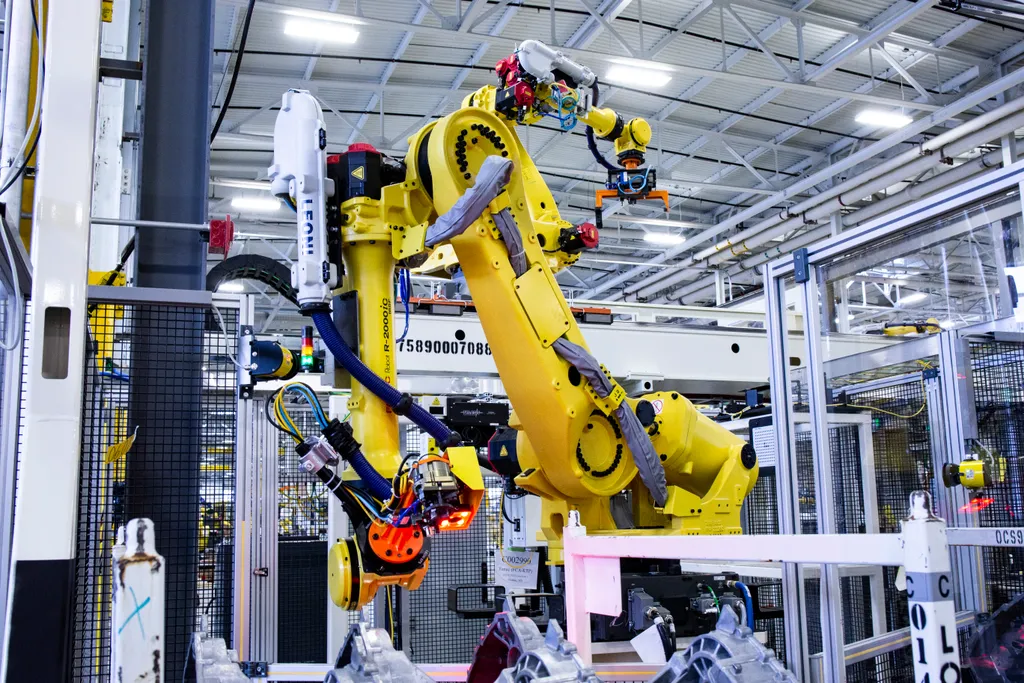
Neither brand wins outright. Across the eight weight classes and robot types where FANUC and ABB go head to head in our database, the split is roughly even — FANUC tends to carry more payload and runs IP67 more consistently across its articulated line; ABB counters with longer reach in the heavy class, a unique dual-arm cobot with no FANUC equivalent, and a broader catalog overall (24 robots tracked vs. FANUC’s 17). In the workhorse 20-25 kg class, for instance, FANUC’s M-20iD/25 beats the ABB IRB 2600-20 on payload (25 kg vs. 20 kg), reach (1,831 mm vs. 1,650 mm), repeatability (0.03 mm vs. 0.04 mm), and IP rating (IP67 vs. IP54) — a clean sweep in that class. But drop into the heavy category and ABB’s IRB 6700-150/3.20 stretches 545 mm further than FANUC’s R-2000iC/165F while matching it on repeatability and IP67 sealing. The right answer depends on your weight class, process environment, and whether you need a dual-arm collaborative cell.
How we structured this comparison
The data comes entirely from the Industrial Robotics Hub database. No manufacturer marketing pages, no third-party databases. Every payload, reach, repeatability, and IP figure below is sourced from that database only; where a figure is not in the database, it is omitted. The comparison pairs robots by weight class so you are looking at like against like — a light-duty 6-axis against a light-duty 6-axis, not a 7 kg SCARA against a 165 kg floor-mount. You can build any custom side-by-side from this data at the compare engine, which pulls live figures for every robot in the database.
The classes covered: light 6-axis (~7 kg), mid 6-axis (~10-12 kg), workhorse (~20-25 kg), heavy (~150-165 kg), super-heavy (500 kg+), cobots, SCARA, and delta. That covers every type both brands field in our current data.
Light 6-axis: FANUC LR Mate 200iD/7L vs ABB IRB 1200-7/0.7
| Spec | FANUC LR Mate 200iD/7L | ABB IRB 1200-7/0.7 |
|---|---|---|
| Payload | 7 kg | 7 kg |
| Reach | 911 mm | 700 mm |
| Repeatability | 0.02 mm | 0.02 mm |
| IP rating | IP54 | IP40 |
Payload and repeatability are identical. FANUC’s LR Mate 200iD/7L carries the advantages here: 211 mm more reach and IP54 protection versus IP40. IP40 offers no meaningful liquid protection — the ABB IRB 1200 is a clean-room and dry-environment arm. If the cell has any coolant mist or even occasional wipe-down, the FANUC is the safer default. If the environment is genuinely dry and reach is not tight, the difference narrows to the integrator relationship and controller familiarity.
Mid 6-axis: FANUC M-10iD/12 vs ABB IRB 1600-10/1.45
| Spec | FANUC M-10iD/12 | ABB IRB 1600-10/1.45 |
|---|---|---|
| Payload | 12 kg | 10 kg |
| Reach | 1,441 mm | 1,450 mm |
| Repeatability | 0.02 mm | 0.02 mm |
| IP rating | IP67 | IP54 |
Reach is nearly identical — the two arms serve the same envelope. The differences are in payload (FANUC carries 2 kg more, which matters when a gripper eats into headroom) and IP rating (IP67 versus IP54). A 2 kg payload difference is often the margin between a gripper-plus-part combination that works and one that does not. IP67 versus IP54 is the margin between an arm that survives a flood-coolant splash and one that does not. We analyzed that specific trade-off in the robot IP ratings washdown post. In this class, FANUC wins on both the specs that tend to bite in year two.
Workhorse: FANUC M-20iD/25 vs ABB IRB 2600-20/1.65
| Spec | FANUC M-20iD/25 | ABB IRB 2600-20/1.65 |
|---|---|---|
| Payload | 25 kg | 20 kg |
| Reach | 1,831 mm | 1,650 mm |
| Repeatability | 0.03 mm | 0.04 mm |
| IP rating | IP67 | IP54 |
This is FANUC’s cleanest sweep in the comparison. The M-20iD/25 wins on all four specs: 5 kg more payload, 181 mm more reach, tighter repeatability, and two IP grades better for liquid ingress. For a wet machining cell or a welding line with occasional coolant, the M-20iD/25 is the straightforward pick. For a fully dry light-assembly environment where the integrator has a strong ABB practice, the IRB 2600 is a capable arm — the spec gap just does not favor it when the environment adds liquid.
Heavy: FANUC R-2000iC/165F vs ABB IRB 6700-150/3.20
| Spec | FANUC R-2000iC/165F | ABB IRB 6700-150/3.20 |
|---|---|---|
| Payload | 165 kg | 150 kg |
| Reach | 2,655 mm | 3,200 mm |
| Repeatability | 0.05 mm | 0.05 mm |
| IP rating | IP67 | IP67 |
This is the most nuanced class in the comparison. Repeatability and IP protection are equal. FANUC carries 15 kg more payload — relevant for handling heavy stampings or large assemblies. ABB stretches 545 mm further — relevant for large press lines, body-in-white cells, or palletizing from a fixed floor position where repositioning costs cycle time. Neither arm is obviously correct. The question for the cell designer is whether that extra reach eliminates a track or a robot position; if it does, ABB’s reach advantage has real economic value. If the payload is the constraint, FANUC’s 15 kg headroom wins. See both arms in the compare engine against your specific reach and payload envelope.
Super-heavy: FANUC M-2000iA/1700L vs ABB IRB 8700-550/4.2
| Spec | FANUC M-2000iA/1700L | ABB IRB 8700-550/4.2 |
|---|---|---|
| Payload | 1,700 kg | 550 kg |
| Reach | 3,734 mm | 4,200 mm |
| Repeatability | 0.27 mm | 0.10 mm |
| IP rating | IP67 | IP67 |
The split here is sharp and the applications are different. FANUC’s M-2000iA/1700L is in a payload class of its own — 1,700 kg is the kind of rating that handles complete vehicle bodies, large press blanks, or industrial containers. ABB’s IRB 8700 carries 550 kg, which is still heavy-duty, but it posts tighter repeatability (0.10 mm vs. 0.27 mm) and longer reach (4,200 mm vs. 3,734 mm). If your application is extreme payload — moving something that weighs more than a car — FANUC has no peer in our database. If your application is a large-envelope cell that demands better positioning accuracy at a more moderate load, the IRB 8700 is the better tool. These two arms are not direct competitors; they address different ends of the same broad category.
Cobots: FANUC CRX / CR series vs ABB GoFa / YuMi
The cobot comparison is where the brands diverge most clearly — and where ABB’s catalog width matters most.
| Spec | FANUC CRX-25iA | FANUC CR-35iB | ABB GoFa CRB 15000-12 |
|---|---|---|---|
| Payload | 30 kg | 50 kg | 12 kg |
| Reach | 1,889 mm | — | 1,270 mm |
| Repeatability | 0.04 mm | — | 0.05 mm |
| IP rating | IP67 | IP67 | IP54 |
FANUC’s cobot line carries far higher payload than ABB’s GoFa range and runs IP67 on both arms listed above. The ABB GoFa CRB 15000-12 and the GoFa-10 are lighter, IP54-rated arms suited to light assembly and inspection in dry environments. For machine tending, a wet cell, or a task that demands 25 kg+ payload in a collaborative format, FANUC’s CRX line has no ABB peer in our database. We ranked the CRX-25iA top in our cobot machine-tending analysis precisely because of that combination.
The exception — and it is a genuine one — is the ABB YuMi IRB 14000. The YuMi is a dual-arm collaborative robot designed for two-handed light assembly: electronics, small components, tasks that require simultaneous manipulation from two arms in close quarters. FANUC has no equivalent in our database. If your cell requires dual-arm human-robot collaboration on small precision parts, ABB is the only option between the two brands.
SCARA: FANUC SR-6iA vs ABB IRB 920-6
| Spec | FANUC SR-6iA | ABB IRB 920-6 |
|---|---|---|
| Payload | 6 kg | 6 kg |
| Reach | 650 mm | 550 mm |
| Repeatability | 0.01 mm | 0.01 mm |
Repeatability is identical at 0.01 mm — the precision benchmark for SCARA robots doing PCB population or pharmaceutical tableting. FANUC reaches 100 mm further, which may matter in a tighter cell. For most SCARA applications, controller ecosystem and integrator familiarity will drive the pick more than this spec gap.
Delta: FANUC M-3iA vs ABB IRB 360 FlexPicker 8/1130
| Spec | FANUC M-3iA | ABB IRB 360 FlexPicker 8/1130 |
|---|---|---|
| Payload | 6 kg | 8 kg |
| IP rating | IP69K | IP69K |
Both delta robots carry IP69K — the high-pressure hot-water washdown standard used in meat and dairy processing, and one of only two ratings at this level across the 264 robots in our database. ABB’s FlexPicker carries 2 kg more payload. For food primary packaging, both are viable; the payload difference may matter if you are picking heavier product formats. Both are the correct answer to the question “which delta robot can survive a daily caustic washdown?” The robot IP ratings washdown analysis covers this class in detail.
Class-by-class verdict
| Class | FANUC | ABB | Verdict |
|---|---|---|---|
| Light 6-axis (~7 kg) | LR Mate 200iD/7L | IRB 1200-7/0.7 | FANUC — longer reach + IP54 vs. IP40 |
| Mid 6-axis (~10-12 kg) | M-10iD/12 | IRB 1600-10/1.45 | FANUC — +2 kg payload + IP67 vs. IP54 |
| Workhorse (~20-25 kg) | M-20iD/25 | IRB 2600-20/1.65 | FANUC — wins all four specs |
| Heavy (~150-165 kg) | R-2000iC/165F | IRB 6700-150/3.20 | Split — FANUC payload, ABB reach |
| Super-heavy (500 kg+) | M-2000iA/1700L | IRB 8700-550/4.2 | Split — FANUC extreme payload, ABB accuracy + reach |
| Cobots (high payload) | CRX-25iA / CR-35iB | GoFa CRB 15000 | FANUC — far higher payload + IP67 |
| Cobots (dual-arm) | No equivalent | YuMi IRB 14000 | ABB — no FANUC match in our DB |
| SCARA | SR-6iA | IRB 920-6 | FANUC — marginal reach edge; otherwise equal |
| Delta (washdown) | M-3iA | IRB 360 8/1130 | ABB — slightly higher payload; both IP69K |
What the catalog breadth tells you
ABB carries 24 robots in our database versus FANUC’s 17. That breadth matters in two ways. ABB’s range includes more cobot variants, a unique dual-arm platform, a painting robot series, and a wider light-duty articulated range. FANUC’s smaller catalog is more concentrated in the articulated and cobot categories where IP67 is the consistent standard across the line. The FANUC brand page and ABB brand page both list the full sets with specs filterable by type.
The IP67 consistency is a real differentiator for FANUC at the articulated level. Of the mid-to-heavy articulated arms compared here, FANUC runs IP67 across the board; ABB’s articulated arms in those same classes sit at IP54. If your cells are wet — machining with coolant, food handling, chemical processing — that difference compounds over the service life of the arm. If your cells are dry — electronics assembly, logistics, clean-room — the IP difference is irrelevant and ABB’s broader range and reach in the heavy class become more relevant.
For the brand payload ladder across all brands in the database, FANUC holds the top slot: the M-2000iA/1700L at 1,700 kg remains the highest payload robot in our data.
How to pick for your cell
Work through four questions in sequence, and the comparison above will narrow itself.
Is the environment wet or dry? If wet — coolant, washdown, food processing — set your IP floor at IP67 for articulated arms and IP69K for delta. In that scenario, FANUC’s articulated line has a systematic advantage over ABB in the mid and workhorse classes. In delta, both brands meet the washdown standard.
What is the payload, including tooling? Add the gripper weight to the part weight and apply at least 20-25% headroom above that sum. In the workhorse class this alone narrows the choice: FANUC’s M-20iD/25 at 25 kg versus ABB’s IRB 2600 at 20 kg may decide the question before any other spec is checked.
What is the required reach? If the cell is large-envelope or if an extra 500 mm of reach eliminates a robot track, ABB’s IRB 6700-150/3.20 at 3,200 mm has a genuine advantage over the FANUC R-2000iC/165F at 2,655 mm. Run the numbers on whether that reach difference saves a track position before choosing on payload alone.
Is collaboration or dual-arm work required? If a human shares the cell and the payload is light — inspection, electronics assembly, two-handed manipulation — ABB’s GoFa and YuMi range covers ground FANUC does not. If the collaborative cell is heavier (machine tending, casting handling), FANUC’s CRX and CR series carry the payload at IP67 that ABB’s GoFa does not match.
The compare engine lets you set any two robots from the full database side by side on all of these specs simultaneously, including models not in this post. If the class or environment you are speccing for falls between the pairs above, that is the place to run the numbers.
All specifications sourced from the Industrial Robotics Hub database, current as of June 2026. Payload and reach are headline manufacturer figures; effective payload at full reach is lower and varies by model. IP ratings reflect the arm rating at the body/wrist as recorded in our database. Figures not in the database are omitted rather than estimated.
Compare these robots