Material Handling Robots in 2026: How to Choose by Payload Class from 2 kg to 1,700 kg
133 material-handling robots from 2 kg to 1,700 kg. How to choose by payload band, when an AMR beats a fixed arm, and the right IP for your environment.
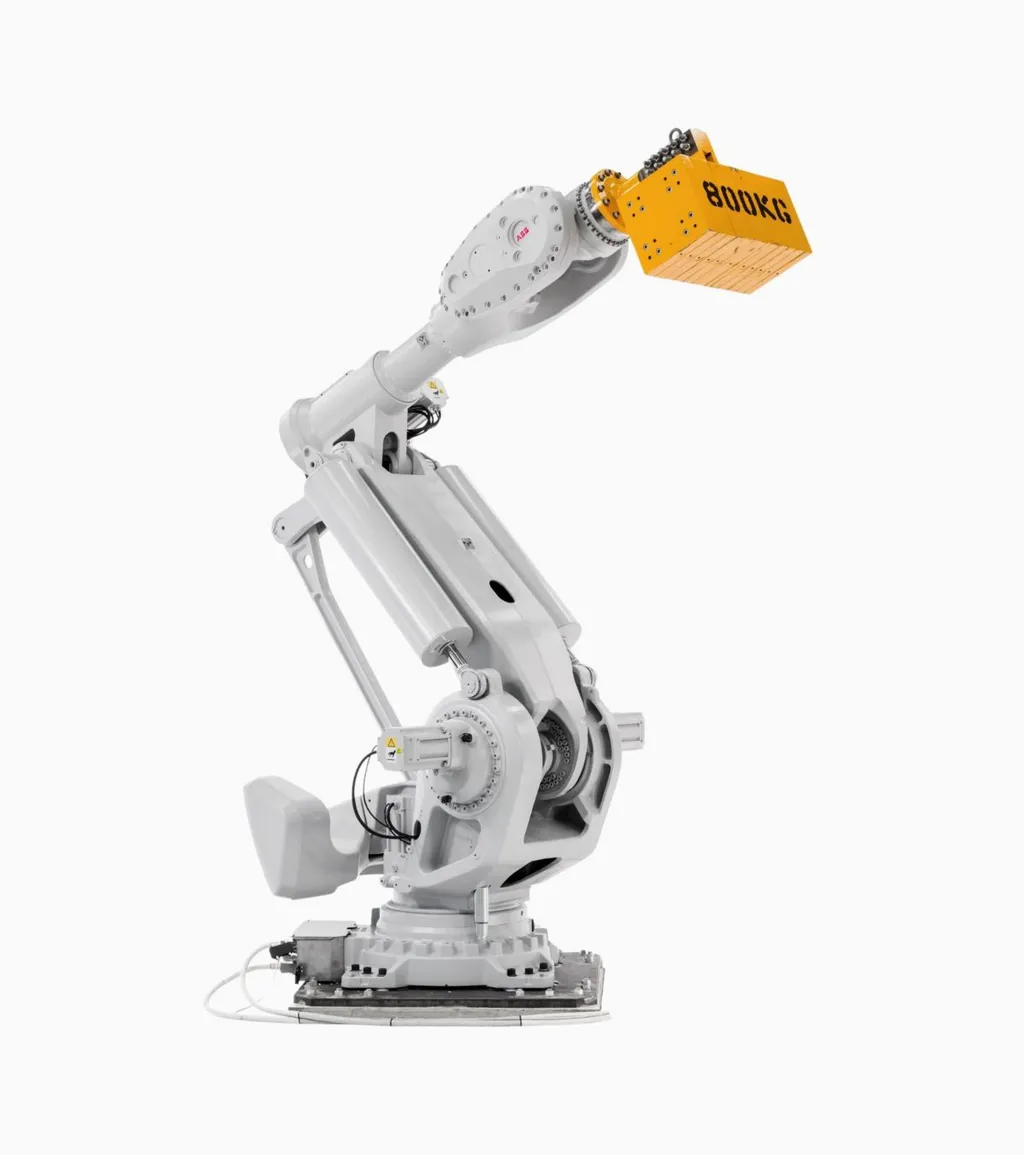
Material handling is the broadest application category in the Industrial Robotics Hub database by payload range. The 133 robots tagged for material handling span 2 kg to 1,700 kg — a 850-fold range. No single robot type covers it. A 5 kg cobot that transfers ECUs between conveyor lines and a 1,700 kg FANUC M-2000iA that lifts a vehicle body shell are both “material handling robots.” They are, in practice, completely different machines selected by completely different criteria.
The payload band is the first decision. Once you know your payload band, the robot type, reach requirement, and IP floor follow from the application rather than from a catalog search.
The four payload bands and what they cover
Light handling (under 20 kg). Parts transfer, box conveyance, component feeding between stations, tray loading and unloading. This band is covered by cobots and small articulated arms. 58 of the 133 material-handling robots in our database fall here. The dominant spec is reach — the arm must bridge the gap between source and destination — and repeatability is less critical (a few millimeters is fine for dropping a box on a conveyor; sub-millimeter accuracy is not needed).
Mid-range handling (20 to 79 kg). Larger subassemblies, engine blocks, gearboxes, structural panels. 49 robots in our database occupy this band. 6-axis articulated arms in the 20 to 80 kg class are the standard format; cobots are available to 50 kg but inertia and ISO 15066 speed limits make them slower than fenced arms at this mass.
Heavy handling (80 to 200 kg). Large press-room stamped parts, castings, structural steel sections. 13 robots in our database cover this band. These are generally large articulated arms from FANUC, ABB, KUKA, and Yaskawa with reaches above 2,000 mm to handle the large envelope that heavy parts require.
Super-heavy handling (above 200 kg). Vehicle bodies, turbine components, shipping containers, heavy structural fabrications. Only 17 robots in our database reach this range — it is a niche product class. FANUC, ABB, KUKA, and Estun supply it. The ceiling in our database is the FANUC M-2000iA/1700L at 1,700 kg payload.
Super-heavy handling: the top robots above 200 kg
| Robot | Payload | Reach | Repeatability | IP |
|---|---|---|---|---|
| FANUC M-2000iA/1700L | 1,700 kg | 3,734 mm | ±0.27 mm | IP67 |
| KUKA KR 1000 TITAN | 1,000 kg | 3,202 mm | ±0.10 mm | IP65 |
| Estun ER700-2800 | 700 kg | 2,800 mm | ±0.10 mm | IP54 |
| FANUC M-410iB/700 | 700 kg | 3,143 mm | ±0.50 mm | IP67 |
| ABB IRB 8700-550/4.2 | 550 kg | 4,200 mm | ±0.10 mm | IP67 |
The FANUC M-2000iA/1700L is the heaviest-payload robot in our database at 1,700 kg — a figure that covers vehicle body shells, press room transfer, and large casting handling in automotive. The ABB IRB 8700 has the longest reach of any material handling robot in our database at 4,200 mm: a reach that allows a single arm to span a large workcell without a track or gantry.
Repeatability in this payload class is measured in tenths of a millimeter at best (±0.10 to ±0.50 mm), not the sub-0.05 mm figures in the assembly category. At 1,700 kg, the structural compliance of the arm itself introduces positional variation that precision control cannot eliminate entirely. For large-part handling, this is acceptable: placing a vehicle body on a fixture is a ±5 mm task, not a ±0.05 mm task.
Light material handling: cobots and small articulated
The light-handling band (under 20 kg) is the largest single group at 58 robots. This is where cobots compete directly with small articulated arms: the cobot eliminates guarding when a human loads source trays; the fenced arm runs faster when no human intervention is needed. The choice is determined by whether the cell is fully automated or requires human presence.
AMRs: when the load needs to move between stations
6 robots in our database carry the “AMR” type tag, all from Omron. These are autonomous mobile robots — wheeled transport platforms, not arm-based manipulators. They belong in a different category from pick-and-place or handling arms, but they frequently appear in the same material-handling projects.
| AMR | Payload | Notes |
|---|---|---|
| Omron HD-1500 | 1,500 kg | Heavy load transport |
| Omron MD-900 | 900 kg | Mid-heavy transport |
| Omron MD-650 | 650 kg | Mid transport |
| Omron LD-250 | 250 kg | Workcell-to-workcell |
| Omron LD-90 | 90 kg | Light transport |
| Omron LD-60 | 60 kg | Bin and tote transport |
AMRs handle the horizontal transport problem that arms cannot: moving a load across a factory floor, between workcells, or into and out of a warehouse aisle. Arms handle the vertical and rotational problem: picking, placing, and manipulating. Most material-handling systems at scale combine both — an AMR delivers a pallet to a position, an arm picks from it.
The AMR vs conveyor decision is worth separating from the arm decision. Conveyors are faster and cheaper per unit for fixed point-to-point routes that do not change. AMRs are correct when routes need to be flexible, the factory layout changes frequently, or the space between stations cannot accommodate fixed infrastructure.
IP rating for material handling: environment drives it
IP rating requirements in material handling are driven by the environment the robot operates in, not by the task itself.
- Press room (stamping, forging): coolant splash and metallic particulate. IP67 is standard for arms in this environment. Most arms in the heavy payload band (Yaskawa GP180, ABB IRB 6700, FANUC M-2000iA) carry IP67 as standard.
- Automotive body shop (welding + handling combined): IP67 on both the handling arm and any end-of-arm tooling.
- Warehouse and logistics light handling: dry, clean environment. IP40 or IP54 is adequate. IP67 in a dry logistics center is overspec.
- Food and pharma material transfer: IP67 or IP69K depending on whether the robot is in the washdown zone. Most cobots in this band top out at IP67 (AUBO iS series, Rokae xMate); IP69K in an arm above 20 kg payload is rare and expensive.
- Outdoor handling (construction materials, yard operations): IP67 minimum; IP65 is insufficient for rain exposure over time.
Of the 133 material-handling robots in our database, 36 are rated IP67 or better (27%) and 42 are rated IP54 (32%). The heavy payload arms disproportionately carry IP67 because they are designed for automotive press-room environments where it is the baseline spec.
Reach: the overlooked spec in material handling
Reach receives less attention in material-handling specifications than payload, but it determines whether the robot can serve the cell without a linear track.
The ABB IRB 8700 at 4,200 mm reach is the longest-reach robot in our material-handling database. A 4.2-meter arm can serve a very wide press station or span two conveyor lanes from a central pedestal. Adding a linear track to extend reach adds €30,000 to €80,000 to an installation and a maintenance point that the robot itself does not have. Selecting an arm with sufficient native reach — even if it costs more — often has a lower total installed cost than a shorter arm on a track.
The rule of thumb: measure the maximum distance from the robot base to the furthest pickup and deposit point, add 20% margin, and set that as the minimum reach requirement. Do not set reach to “as much as possible” — oversizing reach increases cycle time because the arm must move through a larger angular range.
Building your material handling shortlist
- Set the payload at the heaviest part plus the end-of-arm tool (gripper, tool changer, suction cup frame). Apply 1.3x safety factor.
- Identify the payload band (under 20 kg, 20-79 kg, 80-200 kg, over 200 kg). The band determines the arm class.
- Set the minimum reach from the cell geometry. Measure; do not estimate.
- Set the IP floor from the environment: press room or food = IP67; logistics or dry manufacturing = IP40-IP54.
- Decide on AMR separately if loads need to move between stations rather than within a fixed cell.
The full list of 133 material-handling robots with all specs is at the material handling application page. For payload comparisons across any specific models, the compare tool shows every spec side by side.
Data: Industrial Robotics Hub database, 133 robots tagged for material handling across 19 brands. Specs sourced from manufacturer datasheets. Last verified June 2026.
Frequently asked questions
What is the heaviest-payload material handling robot? +
The FANUC M-2000iA/1700L at 1,700 kg is the highest-payload robot in our database -- used for vehicle body transfer in automotive. The KUKA KR 1000 TITAN follows at 1,000 kg.
What reach does a material handling robot need? +
Measure the maximum distance from the robot base to the furthest pickup or deposit point and add 20% margin. The ABB IRB 8700 at 4,200 mm has the longest reach in our material-handling database.
When should I use an AMR instead of a fixed arm? +
Use an AMR when loads must travel between stations across a factory floor. Fixed arms handle picking and placing within a cell; AMRs handle transport between cells. Most large material-handling systems combine both.
What IP rating do I need for press-room material handling? +
IP67 is standard for automotive press-room and body-shop environments with coolant splash and metallic particulate. Most large articulated arms (FANUC M-2000iA, ABB IRB 8700, KUKA KR 1000 TITAN) carry IP67 as standard.
Compare these robots