Robot Controllers: One Brand Doesn't Mean One Platform
68% of 273 robots in our database publish a controller platform. 7 of 12 documented brands run one system end to end. 5 don't, and why differs.
186 of 273 robots in our database, our analysis of the full Industrial Robotics Hub catalog, publish a named controller platform, 68.1%. Of the 20 brands we track, only 12 have enough coverage on that field to compare across their own catalog, 173 robots analyzed across those 12. Seven of those twelve brands run exactly one controller platform family across every model they publish, from their smallest robot to their largest. The other five run more than one, and the reason is different for each: two are mid-transition to a next-generation controller, one splits by robot type rather than age, and two split by robot category or physical form factor. “Same brand” is not a promise about what software your integrator has to learn.
How many robots publish a controller platform?
control.controller is populated on 186 of 273 robots, 68.1%. Five brands publish it on none of their models: AUBO (0/12), Dobot (0/11), Han’s Robot (0/8), JAKA (0/12), and SIASUN (0/11). That is not a claim those brands lack real controllers, just that our database doesn’t document the field for them yet. Two more brands are too thin to analyze: Estun (1/13) and Rokae (3/14).
That leaves 12 brands with real coverage, from Kawasaki at 75% (15/20) up to eleven brands at 100%. Sum across those 12 brands: 173 robots.
| Brand | Robots with controller | Coverage |
|---|---|---|
| ABB | 24/24 | 100% |
| Doosan | 12/12 | 100% |
| Epson | 16/16 | 100% |
| FANUC | 17/17 | 100% |
| Kawasaki | 15/20 | 75% |
| KUKA | 19/19 | 100% |
| Mitsubishi | 11/11 | 100% |
| Omron | 7/12 | 58% |
| Staubli | 11/11 | 100% |
| Techman | 11/11 | 100% |
| Universal Robots | 9/9 | 100% |
| Yaskawa | 21/21 | 100% |
Which brands run one controller from smallest model to largest?
Seven brands keep their entire published catalog on a single controller platform family, regardless of payload class or physical size. Buy the smallest model or the largest model from any of these seven and your integrator gets one software environment, one spare-parts catalog, one training curriculum, regardless of which specific model you chose.
| Brand | Controller platform | Models | Payload span |
|---|---|---|---|
| Doosan | DART Platform | 12/12 | 5 kg - 30 kg |
| FANUC | R-30iB family | 17/17 | 6 kg - 1,700 kg (283x) |
| Kawasaki | F-series | 15/20 (75%) | model-size variants, one lineage |
| Mitsubishi | CR800 | 11/11 | single-name lineup |
| Staubli | CS9 | 11/11 | single-name lineup |
| Techman | TMflow | 11/11 | single-name lineup |
| Yaskawa | YRC1000 family | 21/21 | 0.5 kg - 320 kg (640x) |
Two of these are worth a closer look, because “single platform” is doing more work than it sounds like. Doosan tags 11 of its 12 models “DART Platform” and one “DART Studio.” DART Studio is Doosan’s own name for the software suite that runs on that same base platform, not a second controller generation. FANUC publishes three controller names, R-30iB Plus (11 models), R-30iB Mini Plus (5 models), and R-30iB Compact Plus (1 model), but all three are the same generation in a different cabinet size, and on that one platform FANUC spans 6 kg to 1,700 kg, a 283x payload range. Yaskawa does something similar on its YRC1000 family (some tagged plain YRC1000, some YRC1000micro), and on that single controller lineage spans 0.5 kg to 320 kg, a 640x range, the widest single-controller payload span in our database. Kawasaki publishes several F-series codes (F02, F03, F04, F60, F61, plus an “E” controller) across its 15 published models, one lineage with model-size variants, at 75% coverage.
Mitsubishi, Staubli, and Techman are the cleanest cases: one controller name, full coverage, no asterisks.
Which brands are mid-transition to a new controller?
ABB and Universal Robots aren’t splitting by type or category. They’re mid-generation-change, and depending on which specific model you buy, you land on one side or the other.
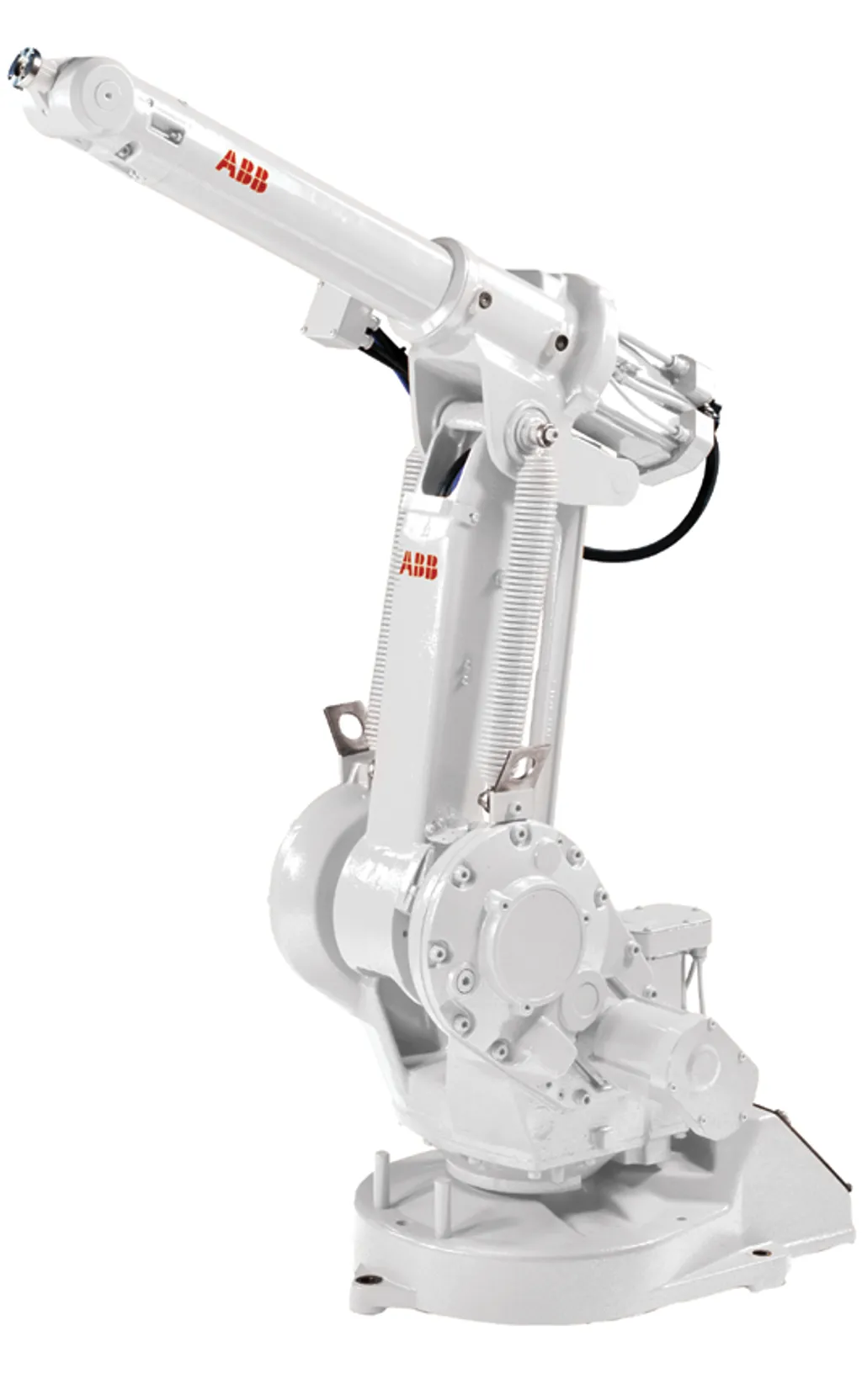
Of ABB’s 24 published models, 21 run some version of OmniCore (C30, V250, plain “OmniCore,” or V400), ABB’s current-generation controller. The remaining 3 still run the older IRC5 family: the IRB 1410 runs IRC5, the IRB 5500 FlexPainter runs IRC5P, and the original YuMi cobot, the IRB 14000, runs an integrated IRC5. This is a real, dated transition, not a legacy afterthought: OmniCore replaces IRC5, and ABB is retiring IRC5 in June 2026, per The Robot Report. Support and spare parts continue for existing installs, but new deployments move to OmniCore. If you’re buying a used or older ABB arm, ask which controller generation is actually in the cabinet.
Universal Robots shows a narrower version of the same pattern. Of 9 e-Series models, 6 (UR3e, UR5e, UR7e, UR10e, UR12e, UR16e) run legacy PolyScope. The three newest, highest-payload models, UR15 (17.5 kg), UR20 (20 kg), and UR30 (35 kg), run PolyScope X, UR’s next-generation software platform, described as powering UR’s AI Accelerator, per Robotics Tomorrow. One caveat worth stating plainly so this doesn’t get overclaimed: UR has said PolyScope X can also be added to e-Series units with a hardware upgrade, so this isn’t a hard architectural wall. Our database reflects what ships by default, the 3 newest models on the new platform, the 6 older ones still tagged legacy PolyScope.
Why don’t KUKA’s own cobots share an operating system?
KUKA is the most nuanced case in our database, and it doesn’t sort neatly into “legacy versus new.” All 14 of KUKA’s classic industrial arms, articulated, delta, and SCARA, spanning 3 kg to 1,000 kg payload, run KR C5 or KR C5 micro hardware, one controller family regardless of robot size or kinematics type.
KUKA’s 5 cobots split further, but not along that same legacy-versus-current line. Three LBR iisy cobots, KUKA’s newer, simplified cobot line, are tagged iiQKA.OS. Two LBR iiwa cobots, KUKA’s original 2013-era force-sensing cobot, are tagged KUKA Sunrise OS, a distinct, older, cobot-specific software environment that predates iiQKA.OS.
Here’s the nuance worth getting right rather than flattening into “old vs. new”: per KUKA’s own documentation, iiQKA.OS2 actually runs on the same KR C5 and KR C5 micro hardware as the classic arms, and combines the proven core of KUKA’s own system software, per The Robot Report. So the iisy split in our data is as much a hardware-name-versus-software-name labeling difference as it is a genuinely second lineage. Sunrise OS is the more real, standalone case: it’s KUKA’s own long-running, separate cobot software stack, unrelated to iiQKA.OS. The punchy version: KUKA’s own two cobot families, iisy and iiwa, don’t share an operating system with each other, even though both wear the same brand badge.
Which brands split by robot category instead?
Two brands don’t split by generation or by robot type. They split because they’re selling genuinely different kinds of machines under one name.
Omron is the clearest example. Its 12 robots run three separate systems: eAIB (2 eCobra SCARA plus 2 Viper articulated arms, 4 robots combined), Sysmac NJ/NX (the 2 i4-series SCARA models, a PLC-integrated architecture), and Fleet Manager/SetNetGo (1 robot, the LD-250 AMR). The remaining 5 of Omron’s 12, mostly other AMRs (LD-60, LD-90, MD-650, MD-900, HD-1500), have no controller tagged at all. Omron is the only brand in our database selling conventional arms, a PLC-embedded robot line, and autonomous mobile robots under one name, so its 3-way split reflects genuinely different product categories, not an age gap.
Epson splits by physical form factor instead. Thirteen models run an RC700-family external controller box (RC700A x8, RC700 x1, RC90-B x3, RC700-E x1). Three of Epson’s most compact, desktop-class units, the T3 (3 kg SCARA), T6 (6 kg SCARA), and VT6 (6 kg articulated), list the controller as “Built-in,” physically integrated into the arm’s base rather than a separate cabinet. That’s a form-factor choice for Epson’s smallest units, not a software generation gap.
What this means when you’re buying
If you’re standardizing a multi-robot cell, or a fleet, on one brand expecting one software environment, one spare-parts list, one training curriculum, that assumption holds cleanly, with zero exceptions, for 7 of the 12 brands we can actually check: Doosan, FANUC, Kawasaki, Mitsubishi, Staubli, Techman, Yaskawa. Buy any two models from those brands and you get the same controller family.
For ABB and Universal Robots, it depends on whether the specific model you’re buying predates the brand’s own platform transition. For KUKA, it depends on which cobot family, not which industrial arm. For Omron and Epson, it depends on robot category and physical form factor.
And for five whole brands, AUBO, Dobot, Han’s Robot, JAKA, SIASUN, all cobot or budget-focused, plus Estun and Rokae at too-thin-to-count coverage, our database doesn’t have enough controller data published to know at all. That’s worth asking your integrator directly before you sign, not assuming.
Compare these robots