Robot Reach by Type: Why No Cobot Passes 2.3 Meters
We measured reach across 259 robots in our database. Articulated arms hit 4,200 mm; cobots top out at 2,246 mm, only 3 of 109 pass 2 meters.
Reach is the filter that runs before payload, and our data shows a wall that no cobot has broken. Across 259 robots in the Industrial Robotics Hub database that publish a reach spec, cobots max out at 2,246 mm and only 3 of 109 clear 2,000 mm at all. Articulated arms reach as far as 4,200 mm, nearly double the longest cobot. Cobots are, by IFR’s own account, one of the fastest-growing segments in industrial robotics right now. None of that growth has moved the reach ceiling. If your application needs more than about 2.3 meters of working envelope, you are shopping in fenced-articulated or palletizer territory, full stop, regardless of how the cobot market is trending.
What is reach, and why does it matter more than payload?
Working envelope, or reach, is the maximum distance a robot’s tool center point can travel from its base. It defines the physical space the arm can actually touch. Payload tells you what the robot can lift. Reach tells you whether the robot can get to the part, the bin, or the weld seam in the first place. A 20 kg payload spec is irrelevant if the arm cannot physically span the workcell. That is why reach is the first cut in most integrator selection processes: it eliminates candidates before payload, speed, or repeatability ever enter the conversation.
Across the full database, reach spans 300 mm to 4,200 mm, a 14x spread, with an overall median of 1,200 mm. That range alone tells you reach is not a minor spec - it is the primary axis robots are built along.
How does reach break down by robot type?
Palletizers post the longest median reach, articulated arms have the widest spread, and cobots sit at the bottom of the field.
| Type | Robots | Min reach | Median reach | Max reach |
|---|---|---|---|---|
| Palletizer | 9 | 2,000 mm | 3,143 mm | 3,255 mm |
| Welding | 4 | 927 mm | 1,831 mm | 2,010 mm |
| Articulated | 96 | 350 mm | 1,550 mm | 4,200 mm |
| Delta | 5 | 800 mm | 1,200 mm | 1,500 mm |
| Cobot | 109 | 500 mm | 1,000 mm | 2,246 mm |
| SCARA | 35 | 300 mm | 650 mm | 1,200 mm |
Source: our analysis of 259 robots in the Industrial Robotics Hub database that publish a reach spec. Welding (n=4) and delta (n=5) are small samples - directional, not definitive.
Palletizer median reach of 3,143 mm makes sense once you picture the job: stacking pallets means spanning a wide, mostly flat footprint from a fixed base, so the whole class is built long. Articulated arms have the widest internal range of any type, 350 mm to 4,200 mm, because “articulated” covers everything from a tabletop SCARA-competitor to a 4.2-meter reach heavy hauler. That spread is the tell: articulated is a mechanism category, not a size category, and its median of 1,550 mm undersells how far the biggest members of the class actually go.
Here is the same ranking as a bar chart, sorted by median:
One painting robot in our database reaches 2,975 mm, but with a single robot in the category there is no median worth reporting, so it is footnoted here rather than charted.
Why can’t cobots pass 2.3 meters of reach?
Two forces cap them, and neither is going away. The first is mechanical: a longer arm carrying the same actuator and structural budget loses stiffness and accuracy at the tip, and cobots are built light by design so they can be moved, mounted, and re-tasked by a two-person crew without a crane. The second is regulatory. Cobots operate under power-and-force-limiting rules for shared human workspaces, and a longer reach means more kinetic energy at the tool tip for the same joint speed, which works against the contact-force limits that define collaborative operation in the first place. Build a cobot arm long enough to compete with a fenced articulated robot and you inherit the engineering problems fenced robots exist to solve, at which point you might as well fence it.
The data backs this up cleanly. Only 3 of 109 cobots in our database reach 2,000 mm or more. The longest is the ROKAE xMate CR35 at 2,246 mm, followed by the AUBO iS35 at 2,100 mm. Nothing in the class reaches 2.3 meters. Median cobot reach, 1,000 mm, is about 65% of median articulated reach at 1,550 mm. Cobots are not simply “smaller articulated arms” - they are a distinct engineering compromise, and reach is where that compromise shows up most clearly.
This matters right now because cobots are one of the fastest-growing segments in the industry, per IFR’s 2026 trends coverage, against a backdrop of industrial robot demand that has doubled globally over the past decade. A product category can grow fast and still be bounded by physics. Reach is the boundary that growth has not touched. If your application needs 2.5 meters of working envelope, cobot sales momentum does not change your shopping list.
Which robots have the longest and shortest reach?
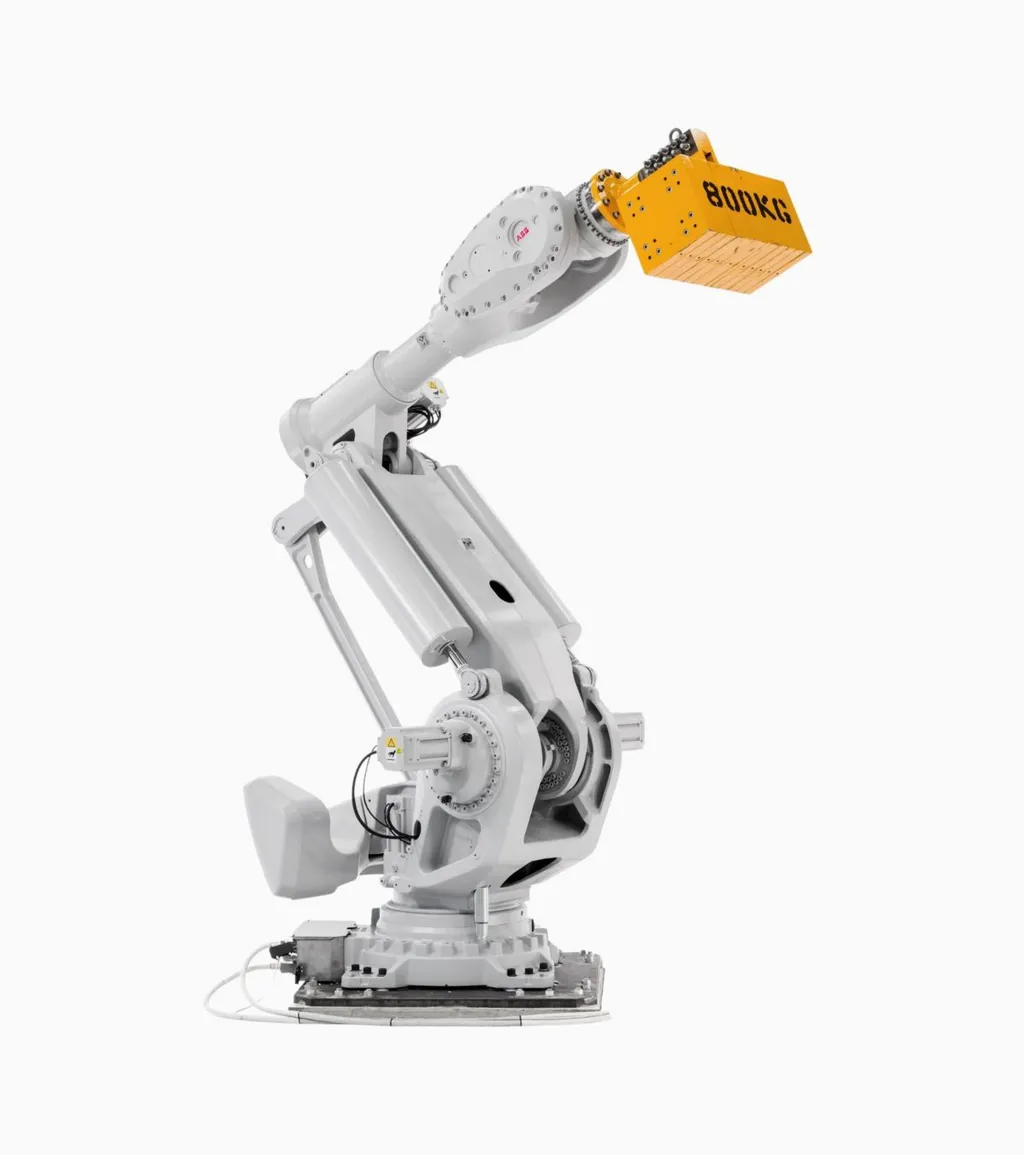
The ABB IRB 8700-550/4.2 leads the entire database at 4,200 mm, an articulated arm built for heavy material handling at industrial scale. Behind it: the FANUC M-2000iA/1700L at 3,734 mm, the FANUC M-900iB/400L at 3,704 mm, and the Staubli TX340 SH at 3,680 mm. All four are articulated, and all four are built for jobs where the part or the workcell, not the robot, dictates the footprint.
At the other end, the Mitsubishi MELFA RH-3FRH reaches just 300 mm, the shortest robot in the database and a SCARA built for compact bench-top assembly. The Yaskawa MotoMINI and Epson G3 both reach 350 mm. SCARA arms as a class post the shortest median reach at 650 mm, which fits their job: fast, precise, small-footprint pick-and-place, not long-span material handling.
How is reach distributed across the whole database?
Most robots cluster short. Of the 259 robots with a published reach:
- Under 1,000 mm: 117 robots (45%)
- 1,000-1,999 mm: 93 robots (36%)
- 2,000-2,999 mm: 32 robots (12%)
- 3,000 mm and over: 17 robots (7%)
Eighty-one percent of the database reaches under 2 meters. Long-reach robots, 3 meters and beyond, are a small, specialized slice, 7% of the field, and every one of them is an articulated arm or a palletizer. That 7% is exactly the territory no cobot enters.
What does this mean for a buyer sizing a cell?
Reach should be your first filter, not your third. Before you compare payload curves or repeatability specs, measure the actual distance your robot needs to cover, base to farthest work point, with margin for tooling and part variation. If that number is under 2 meters, cobots are a legitimate option and you get the collaborative-workspace benefit for free. If it is over 2.3 meters, you are choosing between a fenced articulated arm and a palletizer, and no amount of cobot market momentum changes that math. Run your actual numbers through our reach calculator before you spec a cell - it is a five-minute check that prevents a robot from arriving on the floor unable to reach the part it was bought to handle.
The cobot growth story is real. The reach ceiling is also real. Both can be true, and treating a sales trend as a substitute for a working-envelope measurement is how integrators end up re-quoting a job six weeks after the arm ships.
Compare these robots