Stäubli Robots: 11-Model Lineup From 1kg to 190kg
A Swiss loom maker since 1892, Stäubli builds 11 precision robots spanning a 190x payload range and 0.01mm repeatability — but not one carries an IP67 rating.
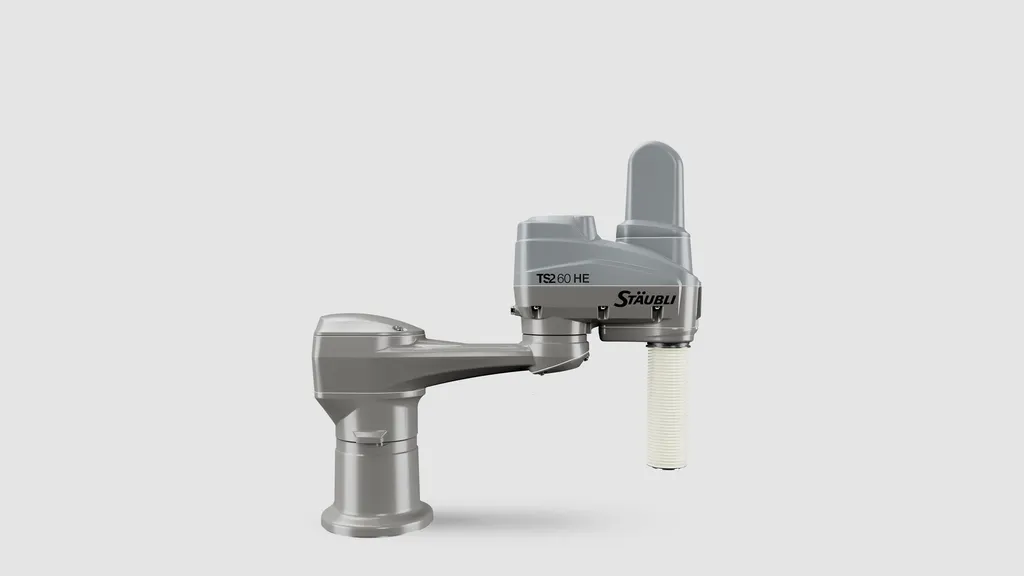
Stäubli’s robotics arm grew out of a 19th-century textile-loom workshop, and today its 11-model lineup stretches from a 1 kg delta picker to a 190 kg, 3,680 mm heavy-hauler - a 190x payload span that almost no other precision-focused brand attempts. What makes this interesting is the precision side: the TS2 SCARA line hits 0.01 mm repeatability, which is at the tight end of what any commercial arm publishes. The catch is that Stäubli publishes zero IP-rated robots in this set, so anyone buying on “washdown-capable” marketing needs to read the fine print carefully.
Who makes Stäubli - and why does a loom maker build robots?
Stäubli International AG is headquartered in Pfäffikon, Switzerland. The group was founded in 1892 in Horgen as “Schelling & Stäubli” by Rudolph Schelling and Hermann Stäubli, originally making dobby looms for the textile industry. Three divisions operate today: Textile, Fluid Connectors, and Robotics. None of this would be relevant to automation buyers except for one acquisition.
In 1989, Stäubli bought Unimation from Westinghouse - including its UK division in Telford. Unimation was the company that built the first industrial robot, the Unimate, for General Motors in 1961. That purchase put Stäubli in direct possession of the core IP and engineering culture of the original robot industry. In 2004, Stäubli absorbed Bosch Rexroth’s robotics division, adding further engineering depth. The result is a brand with a lineage that goes straight back to the founding of the industry, now channeled into cleanroom, pharmaceutical, semiconductor, and high-precision assembly applications.
The positioning is intentional. Stäubli does not chase the high-volume machine-tending commodity market the way FANUC or Yaskawa do. Its primary markets are environments where contamination control, repeatability under thermal variation, and sealed arm construction matter more than cycle-time raw numbers. Medical, pharma, semiconductor, food, plastics, and increasingly EV/battery cell handling.
What types of robots does Stäubli make?
Eleven robots, four categories. The lineup is dominated by articulated 6-axis arms (5 models, 45.5%), followed by SCARAs (4 models, 36.4%), with one delta and one cobot filling out the rest.
The SCARA-heavy composition reflects Stäubli’s precision assembly roots. Four SCARA models (TS2-40, TS2-60, TS2-80, TS2-100) at 460-1,000 mm reach cover the bulk of benchtop assembly, dispensing, and small-part handling. The articulated arm family (TX2-40 through TX340 SH) handles everything from a 2 kg benchtop part to a 190 kg structural component. There is one delta robot - the TP80 fast picker - and one cobot, the TX2touch-90, which is notable for reasons discussed below.
Payload range: 1 kg to 190 kg
Eleven robots, sorted ascending by payload. The 190x range is unusual for a precision brand - most manufacturers in the cleanroom/pharma segment stay under 25 kg.
The payload distribution is bimodal. Eight of the eleven robots cluster below 15 kg - this is Stäubli’s precision-assembly core. Then there is a gap, followed by the TX2-160 at 40 kg and the TX340 SH at 190 kg. Those two outliers exist for heavy-payload machine tending and structural handling, not cleanroom work. If you are evaluating Stäubli for a sensitive environment, the relevant range is 1-14 kg, and that is where the brand’s repeatability numbers are strongest.
The median payload across the lineup is 8.4 kg, driven by the four TS2 SCARAs which share that exact rated number. The median reach is harder to summarize because the delta and heavy-arm outliers stretch the distribution, but for the SCARA and mid-range articulated family, 600-1,000 mm is the typical working envelope.
Stäubli performance specs at a glance
| Type | Robots | Payload median | Repeat median | Speed range | IP67+ |
|---|---|---|---|---|---|
| Articulated | 5 | 14 kg | 0.03 mm | 8,500-10,900 mm/s (2 published) | 0 |
| SCARA | 4 | 8.4 kg | 0.015 mm | - | 0 |
| Delta | 1 | 1 kg | 0.05 mm | - | 0 |
| Cobot | 1 | 10 kg | 0.04 mm | - | 0 |
Two observations on the speed column. Stäubli publishes TCP speed for exactly two robots - the TX2-40 at 8,500 mm/s and the TX2-90 at 10,900 mm/s. This is a common pattern across manufacturers: TCP speed is application-dependent, arm-configuration-dependent, and prone to cherry-picking, so many brands simply don’t publish it. It does not mean the unlisted arms are slow. It means the number is hard to compare fairly.
The IP column is zero across the board. This is the data point that should stop you if “washdown-capable” or “food-safe” is on your requirements list. Stäubli uses an enclosed, sealed arm structure that performs well in cleanroom and controlled-humidity environments, but published IP67/68/69 ratings are absent from the lineup in IRH’s database. Stäubli markets specific variants for “humid environments” - verify the actual protection class on the model datasheet before spec’ing it into a wet process.
Complete Stäubli robot lineup
| Model | Type | Payload (kg) | Reach (mm) | Repeat (mm) | Max Speed (mm/s) | IP |
|---|---|---|---|---|---|---|
| TP80 | Delta | 1 | 800 | 0.05 | - | - |
| TX2-40 | Articulated | 2 | 515 | 0.02 | 8,500 | - |
| TX2-60 | Articulated | 4.5 | 670 | 0.02 | - | - |
| TS2-60 | SCARA | 8 | 600 | 0.01 | - | - |
| TS2-40 | SCARA | 8.4 | 460 | 0.01 | - | - |
| TS2-80 | SCARA | 8.4 | 800 | 0.015 | - | - |
| TS2-100 | SCARA | 8.4 | 1,000 | 0.02 | - | - |
| TX2touch-90 | Cobot | 10 | 1,000 | 0.04 | - | - |
| TX2-90 | Articulated | 14 | 1,000 | 0.03 | 10,900 | - |
| TX2-160 | Articulated | 40 | 1,710 | 0.05 | - | - |
| TX340 SH | Articulated | 190 | 3,680 | 0.10 | - | - |
The TS2 line is worth pausing on. Four SCARAs, one controller family (CS9), shared structural segments with the TX2 articulated line. The TS2-40 and TS2-60 both hit 0.01 mm repeatability - the tightest number in this entire 11-robot set. For comparison, the heavy TX340 SH publishes 0.10 mm, which is acceptable for a 190 kg structural arm but would be catastrophic for the semiconductor assembly work the TS2 targets.
Which Stäubli robot fits your application?
Semiconductor and electronics assembly, sub-0.02 mm tolerance. The TS2-40 or TS2-60 are the answer here. Both publish 0.01 mm repeatability, the tightest in the lineup. The TS2-40’s 460 mm reach is enough for most benchtop assembly cells; step up to the TS2-60 (600 mm) if the work envelope is slightly larger. These are SCARA robots with the structural rigidity and low Z-axis compliance that high-precision pick-and-place demands.
High-speed delta picking, 1 kg parts, food/packaging format. The TP80 is the only delta robot in the lineup. At 1 kg payload and 800 mm diameter working zone, it fits high-cadence pick operations - confectionery, pharmaceutical blister packs, small electronics. One caveat: no IP rating is listed. If your line runs washdown cycles, confirm protection class directly with Stäubli before ordering.
Collaborative cell with high functional-safety requirements. The TX2touch-90 is the only cobot in the Stäubli set, and it carries a notable distinction: it is marketed as the only cobot certified to SIL3/PLe safety level, the highest tier under IEC 62061 and EN ISO 13849 respectively. Standard cobots are typically certified to PLd. The practical implication is that SIL3/PLe reduces or eliminates the need for external guarding in some high-hazard applications where PLd certification would still require a safety fence. According to The Robot Report, Stäubli specifically engineered the TX2touch safety architecture to achieve this rating without sacrificing the 10 kg / 1,000 mm envelope. At 0.04 mm repeatability it is not the tightest arm in the lineup, but for a cobot, that number is strong.
Mid-range machine tending, 10-14 kg parts, 1 m reach. The TX2-90 covers this slot. Fourteen-kilogram payload, 1,000 mm reach, 0.03 mm repeatability, and the only arm outside the TS2 SCARAs with a published TCP speed (10,900 mm/s). If your CNC tending application needs a precise, fast 6-axis arm without stepping up to a 40 kg class robot, this is the natural choice in the Stäubli lineup.
Heavy-payload structural handling or large-part machine tending. The TX340 SH at 190 kg and 3,680 mm reach is the far end of this lineup. Repeatability relaxes to 0.10 mm - adequate for structural handling but not precision assembly. This arm competes with FANUC’s M-2000 series and Yaskawa’s MS range in payload class. It is not the first robot most buyers associate with Stäubli, and it is not the brand’s strongest application, but it exists for integrators building out a single-vendor line.
The bottom line
Stäubli is a precision brand that inherited the original industrial-robot IP via Unimation, refined it through 35 years of cleanroom and pharma work, and built a lineup that is genuinely differentiated at the tight-tolerance end. The TS2 SCARAs at 0.01 mm and the TX2touch cobot at SIL3/PLe are specifications that matter in specific applications - not marketing numbers.
The buying decision compresses to this: if your application demands repeatability better than 0.02 mm, or if you need SIL3-certified collaborative operation, Stäubli has robots worth evaluating seriously. If your primary criteria are raw throughput, the widest ecosystem of integrators, or the lowest unit cost, FANUC and Yaskawa will be more natural fits.
The missing IP ratings deserve a direct statement. Every robot in IRH’s Stäubli dataset publishes no IP67 or higher rating. Stäubli’s enclosed arm design does perform well in cleanroom and low-humidity sensitive environments, and the company markets specific variants for humid conditions. But if you need a documented, certified IP67 or above for washdown or immersion exposure, verify the exact model variant against Stäubli’s datasheet before ordering. Do not assume “sealed design” equals “IP-rated.”
The spec table above is not just a reference - it is a decision filter. Start at payload. If you are at 8 kg or below and tolerance matters, look at the TS2 SCARA column first. If you are at 10-14 kg with a collaborative requirement, the TX2touch-90 has a safety argument no other cobot in this class can match. If you need heavy payload, be honest: the TX340 SH is capable, but Stäubli’s real advantage disappears at 190 kg. The brand’s engineering identity lives in the lower rows of that table.
Compare these robots