ABB Robots: 24 Models From 0.5 kg to 550 kg Payload
ABB's 24-robot lineup spans a 1,100x payload range, from the 0.5 kg YuMi cobot to the 550 kg IRB 8700 giant that reaches 4.2 m. Here's how the full range maps out.
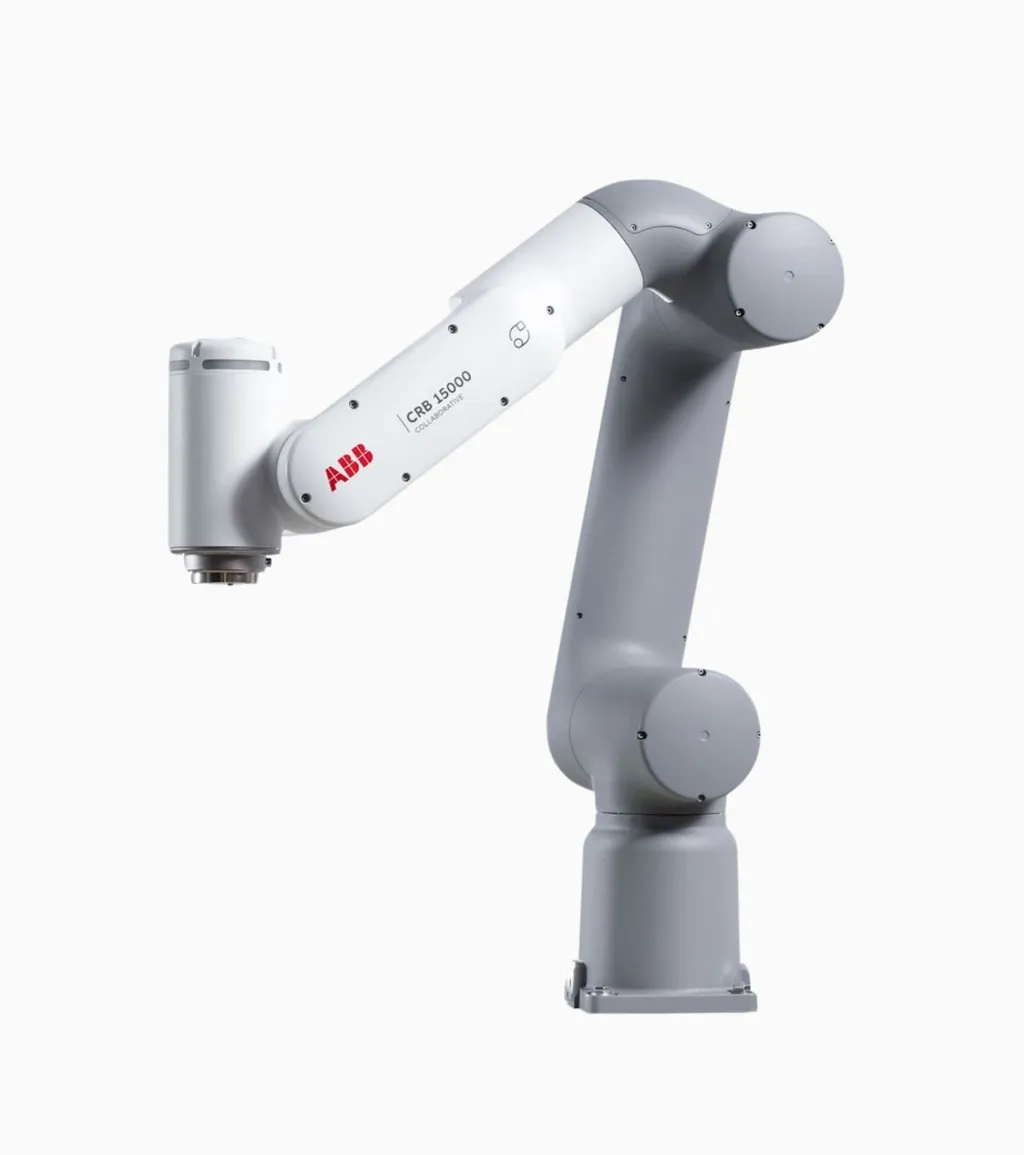
ABB’s robot range covers a 1,100-fold payload spread - the same brand sells a 0.5 kg dual-arm cobot and a 550 kg press-tending giant that reaches 4.2 metres, and if you understand that single fact, you understand the purchase logic for every model in between. Twenty-four robots across five architectures, all running on ABB’s OmniCore controller platform, with repeatability figures that span 0.01 mm for precision SCARA work up to 0.15 mm for automotive paint booths. The median payload across all 24 models is 7.5 kg, which tells you immediately that ABB is not primarily a heavy-industry vendor despite having the heaviest robots in this comparison - it is a full-spectrum brand that happens to also build press-tending giants.
This guide maps the full lineup by payload, type, and real application fit. The goal is to help an automation engineer or procurement lead cut through the portfolio and find which of these 24 models actually belongs on their shortlist, based on hard numbers rather than marketing categories. Section by section: brand history, fleet composition, payload landscape, consolidated performance table, complete model reference, application scenarios, and a buying reframe at the close.
Who makes ABB robots?
ABB Group is headquartered in Zurich, Switzerland, but the robotics business is operationally rooted in Vasteras, Sweden. That distinction matters because ABB’s robotic identity predates the company itself. ASEA - the Swedish engineering firm that became half of ABB - launched the IRB 6 in 1974, which is widely cited as the world’s first all-electric, microprocessor-controlled industrial robot. It carried 6 kg, sold to Magnusson in Genarp, Sweden, and its job was polishing stainless steel tubes. That machine ran on a microprocessor at a time when most industrial automation was pneumatic or relay-logic. The leap from that 6 kg machine to a 550 kg press-tender is fifty years of engineering iteration, not a portfolio acquisition, and the lineage is unbroken.
ABB (Asea Brown Boveri) was formally constituted in 1988 by the merger of Sweden’s ASEA (founded 1883) and Switzerland’s BBC Brown Boveri (founded 1891). The merged entity inherited ASEA’s robot manufacturing capability and kept Vasteras as the technical center of gravity for robotics engineering. Today robots are also manufactured in Shanghai and Auburn Hills, Michigan - a production footprint that reflects ABB’s primary end markets: automotive and electronics in Asia, press automation and material handling in North America, and the full application spectrum across Europe. The geographic spread matters for lead times and support response, both of which vary significantly depending on where your plant sits relative to an ABB manufacturing or service hub.
By installed base, ABB has shipped more than 400,000 robots worldwide since 1974, which positions it squarely in the “Big Four” alongside FANUC, KUKA, and Yaskawa. Its robotics division covers articulated arms, collaborative robots, delta pickers, SCARA arms, and dedicated paint robots. The breadth is deliberate strategy rather than product sprawl - ABB is pitching itself as a complete automation supplier to large manufacturers who want a single programming environment, a single service contract, and a single spare-parts channel across their entire robot fleet. Whether that pitch is worth the premium depends entirely on the size and complexity of your operation. A plant running two welding cells probably does not need that ecosystem. A Tier 1 automotive supplier running 300 robots across three facilities almost certainly does.
The OmniCore controller and RobotStudio simulation platform are central to that pitch. RobotStudio is a full offline programming environment that runs on Windows, pulls CAD geometry directly, and lets engineers validate cell layouts, cycle times, and reach envelopes before anything hits the floor. For large installations with long integration timelines, that capability has measurable value. For smaller buyers, it is a feature they will pay for and possibly never use.
One milestone worth noting separately: in 2015 ABB released YuMi, the IRB 14000, marketed as the first true dual-arm collaborative robot designed for small-parts assembly alongside humans without safety fencing. That is a meaningful claim - not just force-limited joints, but an entire dual-arm architecture with padded surfaces, inherent inertia limits, and a form factor designed to work at human-scale benches. The single-arm IRB 14050 followed, offering the same safety architecture in a more deployable single-arm format. YuMi established the cobot category as ABB understood it: not a caged robot with a lower speed limit, but a machine designed from the ground up for proximity to people on an assembly line.
What types of robots does ABB make?
The 24 robots in our database break across five architecture types. Articulated arms dominate at more than half the lineup, but the presence of delta, SCARA, painting, and cobot variants signals that ABB is positioning itself as a complete automation supplier rather than a single-category specialist.
The 13 articulated robots are the backbone - general-purpose 6-axis arms from the compact IRB 1010 (1.5 kg, 370 mm reach) up to the IRB 8700 (550 kg, 4,200 mm reach). These are the machines most plants think of when they say “ABB robot.” At 54% of the portfolio they dominate headcount, but that also means ABB has put genuine engineering attention into differentiating them: the IRB 1010 is a sub-400 mm reach machine for tight-clearance component handling, the IRB 1520ID and 1660ID carry integrated cable dressing for welding applications, and the IRB 6700 and above enter heavy-industry territory with structural payloads that require floor-mounted or gantry configurations.
The six cobots cluster at the low end of the payload scale, with YuMi at 0.5 kg per arm and GoFa reaching 12 kg - still light duty compared to the articulated range, but intentionally so. These machines are designed for human-adjacent work where the robot and the operator share a workspace without fencing, and the payload limit is partly a function of the force limits that make that safe. SWIFTI sits in a middle tier: it uses the same compact form factor as the IRB 1100 articulated arm but with cobot safety functions active, making it appropriate for semi-collaborative applications where occasional human access to the cell is required.
The two delta pickers and two SCARA arms are specialists that do not overlap in application with the rest of the lineup. Deltas are for high-speed pick-and-place in food, confectionery, and blister packaging - if you are running a conveyor line that needs 80-120 picks per minute on lightweight products, nothing else in this catalog touches delta kinematics for cycle time. SCARA arms are for flat-plane precision assembly: circuit board handling, small connector insertion, syringe filling. The two ABB SCARA models hit 0.01 mm repeatability, which ties for tightest in the lineup alongside the IRB 1010 and IRB 1100 articulated arms. The single painting robot, the IRB 5500 FlexPainter, is an architectural outlier - 5-axis (not 6), hollow wrist for cable routing, explosion-proof construction for ATEX paint booth environments. It is not interchangeable with anything else in the lineup and requires different integration expertise than general-purpose robot cells.
Payload range: 0.5 kg to 550 kg
The median payload across all 24 ABB robots is 7.5 kg, which tells you where the catalog’s center of gravity sits: light-to-medium assembly and handling, not press tending. The heavyweight models are real and impressive in specification, but they are four robots out of 24 - the IRB 4600 (60 kg), IRB 6700 (150 kg), IRB 7600 (500 kg), and IRB 8700 (550 kg). The other 20 models all sit at 20 kg or below. That skew is commercially accurate - the global market for robots above 100 kg is a small fraction of total unit volume, and ABB’s model count reflects market demand rather than any engineering gap at the heavy end.
Source: Industrial Robotics Hub database, 24 ABB robots.
Two things jump out from that chart. First, the bottom half of the lineup is densely packed between 0.5 kg and 15 kg - fourteen of the twenty-four robots land in that range. That is where ABB has the most model variety and, by implication, where most purchasing decisions require careful differentiation between models that look similar on a payload basis but differ in reach, architecture, or safety design. A buyer choosing between the IRB 1300 (11 kg, 900 mm) and the GoFa 12 (12 kg, 1,270 mm) at nearly identical payload is really choosing between a caged articulated arm at higher speed and a collaborative arm with larger reach but no published speed figure. Those are different purchases despite the similar payload numbers.
Second, the jump from IRB 2600 (20 kg) to IRB 4600 (60 kg) is a hard gap with nothing in between. If your application genuinely needs 25-55 kg payload - a common requirement for automotive subassembly handling and engine-component machining - ABB does not have a native option in that range in this dataset. You are either accepting the over-specification of the IRB 4600 (and paying for 60 kg capacity you are not using) or re-engineering the fixturing or part-handling process to get your effective payload requirement under 20 kg. That is a real constraint worth noting in any competitive evaluation.
The IRB 6700 and above are heavy-industry machines by any definition: 150 kg, 500 kg, 550 kg. The IRB 7600 at 500 kg and the IRB 8700 at 550 kg belong on press lines, large die-casting cells, and engine block handling stations. They are not general-purpose arms - they are purpose-built for applications where the workpiece mass and the reach envelope requirement put the job outside anything a mid-range arm could handle. The IRB 8700’s 4,200 mm reach in particular is a specification that only makes sense in tandem-press configurations or large structural-weld cells where the arm needs to span the width of a vehicle body section. ABB also makes an 800 kg variant of the IRB 8700 (not in our current dataset) that extends the payload ceiling further and covers forging and heavy casting extraction.
ABB performance specs at a glance
This table summarizes the five architecture types by their aggregate specs in our database. The “Speed range” column reflects only the three GoFa cobots where TCP speed is recorded - no other ABB models in our dataset publish that figure, which is a data gap worth noting when comparing to competitors.
| Type | Robots | Payload median | Repeat median | Speed range | IP67+ |
|---|---|---|---|---|---|
| Articulated | 13 | 10 kg | 0.04 mm | - | 0% |
| Cobot | 6 | 2.5 kg | 0.02 mm | 2,200 mm/s (GoFa only) | 0% |
| Delta | 2 | 11.5 kg | 0.10 mm | - | 0% |
| SCARA | 2 | 4.5 kg | 0.01 mm | - | 0% |
| Painting | 1 | 13 kg | 0.15 mm | - | 0% |
The repeatability numbers deserve close attention and careful interpretation. ABB’s SCARA arms hit 0.01 mm, matching the IRB 1010 and IRB 1100 at the tightest end of the articulated range. That figure - 10 microns - is at the practical limit of what thermal expansion of the robot’s mechanical structure allows in a real shop floor environment. These are laboratory-grade repeatability figures that assume stable ambient temperature, properly warmed-up joints, and a robot operating within its designed payload range. In practice, you should design your process around a 2x to 3x safety margin on the published repeatability number to account for real-world variation.
The delta FlexPicker and FlexPacker are at 0.10 mm - that sounds loose relative to the SCARA, but delta kinematics trade absolute position accuracy for cycle time. A FlexPicker running 100 picks per minute does not care about 0.10 mm variation when the pick-and-place target is a 40 mm chocolate piece on a conveyor with 3 mm positional uncertainty from the vision system upstream. The 0.10 mm figure is more than adequate for any food, confectionery, or blister-pack application in practice.
The painting robot at 0.15 mm is the loosest in the lineup, which is standard for the category. Spray painting applications do not require sub-millimetre positional accuracy. What they require is smooth, jerk-free path execution, consistent TCP standoff distance from the body surface, and accurate speed control on curved surfaces to maintain paint film thickness. All of those are motion-planning and controller functions, not joint repeatability in the ISO 9283 sense. The 0.15 mm figure is essentially a non-constraint for this application.
IP67 coverage is zero across all 24 robots in our dataset. That is a real purchasing constraint for food processing (washdown with caustic agents), wet casting environments, and outdoor or semi-outdoor installations. ABB does manufacture IP-rated variants for several models in the articulated range - the IRB 1600 in protected configuration, the IRB 6700 with foundry-rated protection. Those specifications are not captured in our current database. If your environment requires IP67 or better as a baseline, do not shortlist from this table alone - verify current protected-variant availability directly with ABB’s product catalog before committing to a model. IP rating requirements that are discovered late in a project can require a complete model change.
Complete ABB robot lineup
All 24 robots. Model links go to their individual data pages. Dashes indicate specs not recorded in our dataset.
| Model | Type | Payload (kg) | Reach (mm) | Repeat (mm) | Max Speed (mm/s) | IP |
|---|---|---|---|---|---|---|
| YuMi IRB 14000 (dual-arm) | cobot | 0.5 | 559 | 0.02 | - | - |
| YuMi IRB 14050 (single-arm) | cobot | 0.5 | 559 | 0.02 | - | - |
| IRB 1010 | articulated | 1.5 | 370 | 0.01 | - | - |
| IRB 910SC-3/0.45 (SCARA) | scara | 3 | 450 | 0.01 | - | - |
| IRB 1100 | articulated | 4 | 580 | 0.01 | - | - |
| IRB 1520ID | articulated | 4 | 1500 | 0.05 | - | - |
| SWIFTI CRB 1100-4/0.58 | cobot | 4 | 580 | 0.01 | - | - |
| GoFa CRB 15000 (5 kg) | cobot | 5 | 950 | 0.02 | 2200 | - |
| IRB 1410 | articulated | 5 | 1444 | 0.05 | - | - |
| IRB 920-6/0.55 (SCARA) | scara | 6 | 550 | 0.01 | - | - |
| IRB 1660ID-6/1.55 | articulated | 6 | 1550 | 0.02 | - | - |
| IRB 1200-7/0.7 | articulated | 7 | 700 | 0.02 | - | - |
| IRB 360 FlexPicker 8/1130 | delta | 8 | 1130 | 0.10 | - | - |
| GoFa CRB 15000-10/1.52 | cobot | 10 | 1520 | 0.05 | 2200 | - |
| IRB 1600-10/1.45 | articulated | 10 | 1450 | 0.02 | - | - |
| IRB 1300-11/0.9 | articulated | 11 | 900 | 0.02 | - | - |
| GoFa CRB 15000-12/1.27 | cobot | 12 | 1270 | 0.05 | 2200 | - |
| IRB 5500 FlexPainter | painting | 13 | 2975 | 0.15 | - | - |
| IRB 390 FlexPacker | delta | 15 | 1500 | 0.10 | - | - |
| IRB 2600-20/1.65 | articulated | 20 | 1650 | 0.04 | - | - |
| IRB 4600-60/2.05 | articulated | 60 | 2050 | 0.05 | - | - |
| IRB 6700-150/3.20 | articulated | 150 | 3200 | 0.05 | - | - |
| IRB 7600-500/2.55 | articulated | 500 | 2550 | 0.08 | - | - |
| IRB 8700-550/4.2 | articulated | 550 | 4200 | 0.10 | - | - |
Notes on the data:
- “Repeat” is +-mm ISO 9283 repeatability unless otherwise stated by the manufacturer.
- Speed is TCP (tool center point) speed where published. Only GoFa cobots have this recorded in our database. No other ABB models publish TCP speed in their public spec sheets.
- The IRB 8700 listed here is the 550 kg / 4.2 m reach variant. ABB also makes an 800 kg / 3.5 m reach configuration - and reportedly a 1,000 kg wrist-down configuration - not captured in our dataset.
- IP ratings are not recorded in our current database for any ABB model. Protected and foundry variants exist for several models in the articulated range.
- Models with integrated dressing: IRB 1520ID and IRB 1660ID. The “ID” suffix denotes internal cable routing, relevant for welding and dispensing applications.
- All reach figures are maximum reach at the TCP, robot in standard floor-mount orientation.
Which ABB robot fits your application?
The spec table is only useful if you map it to what actually happens on your floor. Here are five concrete scenarios and the model they lead to.
You are assembling small electronics next to human workers
The application calls for a cobot under 10 kg payload, human-rated safety, and enough repeatability to place components accurately. Two choices: YuMi IRB 14000 if you need dual-arm coordination for two-handed tasks (screw-driving while holding a housing, for example), or GoFa CRB 15000 (5 kg) if you need a single arm with more reach (950 mm vs YuMi’s 559 mm) and slightly tighter repeat (0.02 mm). YuMi’s 0.5 kg per arm is a hard constraint - if you are handling anything heavier than a small PCB, the 10 kg GoFa handles it at 1,520 mm reach with force-limited safety. Note that SWIFTI CRB 1100 hits 0.01 mm repeat but is a compact caged cobot, not the same open-collaboration safety architecture as GoFa.
You are arc-welding structural components in the 1-2 m reach envelope
This is the IRB 1660ID territory. The “ID” suffix means integrated dressing - the cable harness runs through the arm rather than externally. That matters in welding because cable snag and wear on the external harness is one of the leading causes of unplanned downtime on weld cells. At 6 kg payload and 1,550 mm reach, the 1660ID handles a standard MIG torch and wire feeder. Repeatability at 0.02 mm is more than adequate for structural weld seams. The IRB 1520ID is the alternative at 4 kg / 1,500 mm - same integrated dressing, slightly less payload, marginally shorter reach. Both connect to the IRB 6700 family for larger structural frames, which moves you to 150 kg and 3,200 mm reach but requires a significantly different cell layout.
You are running a confectionery or blister-pack pick-and-place line at 100+ picks per minute
This is exactly what the IRB 360 FlexPicker was designed for. Delta kinematics produce the fastest cycle times in any robot architecture for flat-plane pick-and-place, because the motors are at the base rather than on the arm, which means low moving mass and high acceleration. The FlexPicker at 8 kg / 1,130 mm reach covers standard conveyor widths for most blister and chocolate applications. The 0.10 mm repeat is not a concern for this application - product positional tolerance in confectionery is measured in millimetres, not microns, and conveyor tracking error from the vision system upstream is the dominant source of placement variation in practice.
Vision integration is standard on delta applications. You will need a line-scan camera or area-scan camera above the infeed conveyor, a conveyor encoder input, and a tracking software module. ABB’s PickMaster system is the native option and integrates directly with the IRB 360 and IRB 390. Third-party vision integration is also possible and sometimes preferable depending on the inspection requirements of your application.
If you are packing larger items or need to handle product in secondary packaging (cardboard cases, retail trays), the IRB 390 FlexPacker steps up to 15 kg at 1,500 mm reach with the same delta architecture. The 15 kg payload covers most retail-pack sizes. Neither the FlexPicker nor FlexPacker is appropriate for precision assembly work; the architecture was not designed for it and the repeatability figure reflects that. Do not select these models for any application where angular accuracy or orientation precision is required.
You are tending a medium-tonnage press in an automotive body shop
The IRB 4600-60/2.05 at 60 kg / 2,050 mm is the entry point for this application. It handles the stamping blanks, positions them in the die, and extracts the pressed part. At 0.05 mm repeat it is consistent enough that die wear, not robot positioning, will be your primary maintenance concern. If your press is larger - blanks over 60 kg, or you need the arm to reach further into a tandem press line - the IRB 6700-150/3.20 at 150 kg / 3,200 mm is the next step. The IRB 7600 (500 kg) and IRB 8700 (550 kg) belong in heavy press operations - engine block handling, large structural castings, forging cells where the robot is managing multi-hundred-kilogram workpieces at high temperature. ABB claims the IRB 8700 is approximately 25% faster than comparable competitor robots in its payload class, which matters when you are calculating cost-per-part on a press line running three shifts.
You need to paint car bodies in an ATEX-rated booth
One model exists for this in ABB’s lineup: the IRB 5500 FlexPainter. At 13 kg payload and 2,975 mm reach, it carries a full-size electrostatic rotary atomizer and covers the motion envelope required for a standard passenger car body - hood, roof, doors, rear quarters. A typical automotive paint cell runs two or four IRB 5500 units on a single car body simultaneously, with the robots entering from the sides while the body moves on the conveyor.
The 0.15 mm repeatability figure is deliberate. Paint robots optimize for path smoothness, consistent TCP standoff distance, and accurate TCP speed on curved surfaces - not positional accuracy in the ISO 9283 sense. A painting robot with 0.01 mm repeatability but jerky trajectory control would produce worse surface finish than one with 0.15 mm repeatability and excellent motion-smoothing algorithms. ABB’s paint robot motion control has been developed over decades on automotive production lines, and that software maturity is as important as the mechanical specification.
The IRB 5500 is a 5-axis machine rather than 6-axis because the wrist design is optimized for maintaining a consistent spray angle without requiring full wrist rotation. The hollow wrist carries the paint hose and electrical cable for the atomizer internally, eliminating external hose routing that would contaminate fresh paint surfaces. If you are specifying a new paint cell and you are not already deeply familiar with ATEX zone classification, robot grounding requirements, electrostatic atomizer voltage management, and purge-and-pressurize controller enclosures, this project requires a specialized paint cell integrator before you reach robot model selection. Paint booth automation is one of the highest-risk integration domains in industrial robotics and the IRB 5500 is not a general-purpose arm that happens to be installed in a paint booth.
The bottom line
ABB’s lineup is coherent in a way that not all robot portfolios manage to be. The articulated range covers a genuine spectrum from 1.5 kg bench robots to 550 kg press-room giants, with differentiated models at the sub-15 kg end rather than a single generic mid-size arm padded out to fill the catalog. The cobot family is meaningfully differentiated rather than relabeled: YuMi for dual-arm fine assembly with full collaborative contact safety, GoFa for higher-payload human-adjacent work with documented force limits and TCP speed, SWIFTI for compact precision applications where occasional collaborative access is needed. The delta and SCARA arms are specialists that do one thing well and do not pretend to general-purpose capability.
The repeatability floor across the lineup is competitive. Six models at 0.01 mm, another eight at 0.02 mm. The SCARA and precision articulated arms at the tight end of the range are genuinely suitable for micro-electronics and medical device assembly work where competitor spec sheets often stop at 0.02-0.03 mm. ABB has been building precision arms since the IRB 6 in 1974, and the mechanical refinement in the modern lineup reflects that accumulated experience.
What ABB is not is a budget option. The OmniCore controller ecosystem, RobotStudio simulation license, ABB’s global service network, and the premium that comes with buying from a Big Four vendor all contribute to a total cost of ownership that is meaningfully higher than it looks on a robot-unit quote alone. OEM integrators and system houses who work with ABB regularly know this and price it in. First-time buyers sometimes do not, and the sticker shock at commissioning and annual service contract stages is a recurring pattern.
The counter to that cost argument is the installed base. More than 400,000 ABB robots in the field since 1974 means ABB service engineers, qualified integrators, and compatible spare parts exist in almost every major manufacturing geography. For a plant commissioning its first robot cell without deep internal expertise, that support density is worth real money compared to a lower-priced platform with thin local support infrastructure. The calculation changes if you have a strong in-house robotics team and a vendor relationship with good spare parts availability - in that scenario, the ABB premium is less justifiable.
Who should buy ABB. Automotive manufacturers who need a coherent single-vendor portfolio across press tending, structural welding, body painting, and assembly. Food and beverage lines where the IRB 360 / 390 delta architecture is the right tool for high-speed pick-and-place and the rest of the plant needs articulated arms for palletizing. Electronics manufacturers who want a genuine dual-arm cobot in YuMi rather than a modified single-arm with added force sensing. Large plants building a mixed robot fleet where programming consistency across architectures - articulated, cobot, SCARA, delta all running in the same RobotStudio environment - has measurable operational value. Any operation where downtime cost is high enough that paying for ABB’s service network density is a rational insurance premium.
Who should look elsewhere. Applications requiring IP67 or washdown-rated robots as a baseline requirement: verify current ABB protected-variant availability before shortlisting, but do not assume it from this table. Plants where TCP speed data is a primary differentiator in the evaluation: ABB publishes this figure for GoFa cobots only, which makes direct comparison with FANUC or Yaskawa articulated arms harder than it should be. Operations with a primary budget constraint where a Tier 2 manufacturer’s comparable arm would deliver the application result at 20-30% lower capital cost and where the support infrastructure gap can be managed with a competent local integrator. Startups or research environments that need a robot for one task and do not require enterprise-grade service contracts.
The spec table at the center of this guide is the decision tool. Sort it by your payload requirement first - not your nominal part weight, but your gripper-plus-part worst-case mass at maximum acceleration in the orientation that loads the wrist hardest. Buyers regularly under-specify payload because they weight the part without the end effector. Get that number right before you pick a model.
Then check reach against your cell layout with a 15-20% margin. A robot specified at exactly the reach it needs will spend its service life at the edge of its kinematic envelope, which degrades repeatability and accelerates joint wear. The IRB models include “-1.65” or “-2.05” or “-4.2” in their model numbers for this reason - ABB lists reach as a key variant differentiator, and the same base platform often comes in two or three reach configurations that do not show up in a simplified model list.
Then look at repeatability against your process tolerance. If you are arc-welding structural steel, 0.05 mm repeat is precise enough that weld seam quality will vary with fixturing and consumable consistency long before robot positioning becomes the constraint. If you are inserting a 0.3 mm tolerance electrical connector, the 0.01 mm models - IRB 1010, IRB 1100, and the SCARA arms - are where you need to be.
If those three filters leave you with more than one candidate, the architecture type and integration complexity narrow it from there. The deciding factor between a GoFa cobot and an IRB 1600 articulated arm at comparable payload and reach is whether you need collaborative safety functions - and if you are not sure, the answer is probably “no,” because most manufacturing applications that could use a cobot are already using caged industrial arms and the integration cost of switching is non-trivial.
ABB’s range is wide enough that the right model is almost certainly in the 24-robot lineup. The work is identifying which one is right for your specific application, not which one looks best in a product brochure. Start with payload, reach, and repeatability as the hard constraints, add architecture as the tiebreaker, and you will get to a defensible shortlist of two or three models fast. Everything after that is integrator selection and negotiation.
Data note: All specifications sourced from the Industrial Robotics Hub database. TCP speed is recorded for GoFa cobots only; all other speed fields are not published in ABB’s public spec sheets at the time of writing. IP rating fields are not captured for any ABB model in the current dataset - verify directly with ABB for protected-variant availability. The IRB 8700-800/3.5 configuration (800 kg payload, 3.5 m reach) exists in ABB’s catalog but is not included in the 24-robot dataset this guide covers.
Sources: ABB Group history - ABB Robotics overview - ABB robot product pages - IRB 8700 product page - IRB 7600 product page - IRB 6700 product page - YuMi IRB 14000 product page - ABB Wikipedia
Compare these robots