Epson Robots: 16 SCARA & 6-Axis Models, 0.01mm Precision
The world's #1 SCARA maker runs no IP67 models and tops out at 20kg payload, but hits 0.01mm repeatability and 11,000mm/s across 16 robots.
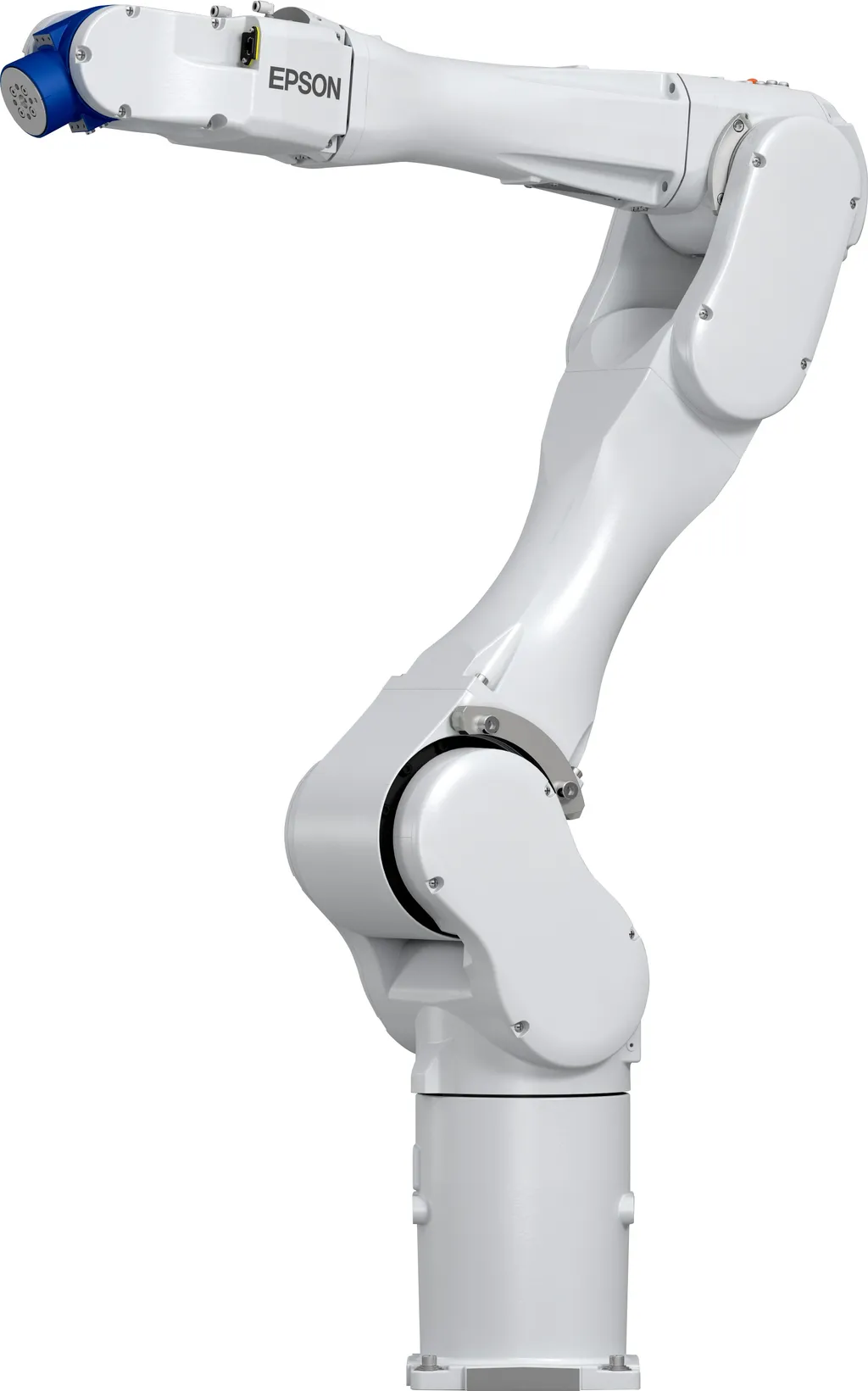
Epson is the world’s number one SCARA robot manufacturer with 150,000+ units installed, yet not one of its 16 robots in our database carries an IP67 rating, and the lightest-payload precision specialist in the lineup hides in plain sight at 0.01 mm repeatability. If your application is electronics assembly, small-parts pick-and-place, or medical device manufacturing and your environment stays clean and dry, Epson’s spec sheet is worth reading carefully. If you need a washdown environment, payloads beyond 20 kg, or ingress protection of any kind, stop here and check a different brand.
That is the BLUF. Everything below is the evidence.
Who makes Epson robots?
Seiko Epson Corporation is headquartered in Suwa, Nagano Prefecture, Japan, a city better known for precision watchmaking than robotics. That watchmaking heritage is not incidental to the robot lineup you see today. Epson started producing robots around 1980 to 1983, developing its first SCARA-type arm specifically to assemble Seiko watches and printers in-house. The logic was straightforward: no supplier made equipment precise enough to handle the components, so they built their own. The robot was a means to a manufacturing end, not a product line in its own right.
By 1984, Epson Robots entered the North and South American market commercially, with the Americas division operating from Los Alamitos, California. The company now markets its robots under the Epson Robots and Epson America Factory Automation labels in that region. For a company that started by solving its own internal precision problem, the product pivot to commercial robotics is a relatively short arc - roughly 40 years from in-house necessity to global market leadership in the SCARA segment. More background on the company’s history is available at Wikipedia’s Epson Robots article and the broader Epson corporate history.
That origin story explains a lot about the current lineup. Epson did not acquire its way into robotics and it did not start with heavy-payload industrial arms. It grew up solving the problem of assembling tiny, tight-tolerance components at speed. Today the robotics division claims roughly 11% of the global SCARA segment and approximately 13% of the global industrial robotics market as of 2025, an installed base exceeding 150,000 units worldwide. That market-share figure comes with context: SCARA dominance inflates overall share numbers because the global SCARA segment is itself narrower than the articulated-arm market. Epson is not the number one robot company in the world. It is the number one company in the specific category it chose to compete in, which is a more defensible position than it might sound.
Two proprietary technologies differentiate Epson from the commodity SCARA market. The first is Residual Vibration Technology, abbreviated RVT, a motion-planning approach that damps arm oscillation at the end of each move so the tool settles faster without requiring software-forced deceleration or a longer dwell time. For pick-and-place cycles where the arm moves, deposits a part, and immediately begins the return stroke, the settling-time reduction compounds across every cycle. At 10 cycles per minute the improvement is almost imperceptible. At 60 cycles per minute across a 16-hour shift, it accumulates into measurable throughput.
The second is the RC700A controller paired with RC+ 7.0 software, which handles high-acceleration moves while keeping settling time short. The controller is the central hub for multi-arm cells, vision integration, force sensing, and PLC communication. RC+ 7.0 supports both Epson’s own proprietary SPEL+ language and a set of external communication interfaces for integration into existing factory software stacks. For engineering teams that have already built automation logic in a preferred environment, the controller’s communication flexibility matters more than any particular language preference.
At Automate 2026, Epson also showcased SafeSense, a safety technology for its SCARA, 6-axis, and cobot lineups, signaling a push toward closer human-robot collaboration without requiring full ISO/TS 15066 cobot certification across the board. SafeSense uses sensor-based workspace monitoring to reduce speed and torque when humans enter defined proximity zones. Whether this matures into a certified cobot offering or stays as a safety add-on for existing arms is not yet clear from public documentation. See the full Automate 2026 coverage at Robotics 247.
One more historical note worth knowing before you read the spec tables: Epson’s robotics business grew directly out of the company’s own precision manufacturing needs. The robots were originally built to assemble Seiko’s watches and Epson’s own printers before being sold commercially. This creates an implicit filter on the product range. Epson has never needed to build a 200 kg payload arm to serve its own factories, so it did not build one. The 20 kg ceiling on the current lineup reflects the actual weight of parts Epson’s own precision manufacturing processes handle, not a deliberate market-positioning decision against heavy-payload competitors. The consequence for buyers is that the lineup is coherent within its range and limited outside it.
What types of robots does Epson make?
Epson’s 16-robot catalog splits into two families: 10 SCARA arms and 6 articulated 6-axis arms. There are no certified cobots in the current lineup by ISO/TS 15066, though the SafeSense technology displayed at Automate 2026 suggests that boundary may blur in the next product cycle. The composition skews heavily toward what Epson knows best.
That 62.5% SCARA share is not a marketing quirk. SCARA kinematics - two horizontal revolute joints, one vertical prismatic joint, and one rotary joint at the wrist - are genuinely faster for flat-plane pick-and-place than a 6-axis articulated arm. The kinematic constraint that makes SCARAs rigid in the vertical axis and compliant horizontally is a feature, not a limitation, when your parts are moving on a conveyor and your tool path is essentially a 2D pattern with Z-axis insertions. A SCARA completes that cycle in fewer joint moves, with less inertia to manage, and at higher speed than a comparably-priced articulated arm.
The 6-axis side of the Epson catalog covers applications where orientation control matters in all three rotational axes: camera-guided bin picking where parts arrive in random orientations, complex assembly sequences where the tool must rotate around the part rather than simply lower onto it, or machine tending where the part must be presented at a specific angle to a CNC chuck or injection mold. The 6-axis catalog also tends to appear in applications where reach is the binding constraint, since Epson’s longest SCARA (the LS20-B at 800 mm) is shorter than the C12XL articulated arm at 1,400 mm.
The absence of a cobot category is meaningful for buyers. If you need force-limited collaborative operation under ISO/TS 15066 with no guarding, Epson is not currently the answer. The SafeSense technology is a step in that direction but it is not the same as a robot that has been certified to the power-and-force-limiting standard. An unfenced Epson SCARA at 7,900 mm/s TCP speed is not a cobot. It is a fast arm that needs guarding, and the integrator is responsible for the risk assessment.
Payload range: 2.5 kg to 20 kg
The lightest robot in the Epson database is the Flexion N2 at 2.5 kg payload and 450 mm reach. The heaviest are the G20 and LS20-B, both at 20 kg. The median across all 16 robots is 6 kg, which tells you the center of gravity of the catalog. Every model below, sorted by payload ascending.
Two observations from that chart.
First, the 6 kg payload band is crowded: five different models - Flexion N6, G6, LS6-B, T6, and VT6L - share the same rated capacity with meaningfully different kinematics, reach, and repeatability. This is not redundancy. Each 6 kg model targets a different combination of workspace geometry, environmental requirements, and motion profile. The G6 at 0.015 mm repeatability is for precision assembly. The T6 at 0.04 mm with a simpler control architecture targets higher-volume, lower-precision applications where cost-per-arm matters. The VT6L at 0.1 mm repeatability is a general-purpose 6-axis arm where orientation control around all three rotational axes matters more than sub-tenth precision. Same payload, completely different use cases.
Second, the 20 kg ceiling is low by industrial arm standards. A Fanuc M-2000iA carries 2,300 kg. An ABB IRB 6700 carries 235 kg. Epson is not competing in heavy payload, and knowing that prevents a mismatch at the quote stage. If your end-of-arm tooling, part weight, and cable management together approach 18 kg, you are at the margin of the G20’s rated capacity. Payload ratings are nominal. At full rated payload and maximum reach, dynamic loads and gravity moment can push the arm against its limits. Design with margin.
Epson performance specs at a glance
Our analysis of 16 Epson robots in the Industrial Robotics Hub database produces the following summary by type. This table is the fastest way to decide whether Epson belongs in your evaluation at all.
| Type | Robots | Payload median | Repeat median | Speed range (TCP) | IP67+ |
|---|---|---|---|---|---|
| SCARA | 10 | 6 kg | 0.02 mm | 4,350 - 11,000 mm/s | None |
| Articulated | 6 | 6 kg | 0.025 mm | Not published | None |
Several things stand out in this summary.
The repeatability figures are exceptional for the price tier Epson occupies in the market. A median of 0.02 mm for SCARAs, with two models - the G3 and LS3-B - hitting 0.01 mm, is in the range where sub-millimeter connector seating and surface-mount component placement become tractable without requiring a vision correction loop on every cycle. For context: a human hair is approximately 0.07 mm in diameter. The G3’s 0.01 mm repeatability is seven times smaller. That is not a boast; it is a statement about what the application must require to justify the precision-grade arm over a lower-cost alternative.
The SCARA TCP speed range of 4,350 to 11,000 mm/s covers only four models in the database - the G3, G6, G10, and G20. The remaining 12 robots do not publish a max TCP speed figure in Epson’s publicly available specifications. This is worth flagging: if cycle time is a primary selection criterion and you are evaluating LS-series or T-series SCARAs, you will need to request actual cycle time data from Epson or its distributor using your specific move profile. Published max-speed figures are tool-center-point velocities under ideal conditions, not cycle time guarantees. But their absence makes competitive comparison harder.
The IP67+ column is uniformly zero. Not one model in the 16-robot catalog carries a dust-tight, liquid-submersion-rated ingress protection rating. Food production, pharmaceutical washdown, outdoor deployment, and chemical process environments are simply outside Epson’s current product scope. Third-party enclosures can add protection at the cell level, but that is an integration cost and a maintenance complexity, not a robot-level feature.
Complete Epson robot lineup
All 16 robots in the Industrial Robotics Hub database. Reach and repeatability are nominal manufacturer figures. Speed is TCP max where published; dashes indicate the value is not published in our data. IP column is uniformly not rated across the lineup.
| Model | Type | Payload (kg) | Reach (mm) | Repeat (mm) | Max Speed (mm/s) | IP |
|---|---|---|---|---|---|---|
| Flexion N2 | Articulated | 2.5 | 450 | 0.02 | - | - |
| G3 | SCARA | 3 | 350 | 0.01 | 4,350 | - |
| LS3-B | SCARA | 3 | 400 | 0.01 | - | - |
| T3 | SCARA | 3 | 400 | 0.02 | - | - |
| C4 | Articulated | 4 | 600 | 0.02 | - | - |
| Flexion N6 | Articulated | 6 | 860 | 0.03 | - | - |
| G6 | SCARA | 6 | 650 | 0.015 | 7,900 | - |
| LS6-B | SCARA | 6 | 700 | 0.02 | - | - |
| T6 | SCARA | 6 | 600 | 0.04 | - | - |
| VT6L | Articulated | 6 | 920 | 0.1 | - | - |
| C8 | Articulated | 8 | 711 | 0.02 | - | - |
| G10 | SCARA | 10 | 650 | 0.025 | 8,800 | - |
| LS10-B | SCARA | 10 | 600 | 0.02 | - | - |
| C12XL | Articulated | 12 | 1,400 | 0.05 | - | - |
| G20 | SCARA | 20 | 850 | 0.025 | 11,000 | - |
| LS20-B | SCARA | 20 | 800 | 0.025 | - | - |
Walking through the table by model family gives a clearer picture than reading left to right:
G-series SCARA (G3, G6, G10, G20). The flagship SCARA line with published TCP speed data. The G3 at 0.01 mm repeatability is the precision outlier of the entire catalog. The G6 at 0.015 mm and 7,900 mm/s is the production workhorse. The G10 at 0.025 mm and 8,800 mm/s steps up in payload for heavier grippers without sacrificing much repeatability. The G20 at 0.025 mm and 11,000 mm/s is the fastest arm in the lineup by published data and the one that requires the most careful safety integration given its speed.
LS-series SCARA (LS3-B, LS6-B, LS10-B, LS20-B). The cleanroom and low-particulate variant of the SCARA family. The LS designation indicates design changes that reduce lubricant emission and particulate generation, making these suitable for controlled environments in medical device manufacturing, diagnostics, and semiconductor-adjacent applications. The LS3-B matches the G3’s 0.01 mm repeatability, making it the cleanroom answer to the same precision-assembly problem the G3 solves in a standard environment. Notably, none of the LS-series models publish a max TCP speed figure in our database, which may reflect either that Epson positions speed as secondary in cleanroom contexts or simply that the data is not included in the public spec sheet.
T-series SCARA (T3, T6). The T-series appears to target cost-sensitive applications where the precision ceiling of the G-series is unnecessary. The T6 at 0.04 mm repeatability is notably looser than the G6’s 0.015 mm. For applications like dispensing, light assembly, or inspection where the tolerance stack allows 0.04 mm variation, the T-series may offer a lower system cost. Neither T-series model publishes a speed figure.
Flexion N-series articulated (N2, N6). The unusual entry in the Epson catalog. The Flexion N-series uses a folding-arm kinematic that allows the arm to fold under itself, reducing the workspace footprint required for intermediate motion points. Epson markets the N6 as the world’s first folding-arm 6-axis robot. At 6 kg and 860 mm reach with 0.03 mm repeatability, the N6 is not the most precise 6-axis Epson makes. Its claim to relevance is workspace efficiency: if your cell layout is constrained and a standard 6-axis arm requires a swept-volume exclusion zone that conflicts with adjacent equipment, the Flexion N6’s ability to fold clear of that zone can eliminate an otherwise mandatory floor-plan redesign.
The N2 at 2.5 kg and 450 mm reach is the lightest robot in the entire Epson catalog. At 0.02 mm repeatability it is precise enough for small-part assembly, but with a 450 mm reach it covers a limited workspace. This is an arm for applications where the part comes to the robot, not the other way around.
C-series articulated (C4, C8, C12XL). The standard 6-axis articulated family. The C4 at 4 kg and 600 mm reach with 0.02 mm repeatability is the small, precise option. The C8 at 8 kg and 711 mm reach with 0.02 mm repeatability steps up payload while maintaining the same repeatability, which is useful for heavier end-of-arm tooling without sacrificing positional accuracy. The C12XL at 1,400 mm reach is the long-reach outlier in the Epson catalog, the only arm that covers a workspace comparable to a medium-duty articulated arm from other brands. Its 0.05 mm repeatability is the loosest in the C-series, which is expected: longer arms flex more under dynamic loads and gravity moments. For machine tending, palletizing sub-20 kg parts, or assembly where the tolerance budget is measured in tenths rather than hundredths, the C12XL is the path.
VT6L articulated. The VT6L at 6 kg, 920 mm reach, and 0.1 mm repeatability is the outlier in terms of precision. It is the loosest-spec robot in the entire Epson lineup by repeatability. At 0.1 mm, five times looser than the G6, it is clearly targeting general-purpose applications where orientation freedom matters more than sub-tenth positioning. If you are using an Epson robot for tasks like camera-guided pick-and-place in variable orientations, simple machine tending, or light assembly where tolerance is generous, the VT6L is the cost-effective entry into Epson’s 6-axis family. Do not use it for connector seating or anything requiring sub-0.05 mm repeatability.
Which Epson robot fits your application?
The following scenarios are drawn from common use cases in the payload and precision range Epson occupies. Each recommendation names a specific model and the spec that makes it the right choice.
Electronics PCB assembly and micro-connector insertion
Start with the G3 or LS3-B. Both carry 3 kg, both hit 0.01 mm repeatability - the best figure in the entire Epson catalog and among the best available in any SCARA at this payload class. The G3 publishes a 4,350 mm/s TCP speed, useful for cycle-time budgeting in multi-shift production. The LS3-B has slightly more reach (400 mm versus 350 mm) with identical repeatability, making it the better fit if the workspace is even slightly wider than a single PCB or if the environment requires cleanroom-grade low particulate emission.
At 0.01 mm these robots are accurate enough for SMT component placement and micro-connector seating without requiring a software vision correction loop on every cycle. The RVT settling-time reduction matters here: at this precision level, residual vibration is the noise floor on positional accuracy. Eliminating it through motion planning rather than dwell time extends the useful throughput envelope.
If the G3’s 350 mm reach is tight, the upgrade path within the G-series is the G6 at 650 mm reach and 0.015 mm repeatability, still in the range for most PCB-level work, at the cost of slightly relaxed repeatability and higher speed.
High-volume pick-and-place at 6 kg, medium workspace
The G6 at 6 kg, 650 mm reach, 0.015 mm repeatability, and 7,900 mm/s TCP speed is the production workhorse of the Epson lineup. It improves on the T6’s 0.04 mm repeatability by more than double and has published speed data for cycle-time calculations. If you are running a multi-shift consumer electronics or medical device line and need a tested, widely-deployed SCARA with documented performance, the G6 is where to start the specification conversation.
Compare it against the LS6-B if the environment requires lower particulate emission. The LS6-B has slightly more reach (700 mm versus 650 mm) and 0.02 mm repeatability, fractionally looser than the G6 but still well within electronics-assembly tolerances. The LS6-B does not publish a TCP speed figure, which is a gap for cycle-time planning.
For applications where 6 kg is sufficient but the process tolerance is generous (above 0.04 mm), the T6 at 600 mm reach and lower list cost may offer a better cost-per-unit-throughput ratio. Run the numbers with actual cycle times rather than headline specs.
Maximum SCARA payload with published speed data
The G20 at 20 kg, 850 mm reach, 0.025 mm repeatability, and 11,000 mm/s TCP speed is the top of the Epson SCARA catalog on every axis - payload, reach, and speed simultaneously. That 11,000 mm/s figure is the fastest published TCP speed in the Epson database by a significant margin. At 11 m/s the arm is moving fast enough that access guarding design, safety zone sizing, and E-stop response time are non-negotiable engineering inputs, not afterthoughts.
The G20 is for high-volume lines where the gripper, the part, and all end-of-arm cabling together approach 15 to 18 kg, leaving margin on the 20 kg rating. Payload margins matter because rated capacity is measured at nominal conditions. Dynamic loading during acceleration and deceleration, gravity moment at extended reach, and tool center point offset all add effective load to the arm beyond the static part weight. Design with at least 15 to 20% margin on the rated payload, and weigh the end-of-arm tooling on a scale before committing to a model.
The LS20-B at 20 kg, 800 mm reach, and 0.025 mm repeatability is the cleanroom equivalent. It has slightly less reach (800 mm versus 850 mm) and does not publish a TCP speed figure, but it matches the G20 on payload and repeatability for applications where low-particulate emission is required.
Compact 6-axis work in a tight cell
The Flexion N6 is the unusual choice here. Epson’s marketing claim - the world’s first folding-arm 6-axis robot - is backed by a concrete engineering benefit: the arm can fold under itself to eliminate intermediate motion points that would otherwise require the arm to sweep through a larger volume on its way between positions. Epson states this reduces required workspace by up to 40% versus a standard 6-axis arm of comparable reach. At 6 kg and 860 mm reach with 0.03 mm repeatability, it is not the most precise 6-axis Epson makes, but it is the one that fits where others do not.
The practical scenario for the N6 is a cell where multiple machines, conveyors, or fixtures share floor space and a standard 6-axis arm’s swept volume creates collision conflicts during the intermediate waypoints in a move sequence. If your integrator is adding extra waypoints to route the arm around obstacles, the N6’s folding kinematic may eliminate those points entirely and shorten cycle time alongside footprint.
At 0.03 mm repeatability the N6 handles assembly work where tolerances are in the 0.05 to 0.1 mm range, but it is not the right choice for micro-connector seating or PCB-level precision. Match the application tolerance to the repeatability spec before selecting.
Long-reach 6-axis for larger parts and machine tending
The C12XL at 1,400 mm reach and 12 kg payload is the only Epson arm that covers a workspace comparable to a medium-duty articulated arm from other brands. The next-closest Epson reach is the VT6L at 920 mm. If your application needs to span across a machine bed, reach into a deep fixture, or service multiple positions across a wide conveyor, the C12XL is the only Epson option.
Its 0.05 mm repeatability is the loosest in the C-series and reflects the extended reach. Longer arms flex more under dynamic loads and gravity moments. For machine tending - loading a CNC chuck, unloading an injection mold, or transferring parts between fixtures - 0.05 mm is typically within the acceptable positional error window, especially if the receiving fixture has a locating feature (a cone, a chamfer, or a guide pin) that accommodates small positional variation.
At 12 kg payload there is headroom for most end-of-arm tooling combinations in machine tending scenarios, particularly when the part weight is below 8 kg and the gripper stays under 4 kg. Again, weigh the complete end-of-arm assembly before finalizing the model.
Lab automation and liquid handling
The LS3-B and LS6-B are the natural starting points for diagnostics lab and life sciences automation. The LS designation means lower particulate emission and a design optimized for cleanroom environments. For plate-handling, pipette-tip attachment, and sample transfer in enclosed diagnostic instruments, the LS-series provides the precision and environmental cleanliness that G-series standard models do not.
One clarification for lab buyers: the LS-series is not rated for chemical exposure or liquid splash. None of the Epson robots carry an IP rating. The LS designation is about particulate emission in controlled dry environments, not about resistance to chemical reagents, condensation, or splash events. If your process involves reagent spillage risk, the LS-series still requires enclosure-level protection designed into the cell.
The LS3-B at 0.01 mm repeatability and 400 mm reach handles single-plate or microplate-scale workspaces. The LS6-B at 6 kg, 700 mm reach, and 0.02 mm repeatability is appropriate for applications where the plate carrier, transfer tooling, or sample weight exceeds 3 kg, or where the workspace spans more than one standard microplate position.
What to watch for when specifying Epson
Several practical issues come up in evaluating Epson robots that are not obvious from the spec table.
End-of-arm tooling payload margin. The 20 kg maximum payload across the G20 and LS20-B means that a gripper designed without weight discipline will consume margin that should be held for dynamic loading. Weigh the complete end-of-arm assembly including cables, sensors, and fittings before selecting a model. This is not Epson-specific advice, but with a 20 kg ceiling it matters more than it does for a 50 kg arm.
Speed data gaps. Only four of the 16 SCARA models in our database publish a TCP max speed figure. For the remaining 12 models - including all six articulated arms and the LS-series SCARAs - you will need actual cycle time data from Epson or a distributor for your specific move profile. Do not extrapolate from the G-series speed figures to estimate LS-series or T-series cycle times.
Repeatability versus accuracy. Epson’s repeatability figures are bidirectional: the arm returns to a taught position within ±X mm. That is not the same as absolute accuracy, which describes how close the arm gets to a position defined in world coordinates without prior teaching. Most assembly applications use taught positions and repeatability is the relevant metric. Vision-guided applications that correct to absolute positions in the camera frame depend on both repeatability and the calibration quality of the vision system.
The RVT and settling-time claim. Residual Vibration Technology is a real engineering approach - motion-trajectory shaping to reduce oscillation at move endpoints - but the magnitude of the benefit depends on move distance, payload, and speed. Short, slow moves with light payloads see minimal benefit. Long, fast moves with payloads near the rated limit see the most benefit. Validate with a representative move profile, not with a benchmark Epson provides, before building RVT settling-time improvements into your cycle-time budget.
No IP rating means cell-level engineering. If your factory environment involves coolant mist, cleaning fluids, dust, or condensation, the Epson robots require cell-level enclosures. Budget for the enclosure design, the access door mechanics, and the ongoing maintenance of seals. A $15,000 enclosure on a $12,000 SCARA changes the economics of the project.
The bottom line
Epson has one of the most legible robot lineups in the industrial market. Every model exists to serve a specific envelope of payload, reach, and precision in clean, dry environments. The catalog is not trying to compete with Fanuc or ABB on payload or environmental ruggedness. It is trying to be the most precise, fastest-settling arm at payloads under 20 kg for electronics and medical device manufacturing. In that lane, it competes well against DENSO, Yamaha, and IAI’s SCARA offerings, and its market-share position suggests it wins that comparison more often than not.
The 0% IP rating across all 16 models is the clearest signal of where Epson does not want to be. Food, pharmaceutical washdown, and outdoor environments are outside the current product scope. Buyers who need ingress protection should evaluate Fanuc’s M-series with IP67 options, Yaskawa’s GP-series with available IP67 configurations, or KUKA’s stainless-steel food-grade variants.
The repeatability figures are the reason to buy Epson. The G3 and LS3-B at 0.01 mm are among the tightest-spec SCARA arms available at their payload class from any manufacturer. The G6 at 0.015 mm and the G20 at 0.025 mm maintain strong precision as payload scales. If your process tolerance is under 0.05 mm, your payload is under 20 kg, and your environment is clean and dry, Epson is a serious first-look candidate, not a niche alternative.
The buying reframe. The spec table has 16 models, three payload tiers, two kinematic families, and a repeatability range from 0.01 mm to 0.1 mm. The fastest way to narrow from 16 to 2 or 3 candidates is this sequence: first, establish whether your environment requires IP protection - if yes, Epson is eliminated. Second, confirm your payload including end-of-arm tooling is under 18 kg with margin - if not, Epson is eliminated. Third, decide whether your application motion is primarily planar (conveyor, tray, flat workspace) or requires full 3D orientation control - planar goes to SCARA, orientation-critical goes to C-series or Flexion. Fourth, set your repeatability requirement based on the tightest tolerance in your process, not the average - if it is above 0.05 mm, the T-series and VT6L are viable; below 0.02 mm narrows you to the G-series and LS-series. By that point you have three candidates. Run a cycle-time validation with representative move profiles before the purchase order.
Do not use peak TCP speed to make the final selection. Most SCARA applications are limited by settling time and process time, not peak velocity. The RVT technology addresses settling time. That matters more than the 11,000 mm/s headline on the G20’s spec sheet - unless your cycle-time analysis with a real move profile shows otherwise.
For an overview of how SCARA kinematics compare to articulated arms across all brands in our database, see the SCARA type page and articulated type page. Individual robot pages link directly from the spec table above.
Marcus Renner spent ten years as a systems integrator on automotive and packaging lines. He now writes data-driven analysis for Industrial Robotics Hub. Data: IRH database, 16 Epson robots, June 2026. External sources: Wikipedia - Epson Robots, Wikipedia - Epson, Robotics 247 - Automate 2026.
Compare these robots